
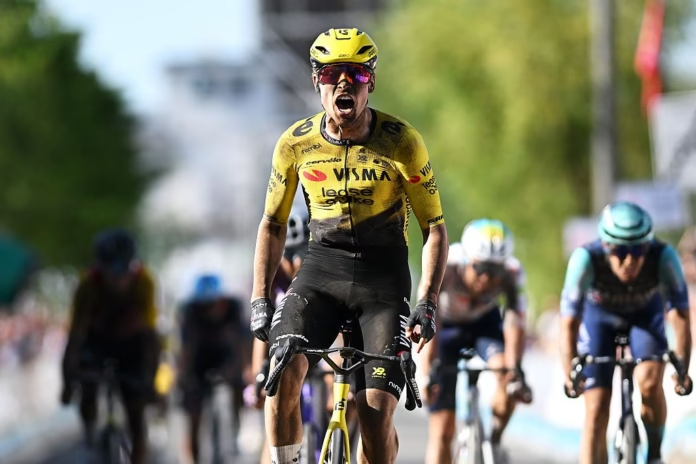
Per Strand Hagenes won Paris-Tours 2026 in 4:31:46, finishing two seconds ahead of Jasper Stuyven and Christophe Laporte. The result came from a late reduction rather than a long solo move, with Hagenes emerging from a small group that had established a gap inside the final 10 kilometres.
Stuyven took second and Laporte third, while Matys Grisel, Jonas Abrahamsen, Paul Lapeira, Thibaud Gruel, Lewis Askey and Florian Sénéchal all finished within the same two-second gap as the runner-up. Toms Skujiņš was the only rider from the leading contest to lose more ground, crossing nine seconds behind Hagenes.
The race was shaped by repeated reductions, several crashes and a late sequence of attacks. An early breakaway of 12 riders was brought closer before gaining ground again, while the decisive phase began after a large crash with 49 kilometres remaining. From there, the front became progressively smaller until the six-rider move was reported with 8.9 kilometres left.
How it unfolded
Twelve riders had opened a small gap with 210 kilometres remaining, but that advantage did not develop in a straight line. The peloton reduced the distance by 192 kilometres to go, only for the gap to increase again by the 170-kilometre point. That fluctuation left the early break as a continuing factor without establishing it as the decisive move.
The opening phase also brought the first signs of attrition. One rider crashed in the peloton at 200 kilometres to go, and Jenthe Biermans was dropped shortly afterwards. The early incidents did not determine the final order, but they formed part of a race in which the field repeatedly lost riders before the closing sequence.
Further crashes followed as the race moved towards its final third. Jason Tesson was involved in a three-rider crash at 114 kilometres remaining and was back on his bike by the 110-kilometre point. At 73 kilometres to go, Aimé De Gendt, Sander De Pestel and Rayan Boulahoite were involved in another crash, while riders were already beginning to drop from the back of the peloton with 63 kilometres left.
The field narrows through a disrupted middle phase
The next major change came at 49 kilometres to go, when 15 riders crashed in the peloton. The incident involved, among others, Daniel Årnes, Kim Heiduk, Fred Wright, Jenthe Biermans, Rick Pluimers, Dorian Godon, Pierre-Henry Basset, Lennes Jacobs, Mathias Vacek, Arnaud De Lie, Alessandro Romele and Anthony Turgis.
The crash mattered to the shape of the race because it was followed immediately by an acceleration from Lewis Askey. His move came with the peloton already reduced and the race entering its closing section, giving the remaining front group a new point of tension rather than allowing the field to settle after the incident.
Askey’s acceleration did not produce the winning gap on its own, but he remained central to the late narrative. Axel Huens attacked with 35 kilometres remaining and was caught two kilometres later. That quick catch showed that individual moves could still be closed, but it also kept pressure on the reduced group.
By 26 kilometres to go, Storm Ingebrigtsen was struggling to hold on in the first group and was then caught by the peloton. Almost immediately, Jenno Berckmoes accelerated. The sequence confirmed that the front was still being tested by successive attacks, with the available group becoming more selective before the final moves were made.
Late attacks turn the race into a small-group contest
Paul Lapeira attacked with 20 kilometres remaining, adding another attempt to separate the strongest riders. Seven kilometres later, a three-rider move was reported containing Jonas Abrahamsen, Florian Sénéchal and Askey. The composition linked Askey’s earlier acceleration to the late break, while Abrahamsen and Sénéchal gave the move two further riders capable of contesting the finish.
That three-rider gap did not remain the final selection. Pierre Gautherat attacked with 10 kilometres left, and at 8.9 kilometres to go the front group had grown to six riders. The race had therefore moved from a broad, repeatedly disrupted peloton to a small leading unit through a series of attacks rather than one single break that stayed clear.
Hagenes’s victory was built in that closing transition. The final result places him first, with Stuyven and Laporte just two seconds back, while five more riders were also recorded on that same two-second margin. The evidence of the late six-rider gap and the compressed finish points to Hagenes taking control of the decisive front group without opening a large winning distance.
Stuyven was not a passive presence in the final kilometres. With 2.7 kilometres remaining, he was reported pulling in the first group, an important detail in the fight immediately behind Hagenes. His presence at the front helped carry him to second, but the two-second result gap shows that the effort did not translate into a winning separation.
Skujiņš tries to change the order
Toms Skujiņš made the final significant attempt to alter the outcome. He accelerated with 2.3 kilometres to go and attacked again at 1.4 kilometres. Those moves came after Stuyven had been working in the leading group, creating the last clear opportunity for a rider outside the Hagenes-Stuyven-Laporte podium order to move away.
Skujiņš’s late attacks did not overturn the result. He finished tenth, nine seconds behind Hagenes, while Stuyven and Laporte remained second and third and the riders from fourth to ninth stayed within two seconds of the winner. The closing attacks therefore changed the distance to the final group more than they changed its podium composition.
Hagenes crossed the finish with the race already reduced to its final contenders. He was followed by Stuyven and then Laporte, with the official result confirming that the leading positions were separated by only a narrow margin. The late six-rider move had been absorbed into an even more tightly packed finish among the main contenders, but Hagenes retained enough advantage to take the one-day race.
Why Hagenes held the advantage
The decisive factor was not a prolonged gap established early in the day. The 12-rider break saw its advantage shrink and then increase, and the later race repeatedly closed attacks from Huens and the riders attempting to move clear. Hagenes instead reached the final selection and came through the last sequence with the fastest finishing result.
The route to the podium was different for each of the three leading riders. Hagenes won from the reduced front contest. Stuyven combined a late position at the front with a final pull at 2.7 kilometres, then finished two seconds down. Laporte was also part of the same narrow final outcome, taking third on the same two-second gap.
The margin illustrates how little separated the top end of the race. Grisel, Abrahamsen, Lapeira, Gruel, Askey and Sénéchal all finished on two seconds, alongside Stuyven and Laporte. The result was therefore decided within a compact group rather than by a large time gap, with Hagenes’s advantage holding through the final attacks and the finish itself.
Skujiņš was the exception to that compressed podium fight. His two accelerations inside the final 2.3 kilometres produced the only notable separation among the riders who had contested the closing group, but he ended nine seconds behind. That late difference left Hagenes clear at the head of the result while the riders immediately behind him remained tightly bunched.
Paris-Tours 2026 never settled into one uninterrupted storyline. The early 12-rider break gained and lost ground, crashes affected the peloton at several points, and riders were dropped before the closing attacks. The field was still being reshaped at 26 kilometres to go, when Ingebrigtsen was caught and Berckmoes accelerated.
From 20 kilometres remaining, the attacks became more directly connected to the final result. Lapeira’s move was followed by the three-rider gap containing Abrahamsen, Sénéchal and Askey, then Gautherat’s attack preceded the six-rider group at 8.9 kilometres. That sequence created the setting in which Hagenes could win, while also leaving the race open until the final kilometres.
The finish was ultimately a narrow one, but the order behind the winner was not accidental in the chronology of the race. Stuyven was active at the front before the finish and secured second, Laporte followed for third, and the next six riders finished on the same two-second gap. Hagenes’s 4:31:46 was enough to separate him from a group that had been reduced repeatedly but never completely split apart.
Hagenes therefore won a race defined by selection rather than distance. The early break did not decide it, the crashes did not by themselves establish the podium, and the late attacks did not produce a solo winner. Instead, the decisive change was the formation of the small leading group, followed by Hagenes’s ability to finish ahead of Stuyven and Laporte as the final moves failed to break the contest open.
Paris-Tours 2026 Result
| Pos. | Rider | Team / nation | Time / gap |
|---|---|---|---|
| 1 | Per Strand Hagenes | Team Visma | Lease a Bike (WT) | 4:31:46 |
| 2 | Jasper Stuyven | Soudal Quick-Step (WT) | +0:02 |
| 3 | Christophe Laporte | Team Visma | Lease a Bike (WT) | +0:02 |
| 4 | Matys Grisel | Lotto Intermarché (WT) | +0:02 |
| 5 | Jonas Abrahamsen | Uno-X Mobility (WT) | +0:02 |
| 6 | Paul Lapeira | Decathlon CMA CGM Team (WT) | +0:02 |
| 7 | Thibaud Gruel | Groupama – FDJ United (WT) | +0:02 |
| 8 | Lewis Askey | NSN Cycling Team (WT) | +0:02 |
| 9 | Florian Senechal | Alpecin – Premier Tech (WT) | +0:02 |
| 10 | Toms Skujins | Lidl – Trek (WT) | +0:09 |

