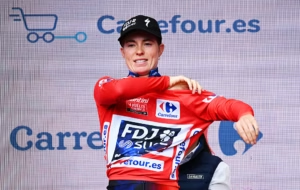
Strade Bianche has a habit of feeling inevitable when Tadej Pogacar turns up in rainbow stripes, but 2026 still managed to add a fresh layer to the familiar script. The finish in Siena was the same theatre, the gravel was the same slow grind into disorder, and the winning move came from the same rider, again from a distance most races reserve for breakaways, not for the decisive attack.
Pogacar rode away on Monte Sante Marie with roughly 80 kilometres still left to race and was never seen again, turning his season debut into a record fourth Strade Bianche title. Behind him, the day’s most important story was not who failed to follow, but who almost did. Nineteen-year-old Paul Seixas briefly looked like he might crack the code, then regrouped, raced smartly, and still finished second after a relentless duel with Isaac del Toro, who completed the podium.
 Photo Credit: Getty
A nervous opening, a late break, and UAE keeping the rope short
It took time for the race to settle into its usual shape. The early kilometres were fast and uneasy, the kind of pace that keeps attacks coming but prevents anything from sticking. The first gravel sectors did not bring a break either, just the slow tightening of the peloton as teams fought for the front before every white road pinch point.
Eventually, after about 40 kilometres and three gravel sectors, a nine-rider break finally formed. It was not a token move either, it had riders capable of surviving deep into the race and forcing teams to keep working. They pushed the advantage out to around two minutes, but that was as far as it was allowed to go. UAE Team Emirates XRG came to the front early and kept the gap under control, a steady tempo that suggested they were not defending against surprises, they were simply building towards the moment Pogacar wanted.
San Martino in Grania turns the race serious, then Monte Sante Marie blows it apart
If the early part of Strade Bianche is about positioning, the middle is about attrition, and the critical part is about timing. Sector 6, San Martino in Grania, served as the switch. It is long, it drags upward, and it does not offer much rhythm, and on this passage, the peloton splintered and reduced. The break came back into view and the race stopped pretending it was waiting for later.
From there it felt like a lead in to the key sector rather than a series of independent moments. UAE maintained a hard, organised pace on the tarmac, the sort of effort that empties riders before the move even happens. When the race hit Monte Sante Marie, the 11.5-kilometre sector that has become the modern fulcrum of Strade Bianche, it was already primed for a decisive acceleration.
Jan Christen set the first cut, splitting the front of the race into a sharp selection that included Pogacar, del Toro, Seixas, Tom Pidcock, Matteo Jorgenson, Romain Gregoire, Kevin Vauquelin’s compatriots nearby, and a handful more who had read the moment perfectly. Then Pogacar went.
He attacked around four kilometres into the sector, close to 80 kilometres from the finish. For a moment, it did not look like a clean separation. Pidcock appeared to be closing to the wheel, Seixas surged hard in pursuit, and the first chase fragments tried to organise. But the brutal detail of Pogacar’s move was not the first acceleration; it was the second. As Seixas clawed back towards contact on the steepest part of the sector, Pogacar kicked again, and the gap became final.
 Photo Credit: Getty
Seixas refuses to panic, Del Toro refuses to work, and the chase becomes a second race
On exit from Monte Sante Marie, Pogacar already had daylight, and he kept adding to it on every subsequent sector. Seixas found himself in the worst possible place and the best possible place at the same time. He was the closest rival on the road, but he also had del Toro with him, and del Toro had every reason to sit on and protect his teammate’s advantage.
Seixas made the mature call. Rather than burn himself into the ground towing a passenger, he waited for reinforcements, allowing a chase trio to come up and form a more coherent group. That decision said as much about his long-term ceiling as his legs did. It was not desperation; it was calculation.
Even so, the dynamic never truly tilted against Pogacar. UAE had riders in the chase, and that mattered. The presence of del Toro and later Christen in the groups behind turned cooperation into a negotiation nobody could win. Every time the chase began to look purposeful, it had to drag a UAE rider with it, and every time the race hit a gravel rise, Pogacar’s advantage held.
The chase swells, then fractures, and the podium fight ignites on Pinzuto and Le Tolfe
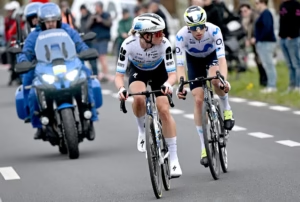
As the race moved into the final circuit, the chase group grew to around 15 riders, a messy mix of climbers, puncheurs and classics specialists who all knew the win was effectively gone but the podium was still wide open. Pidcock tried to force something on Le Tolfe with a big move, Jorgenson rode strongly through the repeated selections, and Wout van Aert, after missing the very sharpest moments, kept working his way back into contention for the top 10.
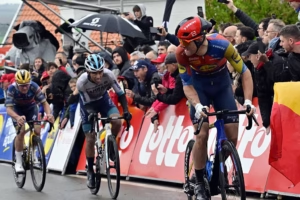
But the decisive battle behind Pogacar was always going to be between the two young riders who had been closest to the initial damage, Seixas and del Toro. Seixas attacked hard on the second ascent of Colle Pinzuto to isolate that contest, and only del Toro could follow. The pattern repeated. Seixas drove, del Toro sat on. It was ruthless team logic, and it forced Seixas to win his result the hard way.
The most impressive part of Seixas’ day was what came next. He not only held the rest of the chasers at bay with minimal help, he still had enough to settle the argument on the Via Santa Caterina kicker in the final kilometre. Seixas dropped del Toro there, then rode into the Piazza del Campo for second, a minute after Pogacar had already finished his latest solo masterpiece.
 Photo Credit: Getty
Pogacar rides to Siena alone again, and the record becomes his
From the moment he broke Seixas on Sante Marie, Pogacar’s race became a solo management exercise, only it never looked like management. He kept pushing through the gravel, kept the gap stable when the chase briefly found momentum, and then lifted it again when the race hit fresh sectors. By the time he turned towards Siena, it had the familiar feel of a rider racing against the clock, not against rivals.
He hit Via Santa Caterina with time to savour it, rode the steep cobbles and crowds as if they were part of the show, and crossed the line for a fourth Strade Bianche victory, moving clear of the record he had previously shared.
The sport is still in his hands. But 2026 offered a clear sign that the riders who will one day challenge him are arriving fast, and they are not afraid to race.
2026 Strade Bianche Men result
Results powered by FirstCycling.com
Main photo credit: Getty