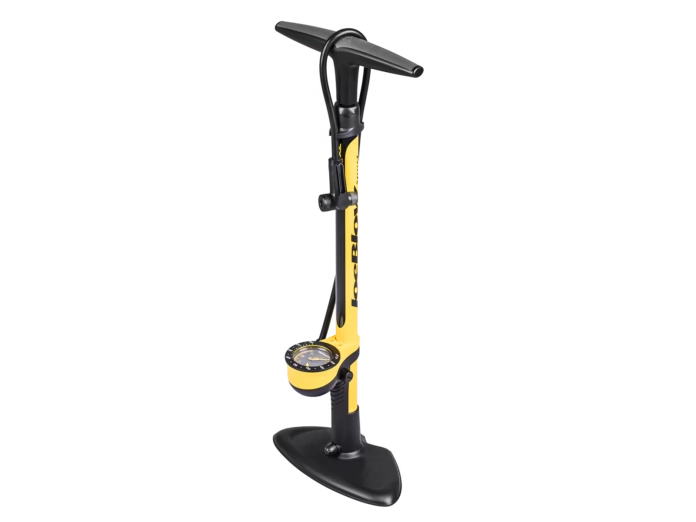
The Topeak JoeBlow Sport III is a conventional floor pump in the best sense. There is no battery to charge and no attempt to turn tyre inflation into a technology project. Instead, Topeak combines a steel barrel and base, a large analogue gauge, a long hose and a dual valve head in a pump designed to live in a garage or workshop for years.
That simple specification is backed by unusually useful independent testing. Cyclist measured 30 strokes to take a 28mm road tyre to 90psi and 26 strokes for a 40mm gravel tyre to reach 45psi. Its reference gauge found the gravel pressure exact and the road tyre within 3psi. Cycling Weekly’s 2026 floor-pump comparison also retained the JoeBlow Sport III as a strong value option.
This article contains affiliate links. ProCyclingUK may receive a commission from qualifying purchases. At the time of checking, Tredz had the Topeak JoeBlow Sport III for £35.99, against an RRP of £46.99.
Topeak JoeBlow Sport III specifications
| Maximum pressure | 160psi / 11 bar |
| Gauge | 3-inch analogue, psi and bar |
| Volume per stroke | 318cc |
| Valve compatibility | Presta, Schrader and Dunlop |
| Pump head | TwinHead DX |
| Barrel | Painted steel |
| Base | Hardened steel |
| Hose length | 72cm |
| Size | 78.5 x 25.3 x 11.7cm |
| Weight | 1.68kg claimed |
The JoeBlow’s biggest strength is straightforward usability
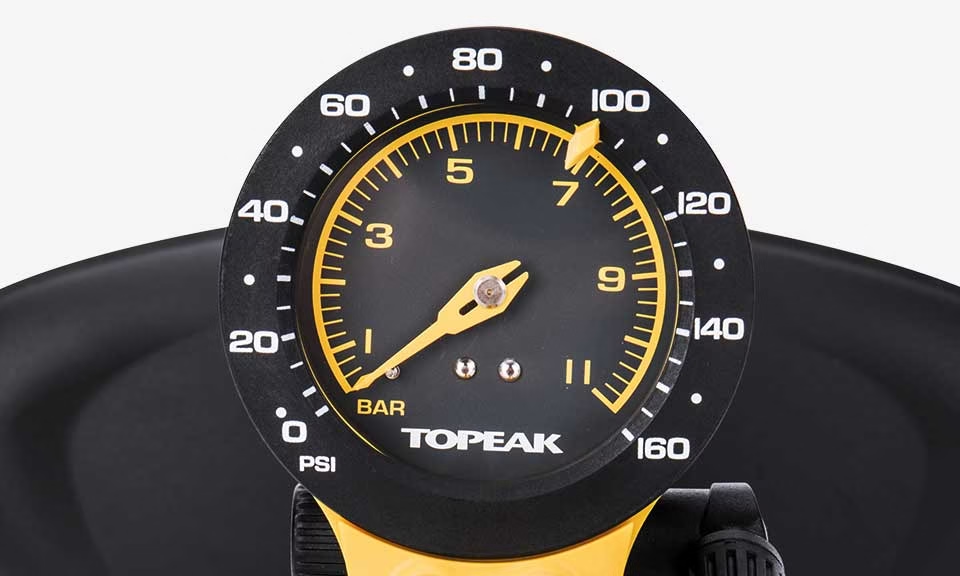
A floor pump is used often enough that small annoyances matter. Topeak positions the three-inch gauge part-way up the barrel rather than down at floor level, making the pressure reading easier to see while pumping. A movable pressure indicator can be set against the target figure, which is useful when several tyres need to be brought to the same pressure.
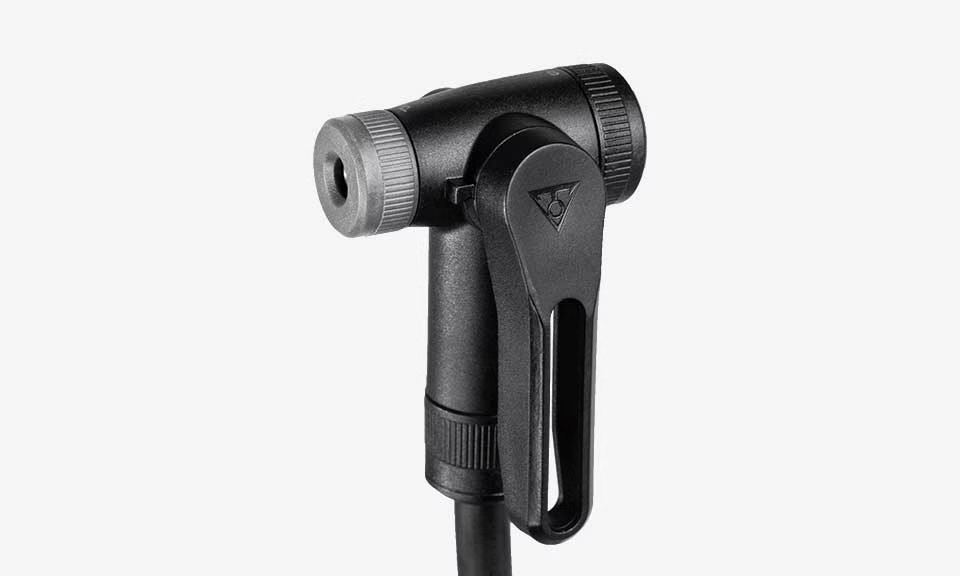
The TwinHead DX has separate openings for Presta and Schrader valves, with Dunlop compatibility as well. It is less elegant than a head that automatically identifies the valve, but it is uncomplicated and avoids dismantling the chuck or changing internal pieces when moving between bikes. The long locking lever also makes it easier to establish a seal without trapping fingers close to the valve.
The 72cm hose rotates at its connection and has storage points against the pump when it is not being used. None of these details is dramatic, but together they make the JoeBlow easier to live with than a cheap track pump that fights its hose, moves around the floor or requires crouching to read its gauge.
Inflation speed is good across road and gravel tyres
Cyclist’s instrumented test gives a useful picture of actual performance. A 28mm road tyre required 30 strokes to reach 90psi, while a 40mm gravel tyre reached 45psi in 26 strokes. The tester rated the physical effort at 6/10 in both cases, which places the JoeBlow in sensible all-round territory rather than optimising it only for high pressure or high volume.
That versatility is useful in a mixed-bike household. A 318cc stroke is large enough that wider tyres do not become tedious, while the 160psi ceiling leaves ample headroom for road tyres even though modern road pressures are normally far below that figure.
Valve type is also unlikely to be a problem. ProCyclingUK’s guide to Presta, Schrader and Dunlop valves explains the differences if you are setting up a new bike or dealing with several types at home.
Gauge accuracy is good enough for everyday use
Analogue gauges are convenient, but their value depends on whether the number is trustworthy. Cyclist’s comparison against a separate gauge found the JoeBlow exact on the 40mm gravel tyre and within 3psi on the 28mm road tyre. That is not laboratory precision, but it is reasonable performance from an affordable mechanical pump.
There is still a case for a separate digital gauge if pressure is particularly critical, especially with modern hookless road setups where maximum permitted pressure needs to be respected. For ordinary road, gravel, commuting and mountain-bike inflation, the large analogue dial is simpler and fast to use.
Steel construction adds stability and weight
Topeak uses steel for both the barrel and hardened base. The obvious advantage is a solid platform when pumping, something independent reviewers repeatedly highlight. The trade-off is weight. Topeak quotes 1.68kg, while Cyclist’s sample weighed around 1.76kg.
That difference is largely irrelevant for a pump that normally stays at home, but the JoeBlow is not designed to be carried around unnecessarily. Riders wanting something for events or regular travel may prefer a lighter model. In a garage or workshop, the extra mass helps rather than hurts.
Repairability is an underrated advantage
A cheap floor pump can become disposable as soon as its hose, gauge or chuck fails. Topeak lists replacement components for the JoeBlow Sport III, including the gauge assembly, TwinHead, hose cap and internal parts kit. That matters for a product whose basic steel structure should comfortably outlast many of its wear components.
Serviceability also changes the value calculation. Spending £35 to £50 on a pump makes more sense if a worn seal several years later does not automatically mean replacing the whole thing. It is one reason the JoeBlow line has remained popular despite an increasingly crowded pump market.
Where the JoeBlow Sport III falls short
The main limitation is that this is an all-round floor pump rather than a tubeless inflator. It moves a useful amount of air, but there is no reservoir that can release a sudden high-volume blast to seat a stubborn tubeless bead. Riders regularly installing difficult tubeless tyres may want a compressor, separate air chamber or a reservoir-equipped pump.
ProCyclingUK’s road and gravel tubeless sealant guide covers the maintenance side of those systems. The JoeBlow remains perfectly useful for routine pressure adjustment once a tubeless tyre is seated.
There is no bleed valve either, and the analogue gauge cannot match the convenience of a good digital display when trying to make very small pressure adjustments. The pump’s 1.68kg claimed weight is another downside if portability matters, although it contributes to the stability that makes it pleasant to use at home.
How it compares with cheaper and more expensive pumps
The JoeBlow Sport III sits in a useful middle ground. Cheaper pumps can inflate the same tyres, but the large gauge, steel base, long rotating hose and replaceable components give Topeak a stronger long-term case. More expensive pumps can offer digital gauges, pressure-release buttons, higher-end finishes or tubeless reservoirs, but those features are not necessary for routine inflation.
Cycling Weekly’s 2026 comparison illustrates how competitive this category has become. The JoeBlow was not the outright test winner, with other pumps scoring particularly well for stability or gauge accuracy, but it remained one of the value recommendations. That is a fair description of its position in the market.
At the £35.99 Tredz price available when checked, the argument becomes stronger. A rider would need a specific reason to spend considerably more, such as tubeless seating, a digital gauge or premium workshop construction.
Who should buy the Topeak JoeBlow Sport III?
This is best suited to riders who want one dependable home pump for several bikes. Its pressure range and 318cc stroke work across road, gravel, hybrid and mountain-bike tyres, while the separate Presta and Schrader connections make switching between bikes straightforward.
It also makes sense for someone buying their first proper workshop pump. The JoeBlow costs more than the cheapest supermarket-style options, but the combination of replaceable parts and steel construction gives it a better chance of becoming a long-term tool rather than another consumable accessory.
Riders who mainly need to seat tubeless tyres should look at a reservoir-equipped model instead. Anyone who travels with a floor pump regularly may also value a lighter design more than the JoeBlow’s substantial base.
Topeak JoeBlow Sport III verdict
The JoeBlow Sport III succeeds because there is very little to explain away. It has a clear gauge, sensible inflation speed, a stable steel base, broad valve compatibility and enough pressure and volume for the tyres most cyclists actually use. Independent testing supports its accuracy and efficiency rather than leaving those qualities to marketing claims.
Its limitations are equally straightforward. It is relatively heavy, it does not provide a dedicated tubeless air blast and the analogue gauge is less precise than a specialist digital tool. None of those weaknesses undermines its role as an everyday floor pump.
At £35.99 from Tredz at the time of review, the JoeBlow Sport III offers particularly good value. It is not the most sophisticated pump available, but it covers the routine job well and is built so that worn components can be replaced rather than sending the whole pump to waste.