
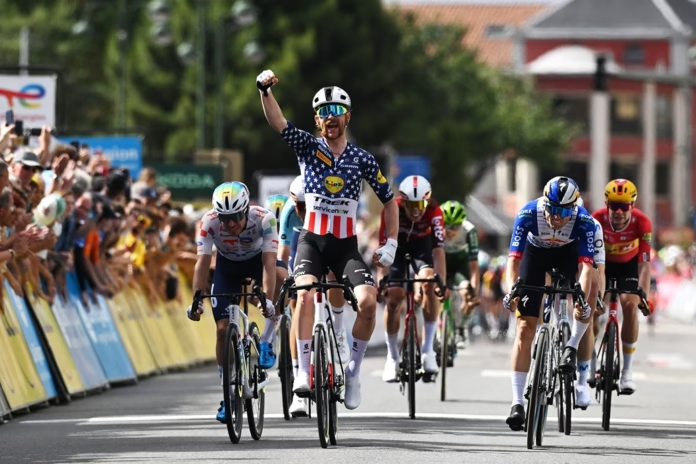
Quinn Simmons won stage 4 of the 2026 Tour Auvergne – Rhône-Alpes after the breakaway survived a frantic late chase into Montrond-les-Bains. The Lidl-Trek rider launched a long sprint from the front group and held off Finn Fisher-Black and Matteo Vercher, taking his first victory in France and his third at WorldTour level.
The stage had looked increasingly likely to fall to the sprinters as Cofidis, Team Visma | Lease a Bike, Bahrain Victorious and several other teams cut into the break’s advantage on the long, exposed run-in. Yet the escape just had enough left. Pablo Castrillo’s attack under the flamme rouge helped keep the move alive, the peloton stalled at the worst possible moment, and Simmons finished off the day with the strongest sprint from what was left of the break.
Alex Baudin safely defended the yellow jersey for EF Education-EasyPost. With stage 5 also expected to suit the sprinters before the race reaches the mountains, the stage 1 winner remains well placed to carry the race lead into the weekend, though the GC favourites had to stay alert on a nervous finale shaped by cross-tailwinds, high speed and a long straight approach to the finish.
Delayed start and early crashes
The stage from Le Puy-en-Velay to Montrond-les-Bains was listed at 167.4 kilometres, with a profile that gave the attackers enough terrain to dream and the sprint teams enough reason to chase. After breakaways had won both of the opening road stages, there was clear incentive for riders to try again, even if Dorian Godon, Michael Matthews, Bryan Coquard and Wout van Aert offered obvious alternatives if the race came back together.
The day began messily. The start was delayed after Baptiste Veistroffer crashed in the neutralised zone on the way to kilometre zero. Once the flag dropped, the riders were immediately on the approach to the Col de la Croix de l’Arbre, 4 kilometres at 4.1 per cent, and the first attacks came with the added difficulty of a headwind.
There was another early crash after 5.5 kilometres, involving Mauri Vansevenant and Thibault Guernalec. Veistroffer, already affected by his neutral-zone fall, was soon reported off the back and suffering. UAE Team Emirates-XRG had also lost Ivo Oliveira before the stage, with the Portuguese rider a non-starter.
The early climb briefly threatened to split the race. Marco Frigo led over the first ascent, but the peloton came back together afterwards. The next categorised climb was still around 50 kilometres away, leaving undulating roads, a long descent and the intermediate sprint in Arlanc before the race could properly reshape.
Headwind stalls the breakaway fight
The opening phase became a long fight for the break. Several riders tried to go clear around Craponne-sur-Arzon, but the strong headwind made it difficult for anyone to establish a gap. That worked in favour of the teams hoping for a sprint, especially Netcompany INEOS and Jayco AlUla, who had Godon and Matthews as likely options if the race stayed under control.
Nadav Raisberg then strengthened his grip on the points classification at the intermediate sprint in Arlanc. Having already won the intermediate sprints on stages 1 and 2, the NSN rider took another 10 points, with teammate Hugo Hofstetter second and Edoardo Affini third for Team Visma | Lease a Bike.
The focus then shifted to the Côte du Temple, 5.7 kilometres at 4.5 per cent. Unlike the first climb, this one did not lead into a long flat or downhill section. A short descent would take the riders straight onto the Côte de Chougoirand, 7.8 kilometres at 5.5 per cent, which made it a much better point for the stronger breakaway riders to force a move.
Simmons helps form the decisive move
The race was still together midway through the Temple climb, but the attacks resumed as the gradient continued. Simmons, Andreas Kron and Jordan Jegat finally managed to get a gap near the top, with Simmons leading over the category 3 climb and taking the KOM points.
Behind them, two chasing groups formed. Pablo Castrillo, Raúl García Pierna and Vercher were at around 10 seconds, while Jan Castellon and George Bennett followed at 20 seconds. Fisher-Black then bridged across as the chase groups merged, before Frigo, Lars Craps and Sam Watson also joined to make the move stronger.
By the time the race was on the Chougoirand climb, the breakaway had become a 12-rider group: Simmons, Watson, Fisher-Black, Kron, Castrillo, García Pierna, Craps, Jegat, Vercher, Castellon, Bennett and Frigo. Hugo Houle and Gijs Leemreize were left in no man’s land behind, while the peloton sat around 1:35 back.
That composition gave the break a real chance. Movistar had two riders with Castrillo and García Pierna, NSN had Bennett and Frigo, and TotalEnergies had Jegat and Vercher. There were also big engines in Simmons, Fisher-Black and Watson. The difficulty was cooperation, because the same strength that made the group dangerous also gave several riders reasons to hold something back.
Cofidis lead the chase
Cofidis took charge behind for Coquard, clearly believing the stage could still return to the peloton. The gap dropped to 1:21 over the Col des Limites, and the break approached the final pair of climbs, the Côte de Léringeux and Côte de Roche-en-Forez, knowing they would need to work properly if they were to survive.
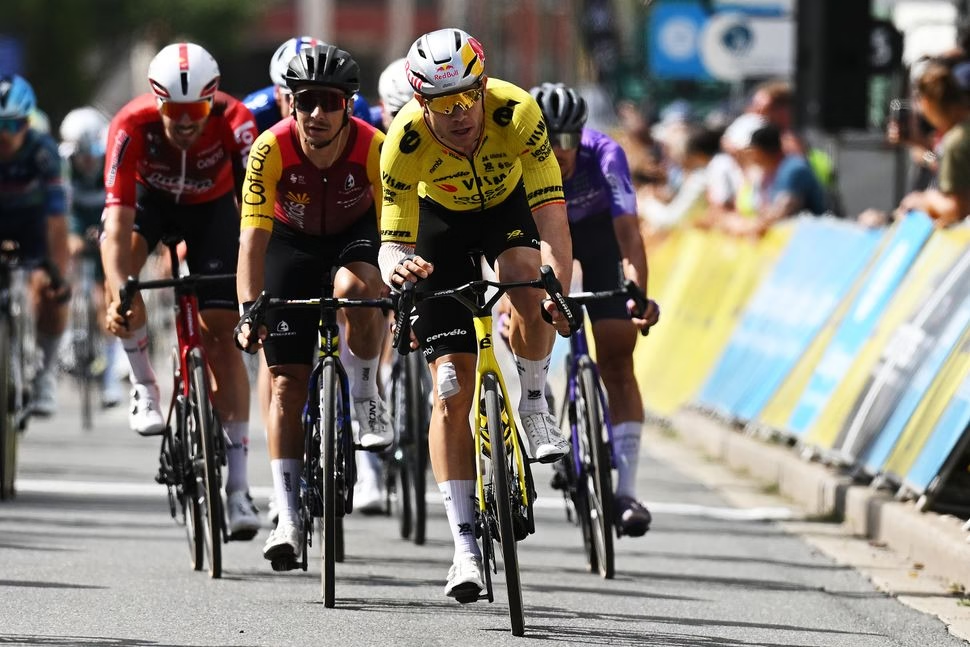
The peloton were still close enough at 60 kilometres to go to make the sprint look likely. Cofidis remained on the front, with Team Visma | Lease a Bike and Alpecin-Premier Tech sitting behind them. Van Aert had not shown his best form earlier in the race, but with a flatter finish approaching, his team were clearly keeping him in the conversation.
The break took a lead of around 1:36 onto the final climb of the day. Castellon had collected 9 KOM points during his time up the road, but not enough to take the mountains jersey from Clément Braz Afonso, who remained secure in the polka-dot classification.
After the last climb, the chase intensified on the descent. GC teams, including Team Visma | Lease a Bike and Netcompany INEOS, moved up to hold position before the run-in, while the sprinters’ teams continued to cut the gap. The wind direction was also becoming important. A cross-tailwind on the final run towards Montrond-les-Bains promised high speeds and plenty of nerves.
Watson crashes as the break starts to fracture
The break’s chances took a major hit with around 40 kilometres to go when Watson crashed at high speed on the descent. The British champion appeared to lose control after his front wheel wobbled, landing heavily on his right side. He was able to get back to his feet and remount, though clearly in pain and with a broken shoe boa strap.
Bennett also dropped out of the move soon after, requiring assistance and leaving Frigo alone for NSN. That reduced the leading group to 10 riders: Simmons, Fisher-Black, Kron, Castrillo, García Pierna, Craps, Jegat, Vercher, Castellon and Frigo.
At 30 kilometres to go, their lead was under a minute. Tudor joined the chase, Cofidis continued working, and the gap kept falling. By 20 kilometres to go it was under 40 seconds, and with several teams now chasing hard at close to 60kph, the break appeared to be running out of road.
The final 10 kilometres were almost entirely on a straight road into Montrond-les-Bains, with strong winds and a tailwind element capable of producing very high speeds. That should have favoured the bunch, but it also gave the break a clear target. There were no complicated corners to manage, only the need to keep riding and avoid hesitation.
Simmons survives the late chase
With 10 kilometres to go, the gap had fallen to 23 seconds. Simmons tried to attack from the break, likely responding to news from the team car that the peloton was closing fast, but he was brought back. The break looked as though it was about to be caught.
Cofidis pushed from behind, then Team Visma | Lease a Bike took over with Affini pulling for Van Aert. The gap dropped to 19 seconds with just over 5 kilometres remaining, then to 16 seconds at 3 kilometres, and 13 seconds as the speed rose above 60kph. The catch seemed almost inevitable.
But the break did not fully collapse. Castrillo attacked under the flamme rouge as the games began, a move that effectively forced the leaders to keep momentum when hesitation could have ended their hopes. With 500 metres to go, the gap was still 8 seconds. The peloton was close, but not close enough.
Simmons then launched the winning sprint. Fisher-Black tried to come back to him, but the Red Bull-Bora-Hansgrohe rider could not reach the American’s front wheel. Vercher finished third for TotalEnergies, completing the podium from a break that had looked doomed less than 10 kilometres earlier.
-
 Photo Credit: A.S.O./Gaëtan Flamme
Baudin keeps yellow as the sprinters miss out
For Simmons, this was a well-earned WorldTour win built on persistence across the whole stage. He had been visible from the early climbs, helped form the decisive move on the Côte du Temple, stayed committed as the chase closed, and still had enough left for a long sprint after the break nearly came apart.
The sprint teams will see it as a missed opportunity. Cofidis had done much of the chasing for Coquard, Team Visma | Lease a Bike came late for Van Aert, and Bahrain Victorious had Bauhaus in the peloton as another possible winner. The timing simply favoured the break by a few seconds, with Castrillo’s late acceleration and Simmons’ finishing power turning a likely bunch sprint into another escapee victory.
For the GC riders, the day was more about survival than opportunity. Baudin remained in yellow, with the main contenders avoiding trouble on a nervous run-in. The stage did not significantly change the overall picture, but it did reinforce the theme of this Tour Auvergne – Rhône-Alpes so far. Breakaways are not just surviving, they are winning, and the sprint teams have now let another stage slip through their hands.
After Baudin on stage 1 and Charmig on stage 2, Simmons made it three breakaway wins from the first four stages, with only the team time trial interrupting that pattern. The race may be heading towards the mountains at the weekend, but the opening half has already rewarded riders willing to take the initiative before the peloton finds its structure.
Tour Auvergne – Rhône-Alpes 2026 stage 4 result
| Position | Rider | Team | Time/gap |
|---|---|---|---|
| 1 | Quinn Simmons | Lidl-Trek | 3:34:08 |
| 2 | Finn Fisher-Black | Red Bull-BORA-hansgrohe | same time |
| 3 | Mattéo Vercher | TotalEnergies | same time |
| 4 | Marco Frigo | NSN Cycling Team | same time |
| 5 | Raúl García Pierna | Movistar Team | same time |
| 6 | Andreas Kron | Uno-X Mobility | same time |
| 7 | Jordan Jegat | TotalEnergies | same time |
| 8 | Lars Craps | Lotto Intermarché | same time |
| 9 | Jan Castellon | Caja Rural-Seguros RGA | same time |
| 10 | Pablo Castrillo | Movistar Team | +0:04 |
Main photo credit: Getty

