
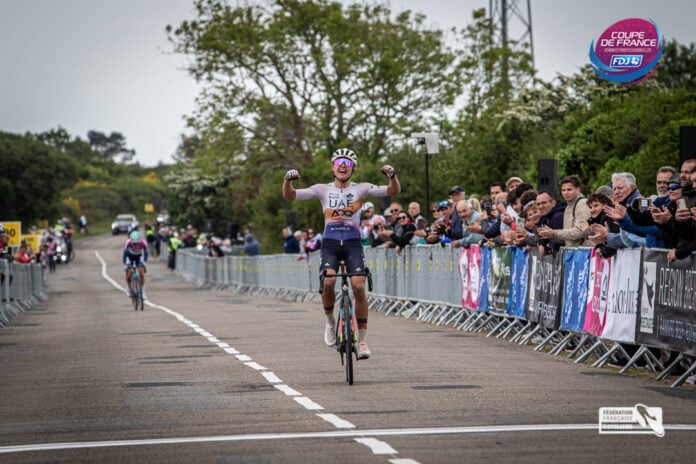
The Pointe du Raz Ladies Classic is one of the youngest races on the international women’s calendar, but few events have climbed through cycling’s hierarchy as quickly.
Created in 2023 as a French domestic event in western Brittany, it joined the Coupe de France N1 in 2024, stepped onto the international calendar as a UCI 1.1 race in 2025 and has been promoted again for 2026. The fourth edition, on Sunday 6 September 2026, will be held at 1.Pro level, placing it among the most important women’s one-day races below the Women’s WorldTour.
That rapid progression has come alongside a transformation in the race itself. Pointe du Raz began as a two-day stage race containing an individual time trial. It has since become a rugged one-day Classic built around the exposed roads of the Cap Sizun peninsula, with short climbs, Atlantic weather and increasingly important stretches of ribinoù, the rough Breton tracks that now give the event much of its identity.
Only three editions have been held so far, but each represents a distinct chapter in the development of the race.

Pointe du Raz Ladies Classic winners
| Year | Winner | Race format |
|---|---|---|
| 2023 | Élyne Roussel | Two-stage French domestic race |
| 2024 | Clémence Latimier | Two-stage Coupe de France N1 race |
| 2025 | Paula Blasi | UCI 1.1 one-day race |
| 2026 | TBC | UCI 1.Pro one-day race |
Élyne Roussel, Clémence Latimier and Paula Blasi therefore appear on the same palmarès despite having won three substantially different versions of the event.

2023: Pointe du Raz begins as a two-day race
The inaugural Pointe du Raz Ladies Classic was held in 2023, when it was still a French domestic competition rather than an international professional race.
Its original structure was very different from the modern event. The opening day featured a short individual time trial around Audierne before a longer road stage took the riders from the Pointe du Raz back towards Audierne.
Sylvia Le Gleut won the opening time trial and became the first race leader in Pointe du Raz history.
The overall classification changed dramatically on the following road stage.
Élyne Roussel, riding for Breizh Ladies, won ahead of teammate Alice Brédard and Églantine Rayer. The gaps created during the road race were sufficient for Roussel to overturn her deficit from the time trial and become the inaugural overall winner.
Several young riders who would later progress into the professional peloton were already present. Rayer was developing into one of France’s leading prospects, while Marion Bunel also finished prominently during the weekend.
The first edition was modest compared with what would follow, but the basic ingredients were already visible: a race rooted heavily in Finistère, difficult coastal roads and an ambition to create a significant standalone event for women.

2024: Coupe de France status raises the level
Pointe du Raz took its first major step forward in 2024 when it became part of the Coupe de France N1 Femmes, France’s leading season-long competition for National 1 women’s teams.
The two-stage structure remained.
This time the race opened with a longer individual time trial around Mahalon. Ema Comte produced the quickest ride, putting herself into the overall lead before the decisive road stage.
The following day, Marie-Morgane Le Deunff won the road race from Pointe du Raz to Audierne after getting clear with Clémence Latimier.
Latimier did not need to beat Le Deunff at the finish to secure the bigger prize. Her performances across the two stages were enough to give her the overall classification, making her the second winner in the race’s short history.
The 2024 edition was important because Pointe du Raz was no longer simply an ambitious regional event. Its place within the Coupe de France brought a stronger national field and made the race a significant target for France’s leading domestic teams.
Yet the biggest transformation was still to come.
2025 changed everything
The 2025 Pointe du Raz Ladies Classic was effectively a reinvention of the race.
The two-day format disappeared. So did the individual time trial.
Instead, Pointe du Raz joined the UCI calendar as a 1.1 one-day race, bringing international professional teams to the Cap Sizun for the first time.
ProCyclingUK looked at the scale of that step when six Women’s WorldTour teams were initially confirmed for the Pointe du Raz Ladies Classic, before previewing the new-look event in our 2025 Pointe du Raz Ladies Classic race preview.
The field eventually contained a mixture of Women’s WorldTour, ProTeam, Continental and leading French domestic squads.
More importantly, the race finally developed the characteristics that now define it.
The ribinoù become part of the race’s identity
The first UCI edition introduced extensive stretches of ribinoù.
The term is associated with Brittany’s rough rural lanes and tracks. They are not necessarily uniform gravel roads in the way riders might encounter at a purpose-built gravel race. Surfaces can vary between compacted tracks, agricultural roads and rough sections where positioning and bike handling become particularly important.
There is an obvious comparison with Tro Bro Leon, the Breton men’s race famous for incorporating its own network of ribinoù, but Pointe du Raz has quickly developed a character of its own.
The 2025 route contained around 12km of unsealed roads spread across 11 sectors.
That altered the demands of the race completely.
A rider no longer needed simply to climb well or possess a good sprint. She also needed to enter the sectors near the front, avoid punctures and crashes, respond to accelerations on constantly changing surfaces and still have enough energy for the closing kilometres.
The geography of Cap Sizun adds another layer.
This is extremely exposed territory on the western edge of Brittany. Wind from the Atlantic can combine with the rough sectors, narrow roads and short climbs to create a race where difficulty comes from accumulation rather than one major obstacle.
Pointe du Raz had found something distinctive enough to justify its place on the international calendar.
Paula Blasi wins the first UCI edition
The first international edition produced a significant winner.
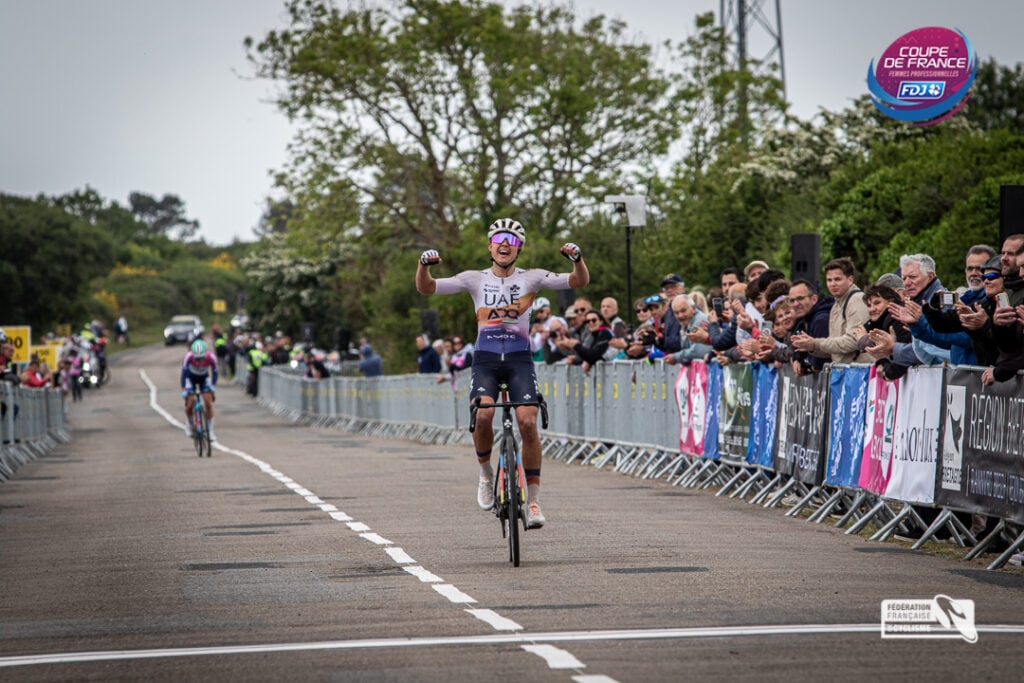
Paula Blasi took victory for UAE Team ADQ, ahead of Britain’s Lauren Dickson and Anneke Dijkstra.
The race had already been heavily fragmented by the time a five-rider group containing Blasi, Dickson, Dijkstra, Sarah van Dam and Célia Gery established itself at the front.
Dickson made an important late attack and briefly looked capable of turning it into victory. Blasi eventually bridged across, dropped the British rider and continued alone towards the finish.
ProCyclingUK covered the decisive move in our report on Paula Blasi’s solo victory at the 2025 Pointe du Raz Ladies Classic.
It was exactly the sort of race the organisers had been attempting to create.
The winner needed strength on the climbs, confidence over the rough roads and enough tactical awareness to recognise when the decisive move was forming. There was no controlled sprint and very little opportunity for teams to repair mistakes once the race had fragmented.
Blasi’s victory also became part of a much wider breakthrough period for the Catalan rider. ProCyclingUK’s Paula Blasi profile looks at her rapid progression towards the highest level of women’s racing.
Why the 2025 edition mattered so much
The importance of 2025 extends beyond the fact it was the first UCI edition.
That was the year Pointe du Raz discovered what sort of race it wanted to become.
The first two editions had been stage races. Their inclusion of an individual time trial made the overall classification dependent partly on a specialist discipline that had little connection with the rough-road identity now associated with the event.
The switch to a one-day format changed that.
Suddenly everything happened in one continuous race. There was no opportunity to compensate for a poor day with a good time trial or protect a classification advantage gained the previous afternoon.
Riders had to survive the ribinoù, respond to attacks and make tactical decisions with the finish continually getting closer.
That format is far more distinctive and gives Pointe du Raz a much stronger identity within a crowded French racing calendar.
2026: another promotion after only one UCI edition
The organisers have not been required to wait long for the next step.
For 2026, the Pointe du Raz Ladies Classic has been upgraded from 1.1 to 1.Pro, placing it on the UCI Women’s ProSeries calendar.
The progression across four editions is remarkable.
| Season | Status |
|---|---|
| 2023 | French domestic race |
| 2024 | Coupe de France N1 |
| 2025 | UCI 1.1 |
| 2026 | UCI 1.Pro |
It means Pointe du Raz has moved from the French domestic calendar to the second-highest level of women’s professional one-day racing in only three years.
The promotion should further increase the quality of the field and make the race a more attractive target for the strongest professional teams.
It also comes with the organisers doubling down on the characteristic that made the first UCI edition successful.
More ribinoù for 2026
Rather than moderating the rough-road element as the race becomes more prestigious, the organisers are expanding it.
The 2026 course is expected to feature around 18km of ribinoù, substantially more than in 2025.
That is important for the long-term identity of Pointe du Raz.
A young race needs something that separates it from dozens of other one-day events. Simply adding kilometres or climbing does not necessarily achieve that. The ribinoù immediately give riders, teams and viewers a reason to recognise Pointe du Raz.
They also ensure the race cannot easily be reduced to a predictable contest between conventional sprinters.
Positioning matters before every sector. Punctures become more significant. Teams can lose riders simply because the group splits across a rough section at the wrong moment.
And because the terrain between the sectors remains relentlessly rolling, there is little opportunity to recover.
A full women’s racing weekend emerges in Finistère
Another important development comes in 2026 with the creation of a second international race around the same weekend.
The new Tout Commence en Finistère Ladies Classic takes place on Saturday 5 September at UCI 1.1 level, followed by the 1.Pro Pointe du Raz Ladies Classic on Sunday 6 September.
That significantly strengthens the proposition for international teams.
Travelling to the western tip of Brittany for one one-day race requires considerable organisation. Offering two UCI races on consecutive days gives teams much more reason to make the trip and allows them to approach the weekend with a deeper squad.
It also moves the project beyond the idea of a single annual race.
Cap Sizun is increasingly becoming the setting for an entire weekend centred specifically on international women’s cycling.
A race built around its location
The geographical identity of Pointe du Raz is difficult to separate from its sporting character.
The Pointe du Raz itself sits near the western extremity of mainland France, overlooking the Atlantic and forming one of Brittany’s best-known coastal landscapes.
From there, the race crosses Cap Sizun using roads through communities including Plogoff, Primelin, Audierne, Cléden-Cap-Sizun and Plouhinec.
Those roads do not resemble the wide highways often associated with stage racing.
They twist continually through exposed countryside, small settlements and agricultural landscapes. The climbs are rarely enormous, but there is almost always another gradient approaching.
Add rough sectors and potentially difficult Atlantic weather and the result is a naturally attritional Classic.
It is precisely the sort of terrain that can give a comparatively young race an established visual identity very quickly.
The race was created specifically around women’s cycling
Another important element of Pointe du Raz is that it was conceived as a women’s event from the beginning.
It is not the women’s version of a long-established men’s professional race and does not exist primarily as part of another event’s programme.
That has allowed the organisers to build the weekend around women’s cycling itself.
The wider event has also been associated with environmental and social initiatives, including attempts to reduce the impact of race vehicles and fundraising or awareness projects linked with women’s health.
Those aspects are not responsible for whether the racing succeeds, but they reinforce the sense that Pointe du Raz is attempting to build a distinct event rather than simply imitate an existing Classic.
-
 Photo Credit: Getty



Three winners from three different versions of Pointe du Raz
The early winners list tells an unusual story because the race has changed so substantially between editions.
Élyne Roussel won a two-day French domestic stage race in 2023.
Clémence Latimier won another two-stage race in 2024, this time as part of the Coupe de France N1.
Paula Blasi won something fundamentally different in 2025: a UCI one-day Classic containing rough-road sectors and professional international opposition.
They are all winners of the Pointe du Raz Ladies Classic, but comparisons between the three victories have limited value.
That should begin to change from 2026 onwards.
The race now appears to have settled on its long-term identity as a one-day Breton rough-road Classic. The 1.Pro promotion strengthens that identity rather than changing it again.
How significant could Pointe du Raz become?
The history is still far too short to place Pointe du Raz alongside France’s established women’s Classics.
But its trajectory is notable.
The international women’s calendar has expanded quickly, and not every new race immediately develops an obvious reason for riders or fans to care about it. Pointe du Raz has benefited from finding one.
It has an instantly recognisable location, distinctive surfaces, difficult but accessible terrain and a place on the calendar that can now support an entire two-race weekend.
The promotion to 1.Pro after just one season as a UCI 1.1 event is evidence of how quickly the race has developed.
What began in 2023 as a two-day domestic competition with a short time trial has become, only three years later, a professional one-day race featuring almost 20km of rough Breton roads.
Pointe du Raz does not yet have a long history.
The speed with which it is creating one is what makes the race interesting.

