The men’s Rapencross at Lokeren brings together several of the form riders from November, but not the two names who have dominated the early X²O Badkamers Trofee rounds. Niels Vandeputte, Joris Nieuwenhuis, Joran Wyseure and Britain’s Cameron Mason are all confirmed on the startlist for Saturday, 21 November. Thibau Nys and Michael Vanthourenhout are absent from the published elite men’s field, leaving a contest with several plausible winners on the Park ter Beuken circuit.
Vandeputte arrives with a recent Superprestige Merksplas victory. Nieuwenhuis is the defending Lokeren winner. Mason has already taken a major breakthrough victory at Niel, and Wyseure has also shown that he can win on a demanding technical course. The event belongs to HG Cross, so Saturday’s result is about victory on the day rather than protecting a cumulative X²O time lead.
A men’s field without the two obvious reference points
Most recent Belgian cyclocross discussion has revolved around Nys and Vanthourenhout, not least because their tussle at Koppenbergcross and the close finish at Hamme-Zogge have shaped the early Trophy standings. Neither appears among the 39 names on the published Lokeren elite men’s startlist. That changes the dynamics substantially: rivals who have spent other races monitoring the movements of those two riders can now take more initiative.
The absence of a dominant presence does not guarantee a chaotic race. Strong riders tend to form a selection quickly, particularly if the conditions are testing. Yet it increases the value of early positioning and correct tactical judgment, because there is less certainty about who will close a gap once it has opened. One rider may attack expecting a response that simply never comes.
The HG Cross calendar and format give Lokeren a different place in the season from Sunday’s Beringen round. A rider with a long-term classification objective in the X²O Trophy can afford to gamble more aggressively in Saturday’s independent event, provided the effort does not compromise the following day. Others, including specialists not targeting that time classification, have every reason to treat the Rapencross as their principal opportunity of the weekend.
2026 HG Cross Lokeren men’s startlist
Vandeputte wears number one on the published list, followed by Felipe Orts, Nieuwenhuis, Wyseure, Mees Hendrikx, Gerben Kuypers, Laurens Sweeck, Jente Michels and Mason among the leading names. Toon Vandebosch and Witse Meeussen provide further depth. This is a credible field of established elite specialists rather than a race determined solely by the two or three riders who have won most recently.
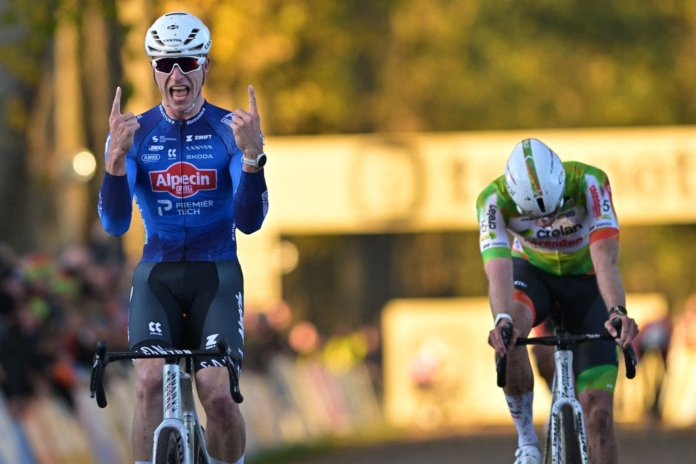
Vandeputte’s Superprestige Merksplas win was achieved by outsprinting Wyseure, demonstrating both his readiness and his finishing speed. That matters on a circuit where Lokeren can produce a race in which small groups survive well into the closing laps. He is not dependent on a long solo move to win, although attacking early could still be an effective way of removing rivals with faster finishing legs.
Nieuwenhuis knows how to turn this park into a winning circuit. He won the 2025 men’s Rapencross ahead of Vanthourenhout and Vandeputte, and the defence of that result gives him a precise reference point when choosing where to force the pace. His experience becomes especially valuable if the race is punctuated by small tactical pauses rather than a relentless chase from start to finish.
Mason provides the clearest British contender. His victory at the Niel Superprestige established that he can convert his increasingly assured pace into an elite win against major opposition. A clean start remains important: when a rider with good lap speed has to spend several minutes overtaking through narrow sections, the effort required can outweigh the underlying fitness advantage. He will want to make his power count without repeatedly paying for lost position.
Park ter Beuken rewards the rider who wastes least energy
Lokeren’s race takes place at Park ter Beuken, where the course combines quick sections with repeated changes of direction and surfaces that may demand different riding lines as conditions evolve. It hosted the Belgian national championships in 2023, evidence that the terrain is capable of challenging the strongest riders even though it lacks the visual signature of a long mountainside climb.
A central challenge is how much speed the riders can preserve between technical obstacles. When the ground is firm, a rider who exits each corner two or three bike lengths behind may spend far more energy than the gap suggests. If moisture softens the circuit, tyre selection and handling become more important; the line that is fastest on one lap may no longer offer the most dependable grip later.
A mechanical problem or an awkward dismount is particularly costly when the race is split into several small groups. Losing the front wheels can mean starting a chase with little cooperation available, whereas a leader can continue to pick a clean line without being disturbed by slower traffic. The race may therefore turn on an apparently minor sequence rather than an unmistakable attack.
The pit offers opportunities to change equipment, but pit timing is a tactical decision. Fresh tyres and a clean drivetrain are useful only if the stop saves more time than it costs, and that calculation changes when there is another rider close behind. Expect experienced contenders to watch how the surface behaves through the early laps before deciding whether repeated exchanges of equipment are warranted.
Three competing routes to victory
Vandeputte can win by pressing hard enough to thin the group while preserving the acceleration that served him at Merksplas. He has shown he can survive a demanding race and still deliver in a sprint, which makes rivals reluctant to tow him to the line. Forcing him to take responsibility for long periods at the front could be a deliberate tactic for competitors who trust their endurance more than their finishing kick.
Nieuwenhuis has a different option: build a sustained effort through the sections where a clean, measured rhythm is valuable, then challenge the rest of the group to follow it. Having previously won on this circuit, he may have an especially clear sense of where riders recover and where they begin to crack. Familiarity is not a substitute for current strength, but it can reduce the number of decisions that must be made under pressure.
Wyseure is well suited to an aggressive contest in which the favourites hesitate. His recent displays underline the danger of treating him as a supporting rider in a larger Belgian group. If he can force Vandeputte to respond repeatedly, the finishing sprint may be less predictable than the Merksplas result suggests.
Mason’s opportunity may come from a more controlled middle phase. On a day when several rivals try to establish themselves early, patience can keep him in the contest long enough to use his speed in the second half. That is not an argument for waiting passively. It means avoiding unnecessary surges while remaining close enough to respond decisively when the front group finally separates.
The 2025 result and Saturday’s tactical differences
Nieuwenhuis won last year’s Rapencross with Vanthourenhout second and Vandeputte third. Their places, together with the absence of Vanthourenhout this weekend, show how the same location can produce a distinctly different contest from one November to the next. The 2025 Lokeren race report traces the earlier contest, while Saturday offers Vandeputte an immediate chance to turn last year’s podium into a victory.
Thibau Nys won the 2024 men’s race, beating Vandeputte and Michels. That record matters because it confirms that fast and technically composed riders have repeatedly been prominent on this circuit, but the comparison should not be pushed too far. Changes in the field and form and changing ground conditions can transform where the decisive gap is made.
The move from a recent place in the X²O Trophy to the HG Cross programme also alters incentives. A rider protecting a time-based classification might be cautious about a risky move in the closing minutes. Here, an attack that leads to a win is worthwhile even if it costs a contender a few seconds should the move fail. That could produce an earlier selection than supporters accustomed to the Trophy’s tactical arithmetic might expect.
Who can exploit a changing race
Laurens Sweeck, Mees Hendrikx and Jente Michels deserve more than a passing mention. Sweeck offers deep experience of pacing and technical choices; Hendrikx has the strength to hold a demanding tempo; and Michels can turn a good start into an influential race position. None needs the favourites to collapse to become relevant. In a race of small mistakes, remaining close is often enough to earn a late opportunity.
Felipe Orts adds another dimension. The Spanish rider is comfortable producing repeated hard efforts and can be difficult to dislodge when conditions are heavy. Gerben Kuypers and Toon Vandebosch also have the experience to profit when a chase breaks down. These names explain why a preview based solely on recent victories would fail to describe the true tactical depth of the startlist.
The weekend schedule adds Saturday’s effort before Beringen on Sunday. Riders entered for both races must balance the chance of victory in Lokeren against the need to recover for the steep be-MINE circuit. That does not imply anyone will hold back deliberately. It does make an early, inefficient chase potentially more costly across the weekend than the immediate time gap on Saturday suggests.
Race time, watching options and the key moments
The elite men are scheduled to race on Saturday, 21 November at 15:00 local Belgian time, which is 14:00 GMT in the UK. The elite women’s event begins earlier at 13:45 in Belgium, or 12:45 GMT. Our UK TV and streaming guide for Lokeren’s men’s race has the latest viewing details, while the 2026–27 cyclocross calendar places this event ahead of Sunday’s Beringen Trophy round.
The opening lap should indicate whether Vandeputte is prepared to take the initiative or whether Nieuwenhuis and Wyseure try to prevent him from controlling the pace. A rider who starts just outside the leading group will need to close the gap before the technical sections begin to magnify the disadvantage. Mason’s position after the opening corners will be an especially useful early indicator.
The middle laps demand attention for changes of rhythm rather than one spectacular attack. If riders repeatedly accelerate after the same corner, that may expose a weaker line or a tactical opportunity. In the closing minutes, Vandeputte’s finishing speed could become the decisive strength, unless another contender has already used the park’s technical demands to establish a lead that cannot be recovered.
-
 Photo Credit: Cor Vos / ProCyclingUK archive
-
 Photo Credit: UAE Team L’IMAD (2026 Gran Premio della Liberazione Donne race report)
-
 Photo Credit: ProCyclingUK archive (original photographer unverified)