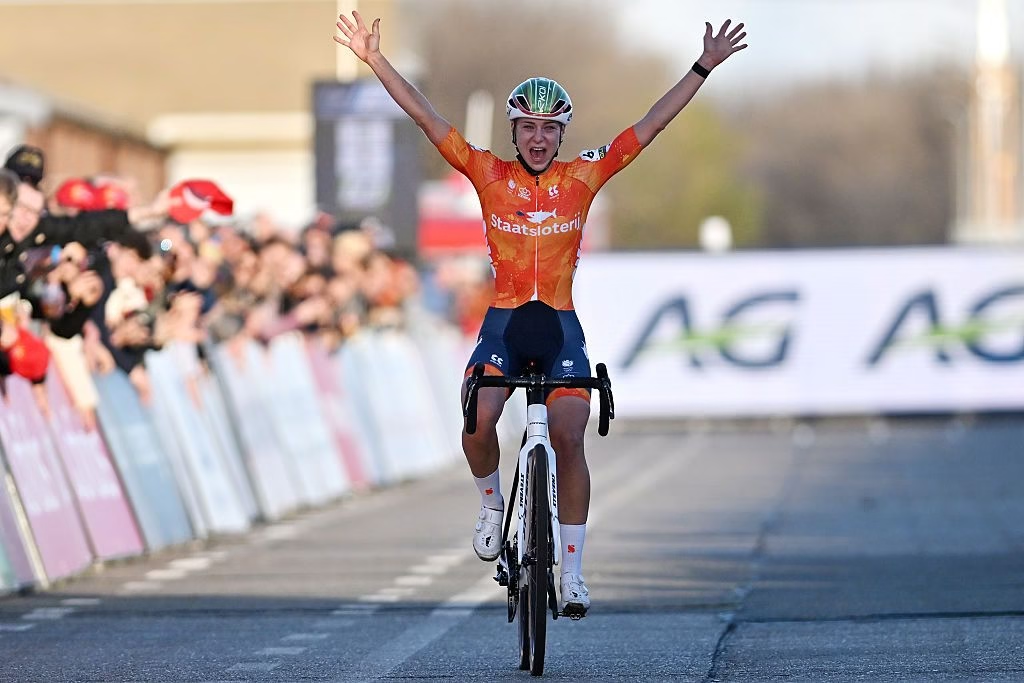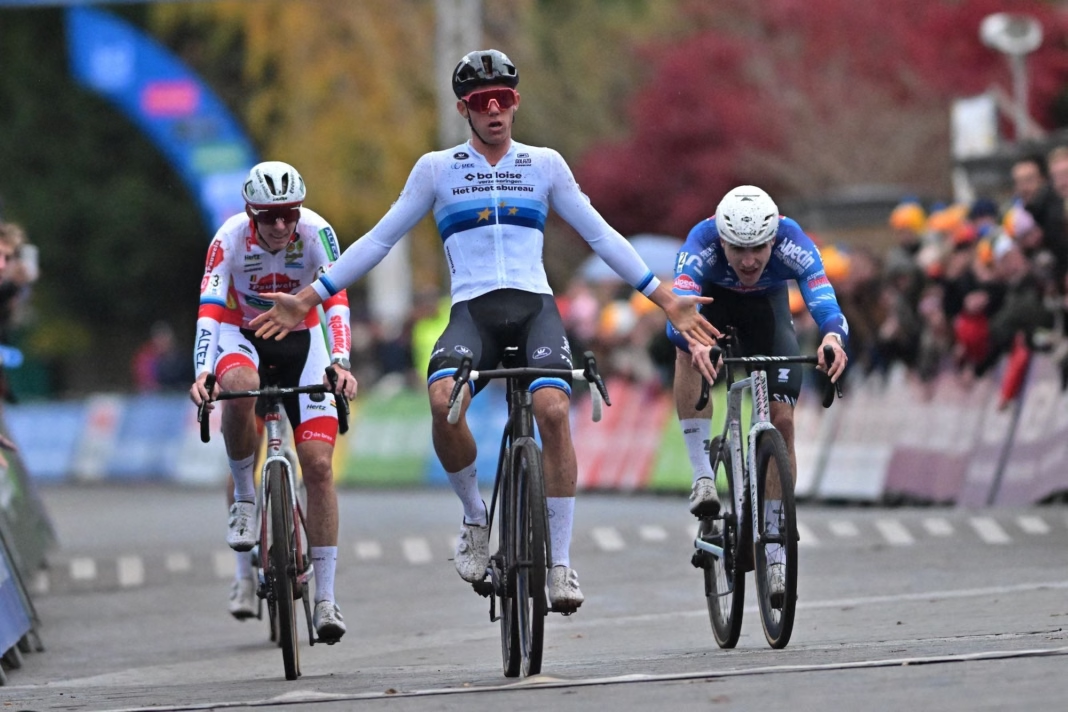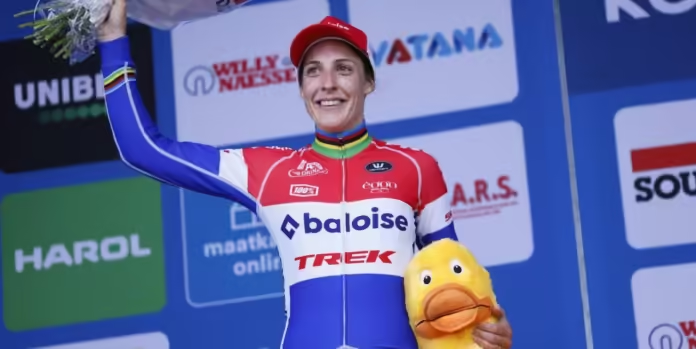
Lucinda Brand is back at the Rapencross in Lokeren with two successive victories to defend. Saturday’s women’s race on 21 November brings a reunion with Marie Schreiber, who crossed the line ahead of Brand at the recent European Championships before a relegation awarded the title to the Dutch rider. The stakes this time are different, but their presence gives a technically demanding race a compelling focal point.
Brand also faces Ceylin del Carmen Alvarado, Sara Casasola, Inge van der Heijden and several other riders capable of getting involved at the front. The startlist is no longer simply a collection of expected entrants. Organiser and independent race information now confirms the principal names, although participation can still change on race morning.
Brand and Schreiber have unfinished business
The European Championships in Zeddam created a memorable sporting argument without settling which woman would have been fastest in a completely clear sprint. Schreiber crossed the line first, but the officials relegated her for impeding Brand. The Luxembourg rider’s form was undeniable, as was the experience Brand drew on to stay within striking distance until the final metres. Lokeren offers a rematch on a different circuit and without a championship jersey being awarded.
Brand’s recent results are a stronger guide to her likely condition than the championship dispute alone. An ankle scare at the Niel Superprestige briefly placed her November campaign in doubt, yet she returned to win at Merksplas and then edged Casasola in the Hamme-Zogge X²O Trophy race. Two victories under different tactical circumstances suggest her ability to respond to rival attacks has survived the interruption.
Schreiber is particularly dangerous when she can make the first lap uncomfortable. A clean start gives her the chance to force the other contenders to take risks in traffic while she concentrates on maintaining speed through corners. The difficulty is sustaining that advantage. Brand has repeatedly shown that she can start within herself, recognise where a gap is vulnerable and increase the pace at a point when others have already spent considerable energy.
2026 HG Cross Lokeren women’s startlist
Among the prominent riders on the published list are Brand, Schreiber, Alvarado, Casasola, Van der Heijden, Manon Bakker, Leonie Bentveld and Julie Brouwers. Alicia Franck and Sterre Vervloet are also among the riders highlighted by the organisers. It is a deeper group than a straightforward two-rider preview might suggest, and there are credible podium possibilities beyond the world champion and her Luxembourg challenger.
Alvarado could change the balance of the race if she starts at full strength. Her acceleration out of corners and ability to regain positions on technical terrain are the qualities that can prevent Brand from turning a hard lap into a solo procession. Some pre-race reports have questioned her readiness, however, so an entry on the list should not be presented as an unconditional guarantee of participation or peak condition.
Casasola has a more established connection with this particular race. She finished third at Lokeren in 2025 and has continued to challenge Brand in the current season, including the close finish at Hamme. Van der Heijden is another reliable technical performer whose chances improve if the leading contenders hesitate, while Bentveld and Bakker can exploit any periods of hesitation in the front group. The 2026–27 cyclocross calendar shows how little recovery time separates this weekend from the next block of important races.
A technical race in Park ter Beuken
Lokeren’s Rapencross takes place in Park ter Beuken, a setting that has hosted Belgium’s national cyclocross championships. The park layout creates a repeated sequence of decisions about entry speed, grip and positioning. There is no single famous climb that determines the whole race. Instead, riders must connect technical sections efficiently and avoid wasting efforts to regain speed after every turn.
Conditions can alter that calculation considerably. On a relatively firm course, maintaining momentum and finding clean exits from corners may be worth more than raw strength. If the surface becomes wet, careful tyre choice and a measured approach to the slippery sections take on greater importance. A rider who loses only a bike length at several points each lap may finish the race having made dozens of extra accelerations.
Starting position matters as much as the first official split. A rider trapped behind a slower cornering rival can lose contact with the leaders even while having sufficient fitness to match their lap times in clear air. Conversely, a confident start can create breathing room without requiring an all-out effort. That is one reason Schreiber’s early speed is an advantage, but also why it can be expensive if she is compelled to defend every metre for most of the race.
Pit choices introduce another variable. In changing conditions, switching bikes may restore cleaner tyres and more dependable handling, but entering the pit costs speed and can surrender the front position. The best riders make the decision according to lap conditions and the gaps around them rather than following a fixed plan. Our HG Cross guide explains the series in which Lokeren now sits.
What the Rapencross record tells us
Recent women’s winners demonstrate that Lokeren does not belong to one type of rider. Aniek van Alphen took victory in 2020 and Denise Betsema won in 2021. Brand then won the 2024 and 2025 editions, converting consistency and precise technical riding into a repeatable advantage. The sequence offers historical context, although it cannot account for the surface and tactical behaviour of Saturday’s field.
Brand’s win in 2025 came ahead of Marion Norbert-Riberolle, Casasola, Van Alphen and Bentveld. The result matters because several of those riders showed that they could remain competitive on the park circuit without needing an early solo move. The 2025 Rapencross report provides the fuller comparison with the men’s race, which Joris Nieuwenhuis won.
The series framework is different this year. The Rapencross is part of HG Cross rather than the X²O Badkamers Trofee, where cumulative time gaps can shape tactical decisions. There is no need for Brand to protect a Sunday-style series lead through every passage of the course. The incentive is to win on the day, which may encourage earlier or more aggressive moves than would make sense during a close general classification battle.
How the women’s race could develop
A fast opening lap from Schreiber would give the contest an immediate structure. That would make the next question whether Brand, Alvarado or Casasola can follow without running into traffic. One small separation can be amplified as riders behind brake and accelerate through a narrow section. A decisive gap can open for the first decisive gap to emerge without a spectacular attack, merely because two competitors choose different lines through the same corner.
Brand has shown that she can win a contest of attrition. If the initial rush settles into a small leading group, she can use repeated changes of pace to find out who is still comfortable. That approach requires patience and clear judgment. A move launched too soon risks giving Schreiber a target to chase, while waiting too long allows a technically quick rival to position herself for a close finish.
Casasola’s strongest opening could emerge precisely when the two principal favourites become preoccupied with one another. She has the endurance to remain involved through a sustained race and the confidence to respond after recent close finishes. Van der Heijden and Bentveld can play a similar tactical role, particularly when the course punishes excessive surges more than a steady sequence of clean laps.
If the leaders reach the last lap together, the final technical passages may matter more than the finishing straight. The rider who enters a corner first and accelerates cleanly can force the others onto less advantageous lines. That kind of advantage is difficult to measure in a conventional split, but it is often visible in the body language of the riders behind.
Form, fatigue and the question of recovery
The November calendar has compressed several races into a short period, and the ability to recover is not distributed equally through the field. Brand’s Merksplas and Hamme results demonstrate excellent current form, but they also represent demanding efforts in quick succession. Schreiber has had her own high-pressure racing, while Casasola and several other contenders have been repeatedly exposed to the intensity of the early winter calendar.
That context is why predicting Lokeren by counting season wins alone is unreliable. A rider who struggled to turn one course characteristic into an advantage last weekend may find a much better fit at Park ter Beuken. Equally, the competitor with the best recent result may discover that a technical rhythm forces her to ride above her preferred effort for too long.
The revealing indicators are more revealing than a simple ranking. Look at how quickly the favourites regain a racing line after a small mistake, whether they can close gaps without standing on the pedals repeatedly, and whether their cornering remains assured after half the race. Such details show which rider is making their speed economically and which is paying for it with every lap.
Start time and the riders to follow
The elite women are scheduled to start on Saturday, 21 November at 13:45 Belgian time, or 12:45 GMT in the UK. The men’s race follows at 15:00 locally, equivalent to 14:00 GMT. For the broadcast arrangements and last-minute schedule changes, see our Lokeren women’s UK TV and streaming guide.
The opening lap should indicate whether Schreiber can create an immediate separation. The middle laps will establish if Brand can break the group through repeated pressure or whether Casasola and the other contenders can keep enough riders together to complicate her choices. An Alvarado start would add another variable, but her actual condition will only become clear once the race is under way.
By the final lap, the winning difference may have less to do with a dramatic late attack than with how accurately each favourite has ridden the previous forty minutes. Lokeren tends to make the cost of small technical errors accumulate. A rider who has had to make the fewest expensive corrections may be in the best position when there is finally room to sprint.
-
 Photo Credit: UAE Team L’IMAD (2026 Gran Premio della Liberazione Donne race report)
-
 Photo Credit: ProCyclingUK archive (original photographer unverified)
-
 Photo Credit: David Pintens/Belga via AFP