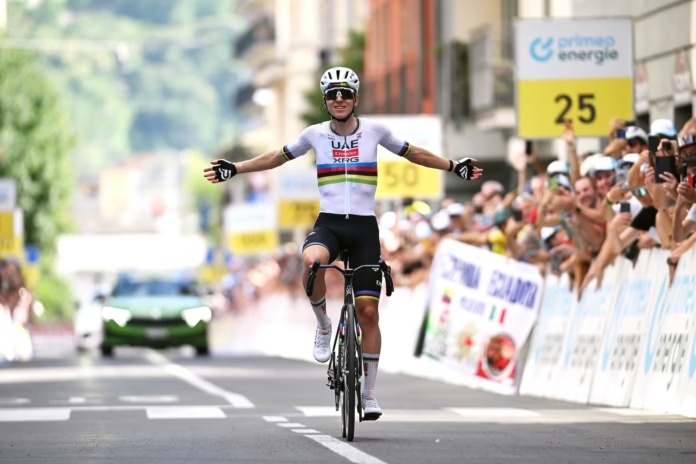
Tadej Pogačar won stage 1 of the 2026 Tour de Suisse with a devastating long-range solo attack, blowing the race apart on his debut at the Swiss stage race. The UAE Team Emirates-XRG rider attacked with more than 70 kilometres still to race, rode away from the reduced peloton before the halfway point, and reached Sondrio with 2:14 over Richard Carapaz and 2:29 over Andrea Bagioli.
It was the kind of performance that immediately reshaped the entire race. Pogačar did not wait for the final climb or a small selection. He moved on the foothills of the second climb of the day, opened a gap almost instantly, and then kept extending it across climbs, descents and valley roads. By the time he reached the final 10 kilometres, the stage was already over and the general classification was close to being decided before the race had properly settled into its week.
Carapaz was the only rider able to offer meaningful resistance, riding alone in pursuit for much of the second half of the stage. Bagioli attacked from the chase group late to take third, while Ilan Van Wilder led home the next group at 4:02, ahead of Mathias Vacek, Brandon McNulty and Wilco Kelderman. Pogačar also took the first leader’s jersey, with Carapaz second overall at 2:22 and Bagioli third at 2:39.
Early break forms before the first climb
The opening stage started and finished in Sondrio, covering 144 kilometres on a route that packed most of its difficulty into a sequence of steep climbs and technical descents. The profile was not a conventional mountain stage, but it was exactly the kind of terrain where the strongest riders could make a difference if the pace was high enough.
Racing began with an early abandon for Alessandro Pinarello, before the first serious move went clear. Cedric Beullens, Pier-André Coté and Fredrik Dversnes attacked, although Coté soon sat up, leaving Beullens and Dversnes to form the break of the day.
Their advantage grew towards 4 minutes as the peloton allowed the move some room. UAE Team Emirates-XRG, NSN, Alpecin-Premier Tech and Red Bull-Bora-Hansgrohe all contributed to the chase behind, keeping the gap manageable before the first serious climb.
The first hour was fast, with an average speed of 46km/h before the race reached Buglio in Monte. That climb, 3 kilometres at 10.1 per cent with a maximum gradient above 20 per cent, had already shaped the women’s race earlier in the day and immediately began to do the same in the men’s race.
Buglio in Monte starts the damage
Dversnes was the stronger of the two breakaway riders on Buglio in Monte, dropping Beullens on the steepest gradients and leading over the top. Behind, UAE Team Emirates-XRG put their whole team at the front of the peloton, and the bunch was already reduced as riders were distanced on the climb and the technical descent that followed.
Beullens was caught before the summit, leaving Dversnes alone out front. That gave him the chance to take the two Tissot Kilometre sprints and collect 6 bonus seconds, but the peloton was closing quickly. Pogačar then took the remaining bonus seconds available from the bunch, claiming 4 seconds across the two sprints after being challenged by Matthew Riccitello.
Those seconds soon looked minor compared with what came next. Dversnes was still ahead, but the race behind had changed tone. The peloton had already been thinned out, UAE were in control, and Pogačar was beginning to move towards the front in a way that suggested he was not waiting for the finish.
Matthew Dinham abandoned during this phase, another early casualty on a stage that became far more selective than a normal opener.
Pogačar attacks with more than 70km to go
The decisive moment came with around 70 kilometres remaining. Pogačar rolled off the front of the peloton on the foothills of the second climb, first bridging towards the remains of the break and then pushing clear of Dversnes. It was not a sharp acceleration that asked who could follow for 30 seconds. It was a sustained move that immediately forced everyone else into damage limitation.
Carapaz and Vacek tried to respond, while McNulty also attempted to bridge back to his leader. Primož Roglič, Riccitello, Bagioli and others formed part of the early chase, but Pogačar had already created separation.
Within a few kilometres, the world champion had a minute on the chasing group. He looked relaxed, even adjusting his radio while continuing to build the gap. UAE Team Emirates-XRG had numbers behind, with Narváez and others joining the first chase group, but the team’s leader was already gone.
The image of the race had been set: Pogačar alone in front, the rest of the contenders scattered across the road behind him, and the opening stage already turning into a statement ride.
Carapaz emerges as the main chaser
Carapaz was the only rider able to make a serious dent in the gap, at least briefly. The EF Education-EasyPost rider attacked from the chase and established himself as the nearest rider on the road, around 1:12 behind Pogačar with 50 kilometres still remaining.
For a while, Carapaz looked strong enough to put pressure on the leader. He built a clear gap over the rest of the chasers and continued riding alone, but the problem was that Pogačar was already too far ahead and still holding his rhythm.
The gaps kept stretching. With 30 kilometres to go, Pogačar led Carapaz by 2:18, with the main chase group at 3:48. Mikel Landa and Van Wilder were present in that group, while Tiesj Benoot worked for Riccitello as Decathlon CMA CGM tried to salvage the situation behind.
Bagioli later attacked from the chase group, moving clear in pursuit of Carapaz. That gave Lidl-Trek a rider on the virtual stage podium, but the Italian had a huge gap to close to both Carapaz and Pogačar.
Final climbs confirm the damage
The final part of the stage included the Ponte in Valtellina, 1.6 kilometres at 8.9 per cent, then the steep Bordighi climb, 1.2 kilometres at an average of 12 per cent with a maximum of 16 per cent. On paper, they could have been launchpads for the favourites. In reality, Pogačar had already used the middle of the stage to put the race beyond reach.
He continued to push hard on the penultimate climb and descended towards the valley floor with more than 2 minutes on Carapaz. Bagioli briefly looked as though he might close in on the Ecuadorian, but he faded slightly as the final climb approached.
Pogačar took the intermediate sprint before Bordighi, then climbed the final ramp still looking in control. The gaps behind him were enormous for stage 1 of a one-week race: Carapaz at around 2:30 on the road, Bagioli at more than 3 minutes, and the main chase group close to 5 minutes back with only a few kilometres remaining.
There was no late slowdown. Pogačar reached the final kilometre alone and had time to celebrate a victory that felt less like an opening stage win and more like a race-defining blow.
Pogačar takes command immediately
Pogačar crossed the line in 3:28:51, taking the stage by 2:14 from Carapaz and 2:29 from Bagioli. Van Wilder led in the next group at 4:02, with Vacek, McNulty and Kelderman on the same time. Großschartner finished at 4:05, while AJ August and Narváez completed the top 10 at 4:30.
The general classification already reflects the scale of the ride. Pogačar leads Carapaz by 2:22, with Bagioli third at 2:39. For most of the field, the race has already become a fight for podium places or damage limitation unless something extraordinary happens later in the week.
Pogačar also took the points and mountains jerseys, although Carapaz is expected to wear the points jersey on stage 2 and Dversnes the mountains jersey after his work in the early break. Vacek took the young rider’s jersey after finishing in the first chase group.
It was a brutal way to open the Tour de Suisse. Pogačar arrived for his race debut and immediately attacked from distance, leaving a field containing Carapaz, Roglič, Riccitello, Van Wilder, Landa and others fighting for scraps behind.
A race already shaped by one attack
This was not simply a strong finish or a statement sprint over a steep ramp. Pogačar changed the entire race with one attack more than 70 kilometres from the finish. The route gave him enough climbing to create a gap, enough descending and rolling terrain to extend it, and enough final difficulty to prevent the chasers from reorganising.
Carapaz deserves credit for refusing to settle into the group behind. His solo chase limited the damage better than anyone else, but even he finished more than 2 minutes down. Bagioli also rode intelligently to take third, while Van Wilder, Vacek, McNulty and Kelderman at least kept themselves near the top of the standings.
The biggest damage came further back. Roglič finished alone behind the main chase, while many riders who had started the day with GC ambitions were already out of realistic contention by the finish in Sondrio.
The Tour de Suisse still has a long way to go, but stage 1 gave it an obvious centre of gravity. Pogačar has the leader’s jersey, the biggest margin, the strongest team and a performance that will leave every rival wondering how to take time back from a rider who was willing to attack before the race had even reached its decisive weekend.
Tour de Suisse 2026 stage 1 result
| Position | Rider | Team | Time/gap |
|---|---|---|---|
| 1 | Tadej Pogačar | UAE Team Emirates-XRG | 3:28:51 |
| 2 | Richard Carapaz | EF Education-EasyPost | +2:14 |
| 3 | Andrea Bagioli | Lidl-Trek | +2:29 |
| 4 | Ilan Van Wilder | Soudal Quick-Step | +4:02 |
| 5 | Mathias Vacek | Lidl-Trek | +4:02 |
| 6 | Brandon McNulty | UAE Team Emirates-XRG | +4:02 |
| 7 | Wilco Kelderman | Visma | Lease a Bike | +4:02 |
| 8 | Felix Großschartner | UAE Team Emirates-XRG | +4:05 |
| 9 | Andrew August | Netcompany INEOS Cycling Team | +4:30 |
| 10 | Jhonatan Narváez | UAE Team Emirates-XRG | +4:30 |
Main photo credit: Getty