
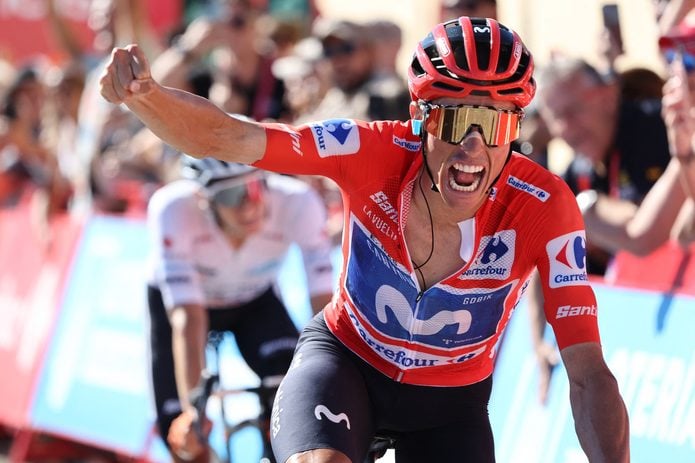
Enric Mas won stage 9 of the 2026 Vuelta a España on Alto de Aitana, attacking in the final 3 kilometres and holding off Oscar Onley to take a major victory in the red jersey.
The Movistar rider began the day as race leader after Tadej Pogačar’s crash and abandon on stage 8, and responded with the strongest ride of his Vuelta so far. Mas attacked from the elite GC group near the top of the final climb, accelerated again inside the final 2 kilometres, and reached the line with Onley on the same time.
Primož Roglič finished third at 12 seconds, taking bonus seconds but losing ground overall. Felix Gall was fourth at 18 seconds after Decathlon CMA CGM had worked hard on the final climb, while Cristian Rodríguez and Mattias Skjelmose finished at 20 seconds. Jarno Widar, Harold Tejada, Richard Carapaz and Santiago Buitrago completed the top 10.
Mas now leads Roglič by 1:18 overall, with Gall third at 1:39 and Onley fourth at 2:20. Carapaz sits fifth at 3:26, with Skjelmose sixth at 3:55.
Aitana reopens the Vuelta after Pogačar’s abandon
Stage 9 took the Vuelta from La Vila Joiosa/Villajoyosa to Alto de Aitana over 187.4 kilometres, with just under 5,000 metres of climbing and six categorised ascents.
It was always going to be one of the most important mountain stages of the race. The route included the Puerto de Tárbena, Alto del Miserat, Puerto de Tollos, Puerto de Tudons, Puerto de Benifallim and the long final climb to Alto de Aitana. The last ascent alone ran for 22 kilometres at 5.8 per cent, with the hardest gradients packed into the second half.
But the context had changed completely overnight. Pogačar had crashed out on stage 8, turning a Vuelta that had looked almost settled into an open GC battle. Mas started the day in red, with Roglič at 1:00, Gall at 1:11, Sepp Kuss at 2:15, Onley at 2:16 and Carapaz at 2:22.
For Movistar, this was the first real test of leadership. Mas had inherited red in difficult circumstances, but Alto de Aitana gave him the chance to show that he could defend it on the road.
Breakaway battle starts immediately
The day began with attacks from the opening kilometres.
A first group formed with riders including Yevgeniy Fedorov and Magnus Cort, before the race continued to split and reform. Alexey Lutsenko was active early, and by the time the race approached the first climb, a stronger group had begun to form around Pavel Sivakov, Andreas Kron, Alastair Mackellar, Fabian Weiss and Alessandro Romele.
The first climb, the Puerto de Tárbena, helped shape the move. Kron led over the summit ahead of Romele and Lutsenko, while counter-attacks continued behind. Santiago Buitrago was one of the most active riders trying to get across, and the peloton remained restless as teams tried to place riders in the move.
That was the first sign of how different the race had become without Pogačar. UAE Team Emirates-XRG no longer had the red jersey to defend, but they still wanted a stage result and placed Sivakov in the escape. Movistar, by contrast, now had to manage the race rather than simply follow UAE’s control.
Eventually, the move grew into a large breakaway with serious strength and enough climbers to keep the stage uncertain for most of the day.
Buitrago chases mountains points
Buitrago was one of the key figures through the middle of the stage.
The Bahrain Victorious rider had lost ground in the general classification earlier in the race, but he used the queen stage to rebuild his Vuelta through the mountains competition. He went over the Alto del Miserat first and moved into the virtual lead of the polka-dot standings, then kept collecting points on Puerto de Tollos and Puerto de Tudons.
That helped make the breakaway hard to control. It was not simply a group riding to the final climb. There were subplots throughout the stage: Buitrago chasing points, Romele racing aggressively on his birthday, Sivakov trying to salvage something for UAE Team Emirates-XRG, and several strong climbers looking for the stage if the peloton hesitated.
By the time the race reached the rugged middle section, the front group had swelled to around 24 riders. The names included Sivakov, Kevin Vermaerke, Bruno Armirail, Embret Svestad-Bårdseng, Buitrago, Ramses Debruyne, Lutsenko, Valentin Paret-Peintre, Kron, Stefan Küng, Romele, Gijs Leemreize, Urko Berrade, Filippo Zana, Marcel Camprubí, Milan Vader, Attila Valter, Raúl García Pierna, Magnus Cort and others.
It was a breakaway strong enough to win, but not one that could relax.
Movistar control in red
Behind, Movistar took responsibility for the first mountain day of Mas’ leadership.
Orluis Aular and Carlos Canal were among the riders doing long turns on the front, keeping the breakaway around the 4 to 5-minute mark through much of the middle of the stage. It was not an all-out chase, but it was enough to show that Movistar understood the obligation of the red jersey.
Mas had said before the stage that Movistar were now in the lead and had to act accordingly. That was exactly how they rode. They did not panic when the breakaway went clear, but they also did not allow the race to drift entirely out of reach.
For much of the day, the stage win seemed balanced between the breakaway and the GC group. The gap was large enough for the front riders to believe, but small enough that the final 22 kilometres of Aitana could still change everything.
The uncertainty kept the race alive until the final climb.
Romele attacks before Benifallim
Romele lit up the breakaway before the final climb.
The XDS Astana Team rider attacked on the descent before the Puerto de Benifallim, using his speed and handling to open a gap on the rest of the escape. He then took the intermediate sprint and pushed on towards the penultimate climb, turning his birthday into one of the more aggressive rides of the day.
Behind him, Sivakov and Camprubí responded. Sivakov accelerated from the chase group, Camprubí also moved across, and the pair began to close on Romele. The Italian still led over Puerto de Benifallim, taking maximum mountain points and bonus seconds, with Sivakov second and Camprubí third.
By the final 40 kilometres, the three riders had come together at the front: Romele, Sivakov and Camprubí. Behind them, the chase group was already starting to fracture, while the peloton remained within striking distance if the GC teams committed on Aitana.
That was exactly what Decathlon CMA CGM were preparing to do.
Decathlon turn the screw
The stage changed when Decathlon CMA CGM took over from Movistar before the final climb.
Bastien Tronchon and Jordan Labrosse were used first, then Callum Scotson, Matthew Riccitello, Léo Bisiaux and Gregor Mühlberger all played their part in lifting the pace for Gall. The goal was clear: make Aitana hard enough to isolate the GC contenders and give Gall a platform to attack.
The effect was immediate. The breakaway’s advantage began to fall quickly, even though Sivakov and Camprubí still reached the base of the final climb with around five minutes over the peloton. Romele was distanced as the road began to rise, leaving Sivakov and Camprubí alone out front.
The heat added to the difficulty. The temperature was reported at 38.5°C on the approach to Aitana, with feeding extended to 10 kilometres remaining because of the conditions. This was not just a tactical battle. It was a survival test.
Once the race hit the final climb, Decathlon’s pressure made the breakaway look increasingly vulnerable.
Sivakov goes solo on Aitana
Sivakov attacked 10 kilometres from the summit.
Camprubí tried to respond, but the French climber opened a gap and went alone. For a moment, it looked like UAE Team Emirates-XRG might rescue something from a difficult week. Pogačar was out, Pablo Torres had abandoned earlier in the stage, and Jay Vine had been distanced early. Sivakov carrying the team to a summit win would have been a significant response.
But the gap was falling too quickly. Decathlon had reduced the peloton to around 20 riders, and Mühlberger’s turn in particular began to shred the GC group.
Kuss was one of the first major names to struggle, losing contact with around 8 kilometres remaining. Skjelmose also drifted before returning later, while the front group continued to thin as Gall sat behind his teammates.
Sivakov still led with 6.5 kilometres remaining, but his margin was down to around a minute. The climb was beginning to turn against the breakaway.
Gall starts the GC attacks
Gall made the first serious GC move.
The Austrian attacked with around 6 kilometres to go, forcing the favourites to respond. Mas, Roglič, Onley, Carapaz and Skjelmose were able to follow the initial acceleration, while the group behind splintered. Gall tried again shortly afterwards, this time with Widar jumping onto his wheel, followed by Mas, Roglič, Onley, Carapaz and Cristian Rodríguez.
It was exactly the race Decathlon had been trying to create. Their work had stripped away domestiques, dropped Kuss and put Gall in a position to test the red jersey.
But Mas looked calm. Each time Gall moved, Mas reacted without panic. He did not need to chase every acceleration immediately with an explosive response. He simply closed the space, stayed near the front and made sure the race did not get away from him.
Sivakov’s lead continued to fall. The breakaway had almost lasted, but the GC group was now coming too fast.
Carapaz nearly steals a march
Carapaz tried to use hesitation behind.
As the pace briefly eased, the EF Education-EasyPost rider attacked and opened a gap. Nobody reacted immediately, allowing him to ride across towards the remnants of the break. He caught Zana and then reached Sivakov, with Buitrago also appearing in the gap.
It was a dangerous move. Carapaz had lost time on stage 7 and needed to put himself back into the podium conversation. A late attack while the favourites watched each other was exactly the sort of move that has won him major races before.
For a moment, it looked like he had created the decisive split. But the GC group eventually responded, and with around 4 kilometres remaining, Sivakov was caught. The stage had gone from a breakaway fight to a full GC contest.
Buitrago tried to go again, Gall chased him down, and the favourites came back together once more. The group now included Mas, Roglič, Gall, Onley, Carapaz, Buitrago and Sivakov, with other riders fighting to return behind.
The stage was still waiting for one final move.
Mas attacks with 3 kilometres to go
Mas made that move with 3 kilometres remaining.
The red jersey accelerated, and Onley immediately gave chase. Behind them, Widar tried to drive the chase, while Roglič, Gall, Carapaz and the others looked to limit the damage.
Mas then accelerated again inside the final 2 kilometres. This time, only Onley could follow. Roglič tried to come back, but the gap opened just enough to turn the stage into a duel between the race leader and the white jersey.
It was a statement from Mas. On the first major mountain day after inheriting red, he did not simply defend. He waited until the final moments, then attacked strongly enough to drop every GC rival except Onley.
That mattered tactically and psychologically. Mas had already shown on stage 6 that he could respond to Pogačar on Puerto El Bartolo. On Aitana, he showed that he could win as the rider everyone else had to watch.
Onley follows but Mas finishes it
Onley produced another strong ride, but Mas had the final answer.
The Netcompany Ineos Cycling Team rider was the only rider able to match Mas’ final acceleration, and his second place on the stage confirmed his place among the strongest climbers in the race. He had struggled after trying to follow Pogačar on the gravel stage, steadied himself at Valdelinares, and then responded superbly on Aitana.
But Mas had the sprint at the end of the climb. The Movistar rider reached the line in 5:10:40, taking the stage win and 10 bonus seconds. Onley finished on the same time and took second place, with Roglič third at 12 seconds after losing contact in the final 2 kilometres.
Gall finished fourth at 18 seconds, having initiated much of the GC action but not gained the reward Decathlon’s work had deserved. Rodríguez and Skjelmose came in at 20 seconds, Widar at 25 seconds, Tejada at 33 seconds, Carapaz at 54 seconds and Buitrago at 1:41.
Mas had turned a defensive day into a stage-winning one.
Roglič limits the damage but loses ground
Roglič remains second overall, but stage 9 moved him further from red.
The Red Bull-Bora-Hansgrohe rider finished third on the stage and took 4 bonus seconds, but he lost 12 seconds on the road to Mas and Onley and finished behind the red jersey in the key selection. In isolation, it was not a collapse. In GC terms, it was another shift towards Mas.
Roglič now sits 1:18 down overall. That is still a workable gap with much of the Vuelta remaining, especially for a rider with his experience and history in this race. But he could not follow Mas’ final acceleration on the first stage where the Spaniard had to defend the jersey in the mountains.
That is the concern. Roglič did enough to stay in second and keep the race alive, but Mas looked sharper in the decisive moment.
The Vuelta is not over, but the balance changed again on Aitana.
Gall’s work brings a podium gain
Gall finished fourth on the stage and moved closer to Roglič overall.
Decathlon CMA CGM did more than any team to make the final climb hard. Their pacing shredded the bunch, dropped Kuss and put Gall in position to attack repeatedly. Gall did attack, and his moves helped bring Sivakov back and split the GC contenders.
The frustration for Decathlon is that Gall did not finish the job. Mas and Onley were stronger in the final 3 kilometres, while Roglič still came around for third on the day.
Even so, Gall gained ground in the podium battle. He now sits third overall at 1:39, only 21 seconds behind Roglič. That keeps him very much in the fight for second and gives Decathlon a clear reason to keep racing aggressively.
Their work did not win the stage, but it did confirm Gall as one of the strongest podium contenders in the race.
Onley moves into the top four
Onley’s second place was one of the most important rides of the day.
The British rider had been aggressive earlier in the race, but he had also paid for trying to match Pogačar on the gravel climb. On Aitana, he got the balance right. He followed when it mattered, did not waste energy chasing every move, and was the only rider able to stay with Mas when the red jersey attacked.
That lifted him to fourth overall, 2:20 behind Mas. He is still 41 seconds off Gall’s podium place, but he has now moved ahead of Carapaz and shown that he can respond on a long, high-mountain finish.
For Netcompany Ineos Cycling Team, it was a strong answer on the first major mountain stage of the new GC race. Onley did not win the stage, but finishing shoulder to shoulder with Mas on Aitana was a major statement.
The white jersey is no longer only defending youth classification status. He is riding like a podium contender.
-
 Photo Credit: Getty

Carapaz loses more time
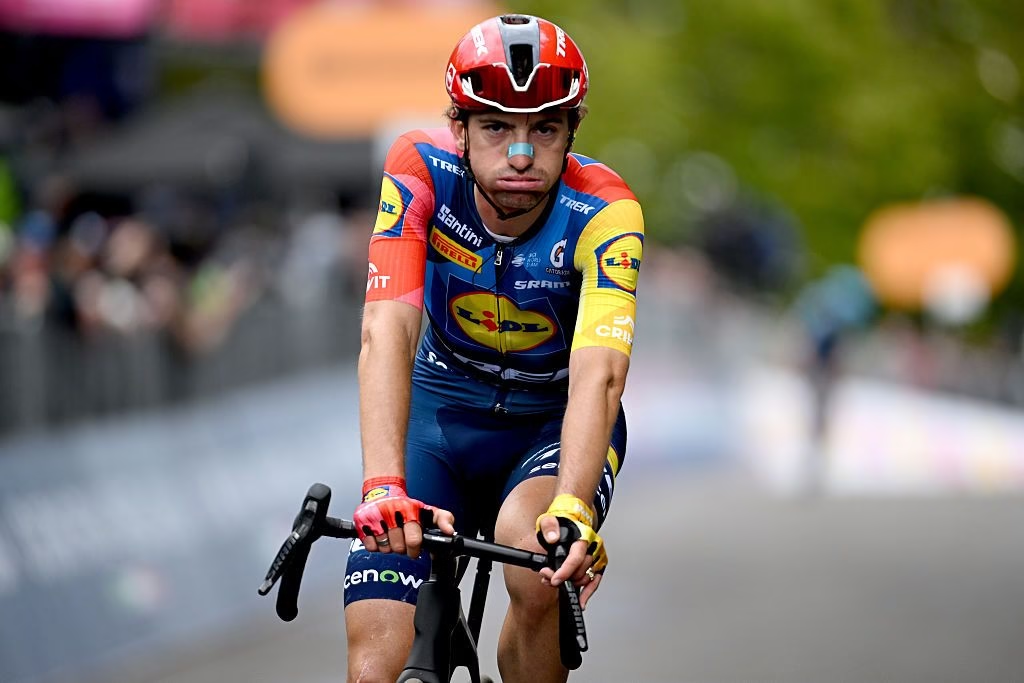
Carapaz tried to change the race, but the finish still cost him.
His attack with just over 5 kilometres remaining was one of the smartest moves of the finale. He went when the pace dipped, nobody reacted, and for a short period he looked capable of turning hesitation into a stage-winning or GC-changing move.
But after being caught, he could not stay with the best climbers when Mas attacked. He finished ninth on the stage, 54 seconds down, and now sits fifth overall at 3:26.
That is still within reach of the podium, but the trend is not ideal. Carapaz lost time at Valdelinares, and although he looked livelier on Aitana, he still lost more ground to Mas, Roglič, Gall and Onley.
The aggression is there. The final climbing response still needs to improve if he is to get back into the podium fight.
Kuss drops out of the front group
Kuss was one of the major losers on Aitana.
The Team Visma | Lease a Bike rider began the stage fourth overall, close to the podium and only 1 second ahead of Onley. When Mühlberger lifted the pace for Decathlon inside the final 8 kilometres, Kuss began to lose contact. Once he was distanced, he never returned to the front of the race.
The result moved Onley ahead of him and changed the upper GC picture. Kuss had steadied himself at Valdelinares after losing time on the gravel stage, but Aitana was a harder blow because it came on a long, more conventional mountain finish.
That matters. The Vuelta still has several major tests to come, but Kuss now has to regain ground rather than simply defend his place inside the top five.
Mas gives Movistar the stage they needed
This was the day Movistar needed.
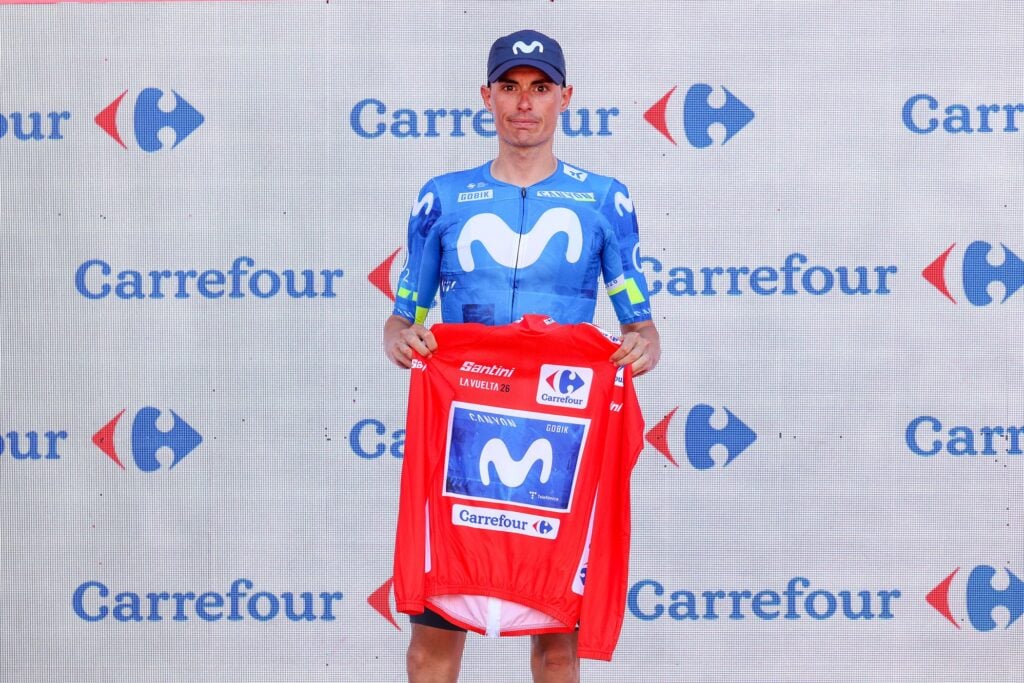
Stage 8 had put Mas into red in strange and uncomfortable circumstances. He had not taken the jersey through an attack or a time gain, but through Pogačar’s crash. The gesture of holding rather than wearing the jersey on the podium reflected that.
Stage 9 changed the story.
Movistar controlled much of the day, managed the breakaway, kept Mas positioned, then watched their leader deliver the decisive attack on one of the race’s hardest climbs. Mas did not just protect the jersey. He won in it.
That matters for how the rest of the race is read. The red jersey is no longer only a consequence of Pogačar’s abandon. It now has a stage win attached to it, on Alto de Aitana, against every remaining GC rival.
Mas has turned an inherited lead into an asserted one.
The Vuelta has a new shape
The first mountain stage without Pogačar gave the Vuelta a new structure.
There is no longer one dominant rider controlling the race by minutes. Mas leads, Roglič is close enough to threaten, Gall is closing on second, Onley has moved into the top four, and Carapaz still has enough aggression to remain dangerous. Skjelmose is sixth, while Kuss has work to do after being dropped on Aitana.
The stage itself had several races inside it. Buitrago hunted mountains points, Romele attacked on his birthday, Sivakov almost rescued the breakaway for UAE Team Emirates-XRG, Decathlon tried to blow the race apart for Gall, Carapaz attempted a late ambush, and Onley confirmed his climbing level.
But the day belonged to Mas. After all the uncertainty created by Pogačar’s crash, the Movistar rider used the hardest stage of the race so far to strengthen red, win the stage and define the Vuelta on his own terms.
Vuelta a España 2026 stage 9 result
| Position | Rider | Team | Time/gap |
|---|---|---|---|
| 1 | Enric Mas | Movistar Team | 5:10:40 |
| 2 | Oscar Onley | Netcompany INEOS | same time |
| 3 | Primož Roglič | Red Bull-BORA-hansgrohe | +0:12 |
| 4 | Felix Gall | Decathlon CMA CGM | +0:18 |
| 5 | Cristián Rodríguez | XDS Astana Team | +0:20 |
| 6 | Mattias Skjelmose | Lidl-Trek | +0:20 |
| 7 | Jarno Widar | Lotto-Intermarché | +0:25 |
| 8 | Harold Tejada | XDS Astana Team | +0:33 |
| 9 | Richard Carapaz | EF Education-EasyPost | +0:54 |
| 10 | Santiago Buitrago | Bahrain Victorious | +1:41 |
Main photo credit: Getty

