

Men’s La Flèche Wallonne 2026 gave the Ardennes week a result that felt bigger than a single midweek Classic. Paul Seixas did not just win on the Mur de Huy. He won it on debut, at 19 years old, and in doing so became the youngest winner in the race’s long history. That alone would have made the result notable. The way he won made it much more than that.
Seixas climbed the Mur de Huy with the kind of authority that instantly changes how a season is read. Mauro Schmid finished 2nd and Ben Tulett took 3rd, but the most important detail was not the podium order behind him. It was that Seixas arrived in Wallonia carrying the momentum of Itzulia Basque Country and left looking like a rider who now belongs in every major one-day conversation on hilly terrain.
That matters because La Flèche Wallonne is one of the most specific races in the calendar. It is not won by vague good form. It is won by riders who can handle repeated positioning battles, survive a selective final hour and then still find the right effort on one of the steepest finishes in the sport. Seixas did all of that immediately.
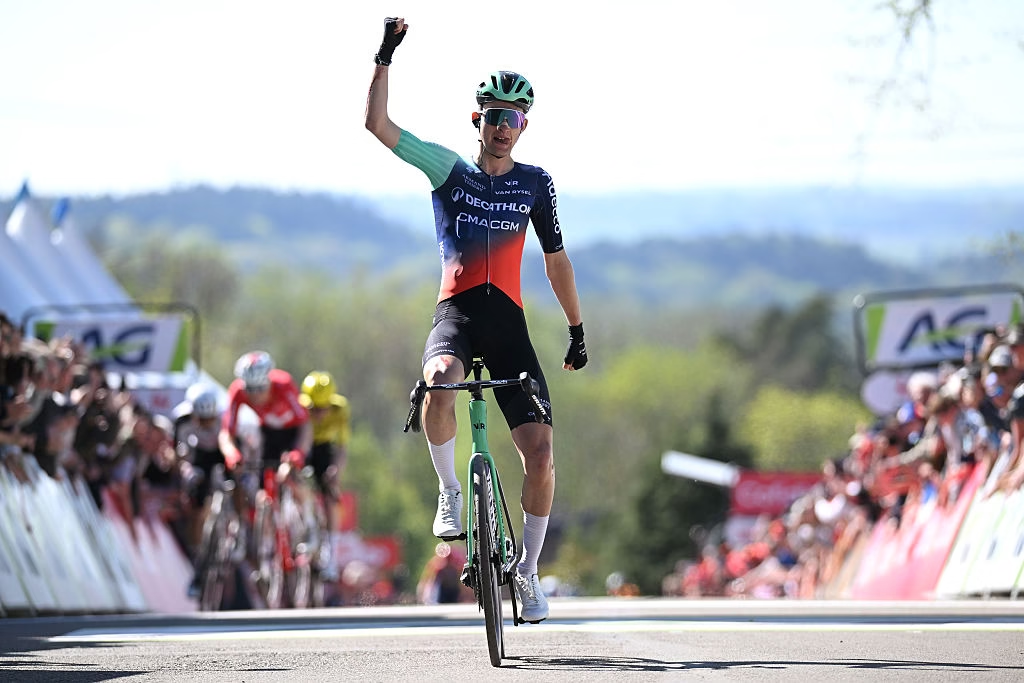 Photo Credit: Getty
Paul Seixas has moved from prospect to reference point
The biggest meaning of Men’s Flèche Wallonne 2026 is that Seixas can no longer be discussed mainly as a future star. He is already changing races in the present. Winning Itzulia Basque Country had already shifted the tone around him, but a week-long stage race and the Mur de Huy are different tests. One asks for repeatability and recovery. The other asks for exact timing under enormous pressure. Seixas passed both inside the same month.
That changes the season immediately. Before Wednesday, he was the most exciting name in the race. After Wednesday, he is one of the most important. Teams can no longer treat him as a rider who might animate a race if everything goes right. They now have to treat him as someone who can finish it off.
It also changes how his team is viewed. Decathlon-CMA CGM did not simply arrive with a talented teenager in form. They arrived with a rider capable of winning one of the hardest uphill one-day finishes in the sport, and that gives the team a much bigger presence in the rest of the spring and beyond.
The Mur de Huy win makes Liège-Bastogne-Liège far more interesting
The most immediate effect of Seixas’s win is on Liège-Bastogne-Liège. La Flèche Wallonne is more compressed and more specific than Liège, but it still tells you who can handle the Ardennes at the sharp end. Seixas now goes into Liège with real momentum and with a result strong enough to force a serious question: can he carry this level into a longer, broader Monument-style test?
That is where the race result becomes so important. Tadej Pogačar and Remco Evenepoel may still be the larger names in a wider one-day hierarchy, but Seixas has now put himself into that conversation on merit rather than hype. Liège is still a different kind of race, one that rewards longer-range strength and a deeper endurance base, but La Flèche Wallonne proved he belongs on the same page before the race has even started.
It is also good for the season more broadly. Cycling needs new rivalry lines and new reference points. A teenager winning the Mur de Huy on debut after dominating Itzulia creates exactly that. The established stars are still there, but the future has stopped waiting its turn.
The established Ardennes names are still strong, but no longer secure
One of the more revealing parts of Men’s Flèche Wallonne 2026 is that several of the established favourites were still good, but not decisive. Mauro Schmid’s 2nd place was an excellent result and confirmed that Team Jayco AlUla continue to be dangerous in these selective one-day races. Ben Tulett’s 3rd place also underlined that Team Visma | Lease a Bike still have riders capable of shaping the hardest one-day finales even without one overwhelming favourite.
Benoît Cosnefroy in 4th and Mattias Skjelmose in 5th also remain central to the wider Ardennes picture. Neither result is poor. In another year, either might have been enough for a more defining headline. But Seixas’s win changes how those placings feel. The older hierarchy was not broken entirely, but it was interrupted.
That matters for the season because it means the strongest established names now have to race with a new problem. They are not only marking each other. They are marking a rider who is still supposed to be arriving rather than already winning at this level.
Youth is not just appearing in the peloton, it is winning the biggest races
There is a wider seasonal meaning here too. Men’s cycling has been getting younger at the top for several years, but Seixas’s win pushes that trend further. It is one thing for a young rider to podium a WorldTour one-day race or win a stage in a week-long event. It is another to win La Flèche Wallonne outright, on debut, on a finish that usually rewards experience and exact judgement.
That matters beyond Seixas himself. It tells every team and every young rider something about the current shape of the sport. The old apprenticeship model still exists in places, but it is weaker than it once was. If a rider is strong enough, the sport is increasingly willing to let that strength define results immediately.
It also raises the standard for development. Teams are no longer only trying to produce riders who can become contenders by their mid-to-late twenties. They are increasingly trying to build riders who can handle major races almost immediately. Seixas is not only a winner here. He is a sign of where top-level men’s cycling continues to move.
Decathlon-CMA CGM have a much bigger season now
For Decathlon-CMA CGM, this result changes the texture of the whole season. A team can arrive at a major one-day race hoping for visibility, a podium or a useful result. Winning La Flèche Wallonne pushes them into a different category. They now have a rider who can change how rivals approach races.
That matters tactically. Once a rider wins a race like this, he is given less freedom the next time. But it also matters psychologically. The team no longer has to imagine what Seixas might be capable of in the biggest races. They have already seen it. That gives them a clearer platform for how to race the next set of targets.
It also matters commercially and structurally. Wins like this change how a team is perceived externally. They add weight to every selection, every race start and every conversation about leadership. Seixas is now one of the riders who can define a race preview by his presence alone. That is a major shift.
-
 Photo Credit: A.S.O./Billy Ceusters
The Ardennes have a new kind of uncertainty
Before La Flèche Wallonne, the Ardennes story felt relatively clear. Pogačar and Evenepoel sat above most conversations, with riders such as Skjelmose, Vauquelin, Cosnefroy and others making up the next layer depending on route and form. Seixas’s win has not erased that, but it has made the whole landscape less settled.
That is useful for the season because it widens the range of believable outcomes in the biggest races. Cycling is strongest when the hierarchy is real but not rigid. Seixas has not dissolved the order. He has stretched it. Suddenly, the gap between established superstar and breakthrough contender feels much smaller than it did a week ago.
That uncertainty should make the rest of spring more compelling. If Seixas can win this race in this manner, then the next question is not whether he belongs. It is how many race shapes he can already master.
What Men’s Flèche Wallonne 2026 really changed
The simplest reading of Wednesday is that a brilliant young rider won one of the sport’s most specific uphill Classics. That is true, but it is not the whole story.
What Men’s Flèche Wallonne 2026 really changed was the scale of the season around Paul Seixas. He is no longer riding ahead of expectation. He is now shaping expectation. He arrives at the next major races not as a talented outsider but as one of the riders everyone else has to account for.
That is a major shift for one rider, one team and the whole Ardennes picture. The Mur de Huy has always been a place where the strongest legs and the clearest timing are exposed. On Wednesday, it exposed something else as well: the sport has a new problem, and it is only 19.

