
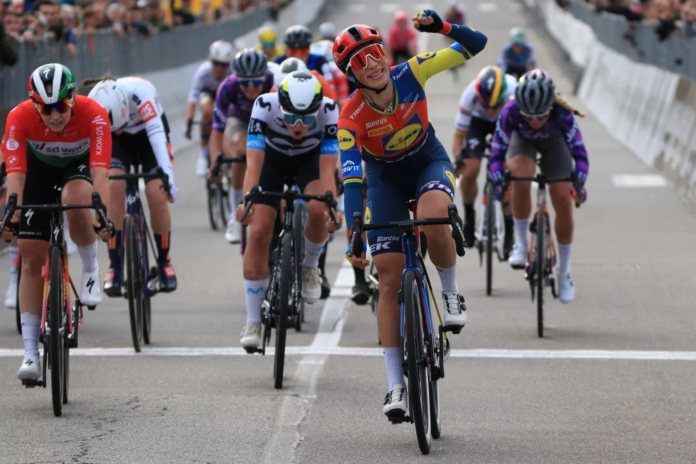
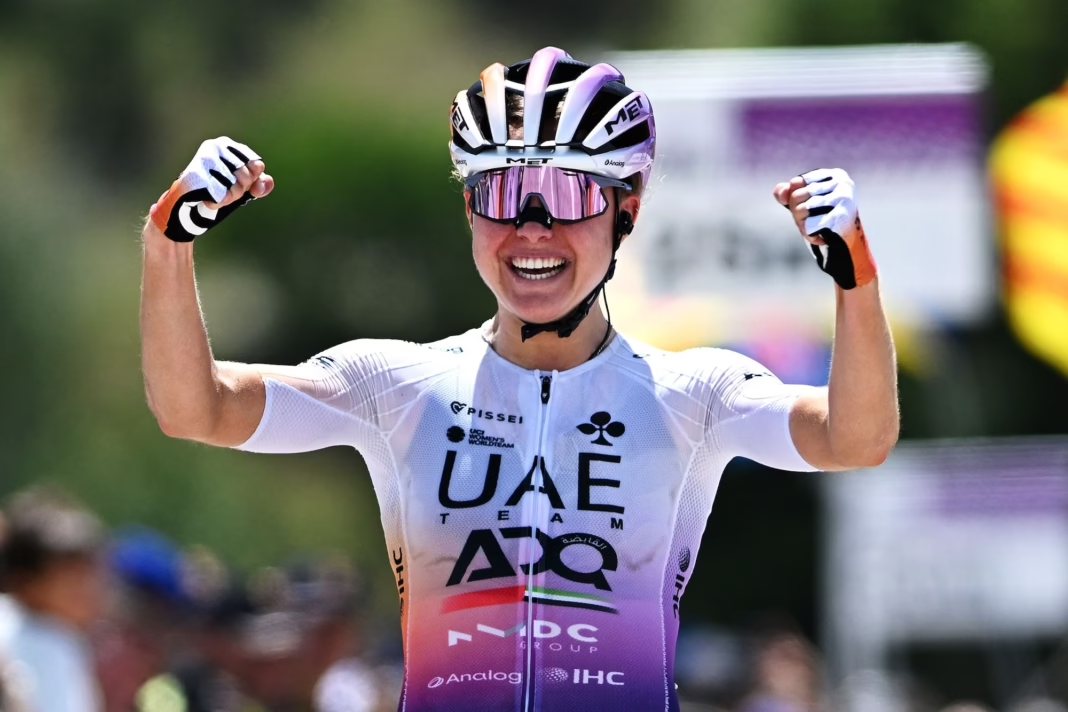
Trofeo Alfredo Binda is one of the great historical races of women’s cycling. Long before the current boom in visibility, long before the Women’s WorldTour became the clear organising structure of the season, this race was already there. First held in 1974, it has given the women’s calendar something few races can match: depth, continuity and a strong sense of place. In 2026, with Karlijn Swinkels winning the 50th edition, that legacy feels even more significant.
That is what still makes the race special. Trofeo Alfredo Binda is not only important because it is old. It matters because it has remained relevant. Over the decades, it has shifted from a race dominated by Italian riders into one of the key early-season proving grounds for the best puncheurs, all-rounders and hard-race finishers in the sport. It sits at the point in the calendar where form is beginning to show properly, but where races are still open enough to reward aggression and freshness as much as hierarchy.
How Trofeo Alfredo Binda began
The first Trofeo Alfredo Binda took place in 1974 and was won by Giuseppina Micheloni. In the early years, the race had a much more Italian character, which reflected the structure of women’s cycling at the time. It was a domestic stronghold before it became a truly international target, and that early period gave Italian riders a strong imprint on the event’s history.
The fact that a Belgian rider, Nicolle Van Den Broeck, won as early as 1975 was significant, but it did not yet mark a broader shift. It still took a long time before non-Italian riders became regular winners. That is one of the most interesting threads in the race’s history. Trofeo Alfredo Binda began as an Italian race in the strongest possible sense, then gradually opened into something much broader as the women’s peloton itself internationalised.
How the race evolved
The race’s middle decades were shaped by powerful repeat winners. Maria Canins won four times, underlining how much the event once rewarded the strongest all-round climbers of the era. Fabiana Luperini won three times as well, while Valeria Cappellotto and Elisabetta Fanton each added multiple victories. For a long time, Trofeo Alfredo Binda looked like a race that reflected Italian dominance both numerically and stylistically.
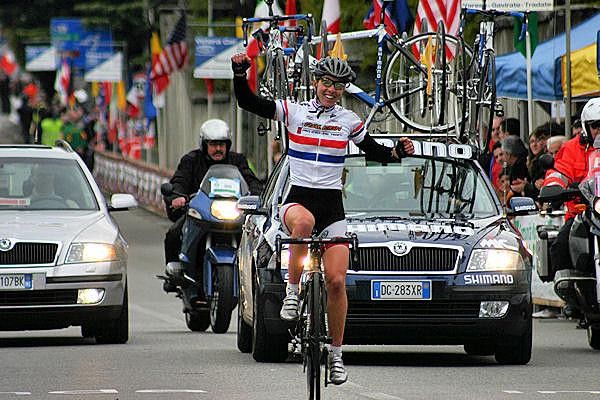
That began to change more clearly in the 2000s. Nicole Cooke won twice, Emma Pooley won twice, and then Marianne Vos established herself as the dominant modern figure with four victories. Lizzie Deignan added two more wins in 2015 and 2016, and Elisa Balsamo has now joined the race’s elite repeat winners with her third success in 2025. The wider pattern is obvious. Trofeo Alfredo Binda evolved from a race Italians largely controlled into one of the most international one-day races in the women’s calendar.
Yet the race still keeps its Italian identity through the roads and through the style of racing it encourages. This is not a northern cobbled war of attrition. It is not a one-climb summit finish either. Trofeo Alfredo Binda is usually shaped through repeated effort on the finishing circuit, where the climbs and descents slowly reduce the peloton until only the strongest and sharpest riders remain.
How the route shapes the race
The route has long revolved around the finishing circuit near Cittiglio, and that repeated-lap format is central to the race’s character. It creates a very different rhythm from races that build towards one final sequence of sectors or one decisive summit. At Trofeo Alfredo Binda, the race hardens incrementally. Every lap offers another chance to attack, another chance for the bunch to lose riders, and another opportunity for teams to make mistakes in timing or positioning.
In modern editions, the Orino climb has become one of the most important features of the finale. It is not a mountain, but it is selective enough to invite attacks and long enough to expose riders who are already close to their limit. That is why the race so often ends with a reduced group, a late solo move or a small selection rather than a conventional bunch sprint. Even when faster riders do win, they usually do so after the route has stripped away most of the pure sprinters.
That is also why Trofeo Alfredo Binda keeps producing such an interesting range of winners. It rewards climbing punch, but not only climbing punch. It rewards finishing speed, but only after a hard enough race. Above all, it rewards riders who can read a repeated-circuit event properly and judge when the final selection is becoming real.
The riders who shaped Trofeo Alfredo Binda history
Maria Canins remains one of the defining names in the race’s long history with four victories. Fabiana Luperini and Nicole Cooke each won three times, while Marianne Vos also reached four victories and for a long period looked like the modern queen of the race. Vos’s combination of punch, sprinting speed and tactical instinct made her a natural fit for Trofeo Alfredo Binda, especially in the years when the race often ended with a reduced front group still fighting for the win.
Lizzie Deignan’s double win in 2015 and 2016 was another important marker because it came during a phase when the race was already fully established as a top-level international Classic. Elisa Longo Borghini’s 2013 victory stood out even more sharply because Italian wins had become rare by then. That result felt like a reconnection between the race’s roots and its modern global status.
Then came the most recent phase. Elisa Balsamo has emerged as one of the key modern figures in Trofeo Alfredo Binda, winning three times across 2022, 2024 and 2025. Shirin van Anrooij’s 2023 victory and Karlijn Swinkels’ 2026 win show that the race remains open to new winners, but Balsamo’s repeated success highlights how much this route still suits riders who can survive a selective day and finish with real speed from a small group.
The greatest Trofeo Alfredo Binda edition
There is still a strong case for 2018 as one of the race’s defining modern editions.
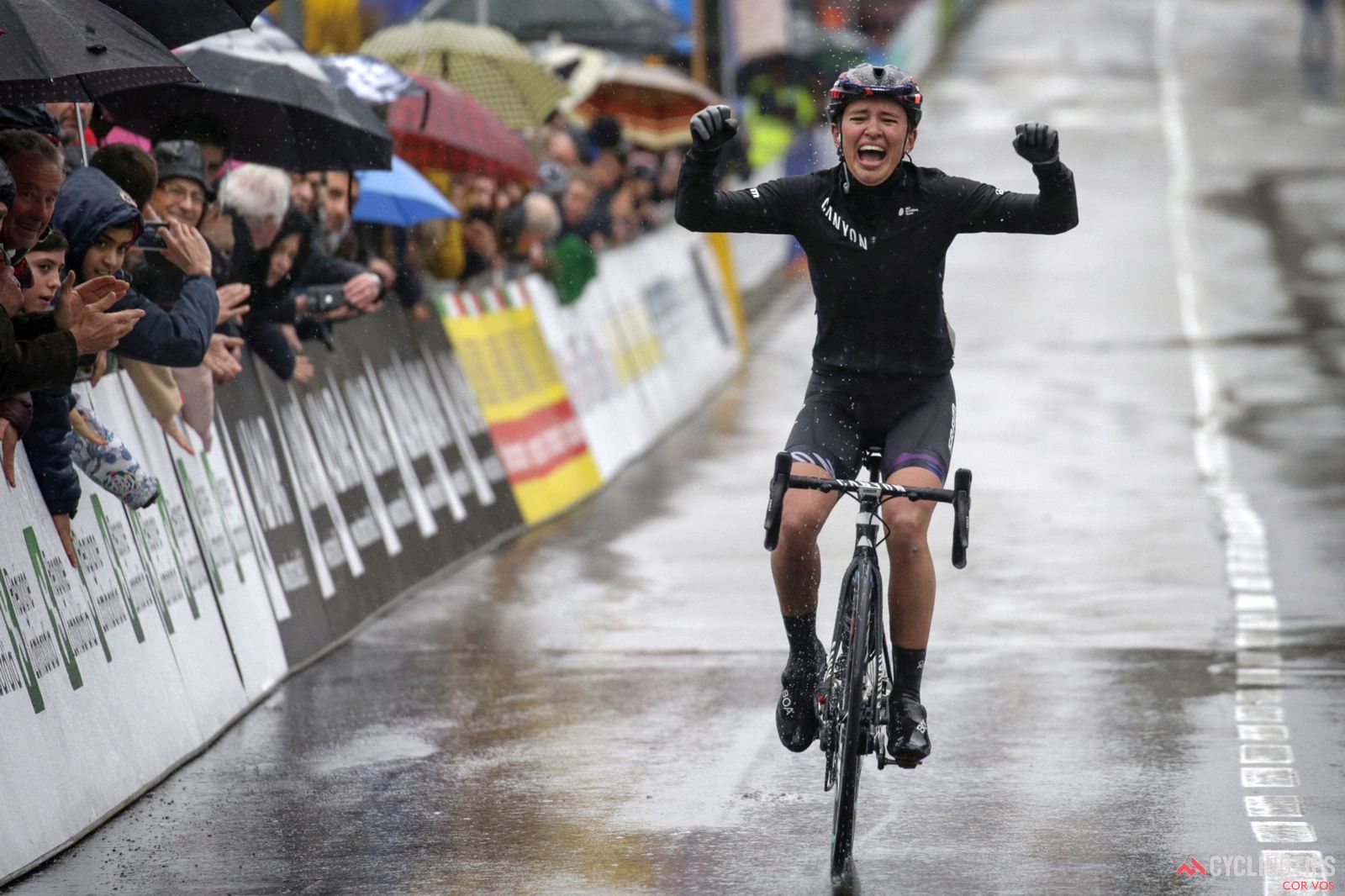
The conditions were truly grim, the kind of wet and difficult day that changes not just the mood of a race but the shape of it. The riders largely waited until the finishing circuit for the real selection to begin, which is often how Trofeo Alfredo Binda works at its best. The race is rarely about wild early moves. Instead, it tends to intensify lap by lap until the strongest riders finally have room to make a difference.
Soraya Paladin attacked first, then Alena Amialiusik and Ane Santesteban got clear, before the race shifted again on the last lap. A sizeable front selection was still in contention as the riders approached the final Orino climb, which is where the decisive moment came. Katarzyna Niewiadoma attacked with around 8km to go and rode clear alone in dreadful conditions, descending confidently and holding off the chase by 23 seconds.
What made that edition so memorable was how complete the performance felt. Niewiadoma did not simply produce the strongest attack. She judged the race perfectly, chose the right point to go, handled the descent in the rain, and finished off one of the most impressive solo wins the race has seen in the modern era.
The defining section of Trofeo Alfredo Binda
The race has several meaningful climbs, but in modern terms the Orino ascent has become one of the clearest launch points for the decisive move. It comes late enough to matter and is hard enough to force real differences if the pace is high. Riders who still have something left can attack there. Riders who are already on the edge often find themselves exposed.
That said, the defining feature of Trofeo Alfredo Binda is really the circuit as a whole. The repeated laps create tension in a different way from one-off climbs. Riders know the road, know the climbs and know the possible attack points, which makes the race more about timing and less about surprise. In that sense, Trofeo Alfredo Binda is one of the most tactically honest races in women’s cycling. The strongest riders generally know where they need to make the difference. The challenge is doing it against rivals who know the same thing.

Trofeo Alfredo Binda previous winners
- 1974 – Giuseppina Micheloni
- 1975 – Nicolle Van Den Broeck
- 1976 – Maria Cressari
- 1977 – Maria Cressari
- 1978 – Maria Cressari
- 1979 – Anna Spezialetti
- 1980 – Maria Canins
- 1981 – Maria Canins
- 1982 – Maria Canins
- 1983 – Maria Canins
- 1984 – Roberta Bonanomi
- 1985 – Luisa Seghezzi
- 1986 – Nadia De Negri
- 1987 – Imelda Chiappa
- 1988 – Elisabetta Fanton
- 1989 – Elisabetta Fanton
- 1990 – Gabriella Pregnolato
- 1991 – Alessandra Cappellotto
- 1992 – Roberta Bonanomi
- 1993 – Roberta Bonanomi
- 1994 – Fabiana Luperini
- 1995 – Valeria Cappellotto
- 1996 – Valeria Cappellotto
- 1997 – not held
- 1998 – not held
- 1999 – Diana Žiliūtė
- 2000 – Fabiana Luperini
- 2001 – Nicole Brändli
- 2002 – Edita Pučinskaitė
- 2003 – Susanne Ljungskog
- 2004 – Nicole Cooke
- 2005 – Nicole Cooke
- 2006 – Nicole Cooke
- 2007 – Trixi Worrack
- 2008 – Emma Pooley
- 2009 – Marianne Vos
- 2010 – Marianne Vos
- 2011 – Emma Pooley
- 2012 – Marianne Vos
- 2013 – Elisa Longo Borghini
- 2014 – Marianne Vos
- 2015 – Lizzie Armitstead
- 2016 – Lizzie Armitstead
- 2017 – Coryn Labecki
- 2018 – Katarzyna Niewiadoma
- 2019 – Elisa Longo Borghini
- 2020 – not held
- 2021 – Elisa Balsamo
- 2022 – Elisa Balsamo
- 2023 – Shirin van Anrooij
- 2024 – Elisa Balsamo
- 2025 – Elisa Balsamo
- 2026 – Karlijn Swinkels
-
 Photo Credit: Getty
Who has won Trofeo Alfredo Binda the most times?
Maria Canins, Marianne Vos and Elisa Balsamo all share the record with four victories each. Which means the race’s all-time summit is unusually crowded for such a long-running event. That in itself says something important about Trofeo Alfredo Binda. Even across five decades, it has resisted belonging to just one rider or one era.
Why Trofeo Alfredo Binda matters so much
Trofeo Alfredo Binda matters because it bridges eras better than almost any other race in women’s cycling. It carries the memory of the sport’s older Italian structures, but it also sits fully within the modern Women’s WorldTour. It has seen national dominance, then internationalisation, then the current era of broader depth where a wide range of riders can arrive with a plausible path to victory.
It also matters because the race is so good at revealing complete riders. Trofeo Alfredo Binda is not won by specialists alone. It usually takes a rider who can climb sharply, handle repeated pressure, stay well positioned and still finish with authority after a hard day. That is why its winners list feels so strong, and why it remains one of the most important one-day races of the early season.

