
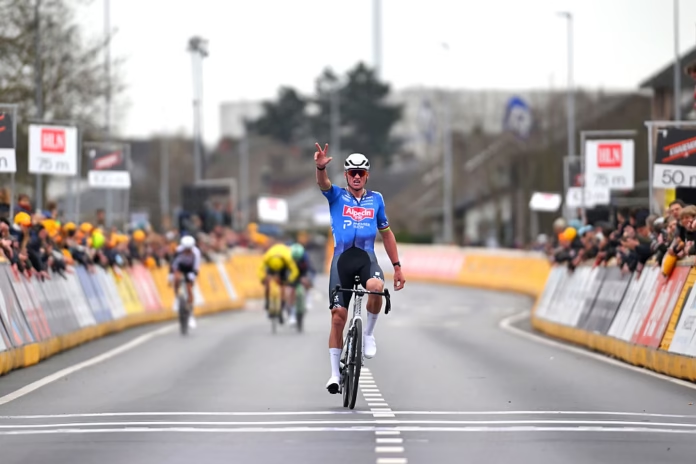
Mathieu van der Poel of Alpecin-Premier Tech won E3 Saxo Classic 2026 on Friday after a remarkable finale in Harelbeke, holding off a rapidly closing chase group that had looked certain to catch him inside the final 2km. The Dutchman appeared to be fading after his long-range move, but found one last acceleration when the four riders behind began to look at each other, turning apparent vulnerability into victory. Per Strand Hagenes took second from the chase, ahead of Florian Vermeersch and Stan Dewulf, after the chance to fight for the win slipped away.
An aggressive opening gives way to the usual tension before the bergs
E3 Saxo Classic did not offer a gentle path into its decisive phase. The race took time to establish a proper break, which already hinted at the intensity behind. Several early moves were tried and shut down before Bastien Tronchon, Michiel Lambrecht and Nickolas Zukowsky finally forced some separation. They were later joined by Stan Dewulf, Luke Durbridge and Sven Erik Bystrøm, forming the day’s main move as the race built towards its long sequence of climbs.
Behind them, the peloton stayed under close watch. Alpecin-Premier Tech did much of the early control through Silvan Dillier, while Soudal-QuickStep, Lidl-Trek and Red Bull-Bora-Hansgrohe all showed themselves near the front before the race hit the decisive sector of bergs and cobbles. The pace was not frantic all the time, but there was no real calm either. That is often the way with E3. Everyone knows where the race will explode, so the waiting phase is really just a long fight for position.
The first proper changes came once the climbs started to stack up. A Visma move through Kielich split things behind the break and created a new chase group, with teams like Alpecin, Lidl-Trek and Soudal-QuickStep all represented. Red Bull-Bora-Hansgrohe and UAE Team Emirates-XRG were more awkwardly placed at moments, and that shaped some of the tactical pressure later on.
Van der Poel lights the race up on the Taaienberg and Boigneberg
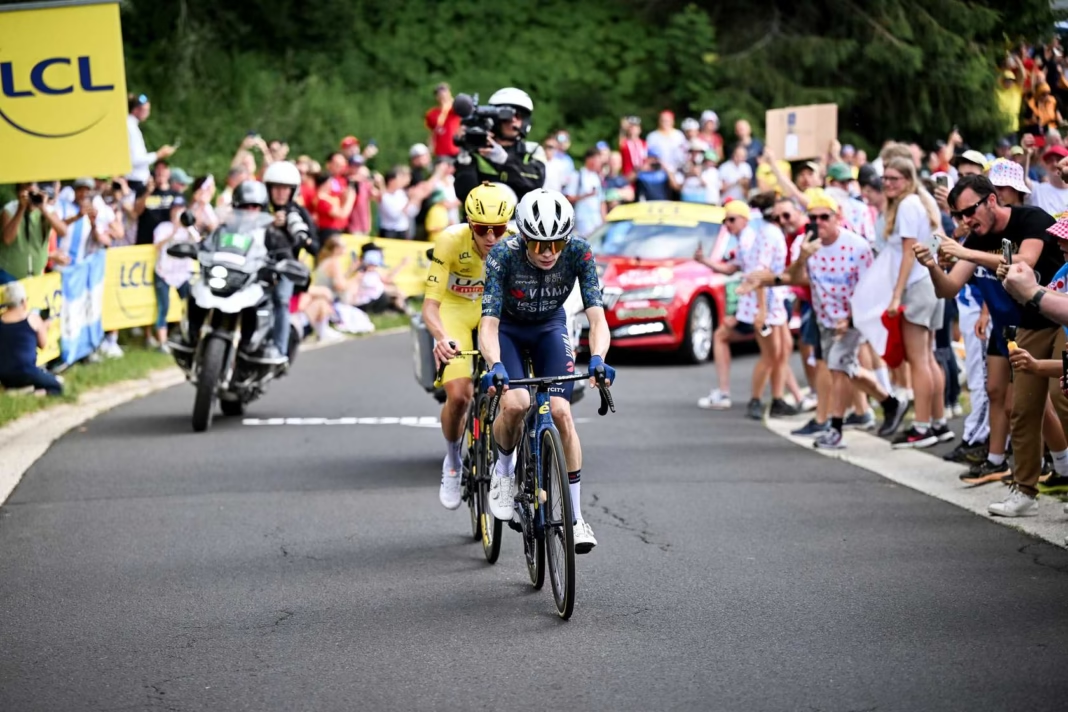
The race began to tilt decisively on the Taaienberg. That is the climb everyone circles, and once the favourites reached it, the expected violence arrived. Tim Van Dijke was the first to get a small gap, but Van der Poel quickly closed him down himself and pressed on. From there, the race moved into a familiar pattern. Van der Poel was no longer waiting for others to make mistakes. He was forcing them.
He joined the chase group and then, on the Boigneberg, made the move that truly blew the race apart. He attacked, dropped everyone, including Van Dijke, and set off alone in pursuit of the remnants of the break. That was the first major statement of the day. It was not merely that he attacked, it was how cleanly he detached the others and how quickly he started taking big chunks of time out of the riders ahead.
By the time he hit the Kapelberg, the six leaders were in sight. He caught them as they crested the climb, immediately turning the race from a pursuit into a solo audition for victory. He still had significant work left to do, but the psychological effect was obvious. Once Van der Poel had bridged across in that style, the rest of the race was forced to respond to him rather than shape its own outcome.
The Paterberg and Oude Kwaremont leave Van der Poel alone
If there was any lingering doubt over whether Van der Poel had gone too early, the Paterberg answered it. He accelerated there in the way he has so often done in the cobbled Classics, and only Dewulf could initially hold on. That did not last. On the run towards the summit, Van der Poel dropped him too and moved clear on his own.
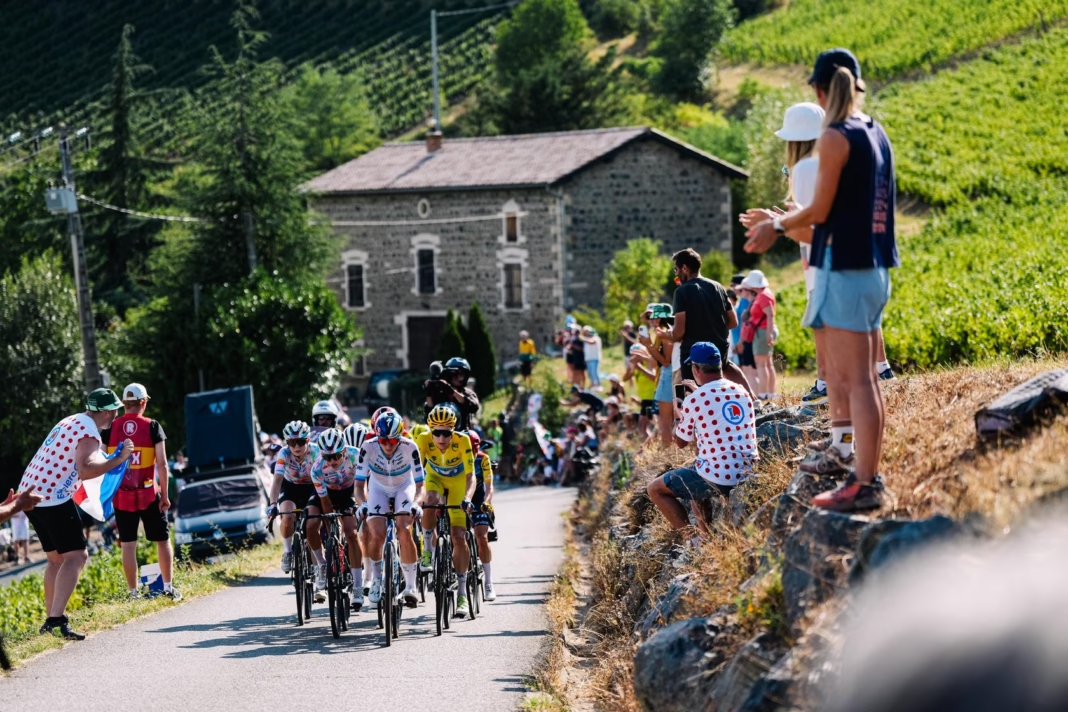
From there, the old pattern returned. He reached the Oude Kwaremont for the second time alone and extended again. Behind him, the race for second was becoming messy. Dewulf was caught by a group containing Hagenes, Vermeersch and Abrahamsen, while the peloton still hovered behind with riders such as Pedersen and Laporte trying to keep themselves relevant. UAE Team Emirates-XRG were active through Morgado and Bystrøm at different moments, Red Bull-Bora-Hansgrohe had Jan Tratnik attacking, and the peloton kept threatening to reorganise, but nobody could match the clarity of what Van der Poel had already done.
With 20km to go, he still held 45 seconds on the chasers and a minute on the peloton. On paper, that should have been enough. But this was not one of those total Van der Poel demolitions where the race becomes a procession. The signs of fatigue were beginning to show.
A tiring leader invites the chase back in
Over the final flat run-in after the Tiegemberg, the race began to tilt again, this time against Van der Poel. The quartet behind, Hagenes, Vermeersch, Dewulf and Abrahamsen, started to make meaningful inroads. Vermeersch appeared to be doing the lion’s share of the work and was visibly frustrated by the limited contribution of some of the others, while the peloton also edged closer to the chasers and briefly threatened to bring the whole race back together.
That was what gave the finale its strange shape. Van der Poel was still leading, but he was no longer pulling away. The gap fell from around 45 seconds to 35, then 28, then 18, and eventually to just five seconds inside the final 2km. The visual impression matched the time checks. He looked to be running out of road and perhaps out of legs as well.
Afterwards, Van der Poel admitted as much. He said, “A few times actually, with a bit more than 1 kilometre to go. The legs were just not really turning well anymore, and then I looked back and they were really close. I knew if I waited I didn’t have the legs anymore to do a sprint. So I just did a seated all-out to the finish line.”
That quote matters because it confirms this was not simply a comfortable bluff from the front. He was in difficulty. The question is how much of what followed was instinctive survival and how much was a deliberately clever reading of the hesitation behind.
-
 Photo Credit: A.S.O./Billy Ceusters
The decisive hesitation
With 1.5km to go, the chasers had him in sight and seemed almost certain to make contact. But that certainty was part of the problem. As the gap came down towards the final kilometre, the four behind began to shift from chasing to anticipating the catch. Instead of riding as if they still needed to close every metre, they started to look at one another and think about what would happen after contact.
That was the golden opportunity lost. None of them are famous for a devastating sprint, and all of them should have known that catching Van der Poel would still leave the race open. Yet the collective urgency dipped at exactly the wrong moment. It was enough for Van der Poel to sense the change, hold back just enough, and then kick again.
He did not attack in the theatrical sense. It was more subtle than that, a seated acceleration at the moment the quartet hesitated. But it was decisive. Before they could react, the elastic had stretched again. What had looked like an inevitable catch suddenly became a race for second place.
That is why the finish invites two readings. One is that Van der Poel played it cleverly, disguising his fatigue just enough to tempt the chase into believing the catch was guaranteed before going again. The other is that the chasers simply threw away a golden opportunity by easing too early. The truth is probably a mix of both. Van der Poel was clearly on the limit, but he also judged the psychology of the moment better than the riders behind him.
Van der Poel holds on as the chasers are left with regrets
Once the gap opened again under the flamme rouge, the race was over. Van der Poel carried his final effort all the way to the line and took another major cobbled victory, though this one looked different from some of his more dominant wins. It required not only the legs to split the race on the Taaienberg, Boigneberg and Paterberg, but also the calm to survive when the race nearly came back to him.
Behind, Hagenes won the sprint for second ahead of Vermeersch, Dewulf and Abrahamsen. That order almost felt secondary given how close they had come to more. The chance was there, and for a few seconds it seemed inevitable. But by the time they realised Van der Poel had found one more effort, the line was too close and the winner was gone again.
E3 Saxo Classic 2026 Result
Results powered by FirstCycling.com

