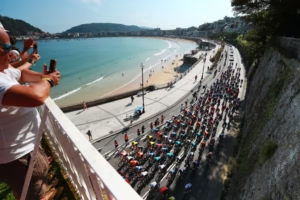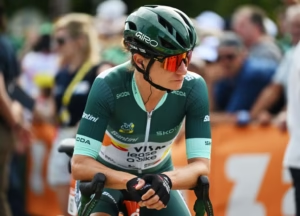
Amstel Gold Race Women has a shorter and more fragmented history than some of the other major spring races, but it has still grown into one of the defining events of the Ardennes block. Its story is unusual because it did not develop in one continuous line. Instead, it appeared early, disappeared for more than a decade, and then returned in a much stronger position as part of the modern Women’s WorldTour era.
The first edition was held in 2001. Two more editions followed in 2002 and 2003, giving the race an initial three-year run on the calendar. Those early years helped establish a women’s version of the Dutch classic, but the event then disappeared because staging the women’s and men’s races on the same day, on similar roads and within the same organisational model proved too difficult at the time.
 Photo Credit: Getty
Even so, that first chapter produced notable winners. Debby Mansveld won the opening edition in 2001, Leontien Zijlaard-Van Moorsel followed in 2002, and Nicole Cooke won in 2003. Cooke’s victory came in a year when the race held World Cup status, which gave the women’s Amstel Gold Race genuine significance even in that brief first spell on the calendar.
After 2003, the race vanished for 14 years. Limburg still remained important to women’s racing during that period, but Amstel Gold Race Women itself was absent until 2017. Its return carried real significance because it was not simply a revival of an old event. It came back at a point when top-level women’s racing was becoming more visible and more coherent, and it helped strengthen the women’s Ardennes week alongside La Flèche Wallonne Féminine and Liège-Bastogne-Liège Femmes.
The 2017 comeback was won by Anna van der Breggen, which felt fitting given both her Dutch nationality and her status as one of the finest hilly one-day riders of her generation. That victory also formed part of a much bigger achievement, as she went on to complete the women’s Ardennes triple that same spring. In many ways, that helped define the modern era of the race, not just as a standalone Dutch Classic but as the opening chapter of the Ardennes sequence.
 Photo Credit: ANP
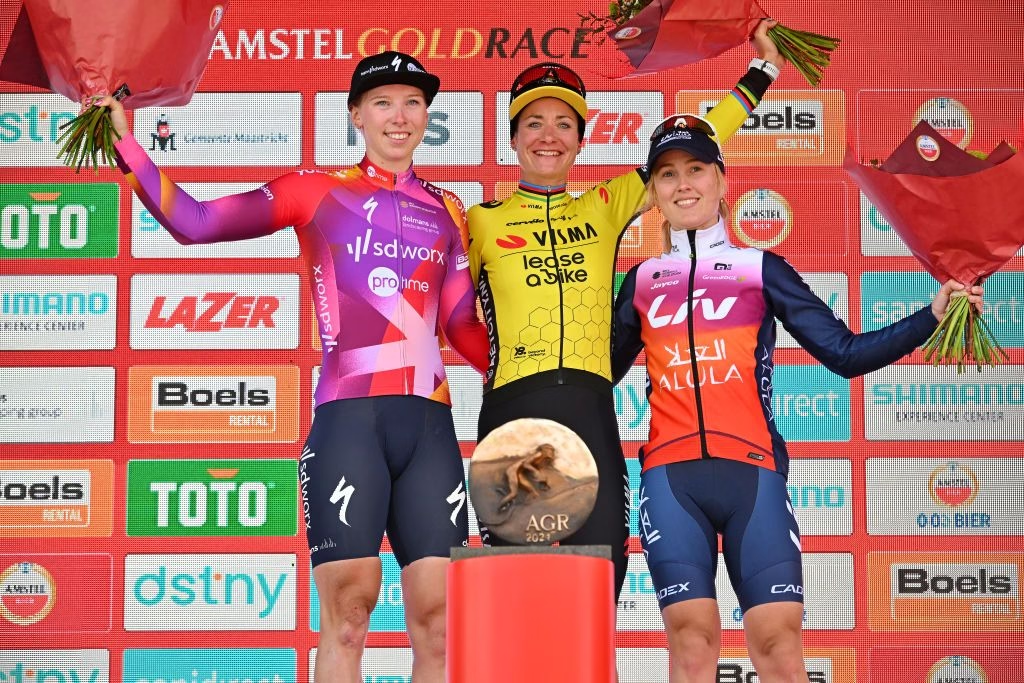
Since the relaunch, Amstel Gold Race Women has built a strong roll of honour in a relatively short space of time. Chantal van den Broek-Blaak won in 2018, Kasia Niewiadoma in 2019, and then the race lost its 2020 edition because of the COVID-19 pandemic. It returned in 2021 with a modified circuit-style route, won by Marianne Vos in one of the most aggressive editions of the modern race. Marta Cavalli then took victory in 2022, Demi Vollering won in 2023 on her way to an Ardennes triple of her own, Vos became the first two-time winner in 2024, and Mischa Bredewold added her name in 2025.
Dutch riders have had an especially strong grip on the event. That is not a surprise given the race’s location and the depth the Netherlands has produced in hilly one-day racing, but it has still helped shape the race’s identity. By the middle of the 2020s, Dutch winners heavily dominated the palmarès, with Vos standing alone as the first rider to win the race twice.

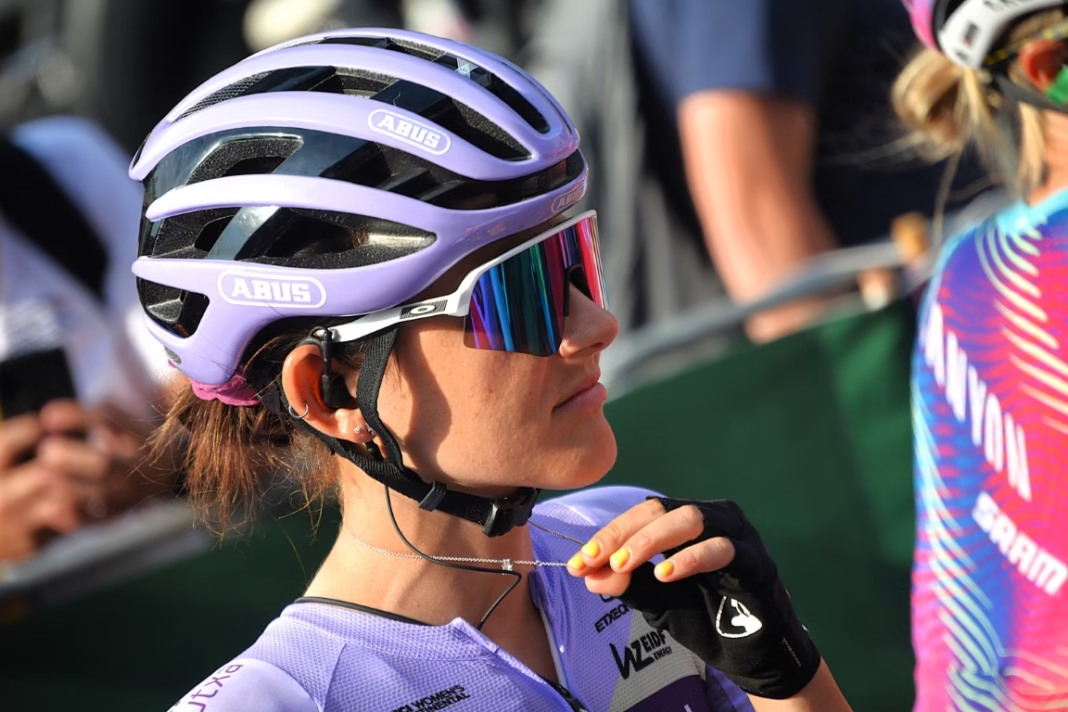
The route has also helped carve out a distinct character. Amstel Gold Race Women is not a high-mountain race, and it is not usually a straightforward sprint either. Instead, it is built around the rolling roads of Limburg, repeated short climbs, constant positioning pressure and the influence of roads around Valkenburg and Berg en Terblijt. Over time, that has made it a race for punchy climbers, explosive classics riders and tactically sharp finishers rather than pure specialists from a single category.
That is a major reason why the race now occupies such an important place on the calendar. It opens the women’s Ardennes block and often gives an early indication of who is truly ready for the week ahead. Some winners have used it as a springboard to a dominant campaign. Others have taken the race through timing, opportunism and tactical control rather than outright superiority. Either way, Amstel Gold Race Women now feels fully established as one of the key one-day races of the season, even if its history has been far less straightforward than the men’s event.
For readers looking to place it within the wider spring, this piece also sits naturally alongside the How to watch Ronde van Vlaanderen 2026 in the UK, the Paris-Roubaix Femmes 2026 route and cobbled sectors guide, and the Lorena Wiebes 2026 season guide, as the calendar moves from the cobbled classics towards the hillier terrain of the Ardennes.