
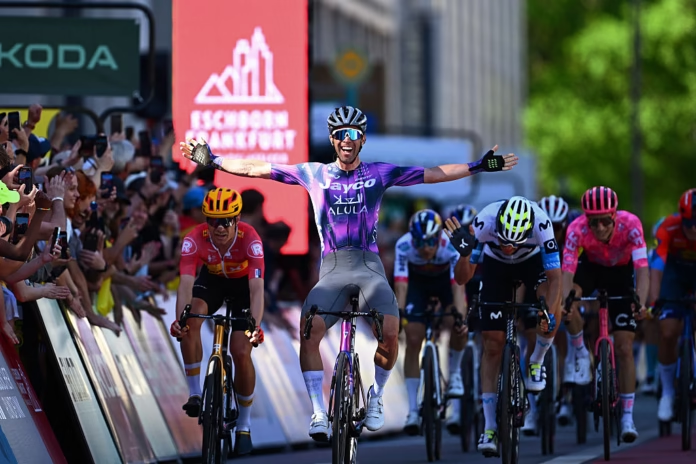
Eschborn-Frankfurt 2026 sits in one of the more unusual positions on the men’s calendar. It takes place on Friday 1st May, just after the Ardennes races and just before the Giro d’Italia begins, which gives it a slightly different feel from the bigger spring Monuments that dominate March and April. It is a WorldTour one-day race, one of Germany’s most important dates in the sport, and in 2026 it looks more interesting than usual because the route has been made significantly tougher.
That change is the key starting point for any beginner’s guide. Eschborn-Frankfurt has often been a race where strong sprinters could survive enough climbing to remain in contention. This year, the route is harder, longer and more selective, which should push the race a little further towards puncheurs, Classics specialists and riders who can cope with repeated climbing and still finish strongly. For the wider season context, ProCyclingUK’s guide to the Men’s WorldTour helps explain where Eschborn-Frankfurt fits into the overall structure of the year.
What is Eschborn-Frankfurt?
Eschborn-Frankfurt is a German men’s WorldTour one-day race held on 1st May. The name comes from its geography, starting in Eschborn and finishing in Frankfurt, with the Taunus hills shaping the middle of the race before the route heads back towards the city.
In practical terms, that means the race is never completely flat, but it has not usually been a pure climbers’ race either. That middle ground is part of what gives Eschborn-Frankfurt its identity. It has often been the sort of race where the question is simple enough on paper – are the hills hard enough to get rid of the fastest finishers? In 2026, that question feels sharper because the route clearly asks more of the field than in previous years.
Why is the 2026 edition more interesting than usual?
The simplest answer is the route itself. Eschborn-Frankfurt 2026 has been designed to be the hardest edition in the race’s history, with 210km of racing and more than 3,300 metres of climbing. That changes the tone of the event straight away.
There are new and more demanding features built into the course, including a double ascent of Mammolshainer Stich, two climbs of the Feldberg from the steeper south-west side, and the addition of the Burgweg climb. Those changes should create more opportunities for teams to race aggressively and make the race selective well before the finish.
That does not automatically turn Eschborn-Frankfurt into a pure climbers’ contest. It still sits in the late-spring one-day space where several rider types can imagine winning. But it does shift the balance. A straightforward sprint outcome now looks less likely than in some past editions, while a reduced front group or a more aggressive winning move feels more plausible.
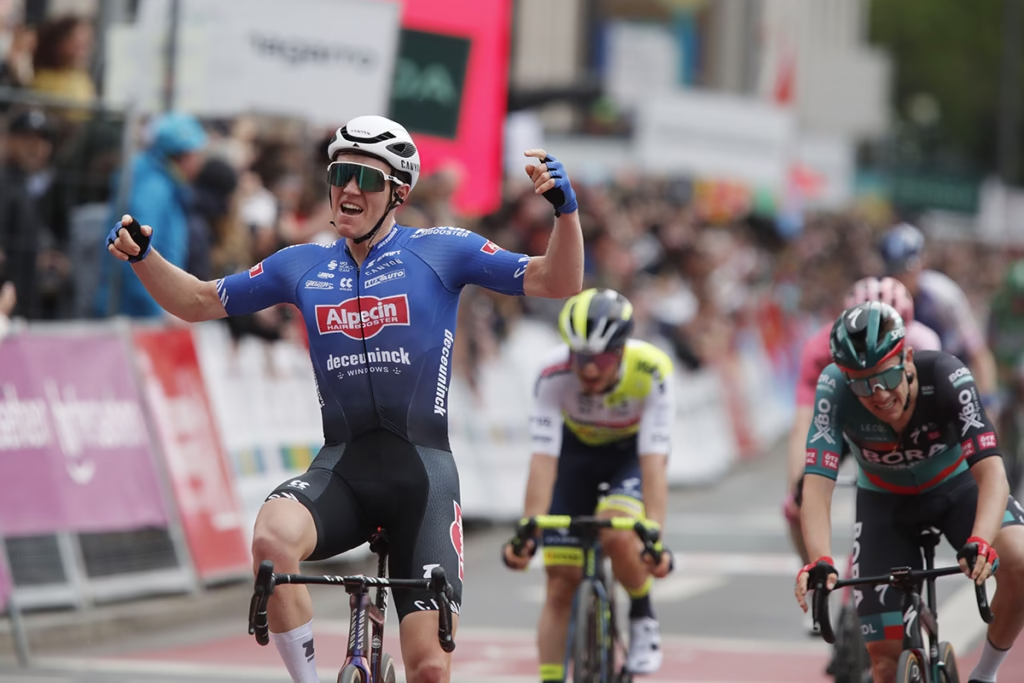 Photo Credit: Rothfoto
What kind of riders usually go well here?
Traditionally, Eschborn-Frankfurt has suited riders who can survive a hard, rolling day and still retain enough speed to finish it off. That has often meant durable sprinters, strong Classics riders and puncheurs rather than specialists at either extreme.
The recent winners underline that nicely. Michael Matthews, Maxim Van Gils and Søren Kragh Andersen are not identical riders, but they all fit the broad profile of riders who can cope with climbing and still deliver in a one-day finish. That variety is part of what makes the race appealing. It does not always reward one single type.
For 2026, the route suggests the balance may tip a little further away from the pure sprint end of the spectrum. Riders who can absorb repeated climbing efforts, handle a tactical one-day race, and still produce a strong final move should be the ones to watch most closely.
Where does the race sit in the calendar?
Eschborn-Frankfurt comes on 1st May, after Liège-Bastogne-Liège and before the Giro d’Italia. That timing gives it a slightly unusual identity. It arrives after the biggest spring Classics have largely been decided, but before the sport has fully moved into Grand Tour mode.
That means the race often attracts an interesting mix of riders. Some arrive with strong spring form and want one more major one-day result. Others use it as a final high-level goal before turning their attention towards stage racing. It is one reason the race can feel a little different from the Monuments. It has less mythology around it, but it still carries real weight in the WorldTour calendar.
For readers exploring that broader spring structure, ProCyclingUK’s history of the men’s Paris-Roubaix and Tour of Flanders coverage show the sort of races that define the spring before Eschborn-Frankfurt takes over as one of the last major one-day stops before the Giro.
Why does 1st May matter so much to the race?
The race’s date is central to its identity. Held on 1st May, it has long been tied to a wider sense of occasion around the event. That gives Eschborn-Frankfurt a feel that is slightly different from many other WorldTour one-day races. It is not just another stop on the calendar. It is a long-established sporting date in Germany with its own local rhythm and atmosphere.
For beginners, that helps explain why the race matters even if it does not always command the same international attention as Milan-Sanremo, Paris-Roubaix or the Tour of Flanders. It has a clear place in the season and a clear role in German cycling culture.
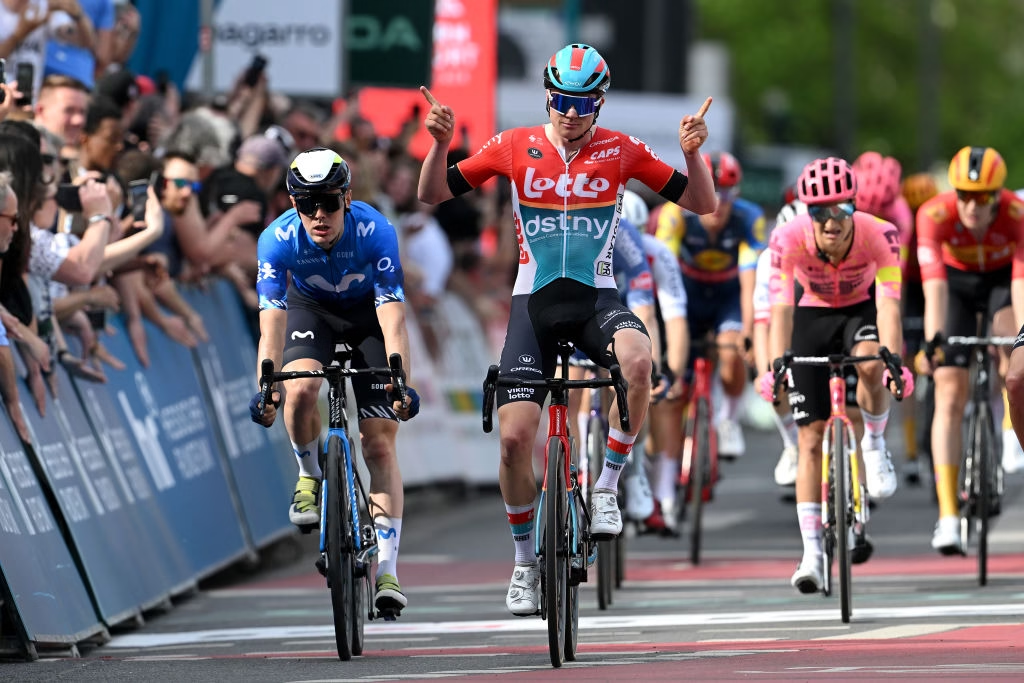 Photo Credit: Rothfoto
What should you expect from the racing?
The easiest way to think about Eschborn-Frankfurt 2026 is as a race with more uncertainty than usual. The tougher route should make it harder for the fastest finishers to simply survive and wait. That opens the door to a more selective race, especially if teams decide to use the climbs aggressively.
So the likely race scenarios narrow down to two broad outcomes. Either a reduced front group survives the hills and fights for victory, favouring strong finishers who can climb, or the added difficulty allows a more attacking move to stick. A full bunch sprint feels less likely than before, even if it cannot be ruled out completely.
That balance is what makes the race interesting. It still offers the unpredictability of a spring one-day event, but in 2026 there is a stronger sense that teams can influence the outcome by making the climbing count.
Why should new fans pay attention to Eschborn-Frankfurt?
Because it offers something slightly different from the races around it. It is not a Monument, not a pure sprint Classic, and not an Ardennes-style uphill finish either. Instead, it sits in the space between those categories, and that makes it a useful race for understanding just how varied top-level one-day racing can be.
It is also a good race for understanding the calendar itself. Not every important spring race happens in March or early April. Eschborn-Frankfurt shows how the season keeps evolving after the Ardennes, and how riders and teams still find meaningful targets before the Giro d’Italia takes over the conversation.
For newer readers who want more background on the way the men’s season is structured, the guide to the Men’s WorldTour is the best companion piece.
-
 Photo Credit: A.S.O./Billy Ceusters
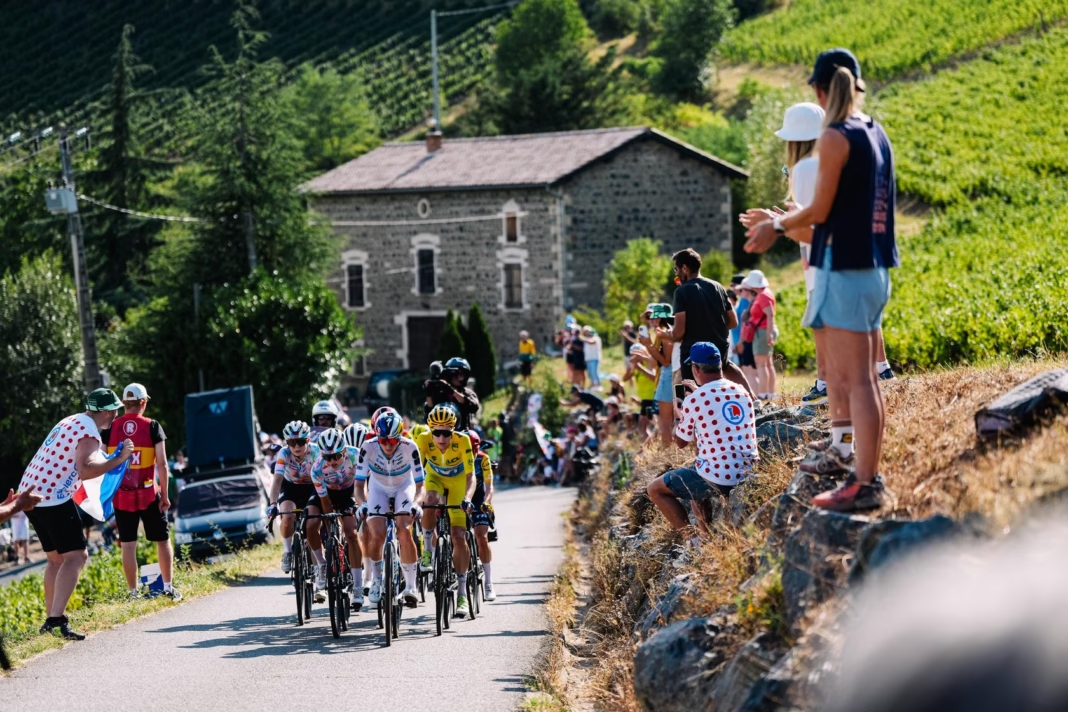

Recent winners of Eschborn-Frankfurt
Here are the five most recent winners heading into the 2026 edition:
- 2025 – Michael Matthews
- 2024 – Maxim Van Gils
- 2023 – Søren Kragh Andersen
- 2022 – Sam Bennett
- 2021 – Jasper Philipsen
That list says quite a lot about the race on its own. There is speed there, but not pure sprint speed alone. There is toughness, climbing ability and one-day instinct. Even before the route was made harder for 2026, Eschborn-Frankfurt already tended to reward riders who were more complete than a standard bunch sprint specialist.
Final thoughts
If you are coming to Eschborn-Frankfurt for the first time, the 2026 edition looks like a very good place to start. It keeps the race’s usual identity as a late-spring WorldTour one-day event on 1st May, but the organisers have deliberately toughened the course to create new dynamics.
That should make it easier to appreciate what the race does well. Eschborn-Frankfurt is not trying to imitate the Monuments. It has its own place in the season, its own rhythm, and in 2026, a route that looks likely to produce a harder and more open race than many of its recent predecessors.

