
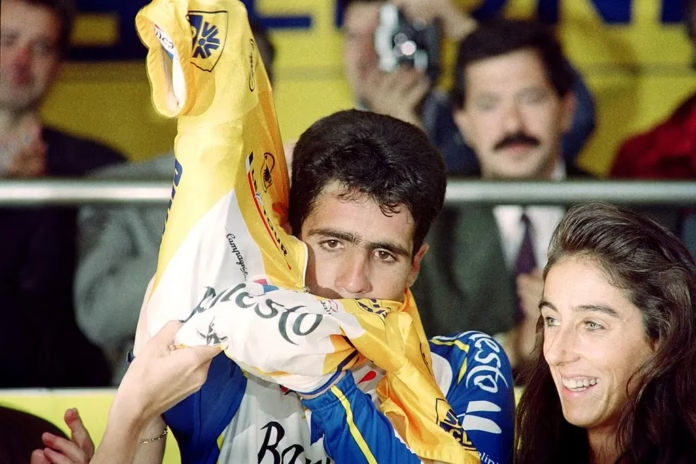
Miguel Indurain’s dominance did not look like Bernard Hinault’s. It was not built around intimidation in the same obvious way, and it did not often feel like a rider trying to crush the entire sport through visible aggression. Indurain’s greatness was quieter, but no less imposing. He won five consecutive Tours de France from 1991 to 1995, added two Giro d’Italia titles, became world time trial champion, and for several seasons made the hardest race in cycling look almost controlled to the point of inevitability.
That is why he remains such a fascinating champion. Indurain was not a rider of constant attacks, flamboyant gestures or theatrical racing. He was a rider of scale, patience and pressure. He had one of the biggest engines the sport has ever seen, and he used it with a calmness that could make rivals look as though they were racing a different event entirely.
For readers following ProCyclingUK’s rider-history series, this piece sits naturally alongside the feature on Bernard Hinault, the brief history of Giro d’Italia and Greg LeMond – talent, trauma and the American who changed the Tour story.
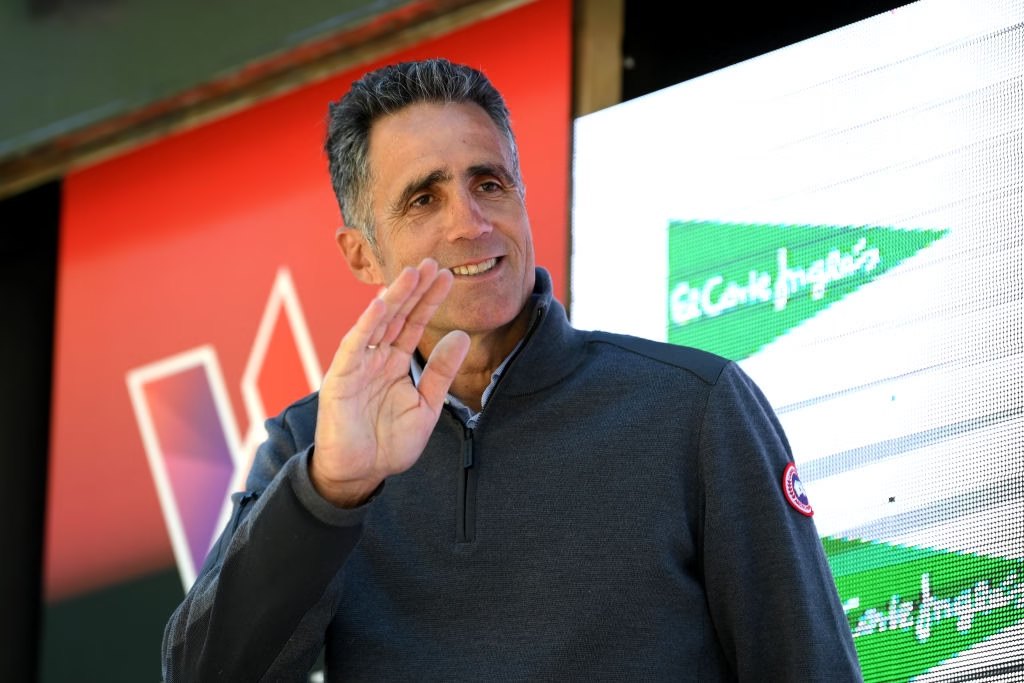
From Navarra to the centre of the Tour
Indurain was born in Villava, in Navarra, on 16th July 1964. That background gives his career an interesting geographical frame. He came from northern Spain, close to a cycling culture built around hard roads, persistent gradients and an intense relationship with the sport. Yet the rider he became did not fit the romantic image of the restless Spanish climber. He became something different: a huge, controlled, aerodynamic stage-race machine.
He turned professional with Reynolds in 1984, the team that became Banesto, and his early career did not immediately suggest five straight Tour de France victories. He was talented, clearly, but his rise was gradual. He first wore the yellow jersey in the 1986 Tour, but he did not yet look like the rider who would dominate the race for half a decade. Instead, he developed slowly, physically and tactically, into a rider built around the specific demands of Grand Tour control.
By the end of the 1980s, the pieces were beginning to come together. Indurain was growing into one of the best time triallists in the world and a rider who could climb well enough to defend huge advantages. He was not explosive in the classic sense, but he had a quality that became even more valuable in Grand Tours: he did not fade easily.
The first Tour win and the start of a sequence
Indurain’s first Tour de France victory came in 1991. Until then, the race had still been shaped by riders such as Greg LeMond, Pedro Delgado and Laurent Fignon, but the balance was changing. Indurain arrived with a different model of dominance. He did not need to attack every day. He needed to build a gap where he was strongest, then remove opportunities for others to take it back.
That became the template. In the time trials, he could take enormous chunks of time. In the mountains, he did not need to destroy everyone. He needed to follow, limit losses and make sure the race never became unstable enough to undo what he had built against the clock. It sounds simple, but it required immense physical reserves, an exceptionally strong team and a temperament almost perfectly suited to pressure.
The 1991 victory opened the door, but the years that followed made him historic. He won the Tour again in 1992, 1993, 1994 and 1995, becoming the first rider to win five Tours consecutively. Others had won five overall, but nobody before him had strung them together in that way. His dominance was less explosive than Hinault’s, less emotionally charged than Coppi’s, and less universal than Merckx’s, but it had its own chilling authority.
The time trial as a weapon
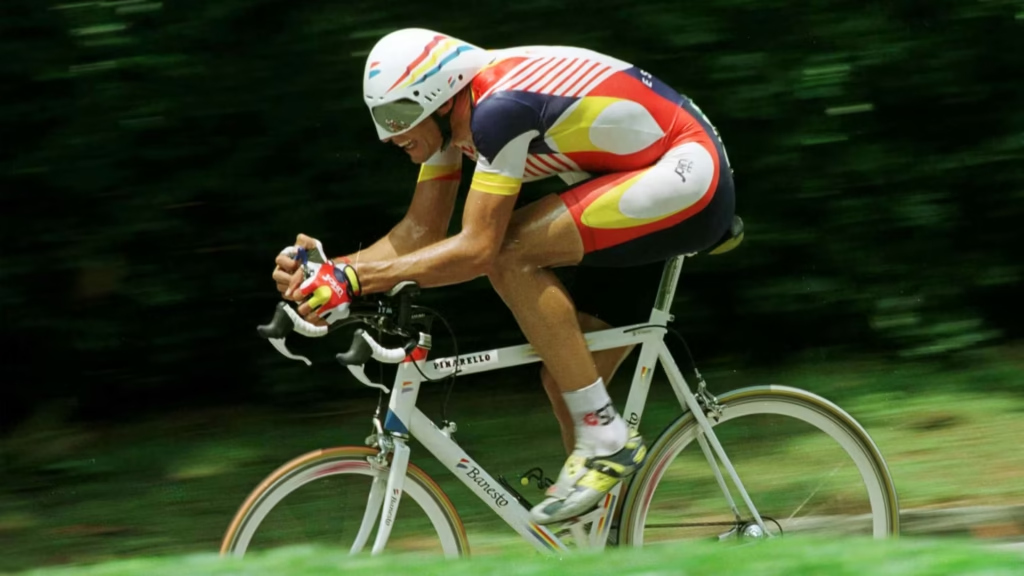
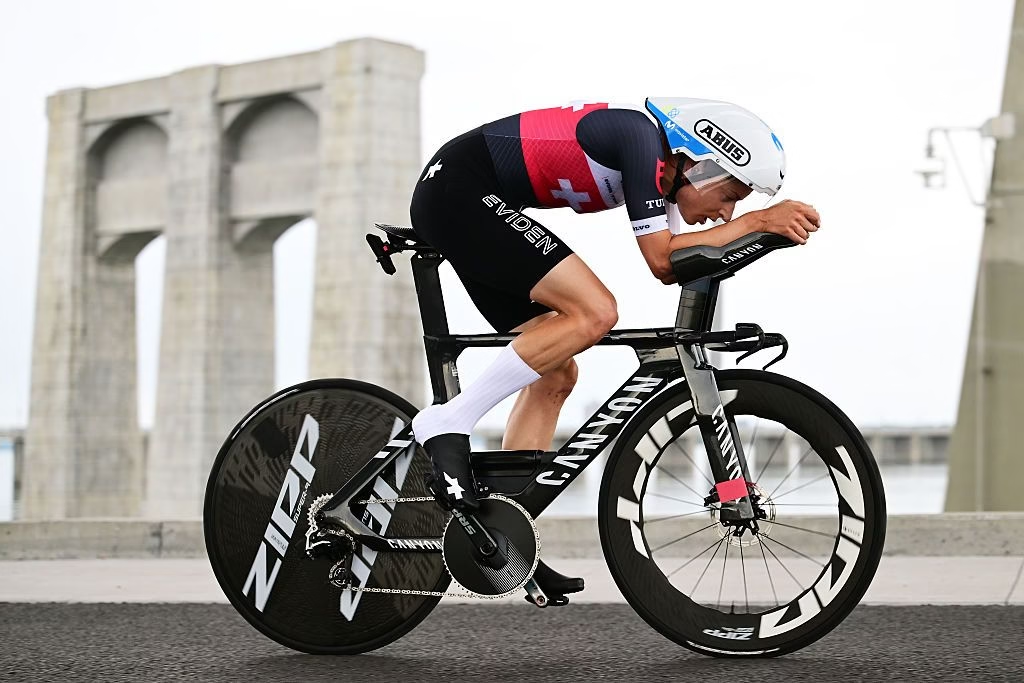
To understand Indurain, you have to understand what he did to time trials. They were not just stages he could win. They were the foundation of his entire rule.
In the long Tour time trials of the early 1990s, Indurain could create gaps that changed the psychology of the race. Rivals did not simply lose time. They lost strategic freedom. Once he had built a significant advantage, they had to attack him in the mountains, but attacking Indurain was not straightforward. He could ride at a relentless tempo, absorb pressure and let others spend themselves trying to produce the kind of acceleration that might finally distance him.
The most famous example came in 1994 at Bergerac, where Indurain produced one of the most crushing Tour time trial performances of the decade. It was the sort of ride that made the race feel mathematically tilted in his favour. Even when the mountains remained, the emotional balance had shifted. Everyone knew they were now chasing a rider who was not likely to panic.
His 1995 time trial to Seraing carried a similar feeling. Indurain’s style was not dramatic in the television sense, but the result was devastating. He could look almost still on the bike while doing damage that others could not repair.
Economy of effort as a racing philosophy
Indurain’s racing was sometimes criticised for being conservative, but that undersells what he was doing. His dominance came from economy of effort. He understood what he needed to win and rarely wasted energy proving anything more.
That is a very particular kind of power. Some champions need to show themselves constantly. Indurain often did the opposite. He stayed calm, measured the race and let his strength appear at the moments where it carried the greatest return. The result could look unemotional, even cold, but it was ruthlessly effective.
In the mountains, he was often defensive rather than spectacular. Yet defensive is not the same as weak. When rivals attacked, Indurain could ride them back with a steady pressure that drained the romance out of their moves. He did not always need to jump across immediately. He could let the effort settle, hold his line, and bring the race back under control.
This is where his dominance differed most from the great attackers. Indurain did not always impose himself by multiplying attacks. He imposed himself by reducing the number of meaningful choices available to everyone else.

Banesto and the machinery of control
Indurain’s reign was also a team story. Banesto provided the structure around him, and that structure suited his strengths perfectly. The team did not need chaos. It needed control, positioning, mountain support and a clear hierarchy. Indurain gave them that hierarchy completely.
His calm style made the team’s race easier to understand. Protect him early, guide him through danger, support him in the mountains, and let him take decisive time in the time trials. That may sound formulaic now, but in the early 1990s it helped shape a model of Grand Tour racing that became increasingly familiar later: one dominant leader, one strong team, one controlled race rhythm.
There was also a psychological effect. Indurain’s lack of visible panic seemed to spread through the team. Even when rivals tried to unsettle the race, Banesto often looked as though it believed the road would eventually return to order. More often than not, it did.
The Giro d’Italia and proof beyond the Tour
Indurain’s Tour record is the centre of his legacy, but his two Giro d’Italia victories are essential to understanding his full level. He won the Giro in 1992 and 1993, completing the Giro-Tour double in both seasons.
That is a remarkable achievement. The Giro is not just a smaller Tour with different scenery. It often asks different questions: sharper weather risk, more irregular routes, steeper climbs, and a less predictable rhythm. Winning both the Giro and Tour in consecutive seasons required not only talent but an exceptional ability to recover and repeat peak form.
Those Giro wins also pushed back against the idea that Indurain was only a product of Tour-specific design. He could dominate the biggest race in France, but he could also carry that control into Italy. He did not have the same visceral Giro mythology as some Italian champions, but his performances there were hugely significant. They showed that his method could travel.
That part of his career fits naturally with the broader history of the race itself, covered in ProCyclingUK’s brief history of Giro d’Italia.
The hour record and the limits of the engine
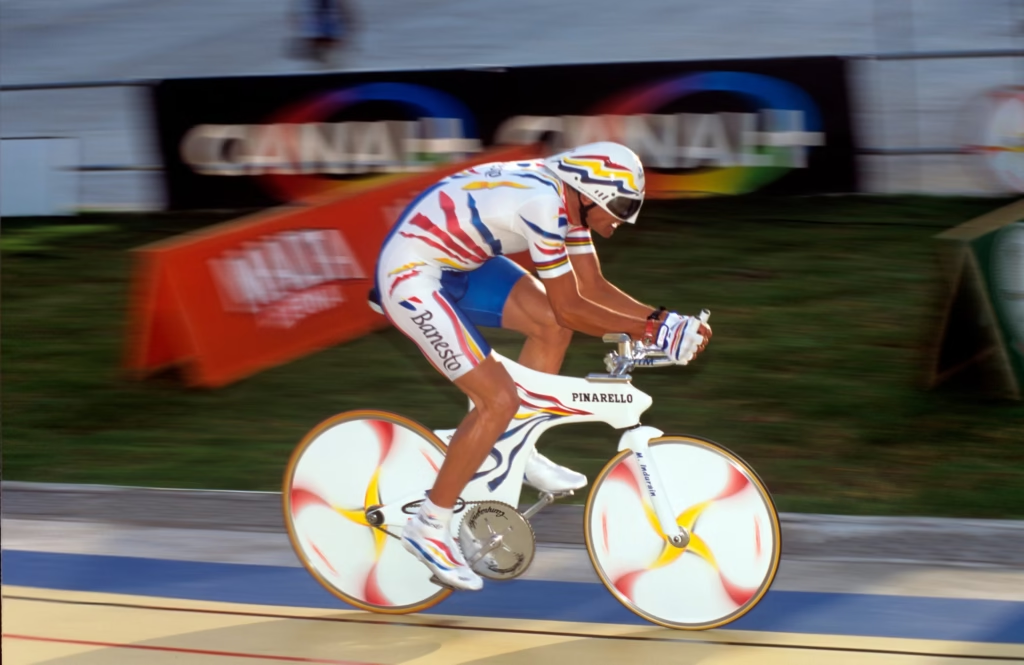
Indurain’s physical capacity was always part of his legend, and the hour record fitted that image perfectly. In 1994, he broke the world hour record in Bordeaux, covering 53.040km. It was a pure expression of the qualities people associated with him: aerodynamic efficiency, enormous sustained power and the ability to sit inside a brutal effort without visible disorder.
The hour record suited his myth because it removed tactics, teammates and terrain. It was simply rider, bike, track and time. For a champion whose dominance was so often explained through the size and smoothness of his engine, that kind of test felt appropriate.
Yet even there, the story was not simple. The hour record battles of the 1990s were shaped by technology, position and changing rules, and Indurain’s ride belonged to that period of experimentation. Still, as a statement of sustained physical power, it remains one of the more fitting episodes in his career.
The world title he won and the one he nearly did
Indurain became world time trial champion in 1995, which felt almost inevitable given his reputation. If there was one rainbow jersey that belonged naturally in his palmarès, it was that one. The discipline matched him perfectly.
The same year, he also finished second in the road race behind Abraham Olano, his Spanish teammate. That result is sometimes overshadowed by his Grand Tour record, but it adds texture to his career. Indurain was not merely a Tour specialist who vanished outside July. He could still contest world championship events at the highest level, even if the road race did not become the defining part of his legacy.
His Olympic time trial gold in 1996 added another major line, and in some ways served as the last great affirmation of what made him special. Even as his Tour dominance was fading, he remained capable of producing world-class performances against the clock.
The end of the reign
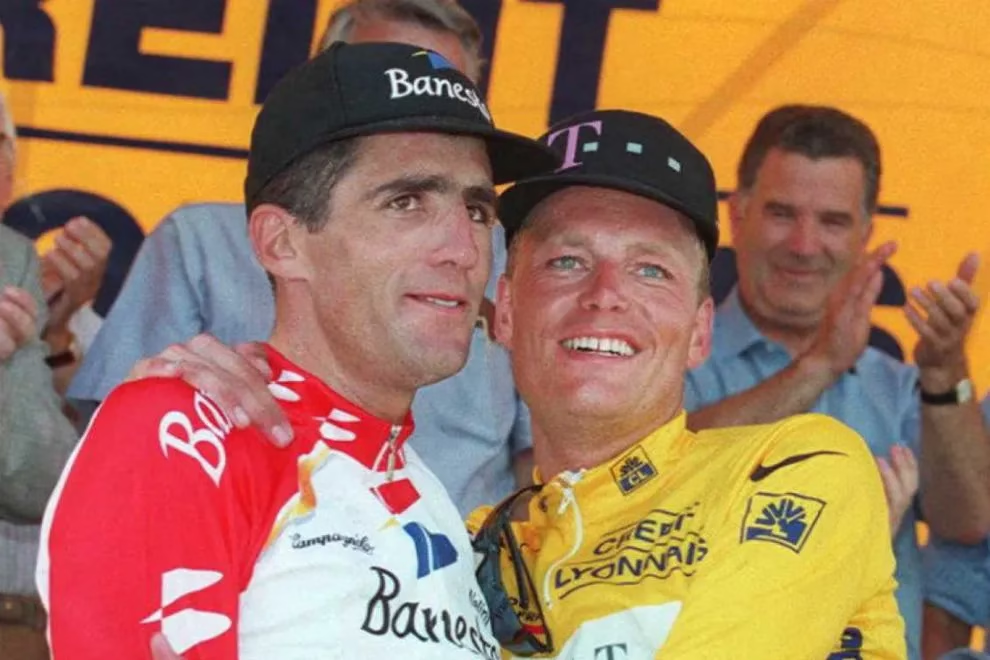
Indurain’s run ended at the 1996 Tour de France. After five consecutive victories, he finally cracked. Bjarne Riis won the race, Jan Ullrich emerged as the next great force, and Indurain finished outside the podium. The shift felt abrupt because his rule had seemed so stable for so long.
That is often how controlled dominance ends. It does not always unravel gradually in public. One year the rhythm still holds, and the next it does not. Indurain’s method depended on being able to limit damage in the mountains and then impose himself elsewhere. Once that balance tipped, the whole structure became vulnerable.
He retired at the start of 1997, leaving the sport without the long decline that often complicates great careers. That helped preserve the shape of his legacy. He remains fixed in memory as a rider of peak control rather than slow erosion.
The shadow over the era
No serious account of Indurain’s career can ignore the broader context of 1990s cycling. His dominance came during an era that was later heavily stained by doping revelations across the sport. Indurain himself was not stripped of his major titles, but the period around him became one of the most scrutinised in cycling history.
That context affects how the era is read. The early and mid-1990s cannot be separated from the wider credibility problems that later engulfed the sport. At the same time, Indurain’s official record remains intact, and his place in cycling history is still shaped by what he did on the road: five straight Tours, two Giros, time trial supremacy and a level of physical control that defined a generation.
The honest position is to hold both truths. Indurain was one of the defining champions of modern cycling. He also dominated in an era whose wider conditions are impossible to discuss innocently.
-
 Photo Credit: A.S.O./Billy Ceusters

Why Indurain still feels different
Indurain’s dominance can be harder to explain emotionally than some other champions. He did not give the sport the same dramatic vocabulary as Hinault, Merckx or Pantani. He did not attack with constant theatrical intent. He did not turn every mountain stage into a duel of gestures.
Instead, he made greatness look almost economical. He rode as though effort itself had to be budgeted, saved and released only when the return was worth it. That can make him seem less romantic, but it also makes him one of the most intellectually interesting champions the sport has had.
He changed what Grand Tour control looked like. His era pointed towards a more managed, time-trial-heavy, team-driven model of winning. Later Tour champions would use different tools and different teams, but the idea of dominating through structure, pacing and selective violence owed something to the Indurain years.
A very particular kind of dominance
Miguel Indurain was not the last great Grand Tour rider, and he was not the last rider to build a team around control. But he was the last rider to make five consecutive Tours feel so calmly inevitable. That is his particular place in the sport.
His dominance was not noisy. It was not built around constant attack or visible anger. It was built around a huge engine, a measured temperament and a style of racing that made rivals run out of options. He could win the Giro, control the Tour, crush a time trial and then sit in the mountains with the expression of a man who knew the arithmetic was still on his side.
That is why Indurain remains so distinctive. He did not own the sport in the emotional way Hinault had tried to do, or in the total calendar sense of Merckx. He owned a very specific form of modern Grand Tour dominance: controlled, efficient, immense, and for five Julys in a row, almost impossible to break.

