
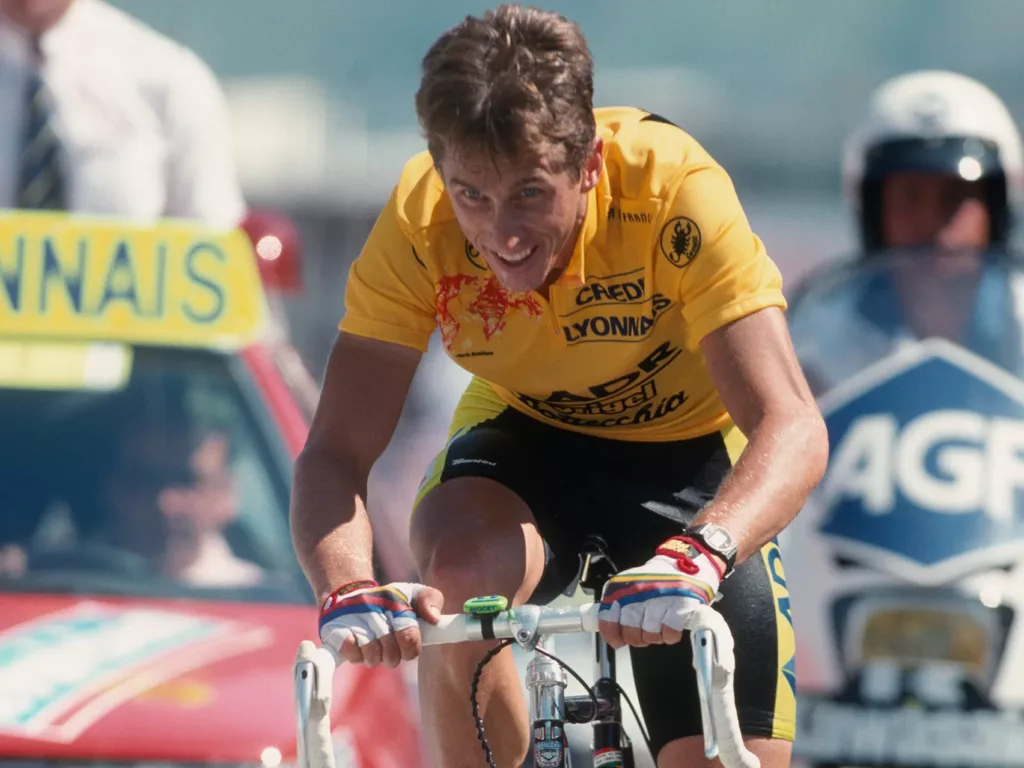
Greg LeMond’s place in cycling history is secure on results alone. He won the Tour de France three times, took two elite men’s world road titles, and became the first non-European rider to win the Tour in 1986. But that only explains part of why he still matters. LeMond changed the story of what the Tour could be, who could win it, and how a champion could speak once the winning was done.
He arrived as a rare talent, almost unnervingly complete. By 1983 he had already become the first American man to win the world road race title, and within a few years he was no longer being treated as an interesting outsider from the United States. He was one of the best stage-race riders in the world. That mattered in a sport still heavily shaped by European assumptions about where greatness came from. LeMond did not just break through. He altered the geography of belief.
For readers moving through the wider history of the sport, this piece sits naturally alongside ProCyclingUK’s Men’s cycling history, races, riders and teams hub, A brief history of Paris-Roubaix, A brief history of the Men’s Tour of Flanders and A brief history of the Men’s Flèche Wallonne.
-
 Photo Credit: Canyon SRAM (supplied media release)
 -
 Photo Credit: Park Tool


A talent that arrived early and made Europe pay attention
LeMond was not built slowly into a champion. He was identified as exceptional very young, raced successfully in Europe as an amateur, won the 1982 Tour de l’Avenir, then took the 1983 world title. That world championship was especially important because it made him the first American man to win the elite road race title, a result that gave his career an authority beyond promise.
What made him so compelling was his range. He was not simply a good climber, or only a time triallist, or a rider who needed one very specific kind of race to win. He had the breadth that true Tour contenders need. By the time he reached the mid-1980s, it was already clear that he could do far more than collect good results. He could shape the biggest race in the sport.
The Tour breakthrough was bigger than one yellow jersey
LeMond’s 1986 Tour de France win still carries a particular weight because of what it represented. He became the first non-European rider to win the race, which changed the Tour’s cultural frame as much as its results sheet. The Tour had always been international in one sense, but not in the sense that mattered most. LeMond showed that the race’s highest prize did not belong by default to France, Belgium, Spain or Italy.
That victory also came through one of the most complicated team stories in Tour history. Bernard Hinault, his teammate and one of the most imposing figures the race had ever seen, remained central to the 1986 narrative deep into the event. The tension between LeMond’s rising authority and Hinault’s refusal to fade quietly gave that Tour a sharp, unsettled edge. LeMond did not inherit the race. He had to take it in an environment that seemed only partly willing to let him.
That is one reason the win still feels larger than a simple first Tour. It was not just a young champion arriving. It was a shift in the race’s power map.
For readers interested in the broader sweep of stage-race history, this sits neatly with the wider grand tour and Classics material across the Men’s cycling history, races, riders and teams hub.

The trauma that nearly ended everything
Less than a year after winning that first Tour, LeMond was accidentally shot while hunting in 1987. The injuries were severe. He underwent surgery, lost huge amounts of blood, and missed the next two Tours as his career fell into uncertainty.
This is the point where LeMond’s story becomes something harsher and more human than a standard champion’s rise. Plenty of great riders lose form. Very few lose years of their prime to trauma of that scale and still come back to the summit. The hunting accident did not merely interrupt momentum. It split his career into two distinct lives, the first built on prodigious talent, the second on pain, recovery and stubbornness.
That is why LeMond’s later victories carry such emotional force. They were not extensions of easy dominance. They were recoveries from catastrophe.
1989 changed the Tour story all over again
If 1986 made him historically important, 1989 made him unforgettable. LeMond returned to win the Tour de France by eight seconds over Laurent Fignon, still the closest margin in the history of the race. He overturned a 50-second deficit in the final time trial into Paris, using an aerodynamic set-up that looked radical at the time and now feels prophetic.
That final-day win has become part of Tour mythology because it felt impossible until it happened. But it also mattered for another reason. It showed that LeMond was not merely the gifted rider who had broken through in 1986. He was now the rider who had come back from near-disaster and rewritten the logic of the race through intelligence as much as instinct. He did not just survive the modernising sport. He helped push it forward.
Later that same year he won the world road race title again, making 1989 one of the great comeback seasons in the sport.
 Photo Credit: AP Photo/Laurent Rebours
The third Tour confirmed the scale of the rider
LeMond’s 1990 Tour win can sometimes sit slightly in the shadow of 1986 and 1989, but it matters because it confirmed that his comeback was not a single miracle. It was sustained greatness. With that victory, he joined the select group of riders to win the Tour at least three times.
That third win also completed the broad shape of his Tour legacy. The first had broken a barrier. The second had become legend. The third established permanence. No serious history of the Tour can treat him as an interruption or a curiosity. He is part of the race’s core story.
He changed more than nationality in the Tour
LeMond’s influence on the Tour was not only about being American. It was also about what kind of rider won. He was among the most visible early adopters of aerodynamic refinements that would become standard, and his 1989 final time trial is still remembered partly because it announced a more modern understanding of speed and equipment.
He also changed the emotional tone of what a Tour champion could be. LeMond never fit the image of the silent, sealed-off winner. Even during his racing career, and certainly after it, he spoke more openly than many champions about the politics of teams, betrayal, recovery and the sport’s deeper problems. Later, he became one of cycling’s most persistent anti-doping voices, refusing to protect comforting myths simply because they were popular.
That willingness to speak is part of why his legacy has remained so alive. LeMond was not only a champion from an earlier time. He became a conscience of the sport too.
Why LeMond still matters
Greg LeMond matters because his story contains more than one kind of greatness. There is the obvious greatness of the results: three Tours, two world titles, and a place among the defining riders of his generation. Then there is the harder greatness, the sort that survives trauma, public tension and the weight of being first.
He changed the Tour story because he made it less provincial, less predictable and, in some ways, more modern. He proved an American could win it. He proved a rider could come back from terrible physical damage and still take the race’s highest prize. He helped show that intelligence, aerodynamics and nerve could shift the outcome of the sport’s grandest event as much as mountain dominance alone.
That is why LeMond remains such a powerful figure in cycling history. He was a champion of talent, then a champion of resilience, and then something even more complicated. A rider who did not simply win the Tour, but changed what the Tour believed about itself.
For related reading, this also pairs well with A brief history of Paris-Roubaix, A brief history of the Men’s Tour of Flanders, A brief history of the Men’s Flèche Wallonne and the broader Men’s cycling history, races, riders and teams hub.

