
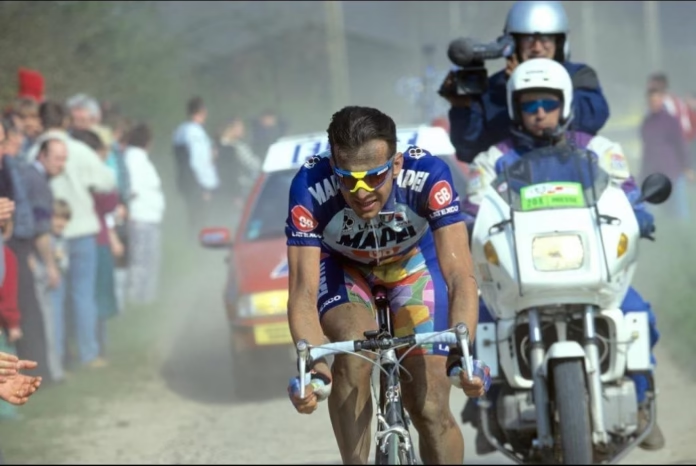
Franco Ballerini will always belong to Paris-Roubaix. Some riders win the race and become part of its record. Others seem to absorb something of its identity. Ballerini was in the second group. He was not the most prolific rider of his generation, nor the most obvious all-round great, but on the cobbles of northern France he became one of those figures whose career makes immediate sense.
Two wins at Paris-Roubaix, in 1995 and 1998, are enough on their own to give him a permanent place in Classics history. Yet Ballerini’s story is richer than that. He was also the rider beaten by Gilbert Duclos-Lassalle in the 1993 velodrome sprint, the Mapei leader who helped define one of the most dominant cobbled teams of the 1990s, and later the Italian national coach who turned tactical authority into world and Olympic success.
His legacy sits across two worlds: the solitary suffering of the pavé and the collective intelligence of national-team racing. That combination is what makes him more than just a two-time Roubaix winner. For wider context on the race that defined him, our brief history of the men’s Paris-Roubaix traces the event from its early editions to the modern era, while our men’s cycling history hub brings together more rider, race and team features from across the sport.
Franco Ballerini: A rider built for Paris-Roubaix
Ballerini’s relationship with Paris-Roubaix was never casual. He was not a rider who simply added the race to a broad palmarès. Roubaix became the place where his gifts were most clearly expressed.
He had the right physical profile for the event: powerful, resilient, able to maintain force over terrible surfaces and long distances. Just as importantly, he seemed to understand the psychological demand of the race. Paris-Roubaix does not reward riders who only tolerate discomfort. It rewards those who can keep making decisions when the race has become noisy, brutal and uncertain.
That was where Franco Ballerini looked at home. He could ride the cobbles with rhythm rather than panic. He had the strength to force selections, but also the patience to wait for the race to reveal where the real damage would come. In an event where punctures, crashes and mechanicals can turn certainty into loss within seconds, that calmness mattered.
The defining image of Ballerini is not simply a rider lifting his arms in Roubaix. It is a rider who kept returning to the same punishment because he knew it suited him better than almost anywhere else. Our guide to the toughest cobbled sectors of Paris-Roubaix explains why that skillset remains so rare, especially on sectors such as Arenberg, Mons-en-Pévèle and Carrefour de l’Arbre.
The near miss in 1993
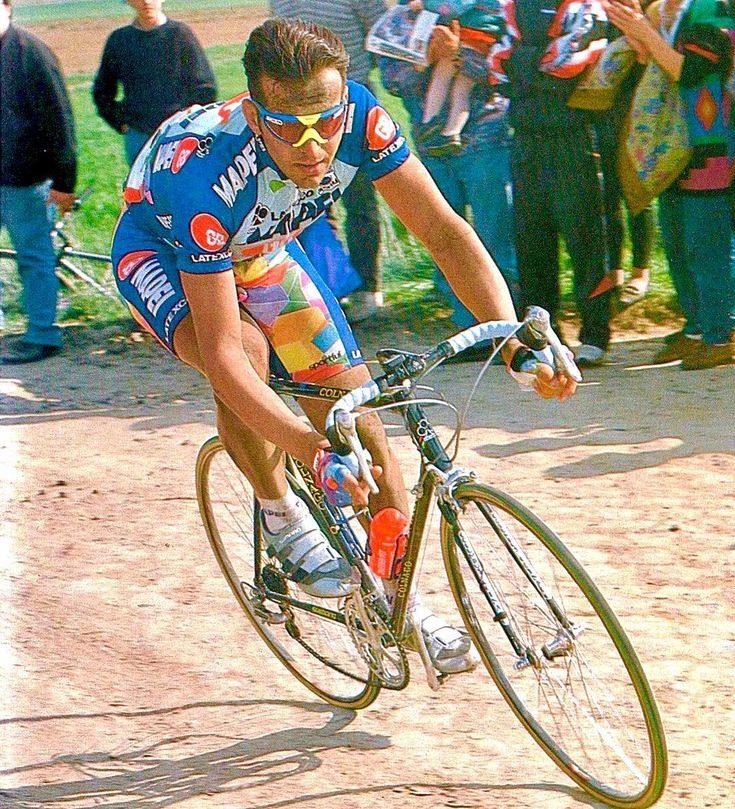
Before Ballerini won Paris-Roubaix, he had to lose it in a way that would have marked almost any rider.
The 1993 edition came down to the Roubaix Velodrome, where Ballerini faced Gilbert Duclos-Lassalle, the French veteran and defending champion. It was one of those finales that felt both simple and cruel: two riders, one sprint, a lifetime of work compressed into the final metres.
Duclos-Lassalle beat him on the line. For Ballerini, it was a defeat that seemed painfully close to victory. In Paris-Roubaix, second place can be harder to carry than in almost any other race, because the day costs so much before the rider even reaches the velodrome. To survive the cobbles, make the decisive move, reach Roubaix and still lose is a particularly severe form of sporting punishment.
The velodrome has always magnified those emotions. It is not just a finish line, but a theatre where exhaustion, relief and regret become visible in a way few races can match. Our piece on the Roubaix Velodrome looks at why that final lap carries such weight in the mythology of the race.
Yet that defeat also shaped the rest of Ballerini’s Roubaix story. It proved he could win the race. It showed that he had not merely been present in the final, but had been strong enough to contest it with one of the finest Roubaix riders of the period. The line went against him, but the race had already told him where he belonged.
That 1993 defeat makes the later victories feel more complete. They were not sudden triumphs. They were part of a longer conversation between Ballerini and the race.
Paris-Roubaix 1995: the breakthrough for Franco Ballerini
Ballerini’s first Paris-Roubaix victory came in 1995, and it changed how his career was understood. Before then, he was a strong one-day rider with clear qualities on hard terrain. After Roubaix, he became a reference point.
The win carried emotional force because of what had happened two years earlier. Paris-Roubaix is full of riders who came close and never returned to the same position. Ballerini did return. He did not let the 1993 defeat become the final word.
His 1995 victory confirmed him as one of the specialist riders of the decade. He was no longer the man who had almost won Roubaix. He was the man who had mastered it. That distinction matters, because Roubaix does not hand out consolation legends. The race is unforgiving in how it remembers riders. Winners remain. Nearly men need something more if they are to be recalled with the same clarity.
Ballerini found that something more by winning.
The 1995 season also underlined his broader Classics strength, with victory at Omloop Het Volk adding another northern one-day race to his record. He was not simply a one-day anomaly on the cobbles of France. He had become a rider with authority across the rougher, colder, more attritional part of the calendar.
Mapei and the age of cobbled control
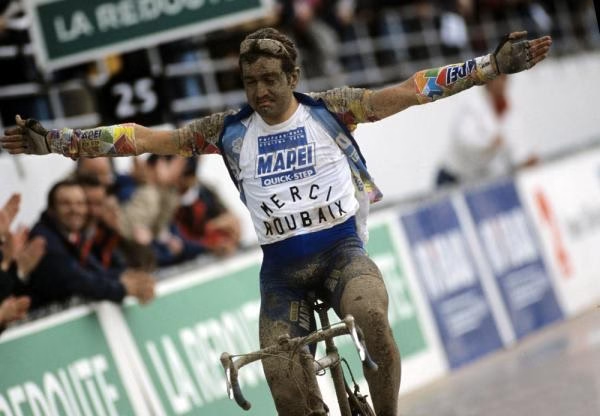
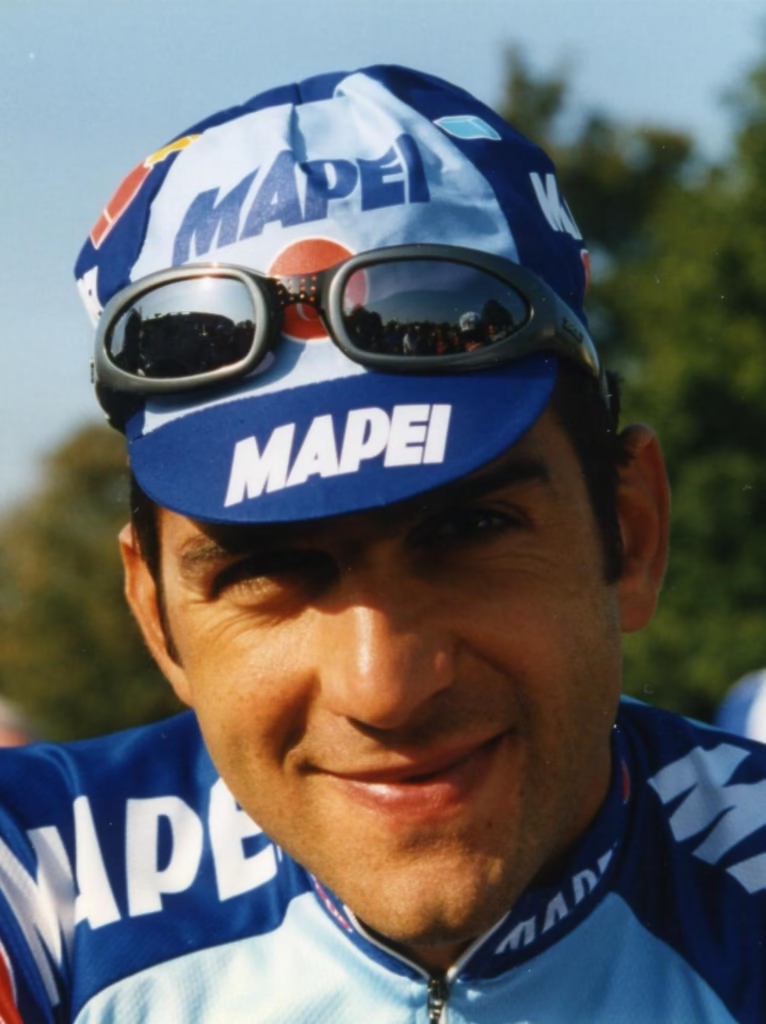
To understand Franco Ballerini properly, he has to be placed within Mapei’s wider dominance. Few teams have ever been so strongly associated with Paris-Roubaix. Their jersey became part of the visual language of the race in the 1990s, and their collective strength turned the cobbles into a private contest on more than one occasion.
Ballerini was central to that story. Mapei had depth, power and tactical confidence, but they also had riders who could finish the job. Ballerini was one of them.
The team’s 1996 Paris-Roubaix 1-2-3 with Johan Museeuw, Gianluca Bortolami and Andrea Tafi is often the most famous image of that era, but Ballerini’s own Mapei chapter is just as important. Our flashback to the Mapei 1996 Roubaix podium revisits one of the most striking team performances in modern Classics history, while our Mapei team history looks in more detail at how the squad turned the Spring Classics into a tactical and physical showcase.
Ballerini’s role in that era was not decorative. He was one of the riders who gave the dominance substance. Mapei’s power was not only in having numbers. It was in having riders who could convert those numbers into the kind of result that still shapes how the 1990s are remembered.
Paris-Roubaix 1998: winning again, and winning differently
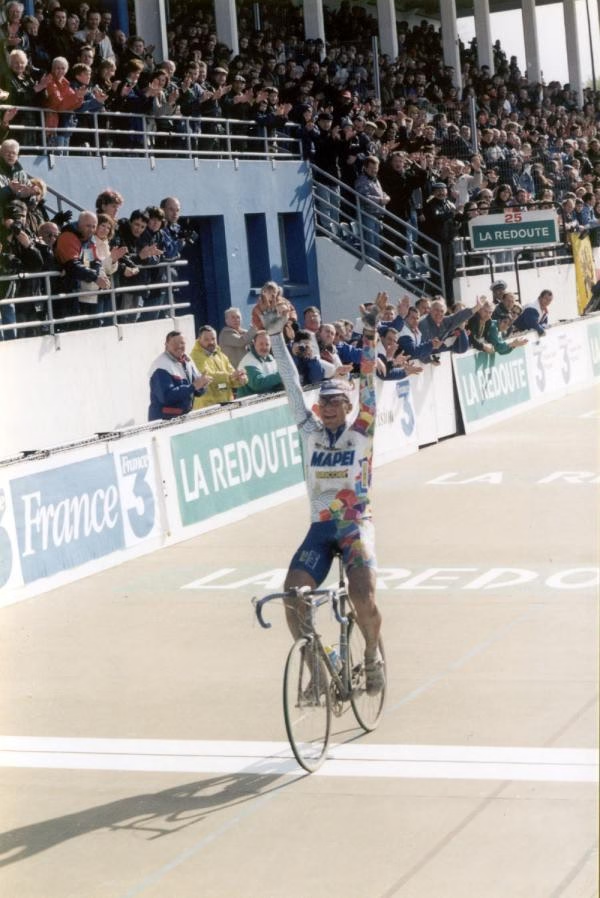
If 1995 confirmed Franco Ballerini as a Paris-Roubaix winner, 1998 confirmed that he was one of the race’s defining riders of the decade.
His second victory came in another Mapei-dominated edition, with Ballerini leading home Andrea Tafi and Wilfried Peeters. It was not simply another win for the team. It was a demonstration of how Mapei could control the most chaotic race in cycling through strength, numbers and the ability to place the right rider in the right position at the decisive moment.
For Ballerini, the second Roubaix changed the scale of his legacy. One victory can be explained by form, fortune and timing. Two victories at Paris-Roubaix suggest something deeper. They show compatibility with the event’s demands. They make a rider part of the race’s internal history.
He was not a serial Monument collector in the style of Eddy Merckx, Roger De Vlaeminck or later Tom Boonen and Fabian Cancellara. He did not need to be. His greatness was more concentrated. Ballerini’s career was not about breadth of domination, but about the clarity of his relationship with one race.
That is why he remains so strongly associated with Roubaix. He did not win everything. He won the race that suited him most, twice, after first being made to suffer by it.
The broader palmarès of Franco Ballerini
Paris-Roubaix dominates Ballerini’s memory, but it should not completely obscure the rest of his career. He won a stage of the Giro d’Italia in 1991, took Omloop Het Volk in 1995, and had earlier victories at races such as Paris-Brussels and Tre Valli Varesine.
That record matters because it shows he was not a rider reduced entirely to one Sunday in April. He had range within a certain type of racing. He could handle long one-day events, difficult northern conditions and races that rewarded strength over smoothness.
Still, his palmarès also explains why his reputation is so tightly focused. Ballerini was not a rider with dozens of major wins across the calendar. His career is remembered through its sharpest points: Roubaix in 1993, 1995 and 1998, the Mapei years, and then the second act that followed.
In some ways, that makes his story cleaner. He is not difficult to place. He belongs to the cobbles, to Mapei, and then to the Italian national team car.
From rider to Italian national coach
Ballerini’s post-racing career is where his legacy becomes more interesting. Many great riders become symbols of what they did on the bike. Fewer turn that authority into major success from the team car.
After retiring, Ballerini became the Italian national coach, a role that required a very different type of skill. A national coach does not have the same day-to-day control as a trade-team director. He has to select, persuade, organise and manage egos. He has to build unity from riders who spend most of the year working for different teams and different interests.
Franco Ballerini proved extremely well suited to that challenge. Under his leadership, Italy became one of the defining national teams of the 2000s. Mario Cipollini won the 2002 world road title in Zolder. Paolo Bettini won Olympic gold in Athens in 2004, then world titles in 2006 and 2007. Alessandro Ballan added another world title for Italy in 2008.
That run was extraordinary. It also reflected Ballerini’s ability to understand races not just as an athlete, but as a strategist. He knew how to make strong riders serve a plan. He knew how to create an environment in which Italian cycling’s individual brilliance could be turned into collective force.
There is a natural line from the rider who understood Roubaix to the coach who understood Worlds racing. Both required patience, clarity and an instinct for when chaos could be shaped rather than merely survived.
The Bettini connection
Ballerini’s work with Paolo Bettini is a crucial part of his coaching legacy. Bettini was one of the great one-day riders of his era, explosive, instinctive and suited to races that became unpredictable. Franco Ballerini helped place that talent in structures where it could decide the biggest events.
The 2004 Olympic road race in Athens was a perfect example. Bettini had the legs, but he also had the national framework around him. Two years later in Salzburg, then again in Stuttgart, he turned world championship opportunities into rainbow jerseys. Ballerini’s Italy was not merely hoping its best rider would produce something. It was organised around giving that rider the right platform.
Our Paolo Bettini rider feature goes deeper into the qualities that made Bettini such a dangerous championship rider. Those qualities needed space, timing and tactical trust. Ballerini’s Italy gave him all three.
This is where Ballerini’s deeper legacy becomes clearer. His coaching success was not built on abstract theory. It came from lived experience. He knew how a major one-day race felt from inside the group. He knew when the body was under pressure, when the race was likely to split, and when a rider needed freedom rather than instruction.
That understanding made him more than a selector. It made him a translator between the road and the team car.
-
 Photo Credit: A.S.O./Billy Ceusters

A legacy cut short
Franco Ballerini died on the 7th February 2010 after a rally crash in Tuscany. He was 45. The shock was immediate because he was still active, still influential and still very much part of Italian cycling’s present rather than only its past.
His death froze his legacy at a point where he had already achieved enough for permanence, but not enough to feel complete. As a rider, he had conquered Paris-Roubaix twice. As a coach, he had overseen world and Olympic success. Yet he was still young enough that another decade in leadership seemed entirely possible.
That is part of the sadness around Ballerini. His story does not end with decline or gradual fading from the sport. It stops suddenly, while he was still one of the figures shaping Italian cycling’s identity.
For riders, teams and fans who had watched him move from Roubaix specialist to national coach, the loss was not only emotional. It removed a rare kind of cycling intelligence from the sport.
Why Ballerini still matters
Franco Ballerini still matters because he represents a particular kind of cycling life. He was not a rider whose greatness depended on endless statistics. His meaning comes from depth rather than volume.
At Paris-Roubaix, he became one of the race’s essential modern figures: beaten in the velodrome, then twice victorious, then forever linked with the cobbles. At Mapei, he was part of a team that changed how dominance in the Spring Classics could look. With Italy, he became a coach capable of turning national expectation into major victories.
That combination gives him a wider relevance than a simple Roubaix roll call would suggest. He understood suffering as a rider and structure as a coach. He knew the emotional violence of losing by almost nothing, the authority that comes from returning to win, and the intelligence required to help others achieve what he no longer could from inside the peloton.
Paris-Roubaix gave Ballerini his most famous days, but it did not contain his whole legacy. The cobbles made him. The team car completed the picture.

