

Clásica Féminas de Navarra is one of the younger races on the women’s calendar, but it has already built a clear identity. It is not a race with a century of mythology behind it, nor one of the established spring landmarks that carries instant name recognition. Its importance comes from something more recent: the rapid growth of women’s one-day racing in Spain, the rise of the UCI Women’s ProSeries, and the way Navarra’s terrain gives riders a proper tactical test.
The race is also a useful reminder that modern women’s cycling history is still being written quickly. In only a few editions, Clásica Féminas de Navarra has moved from a developing UCI race into a recognised mid-May fixture, sitting in the same Spanish block as races such as Itzulia Women, Vuelta a Burgos Feminas and La Vuelta Femenina. That has helped give Spain a much stronger presence in the women’s calendar than it had a decade ago.
It has also had several names and slightly awkward English renderings, which can make its history feel more complicated than it really is. Clásica Féminas de Navarra, Navarra Women’s Elite Classic and Navarra Women’s Elite Classics have all appeared in different contexts. The core identity remains the same: a hilly one-day race in Navarra, usually centred around Pamplona or the surrounding roads, built for riders who can handle sharp climbs, changing rhythm and a difficult finish.

A race born during a changing era for women’s cycling
The first edition was held in 2019, when Sarah Roy won ahead of Maria Martins and Marta Lach. At that point, the race was still finding its place. It had UCI status, but not yet the profile it would gain later. Even so, the opening edition already hinted at the type of winner Navarra could produce: fast enough to finish, strong enough to survive a hard day, and tactically aware enough to handle a selective finale.
The timing of the race’s arrival matters. Women’s cycling was becoming more structured, but many important races were still relatively new or still fighting for calendar space, broadcast attention and sponsor stability. In that environment, a new Spanish one-day race with genuine terrain had value. It gave teams another meaningful target, and it helped broaden the calendar beyond the more familiar clusters in Belgium, the Netherlands, France and Italy.
Navarra also brought a different feel. This was not a flat sprinters’ race, and it was not a pure mountain event either. It sat somewhere in between, with enough climbing to split the field but enough tactical space for attacks, small groups and reduced sprints. That balance has become one of the race’s defining characteristics, and it is why the event now fits naturally within a broader set of women’s cycling race previews each season.
Van Vleuten gave the race early weight
The 2020 edition gave Clásica Féminas de Navarra a major name on its winners’ list when Annemiek van Vleuten took victory. That mattered because new races often need either time or star power to become familiar. Van Vleuten supplied the second of those quickly.
Her win fitted the race well. Navarra’s roads suited a rider who could turn climbing pressure into a decisive move, and Van Vleuten’s presence helped establish the event as more than just another date on the calendar. It was a race that could attract major riders and reward aggressive, high-level racing.
That early association with a rider of Van Vleuten’s stature also connected the race to the broader development of Spanish women’s cycling. Van Vleuten’s later years with Movistar helped make Spain a more visible centre of the women’s peloton, and Navarra formed part of that wider racing environment. In that sense, the race belongs to the same modern chapter of the sport as the renewed growth of Spanish stage racing and the increased visibility of the Women’s WorldTour.
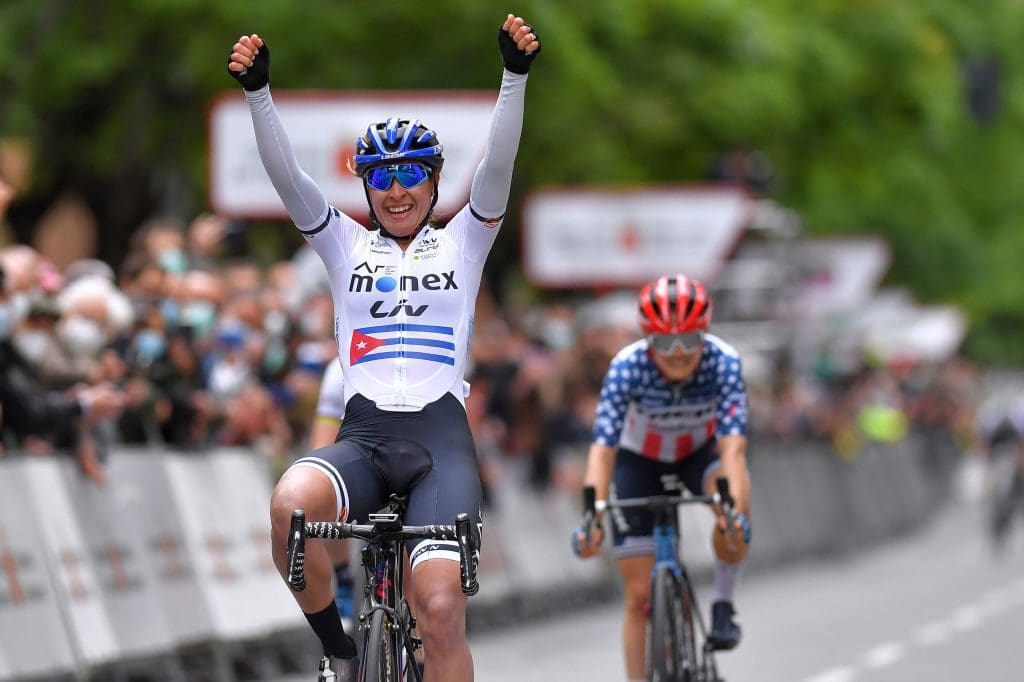 Photo Credit: Getty
Arlenis Sierra and Veronica Ewers showed its range
Arlenis Sierra’s 2021 victory added a different kind of winner. Sierra was never just a sprinter, and Navarra was never a simple sprint race, but her win showed that the event could still reward riders with speed if they were strong enough to survive the climbs. She beat Ruth Winder, with Van Vleuten also involved in the final picture, which underlined the quality of the race even before its later ProSeries promotion.
Veronica Ewers then won in 2022, again reinforcing the idea that Navarra could produce different types of outcomes. Ewers was part of a generation of riders using the Spanish calendar to show their climbing strength and one-day potential. Her win also came during a period when EF Education-TIBCO-SVB and similar teams were increasingly visible in women’s racing, taking opportunities in races that sat just below the very biggest WorldTour spotlight.
Those editions helped give the race its personality. It was not simply a procession towards a predictable favourite. It could be won by a rider with finishing speed, by a climber with attacking instinct, or by someone able to read a messy finale better than the rest. That made it useful for teams because it offered several routes to victory.
The move into the UCI Women’s ProSeries
The race’s promotion into the UCI Women’s ProSeries from 2023 was an important step. It placed Clásica Féminas de Navarra in a stronger category and reflected how quickly it had become established. The ProSeries level is significant because it sits below the Women’s WorldTour, but above the ordinary one-day class events. In practical terms, it gives the race more status, stronger start lists and a clearer role in the season.
Riejanne Markus won the 2023 edition, giving the newly elevated race a winner with WorldTour pedigree. Her victory also suited the character of the event: strong, controlled, and built around the ability to handle a demanding day rather than simply wait for a final sprint.
That 2023 step also placed Navarra more firmly within a Spanish women’s racing block that has become increasingly important. Riders can now move through a run of races in northern Spain that test climbing, punch, resilience and team depth. For younger riders, it is a proving ground. For established riders, it is a serious target. For teams, it is a way to build form and results between the spring Classics and the summer stage races.
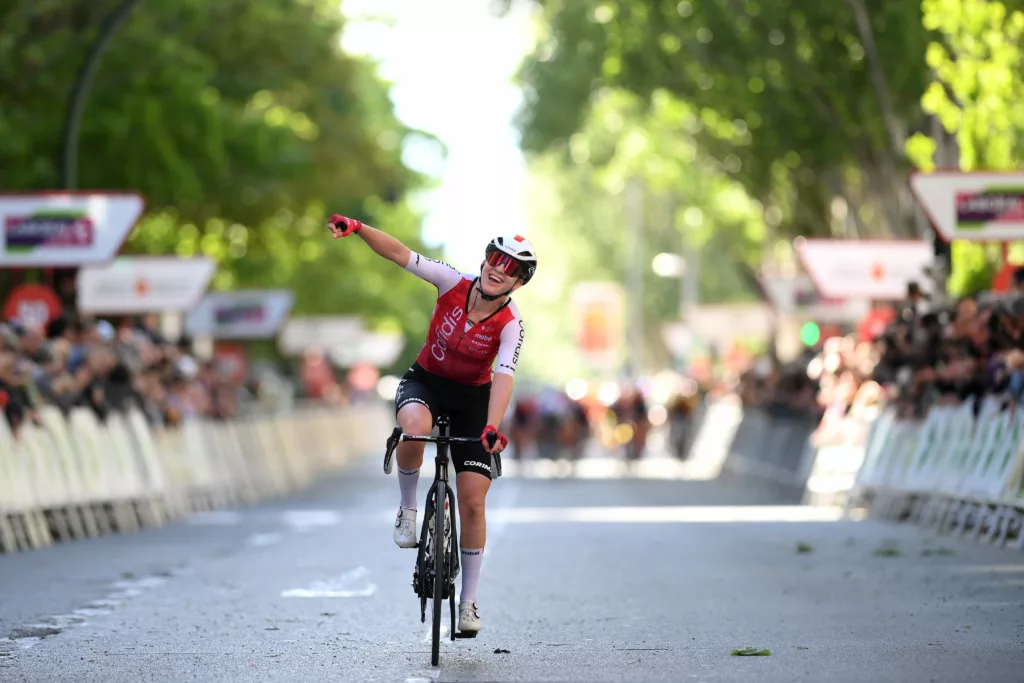 Photo Credit: Getty
Hannah Ludwig’s solo win added another chapter
Hannah Ludwig won in 2024 with a solo move, giving the race one of its clearest modern examples of how aggression can pay off. Her attack before the final climb of the Muro de Arlegui gave the chasers a problem they could not solve in time, and it reinforced the race’s growing reputation as one where riders have to commit before the final few hundred metres.
That is one of Navarra’s strengths. Some one-day races become predictable once the peloton understands the route. Clásica Féminas de Navarra has kept enough uncertainty to reward initiative. A reduced sprint can happen, but so can a solo move or a small-group finish. The terrain does not force one single race script.
Ludwig’s victory also mattered for Cofidis, a team still building its identity in the women’s peloton. Results like that are important because ProSeries races can offer major competitive value without requiring a team to beat the full concentration of the Women’s WorldTour at once.
Cat Ferguson made the race a British breakthrough story
The 2025 edition brought one of the race’s most interesting winners so far, with Cat Ferguson winning in Pamplona for Movistar. For Ferguson, it was her first victory of the 2025 season and her third professional win, confirming that her early promise had already become real race-winning ability.
Ferguson beat Soraya Paladin and Ruth Edwards in a fast uphill finish, which suited the race’s modern identity. It was not a straightforward bunch sprint. It was a finish for riders who could handle a hard, selective day and still produce speed when the road tilted. That is exactly the type of result that has made Navarra useful as a form guide for rising talents.
The win also had extra resonance because it came in Movistar colours. Navarra is home terrain for a Spanish team, and a young British rider winning there added a neat layer to the story. Ferguson had already shown she could win professionally, but victory in a ProSeries one-day race gave her a more substantial place in the wider season narrative, especially within the growing story of British riders to watch in women’s cycling.
Why the race matters
Clásica Féminas de Navarra matters because it fills an important space in the women’s calendar. It is not one of the sport’s oldest races, but it is exactly the kind of event that modern women’s cycling needs: serious terrain, meaningful status, strong but varied start lists, and enough tactical uncertainty to create different winners.
It also helps give the Spanish calendar more depth. La Vuelta Femenina is now a major stage-race centrepiece, Itzulia Women has become one of the most important hilly stage races in the sport, and Vuelta a Burgos Feminas continues to provide another strong test in the same part of the season. Navarra sits alongside them as a compact one-day race where riders can prove climbing strength, tactical sharpness and finishing ability.
The winners’ list already tells that story. Roy, Van Vleuten, Sierra, Ewers, Markus, Ludwig and Ferguson are not one type of rider. They represent different ways to win: sprinting after selection, attacking solo, handling climbs, and surviving a messy uphill finish. That variety is the mark of a race with a healthy route identity.
-
 Photo Credit: quentinphotographiebe
 -
 Photo Credit: Getty


Past winners of Clásica Féminas de Navarra
- 2019 – Sarah Roy
- 2020 – Annemiek van Vleuten
- 2021 – Arlenis Sierra
- 2022 – Veronica Ewers
- 2023 – Riejanne Markus
- 2024 – Hannah Ludwig
- 2025 – Cat Ferguson
How Clásica Féminas de Navarra should be remembered so far
It is still too young to have the weight of a historic Classic, but that is part of its interest. Clásica Féminas de Navarra is a race from the modern growth phase of women’s cycling, not the older inherited calendar. Its history is short, but it has already shown ambition, upgraded status and a winners’ list that looks stronger with each passing year.
The race has also carved out a useful identity. It is hilly without being a pure climbers’ race, selective without being closed to fast finishers, and important without yet being overloaded by expectation. That makes it a valuable piece of the season, especially for riders who thrive in the space between Classics specialist, puncheur and stage-race climber.
For now, the brief history of Clásica Féminas de Navarra is a story of a race growing into itself. It began as a new Spanish one-day event, gained credibility through winners such as Van Vleuten and Sierra, stepped up into the ProSeries era, and has become a race where emerging names like Ferguson can turn promise into a headline result. That is a strong foundation for a race still young enough to keep evolving.

