
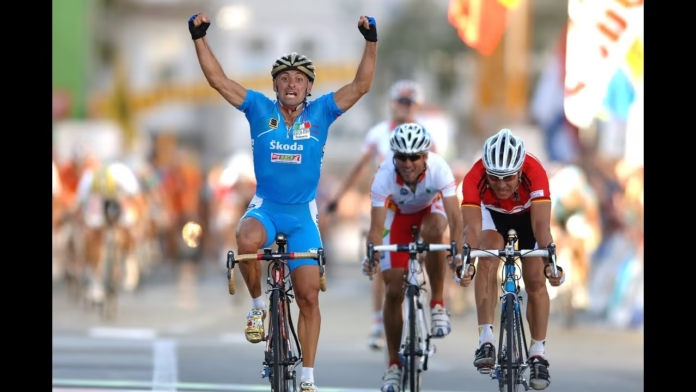
Paolo Bettini was never the biggest rider in the bunch, nor the sort of champion who imposed himself through cold, mechanical control. His racing was more instinctive than that. He won by sensing the shift in a race before others had fully understood it, by attacking when the road tilted, by following the right wheel through a corner, and by turning difficult, messy finales into places where his acceleration became decisive.
Across the early and mid-2000s, Paolo Bettini became one of cycling’s most reliable winners on days that were anything but predictable. He was a two-time world champion, Olympic road race champion, multiple Monument winner and three-time World Cup champion, yet the raw list of victories only partly explains his appeal. Bettini raced with visible emotion. He attacked often, sprinted ferociously from reduced groups, and seemed at his best when a race had become too complicated for simple strength to decide it.
For a rider of his size, he carried an enormous presence. Paolo Bettini was compact, explosive and technically sharp, with the sort of punch that made him dangerous on short climbs and the finishing speed to punish any group that allowed him into the final kilometre. He was not a pure sprinter, not a pure climber, and not a time trial specialist. He was something more specific and, in many ways, more valuable in one-day racing: a rider built for uncertainty.
Paolo Bettini: the making of a Classics specialist
Born in Cecina, Tuscany, in 1974, Bettini came through the Italian cycling system at a time when the country still produced an endless stream of one-day specialists. Italian racing culture valued tactical intelligence, durability, finishing speed and the capacity to read the rhythm of a race. Bettini absorbed all of it.
His professional career began in 1997 with MG-Technogym, before spells with Asics, Mapei and Quick-Step. The Mapei environment was important. It was one of the strongest teams of the era, packed with established leaders and ruthless winning standards. Bettini did not arrive as the finished article, but he quickly found his place as a rider who could support bigger names and then, increasingly, win major races himself.
The connection with Michele Bartoli was especially significant. Bettini initially worked for Bartoli, learning the demands of major one-day racing at close range. Their relationship later became complicated as Bettini’s own ambitions grew, but the apprenticeship gave him an understanding of how elite Classics were won. Timing mattered. Positioning mattered. So did patience, even for a rider whose natural instinct was to attack.
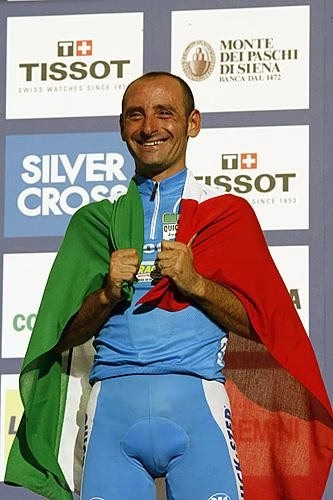
By the turn of the 2000s, Bettini had started to become one of the most dangerous riders in the peloton. His breakthrough at the very highest level came at Liège-Bastogne-Liège in 2000, where he won a race that suited his sharp climbing, aggression and fast finish. It was a victory that established him not simply as a lively Italian opportunist, but as a genuine Classics force. His success placed him firmly among the riders who helped define the modern spring calendar, alongside the sort of names explored in ProCyclingUK’s greatest spring Classics riders features.
Winning when the race lost its shape
Bettini’s great strength was his ability to turn disorder into opportunity. Some champions prefer structure: a strong team controlling the pace, a clean lead-out, a known climb, a fixed pattern. Bettini could win in those circumstances, but he was more threatening when the script broke.
He was brilliant in reduced groups because he combined three things that rarely sit together so neatly. He could climb well enough to survive or split the field, he had the acceleration to create separation over short, sharp rises, and he possessed the sprint to finish the job. Rivals often had to choose between chasing him early or trying to beat him late, and neither option was comfortable.
His tactical range showed across different races. At Liège-Bastogne-Liège, he could manage the repeated climbs and still produce a decisive finish. At the Championship of Zurich, he won on terrain that rewarded resilience and patience. At Milan-San Remo, a race often reduced in memory to the Poggio and a sprint, Bettini’s 2003 victory showed how dangerous he could be when late attacks and hesitation opened a gap.
That Milan-San Remo win captured much of Bettini’s character. He was not the obvious pure sprinter waiting for Via Roma. Instead, he was part of a late move that exploited the tension of the finale. It was the kind of scenario in which Bettini was at his most alive: fast roads, tired legs, nervous rivals, and just enough confusion for instinct to become the difference. It also made him part of the long Italian story of riders who shaped the race before the Via Roma sprint became the dominant modern image of Milan-San Remo.
Olympic gold and the peak of belief
Bettini’s Olympic road race victory in Athens in 2004 remains one of the defining results of his career. The course suited a rider who could absorb repeated efforts and still attack sharply. Bettini judged the finale with typical clarity, forming the decisive move with Sérgio Paulinho before beating him to the gold medal.
It was a victory that fitted neatly into the Italian tradition of valuing the road race as a test of tactical craft as much as physical power. Bettini did not win because he was the strongest rider in a simple, measurable sense. He won because he made the right race happen around him.
By then, he was already one of the peloton’s elite one-day riders. The Olympic title elevated his status further. It also underlined something central to Bettini’s career: when the stakes were high and the final hour became tense, he rarely looked intimidated. He seemed to enjoy that pressure.
The win in Athens also came during a period when Bettini was one of the most consistent riders in the now-defunct UCI Road World Cup. He won the competition in 2002, 2003 and 2004, an achievement that spoke to his versatility across the one-day calendar. He was not merely picking off isolated results. He was present across the whole season, from the spring Classics into late-season racing, repeatedly making himself relevant on courses that demanded different versions of the same skill set.
The rainbow years
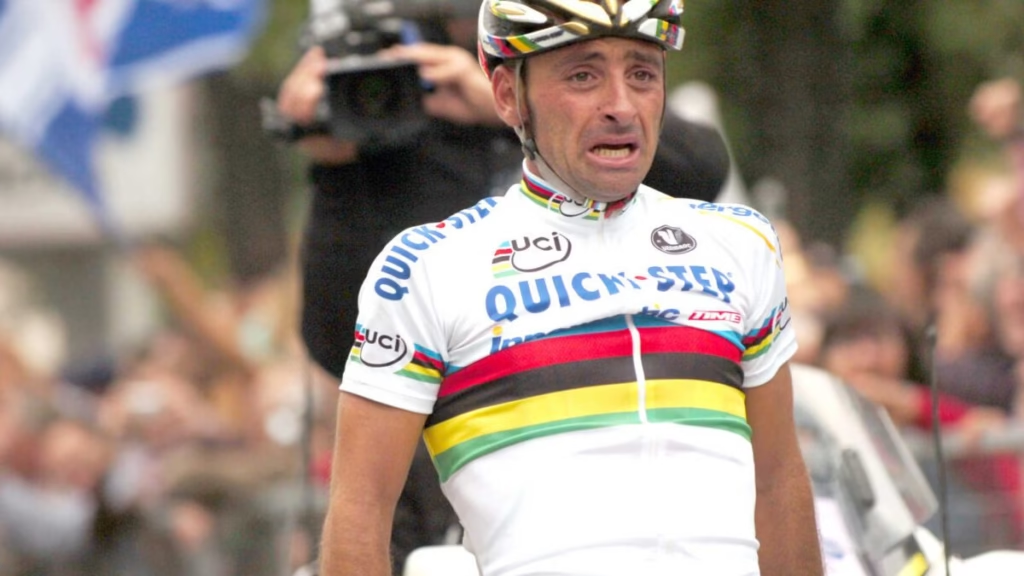
If Olympic gold gave Paolo Bettini one of cycling’s most prestigious single-day victories, his world championship double gave him something rarer: sustained authority on the sport’s most symbolic one-day stage.
His first rainbow jersey came in Salzburg in 2006. It was an emotional victory, arriving shortly after the death of his brother Sauro. Bettini’s win from a reduced group was pure Bettini: alert, aggressive, composed when the race became stretched, and fast enough at the end to convert the opportunity. The images of him after the finish, overcome by grief and triumph, became some of the most memorable of his career.
A year later, in Stuttgart, he defended the world title. Back-to-back men’s world road race wins are rare for a reason. The race changes each year, the course changes, the tactical pressure increases, and the defending champion carries an obvious target. Bettini still found a way through. His 2007 victory reinforced the sense that he was not just a rider of brilliant moments, but one who could repeatedly deliver when every rival knew exactly what he wanted to do.
The rainbow jersey suited him because he raced with the personality of a world champion. Bettini was expressive, combative and visible. He did not disappear into the bunch and emerge only for the last 200 metres. His wins often felt earned in public, built through choices that viewers could see unfolding in real time.
A rider made for the old World Cup
Bettini’s three consecutive World Cup titles deserve more attention than they often receive. The series rewarded consistency across the biggest one-day races, and in that format Bettini was close to the ideal rider.
He could win Monuments, score in hilly Classics, handle long distances and remain competitive deep into the year. His skill set was broad without becoming vague. On flat finishes against pure sprinters, he could be overmatched. On the longest mountain climbs, he was not a Grand Tour climber. But across the awkward middle ground where the best one-day races are often decided, Bettini was exceptional.
That middle ground was his territory: climbs hard enough to hurt sprinters but not selective enough to guarantee a climber’s win; finales where teams were too tired to control every attack; groups where everyone knew he was fast, yet nobody could easily drop him. Bettini’s presence changed the way rivals had to race. Let him sit in and he could outsprint them. Give him space and he could attack. Chase everything and he might simply wait for the next moment of hesitation.
This was why he was so effective in chaotic races. Chaos removed hierarchy. It stripped away the neat plan and exposed who could think, react and accelerate under stress. Bettini could.
Strength, style and controlled aggression
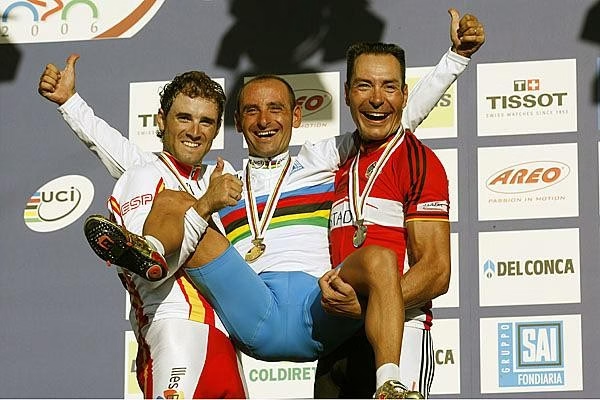
Bettini’s nickname, “Il Grillo”, the cricket, suited his racing. He bounced across the road with restless energy, never quite seeming still, always ready to jump. His attacks were not long, grinding demonstrations of superiority. They were sudden, sharp and disruptive.
There was a physical elegance to it, but also an edge. Paolo Bettini could be ruthless in a finale. He knew when to bluff, when to force others to chase, when to commit and when to gamble on his sprint. His best wins were rarely sterile. They had tension, movement and emotional heat.
Technically, he was also very strong. That side of his racing can be overlooked because the highlights often focus on the final acceleration, but Bettini’s handling, positioning and descending helped make him so hard to contain. A rider who depends on explosive moments must first arrive in the right place to use them. Bettini usually did.
His size helped on steep, punchy climbs, but he was not fragile. He could handle hard racing over long distances, and he had the durability needed for Monuments and championships. It was the combination that made him so valuable: small enough to dance over short climbs, powerful enough to sprint, tough enough to survive 250km, and smart enough to know when the decisive moment was forming.
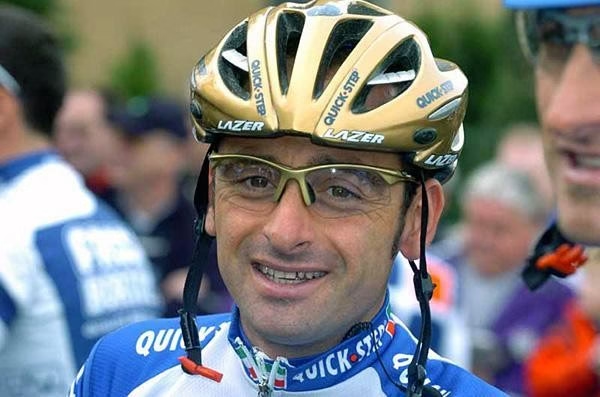
The place of Paolo Bettini in Italian cycling
Bettini sits in an important line of Italian one-day riders. He followed the era of riders like Gianni Bugno, Maurizio Fondriest and Michele Bartoli, and carried Italian hopes through a period when the Classics and world championships still occupied a central place in the country’s cycling imagination.
He was not a Grand Tour figure in the mould of Marco Pantani or Ivan Basso. His identity was sharper and more specialised. Paolo Bettini belonged to the road race, to the unpredictable afternoon, to the final lap of a world championship, to the late attack after a hard climb, to the reduced sprint where everyone already knew he was the danger and still could not stop him.
That made him hugely popular. Italian cycling has always admired riders who race with panache, and Paolo Bettini had that in abundance. He showed emotion openly, both in victory and disappointment. He was not remote. He looked like a rider living every race through instinct and nerve.
His career also bridged eras. He emerged from the Mapei super-team years, carried his success into Quick-Step, and remained a major force as cycling’s tactical and physical landscape continued to evolve. Through it all, his essential identity stayed the same. Bettini was a finisher, but never just a finisher. He was a racer.
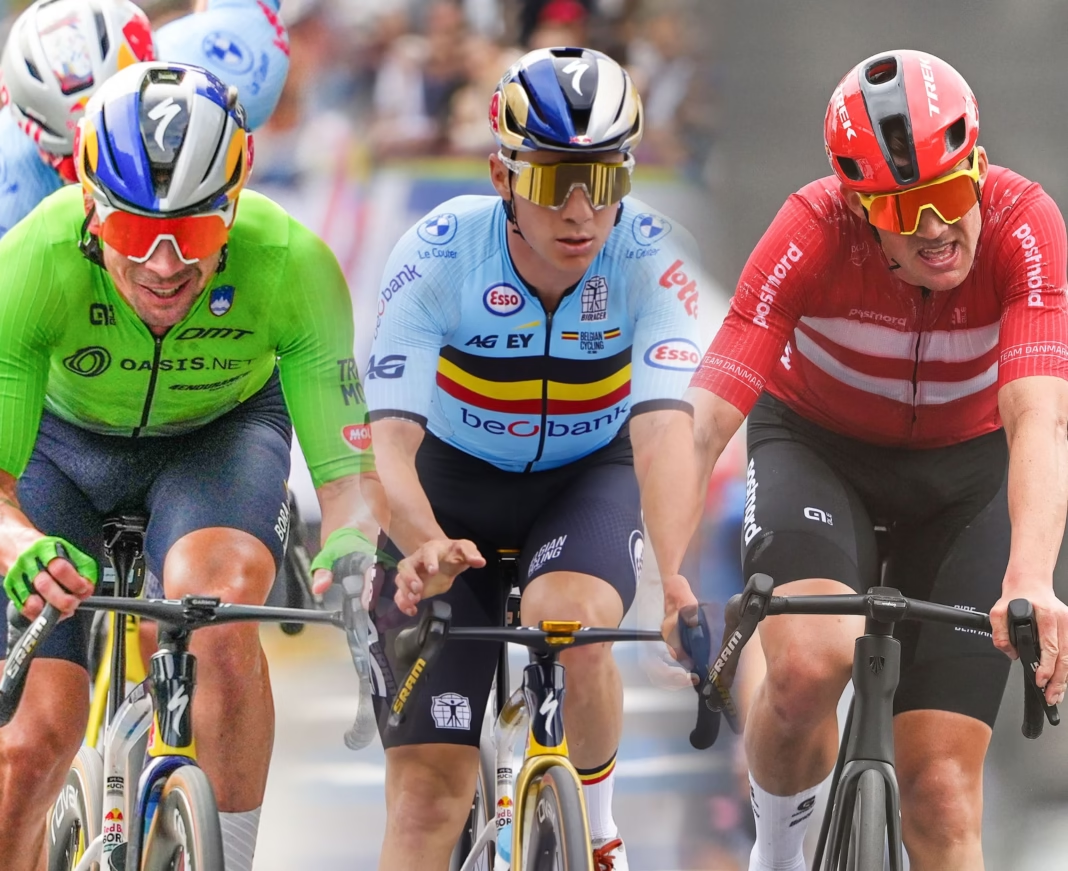
That distinction also helps explain why he sits so naturally alongside riders such as Philippe Gilbert and Alejandro Valverde. All three could finish quickly, all three could survive hard terrain, and all three understood how to turn the final hour of a one-day race into a contest of nerve as much as legs.

Retirement and legacy of Paolo Bettini
Bettini retired at the end of the 2008 season, closing a career that had delivered Olympic gold, two world titles, Milan-San Remo, Liège-Bastogne-Liège, Il Lombardia, the Championship of Zurich, Clásica San Sebastián and three World Cup crowns. It is a palmarès that stands among the finest of his generation in one-day racing.
After retirement, he moved into management and media, including a spell as Italian national coach. That role felt natural in one sense because Bettini understood championship racing from the inside. Few riders have been better at reading the emotional and tactical temperature of a one-day race.
His legacy is not just numerical, though the numbers are strong enough. Paolo Bettini represents a particular kind of champion: explosive, opportunistic, emotionally open and tactically alive. He won the biggest races not by reducing them to a formula, but by embracing their volatility.
In modern cycling, where teams increasingly try to control every variable, Bettini’s career remains a reminder of the value of instinct. The best one-day riders do not simply follow plans. They recognise when the plan has stopped working and move before everyone else has adjusted.
Paolo Bettini was one of those riders. When the bunch hesitated, he attacked. When a climb softened the field, he accelerated. When a small group reached the finish, he trusted his sprint. And when the race turned chaotic, he often looked like the calmest man inside the storm.

