
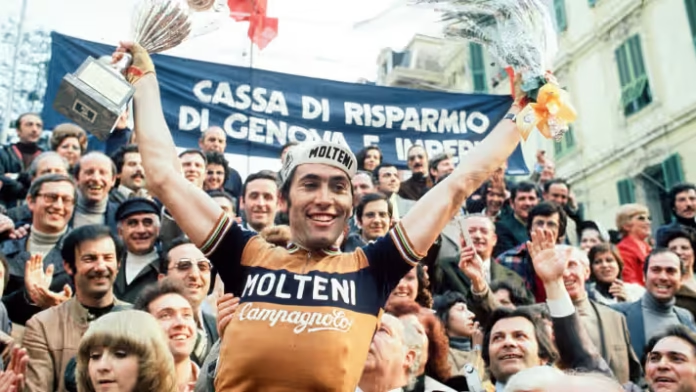
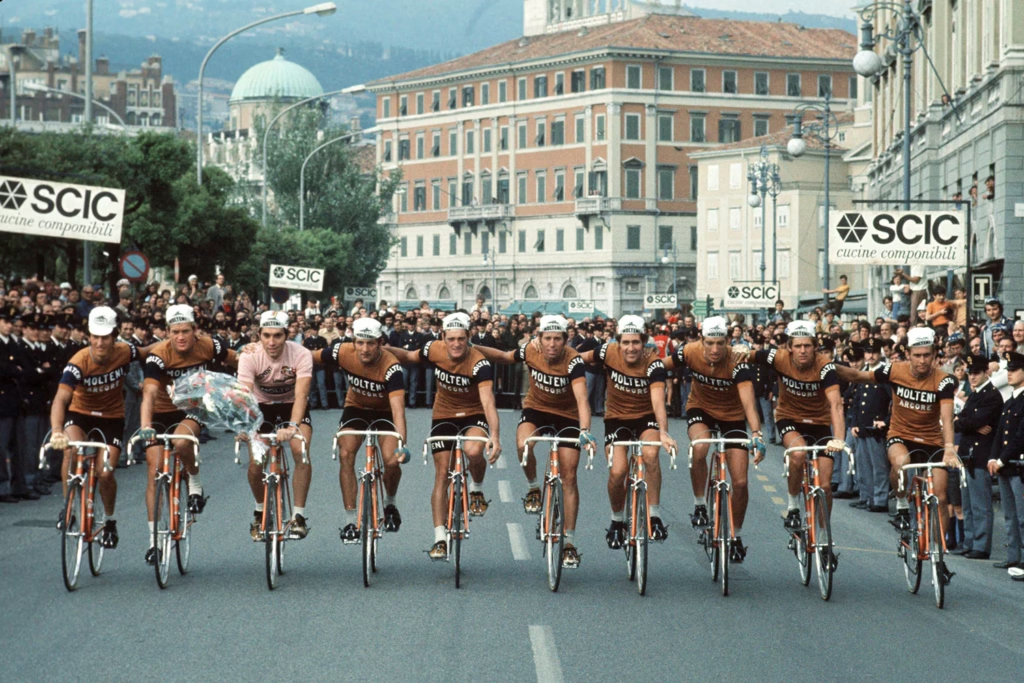
Molteni is remembered through colour as much as results. The orange jersey, the black trim, the simple block lettering, the almost severe visual identity of a team that looked less like a sponsor’s experiment and more like a permanent fixture of the sport. In the early 1970s, that jersey became inseparable from Eddy Merckx, and in turn from one of the most dominant periods any rider or team has ever produced.
The team was Italian by origin, backed by the Molteni meat company from Arcore near Milan, but its greatest years became something more complex. When Merckx arrived for 1971, he brought Belgian gravity into an Italian structure. Teammates, staff, habits and tactical assumptions shifted around him. Molteni was no longer simply a long-running Italian professional team. It became the machine through which cycling’s most insatiable rider sharpened his control over the sport.
That is why Molteni still carries such weight. It was not the only team Merckx rode for, and it did not create him from scratch. His Tour de France breakthrough and early Grand Tour dominance had already come before he wore orange. But Molteni gave him a platform that matched his appetite: disciplined, strong, direct, visually unmistakable, and capable of turning one man’s hunger into a team-wide operating system.
For a wider look at the structures that shaped professional cycling’s most recognisable eras, our men’s cycling history hub brings together more rider, race and team history features, including the story of Mapei and the team that turned the Classics into a private battlefield.
How did the Molteni team begin?
Molteni began in 1958, long before Merckx arrived and long before the orange jersey became one of cycling’s most recognisable images. The team was created around the sponsorship of Molteni, the Italian salami and meat producer, and was rooted in the older Italian model of cycling patronage: a family company, a commercial identity, and a professional squad that carried the brand across the roads of Italy, Belgium, France and Spain.
That matters because Molteni was not a short-lived vanity project built only for Merckx. It had history before him. The team developed through the 1960s as part of a strong Italian professional scene, racing at a time when trade teams were closely tied to domestic sponsors and national cycling cultures. Italy had its own powerful race calendar, its own stars, and its own expectations of what a serious professional team should look like.
The early Molteni years gave the team credibility. Gianni Motta won the 1966 Giro d’Italia in Molteni colours, establishing the squad as a Grand Tour-winning operation before Merckx entered the picture. Michele Dancelli also became closely associated with the team in the 1960s, adding Classics pedigree and Italian visibility. Molteni already had substance. Merckx turned that substance into mythology.
Why did Eddy Merckx join Molteni?
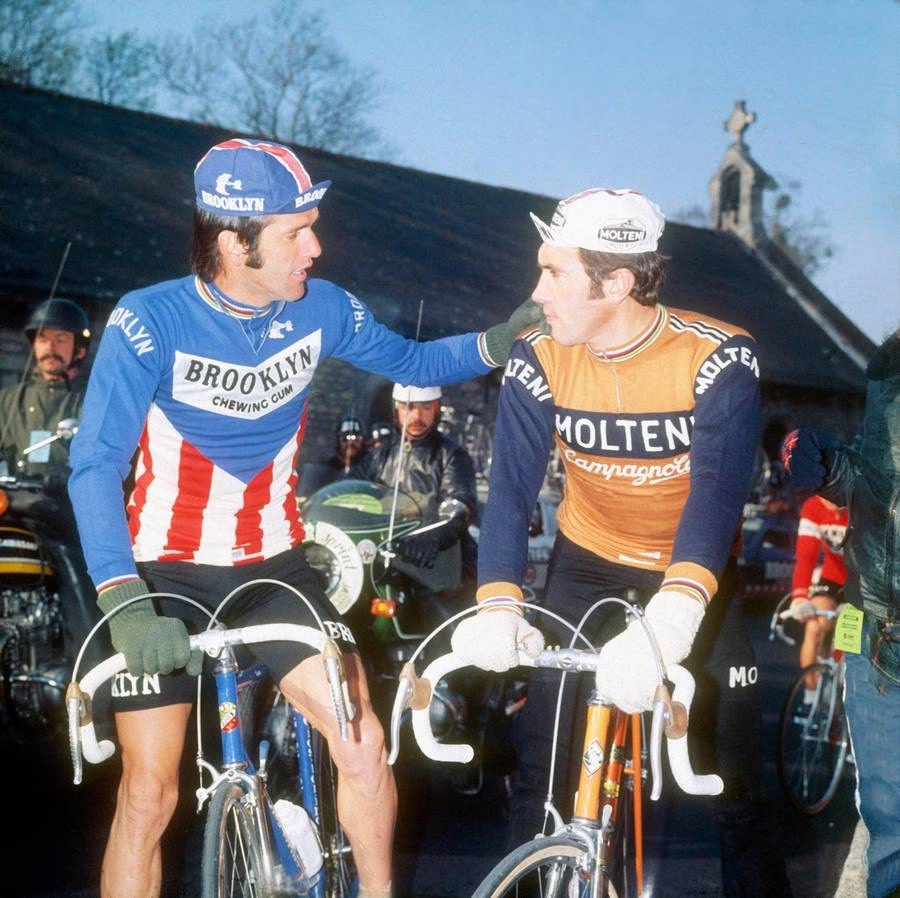
Merckx joined Molteni for the 1971 season after Faemino-Faema ended. By then, he was already the dominant rider in the world. He had won the Tour de France in 1969 and 1970, the Giro d’Italia in 1968 and 1970, and enough Classics to make it obvious that cycling was dealing with something beyond a conventional champion.
Molteni gave him a new home at the exact point when his authority over the sport was becoming almost total. The move was not simply about changing jerseys. Merckx arrived with a group around him, and the team became increasingly Belgian in character despite its Italian sponsor. That blend gave Molteni its distinctive identity: Italian backing, Belgian command, and Merckx at the centre of everything.
The team’s purpose became clear. It was built to help Merckx win everywhere. Grand Tours, Monuments, week-long races, smaller stage races, time trials, sprints from reduced groups, attacks from distance. Molteni was not a team designed around one narrow objective. It was designed around a rider whose ambition had no narrow objective.
That is what made it so intimidating. Rival teams knew that when Molteni appeared at the front, the race was not simply being controlled. It was being bent towards Merckx’s preferred shape.
Why was Molteni such a good platform for Merckx?
Molteni worked for Merckx because it gave him structure without softening him. Some great riders need a team to protect them from chaos. Merckx needed a team that could help him create chaos, then make it sustainable.
The orange train was not just there to keep him out of trouble until the final climb. It could chase, pressure, isolate rivals, manage breakaways and keep races hard enough that Merckx’s range became decisive. He was not a rider who only needed support for one final move. He needed a team that could make the whole day uncomfortable.
Molteni gave him that. The team had strong domestiques, experienced direction and a clear hierarchy. Everyone knew the centre of gravity. That clarity can be brutal, but in Merckx’s case it was effective. There was no confusion about leadership, no awkward balancing of equal ambitions, no need to protect multiple stars with competing priorities. The team existed to maximise the most complete rider cycling had ever seen.
That does not mean his teammates were anonymous. Riders such as Joseph Bruyère, Jos Huysmans, Roger Swerts, Vic Van Schil and others were important parts of the Molteni era. Their work helped turn Merckx’s talent into repeated domination. But the team’s identity was never ambiguous. Molteni was Merckx’s sharpest platform because it accepted the logic of his dominance and built around it completely.
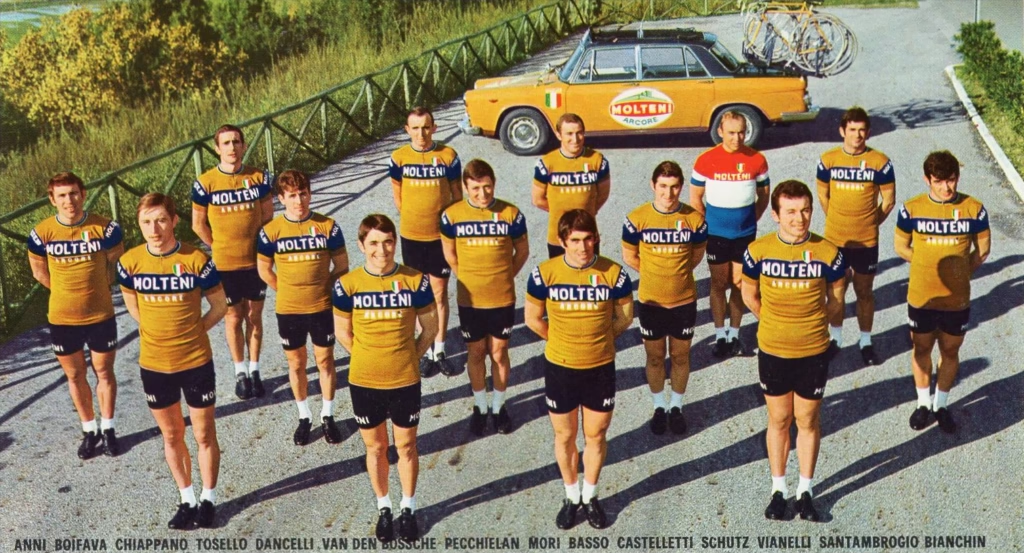
The orange jersey and cycling’s visual memory
Some teams are remembered because of results. A smaller number are remembered because the jersey itself becomes historical shorthand. Molteni belongs in that second group.
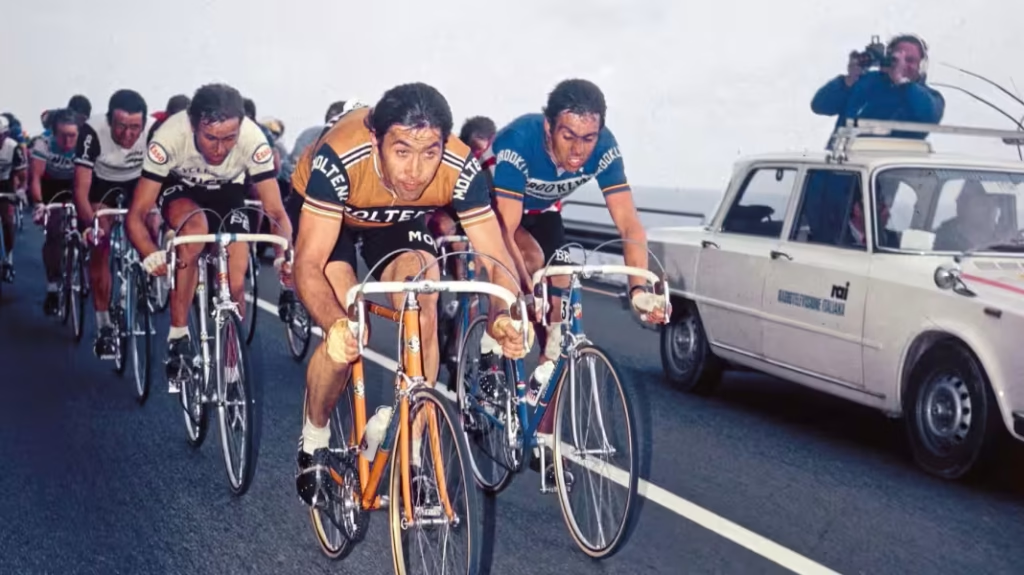
The orange kit was stark, simple and unmistakable. It did not rely on complicated graphics or modern branding. It looked industrial, direct and almost severe. That suited Merckx perfectly. In photographs from the period, the jersey seems less like decoration and more like a warning: Molteni at the front meant the race had entered serious territory.
Cycling memory is built from images as much as statistics. Merckx in orange on a climb. Merckx in orange in a time trial position. Merckx in orange on the cobbles. Merckx in orange with the rainbow bands. Those pictures have outlasted the commercial life of the sponsor because they represent an era when the sport was still raw, hard and visually uncluttered.
The Molteni jersey also helps explain why the team remains culturally important. Other teams won plenty. Other sponsors lasted longer. But Molteni had a visual identity that fused perfectly with its greatest rider. Like Mapei’s 1990s Classics dominance, Molteni became more than a line in a results database. It became an image of control.
Molteni and the Grand Tours
Merckx’s Molteni years included some of the most complete Grand Tour performances of his career. He won the Tour de France in 1971, 1972 and 1974 in Molteni colours, adding to the two Tours he had already taken before joining the team. Those victories helped complete his record of five Tour wins, a figure that still defines the upper limit of men’s Tour de France history.
The 1972 Tour was especially emphatic because it came in the same season as his Giro d’Italia victory. That Giro-Tour double under Molteni showed the full scale of his capacity. It was not just that he could peak once. He could dominate the spring, win the Giro, recover, and then win the Tour against the best stage racers in the world.
In 1973, he skipped the Tour but won both the Vuelta a España and the Giro d’Italia. That Vuelta-Giro double is one of the more revealing parts of the Molteni story because it shows how Merckx’s ambition was not limited to the most visible prize. He wanted the whole map. If a race was prestigious, he wanted it. If a classification was available, he chased it. If a stage could be won, he often treated it as something that should be won.
Molteni’s Grand Tour record under Merckx was therefore not just a set of overall victories. It was a demonstration of how completely a team could organise itself around one rider’s appetite. The squad controlled stages, protected leads, chased rivals and enabled a style of racing that made Merckx seem present everywhere.
For more on the race that most shaped Merckx’s wider reputation, our Tour de France hub follows the history, route and modern coverage of cycling’s biggest event.
Molteni in the Classics
Molteni’s power was not restricted to stage racing. Merckx’s Classics record in orange was extraordinary, and the team became a regular presence in the Monuments and major one-day races that defined spring.
He won Milan-San Remo multiple times in Molteni colours, including the 1976 victory that gave him a record seventh win in the race. He won Liège-Bastogne-Liège, Paris-Roubaix and the Tour of Flanders during the Molteni period, and he remained a constant force in the races where endurance, positioning and aggression mattered most.
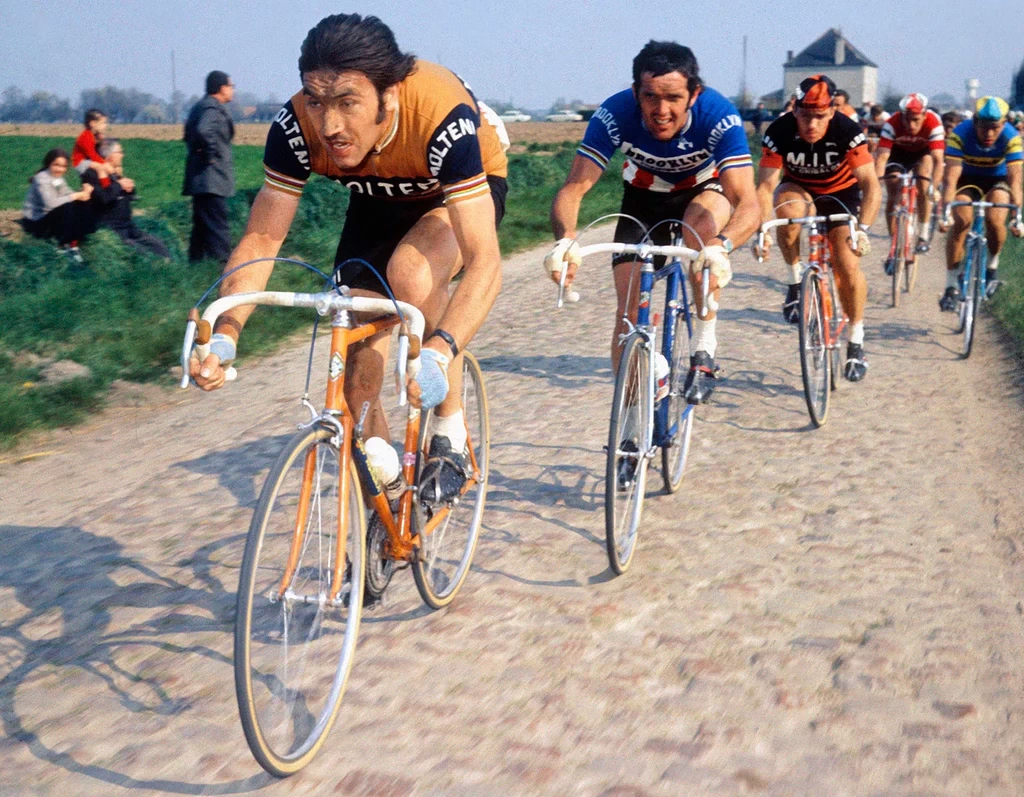
Paris-Roubaix is a useful lens for understanding the Molteni effect. The race is too chaotic to be controlled completely, but a strong team can still shape it by keeping a leader positioned, responding to dangerous moves and making sure the decisive parts of the race are reached with options intact. Merckx’s 1973 Paris-Roubaix win in Molteni colours was one of the clearest examples of his ability to impose himself on the hardest terrain.
The Classics also showed why Merckx was different from many Grand Tour champions. He was not a climber who tolerated one-day races or a stage racer who picked off occasional Classics. He was a rider who could define both worlds. Molteni made that easier because the team was not built narrowly. It could support him in the Ardennes, on the cobbles, in Italian semi-Classics, in week-long stage races and across three-week tours.
That range is one reason the Molteni era still feels so complete. Many team dynasties are associated with one kind of race. Molteni, through Merckx, seemed to stretch across all of them.
For more on the terrain and culture of one of the races Molteni helped shape, our features on the toughest cobbles in Paris-Roubaix and the Roubaix Velodrome explore why that race remains so central to cycling history.
The Hour Record and the Molteni aura
Although the Hour Record is an individual effort rather than a trade-team race, Merckx’s 1972 record in Mexico belongs emotionally to the Molteni period. It came at the height of his orange years and reinforced the sense that he was not content with winning races alone. He wanted the sport’s measurements too.
The Hour Record mattered because it stripped cycling down to a rider, a bike, a track and time. There were no teammates in front of him, no rival tactics to manage, no mountain gradients or weather patterns to exploit. It was a pure test of controlled suffering. Merckx’s success added another layer to the Molteni-era image: road domination, Grand Tour control, Classics aggression and now a place in cycling’s most austere record tradition.
It also fitted the personality of the period. Merckx’s Molteni years were not about selective greatness. They were about accumulation. Wins piled onto wins, jerseys onto jerseys, monuments onto Grand Tours, records onto championships. The Hour Record became another line in a career that already looked impossible to contain.
Who else mattered in Molteni’s history?
Merckx dominates any Molteni history, but the team deserves to be remembered beyond him. Gianni Motta’s 1966 Giro d’Italia win gave Molteni a Grand Tour identity before Merckx arrived. Motta was one of Italy’s major riders of the 1960s, and his Giro victory helped establish the team’s credibility on home soil.
Michele Dancelli was another important figure. He brought flair, aggression and Italian one-day pedigree, and his long association with Molteni helped shape the team’s pre-Merckx profile. Dancelli later won Milan-San Remo in 1970 after leaving Molteni, ending a long wait for an Italian winner, but his development and reputation were closely linked to the Molteni years.
Marino Basso also gave Molteni sprinting quality and visibility. He was one of the fastest Italian riders of his generation and became world road race champion in 1972, during the broader Molteni period. His presence underlined that Molteni was not merely a one-man shell, even if Merckx inevitably pulled the team’s history towards himself.
Then there were the Belgian lieutenants and workers who made the Merckx machine function: riders who did the work that made domination look cleaner than it really was. Molteni’s strength was not only having Merckx. It was having enough around him to make Merckx’s ambitions repeatable.
Giorgio Albani and the team behind the team
A great team is never just riders. Molteni’s direction also mattered, and Giorgio Albani became one of the important figures in the squad’s management. A former rider and Italian champion, Albani helped shape the team from the car and gave Molteni a strong sporting identity during its most famous years.
The Merckx period also involved experienced Belgian influence, including Robert Lelangue. That cross-border blend was central to the team’s character. Molteni was not purely Italian in racing culture once Merckx arrived, and it was not purely Belgian either. It became a hybrid built around winning.
That hybrid identity was one of its strengths. Italian sponsorship and racing tradition gave the team depth and commercial grounding. Belgian riders and staff gave Merckx familiar support and helped translate his racing instincts into team structure. The result was a squad that could operate across the full European calendar without feeling like a visitor anywhere.
Why Molteni felt different from later superteams
Modern cycling has produced several dominant teams, but Molteni’s dominance had a different flavour. Today’s superteams often operate through data, altitude camps, nutrition plans, layered leadership groups and a calendar divided into carefully managed objectives. Molteni’s power felt more direct.
That is partly because of the era. Racing was longer, equipment was simpler, roads were rougher, and the culture of control was less scientific. But it is also because Merckx himself made the team feel different. His dominance was not based on marginal selectivity. It was based on racing more, winning more and refusing to narrow his ambition.
Molteni therefore felt less like a modern performance structure and more like a dynasty built around appetite. It could be ruthless, exhausting and almost unfair in its clarity. Everyone knew who the race revolved around. Everyone knew what the team intended. The remarkable part is that opponents still so often could not stop it.
That separates Molteni from many later dominant squads. Some teams are remembered for systems. Molteni is remembered for a system fused so completely with one rider that the team and rider became difficult to separate.
The decline and end of Molteni
Molteni’s final years coincided with the slow decline of Merckx’s physical dominance. By 1975 and 1976, he was still capable of major victories, but the invincibility had begun to crack. The 1975 Tour de France, where he finished second after a brutal race and a punch from a spectator, marked the end of his Tour-winning era. In 1976, he won Milan-San Remo for the seventh time, but the broader direction was clear.
Molteni ended after the 1976 season. The sponsor withdrew, and Merckx moved on to Fiat France for 1977. By then, the orange dynasty had already completed its historical work. It had carried Merckx through the central years of his dominance, produced some of cycling’s most recognisable images, and created a team identity that outlived the company’s time in the peloton.
There is something fitting about the way Molteni ended. It did not drift into decades of rebrands or diluted identities. It remained tied to a specific era, a specific colour and a specific rider. That makes its memory unusually clean. Molteni is not a vague name in cycling history. It is a picture: Merckx in orange, the race under pressure, and everyone else trying to survive the consequences.
Molteni’s legacy
Molteni’s legacy is built on three things: results, image and clarity.
The results are overwhelming. Across its full existence, the team won hundreds of races, with Merckx responsible for many of the most famous. Grand Tours, Classics, stage races, time trials and championships all fed into the same impression of supremacy.
The image is just as powerful. The orange jersey remains one of cycling’s most recognisable kits, not because it was elaborate, but because it was attached to domination. It looked severe, memorable and permanent, even though the team itself lasted less than two decades.
The clarity may be the most important part. Molteni knew what it was during the Merckx years. It was the team of the best rider in the world, built to help him win across the whole calendar. That kind of identity is rare. Many teams search for a philosophy. Molteni had one because Merckx forced it into existence.
That is why the team still matters. It represents a period when cycling’s greatest rider had a platform sharp enough to match him. Not gentle, not balanced, not democratic, but brutally effective. The orange jersey became the uniform of an era in which one rider tried to win almost everything, and for a while, with Molteni behind him, often did.
Why Molteni remains one of cycling’s defining teams
Molteni remains one of cycling’s defining teams because it captured the sport at a point where individual dominance and team structure met perfectly. Merckx was already extraordinary before he joined, but Molteni gave his dominance its most enduring shape.
It provided the colour, the formation, the support and the permanence of image. It made his victories look part of a system rather than isolated acts of brilliance. It helped him win Tours, Giros, Classics, week-long races and records, while also preserving a visual identity that still feels instantly recognisable half a century later.
The team’s history is not only the story of Eddy Merckx, but it is impossible to escape him. Molteni had important riders before and around him, yet its place in cycling memory comes from the way it became the clearest expression of his rule. Orange did not just become his jersey. It became the colour of inevitability.
That is the Molteni story: an Italian team, a Belgian centre of gravity, a sponsor from Arcore, a jersey burned into cycling memory, and the sharpest platform ever given to the Cannibal.

