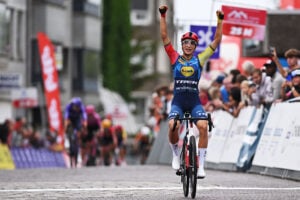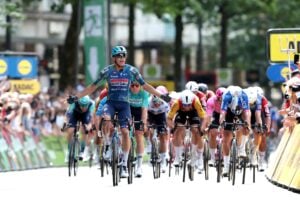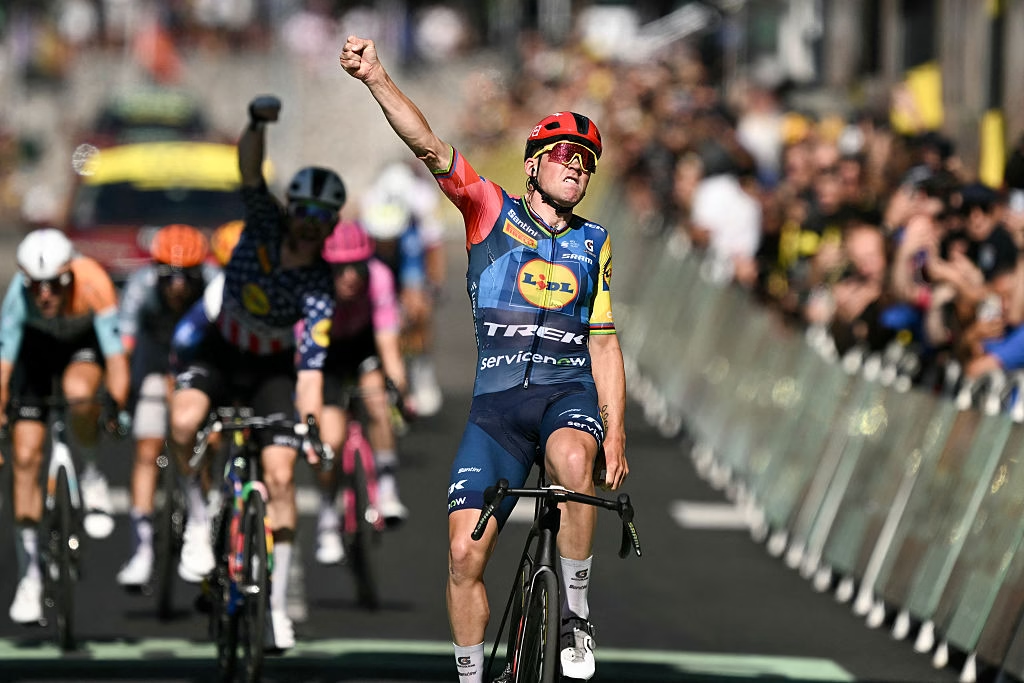
Mads Pedersen won stage 4 of the 2026 Tour de France in Foix, sprinting to victory from the breakaway after Lidl-Trek dominated the finale with numbers, timing and control. Quinn Simmons completed a one-two for the team, while Raúl García Pierna took third for Movistar after a hard day through Cathar country and the Ariège.
Table of Contents
ToggleThe stage also brought a major change in the general classification. Torstein Træen finished in the decisive front group and moved into the yellow jersey, taking over from Tadej Pogačar after the main peloton came in around 13 minutes down. It was a historic day for Uno-X Mobility, with Træen adding a Tour de France race lead to the four days he spent in red at La Vuelta last year.
Pedersen, a former world champion, delivered the win after surviving the final category 2 climb of the Col de Montségur and relying on teammates Simmons and Mathias Vacek to bring the reduced front group to the finish. It was his third Tour de France stage win and his first victory of the 2026 season.
Breakaway day from Carcassonne to Foix
Stage 4 covered 181.9 kilometres from Carcassonne to Foix and was always marked as a possible breakaway day. After three opening stages shaped by the GC battle, a team time-trial, Montjuïc and the Les Angles summit finish, this was the first day where the race finally allowed a large move to build a decisive advantage.
The route crossed Cathar country before moving into the Ariège, with enough climbing to make the stage difficult but not enough to force an automatic GC fight. The two main category 2 climbs, the Col de Coudons and Col de Montségur, gave the breakaway enough terrain to split itself apart, while the fast descent into Foix made the final selection difficult to bring back.
Pogačar began the day in yellow after winning stage 3 at Les Angles by the narrowest of margins. UAE Team Emirates-XRG had been dominant across the previous two road stages, but with a sprint day expected next and bigger mountains still to come, they had little reason to chase all day for another stage win.
That changed the shape of the race. Instead of a controlled GC stage, a large and dangerous breakaway formed, with riders hunting the stage, points, the team classification and the yellow jersey.
Big move goes clear
The breakaway that eventually formed was large, strong and difficult to control. It included sprinters, rouleurs, climbers and GC outsiders, giving it enough depth to survive both the climbs and the long flatter sections between them.
Among the key names were Pedersen, Simmons and Vacek for Lidl-Trek, Træen for Uno-X Mobility, Sean Quinn for EF Education-EasyPost, Kévin Vauquelin for Netcompany INEOS, Marco Frigo for NSN Cycling Team, Ramses Debruyne for Alpecin-Premier Tech, and Movistar pair Pablo Castrillo and García Pierna.
There were also early sprint interests in the move. Biniam Girmay and Jasper Philipsen were among the riders targeting points, while Pedersen had made no secret of his own green jersey ambitions. With the GC teams behind unwilling to commit fully, the gap began to rise.
By the time the race reached the intermediate sprint at Quillan, the move had already built a useful margin. Girmay narrowly took the sprint, but Pedersen’s presence in the break ensured he remained well placed in the points battle. Philipsen and others later eased off after the sprint, their work for the day effectively done.
UAE let the gap go
The key moment of the stage came not through an attack, but through inaction. UAE Team Emirates-XRG rode on the front through Nils Politt and later Florian Vermeersch, but the chase was controlled rather than urgent. As the gap passed 4 minutes and then continued growing, it became clear the stage win would come from the break.
That was a major shift after the previous two days. UAE had dictated the Montjuïc circuit on stage 2 and then controlled the final climbs to Les Angles on stage 3. On stage 4, they allowed the race to move away from them, likely judging that defending yellow this early was not worth the cost.
That decision opened the door for Træen. The Uno-X Mobility rider had started the day 5:06 down on Pogačar, and as the break’s advantage moved beyond 7 minutes, he became the virtual race leader. By the time the peloton sat almost 8 minutes back before the final climb, the yellow jersey was all but moving away from UAE.
For Lidl-Trek, the situation was even better. They had Pedersen for the stage, Simmons for support and Vacek as another engine in the decisive phase. They also had the possibility of moving Vacek into the best young rider’s jersey and pushing the team towards the top of the team classification.
Tratnik and Vacek force the split
The Col de Coudons began to reshape the break. Jan Tratnik and Vacek pushed clear, with Vacek able to sit on while Tratnik did the work. The pair opened a gap over the large break, which was now starting to fracture under the heat, the pace and the terrain.
Tratnik led over the Col de Coudons to take maximum mountain points, while Vacek stayed glued to him. Alex Molenaar, still chasing points in the mountains classification, took more points behind, but Alex Baudin remained safe in the polka-dot jersey after his stage 3 breakaway ride.
The move with Tratnik and Vacek did not look like a stage-winning escape, but it did force the rest of the break to react. Alex Kirsch later bridged across, making it three at the front, but Movistar and EF Education-EasyPost began working harder behind.
The peloton, meanwhile, was now too far back to matter for the stage. The battle had fully shifted to the breakaway: who would survive the Col de Montségur, who would keep enough teammates, and who would arrive in Foix with a sprint still left.
Col de Montségur breaks the move apart
The final major climb, the Col de Montségur, was 6.9 kilometres at 6.1 per cent and came with around 40 kilometres remaining. It was not long enough to guarantee a solo winner, but it was hard enough to drop several riders who had been hanging on in the large break.
Tratnik, Kirsch and Vacek were caught on the lower slopes as the stronger climbers and more committed teams came through. EF Education-EasyPost drove the pace through Michael Valgren, trying to put pressure on Træen and give Quinn a chance of moving into yellow instead.
Movistar also began using their numbers. Castrillo and García Pierna repeatedly tried to stretch the group, while Lidl-Trek relied on Simmons and Vacek to keep Pedersen close enough to the front.
As the gradient kicked up towards 11 per cent near the summit, the front group was reduced to around 10 riders. Pedersen was under pressure but still present, and that was the decisive detail. If he could survive the climb within touching distance, he would become the obvious favourite on the run into Foix.
Frigo took maximum points over the top, with Castrillo, García Pierna, Debruyne and Træen among the leaders. Vacek, Pedersen, Simmons, Vauquelin and Quinn were only a handful of seconds behind, and the groups soon merged on the descent.
Ten riders fight for the stage
After the Col de Montségur, the front of the race formed into a decisive group of 10: Debruyne, Træen, Frigo, Castrillo, García Pierna, Pedersen, Simmons, Vacek, Quinn and Vauquelin.
The composition immediately favoured Lidl-Trek. They had three riders in the group, including the fastest finisher, while Movistar had two attackers and EF had Quinn racing partly with yellow in mind. Træen’s priority was not the stage win but maximising his advantage for the general classification.
With 24 kilometres remaining, the group had around 50 seconds over the nearest chasers. The gap then stretched to a minute, making it increasingly clear that the stage would be decided between the 10 leaders.
Castrillo and García Pierna tried several times for Movistar, launching repeated attacks in an attempt to break Lidl-Trek’s control. Vauquelin, already a Tour stage winner, sat quietly at the back and waited for one chance rather than joining the constant accelerations.
Pedersen, though, had the support and the confidence. Whenever the attacks went, Simmons or Vacek shut them down. When needed, Pedersen himself responded.
Lidl-Trek control the Foix finale
The final descent into Foix was fast and broad, giving little room for a rider to build a lasting gap unless the group completely hesitated. Movistar kept trying, but Lidl-Trek had too much control.
García Pierna opened one promising gap of around 50 metres, only for Simmons to bring it back. Castrillo attacked repeatedly, but the effect was more disruptive than decisive. Vacek followed moves, Simmons closed gaps and Pedersen stayed protected for the sprint.
Inside the final 5 kilometres, it was increasingly Pedersen’s race to lose. The front 10 remained together, but every failed attack made the sprint more likely. Vauquelin tried to surprise Lidl-Trek in the final corner, but there was not enough separation to stop Pedersen from opening up properly.
The Dane hit the sprint from a position of strength and quickly moved clear. He won by several bike lengths, with Simmons taking second to complete a dominant one-two for Lidl-Trek. García Pierna finished third, giving Movistar a podium after an aggressive but ultimately unsuccessful finale.
Pedersen dedicates win to Guercilena
Pedersen called the victory a masterpiece in teamwork, even if he admitted he had suffered on the final climb. The key, he said, was the work of Simmons and Vacek, who kept him close enough over the summit and then drove the group towards Foix.
It was also an emotional win for the team. Pedersen dedicated the stage to long-serving Lidl-Trek manager Luca Guercilena, who is set to leave the squad, saying the team had identified the stage as one they could win.
The victory also moved Pedersen firmly into the green jersey battle. By the finish, he had taken the lead in the points classification by 48 points, turning a breakaway day into a major gain for one of his biggest goals of the race.
For Simmons, second place was another sign of his value in hard transition stages. He spent much of the finale working for Pedersen, closed attacks and still had enough left to finish second. Vacek also gained from the day, moving into the best young rider’s jersey.
Træen takes yellow for Uno-X Mobility
Pedersen won the stage, but Træen took the race lead. The Norwegian finished safely in the front group and then waited at the finish as the gap to the peloton grew large enough to confirm the yellow jersey.
The main bunch came in around 13 minutes down, meaning Træen moved well clear in the general classification. He now leads Quinn by 28 seconds, with Vacek third at 3:50 and Pogačar dropping to 7:53.
That is a major buffer after only four stages. Barring a collapse, Træen could now keep yellow deep into the second week, potentially as far as the Vosges, depending on how the GC teams choose to race the coming stages.
It is also a major moment for Uno-X Mobility, giving the Norwegian team its first Tour de France leader’s jersey. Træen had already shown he could handle the pressure of leading a Grand Tour after wearing red for four days at La Vuelta, but yellow at the Tour is a different level of significance.
Pogačar gives up yellow without panic
For Pogačar and UAE Team Emirates-XRG, losing yellow was not necessarily a setback. They had spent two days controlling the race and had already taken a stage win through Pogačar and a one-two through Del Toro and Pogačar. Defending the jersey through a transition stage in intense heat would have cost more energy than it was worth.
The team still rode enough to keep the race calm behind, with a more concerted pace late on to prevent any late disruption, but there was no full chase. The decision allowed the break to take the day and moved responsibility away from UAE.
Pogačar now sits almost 8 minutes down on Træen, but that margin is less relevant than his position against Vingegaard, Evenepoel and the other main GC contenders. The yellow jersey has moved to a rider who was allowed time by design, not because the main favourites were beaten on the road.
That gives UAE tactical breathing room. They no longer have to carry the full weight of the race every day, while the established GC rivalry can reset behind Træen’s new lead.
New classifications after stage 4
The yellow jersey was not the only classification to change hands. Pedersen’s stage win and sprint points moved him into the green jersey, giving Lidl-Trek another major success on the day.
Vacek took over the best young rider classification, adding to his role in the winning move and giving Lidl-Trek a second jersey from the stage. The team also moved into the lead of the team classification after placing three riders in the decisive break and finishing first and second on the stage.
Baudin retained the mountains jersey despite Molenaar’s continued attempts to collect points. After the Frenchman’s long stage 3 breakaway and his haul on the Col de Toses and Col du Calvaire, his advantage was enough to carry through another day.
The overall picture of the Tour now looks very different. Four stages in, the race has already had repeated changes in yellow, two UAE statements, a first summit finish, and now a major breakaway reshuffle.
Lidl-Trek own the day in Foix
Stage 4 belonged to Lidl-Trek more than anyone else. They placed three riders in the decisive group, protected Pedersen over the hardest climb, shut down attacks on the run-in and finished first and second. It was the kind of day that only works when strength, numbers and clarity all come together.
Movistar had aggression but not the finishing speed. EF had a route towards yellow through Quinn but could not distance Træen. Vauquelin waited for his chance but never found the gap. Træen had the biggest GC reward, but the stage itself was Pedersen’s.
After the GC fireworks of Barcelona and Les Angles, Foix delivered the first major breakaway day of the 2026 Tour. It changed the race lead, the points competition, the young rider standings and the team ranking in one afternoon.
Pedersen got the win he and Lidl-Trek had targeted. Træen got yellow. Pogačar let the jersey go. The Tour, only four days old, already has another new shape.
Tour de France 2026 stage 4 result
Results powered by FirstCycling.com
Main photo credit: Getty