
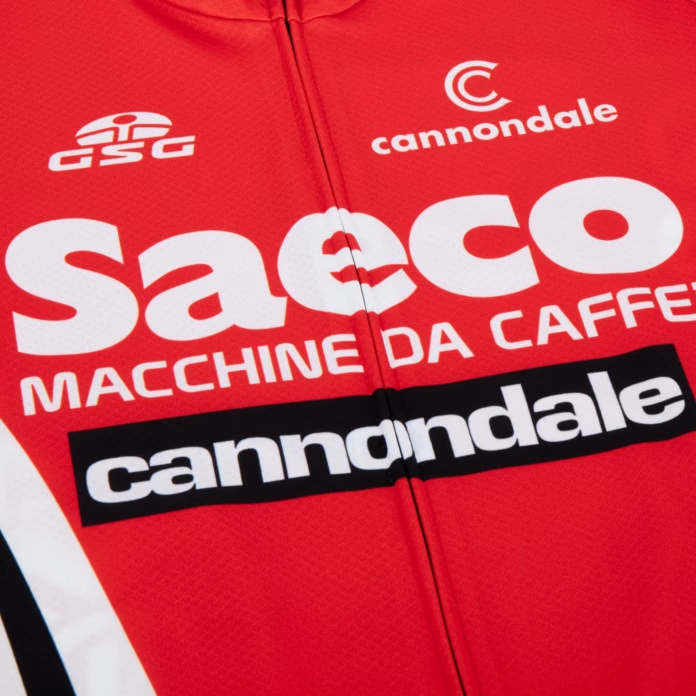
Saeco were never a team designed to disappear into the peloton.
They were red, loud, Italian and unusually easy to recognise. In an era when cycling teams were often remembered through their leaders, Saeco managed to become something more visual and immediate. You did not have to read the start list to know they were there. You could see them.
That was part of the point.
For much of the late 1990s, Saeco meant Mario Cipollini, the red sprint train, Cannondale bikes, lead-out discipline and a sprinter who understood that performance and theatre did not have to be separate things. The team became one of the clearest examples of modern sprint organisation, but also one of the clearest examples of cycling as spectacle.
Yet Saeco’s story was not only about Cipollini. The team won the Giro d’Italia with Ivan Gotti in 1997, Gilberto Simoni in 2003 and Damiano Cunego in 2004. It produced Italian champions, mountain drama, internal tension, controversy and one of the strangest late-era Giro handovers of the early 2000s.
Saeco were built to be seen. But they also won enough to make the colour matter.
For broader context on the teams that shaped the sport, see the Men’s Cycling History Hub and our wider archive of men’s team histories, including Mapei, Telekom, Rabobank and Liquigas.
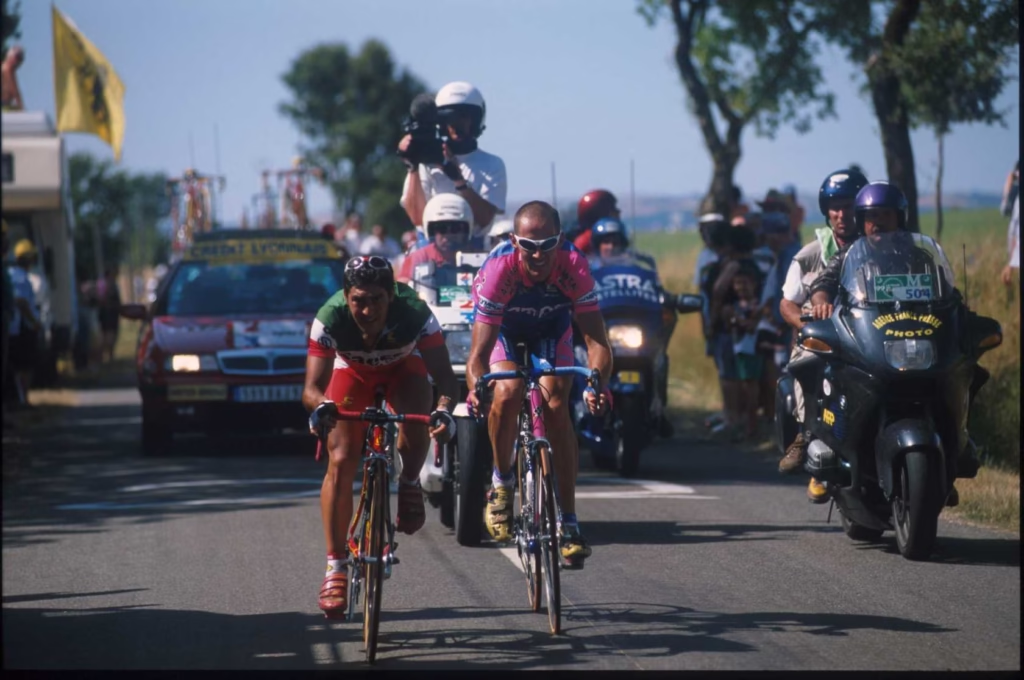
What was the Saeco cycling team?
Saeco was an Italian professional men’s road cycling team best remembered for its red kit, Mario Cipollini’s sprint train and its success at the Giro d’Italia.
The team raced under the Saeco name from the mid-1990s until the end of 2004, when its structure merged into the Lampre-Caffita project for the new ProTour era. Its main sponsor was Saeco, the Italian coffee machine company, and its identity was tied closely to Cannondale bikes for much of its most recognisable period.
That mix helped define the team. Saeco were not just another Italian squad. They had a strong commercial image, a clear colour, a visible star and a racing style that television could understand instantly.
| Saeco identity | What it meant |
|---|---|
| Red kit | One of the most recognisable looks of the late 1990s peloton |
| Mario Cipollini | Sprint wins, theatre and global visibility |
| Treno Rosso | A lead-out train that helped shape modern bunch sprinting |
| Cannondale | Strong bike-brand association and technical image |
| Giro d’Italia | Major wins with Gotti, Simoni and Cunego |
| Italian flair | A team that mixed racing results with showmanship |

A team that understood image
Saeco’s visual identity was unusually strong.
The red jerseys mattered because they made the team obvious. In the final kilometres of flat Grand Tour stages, that had a tactical and commercial effect. When Saeco took the front, the race changed shape. Viewers saw a red line of riders forming at high speed. Commentators knew what it meant. Rivals knew what was coming.
That kind of recognition is valuable in cycling. Sponsors pay for visibility, and Saeco made visibility part of the product.
The team did not only win sprints. It staged them. Cipollini was the star, but the image worked because the whole train looked coordinated. The riders in front of him were not background figures. They were part of the machine.
In that sense, Saeco were ahead of many teams in understanding how racing looked on television. The red train was practical, but it was also branding. It told viewers: this is our race now.
That visual legacy is one reason Saeco still appears in cycling nostalgia, memorabilia and retro-kit culture. Our piece on cycling in Flanders and the Flandrien Hotel notes how the Saeco-Cannondale era remains instantly recognisable to fans who grew up with late-1990s and early-2000s racing.
Mario Cipollini and the red train
Cipollini gave Saeco its defining early identity.
He was already a major sprinter before Saeco, but the team gave him a more complete stage. With Saeco, the sprint train became cleaner, more visible and more intimidating. Riders such as Paolo Fornaciari, Giuseppe Calcaterra, Gian Matteo Fagnini and Mario Scirea helped create the kind of lead-out structure that would later become standard for elite sprint teams.
At the time, it still felt distinctive.
Saeco did not simply chase the break and hope Cipollini could find a wheel. They built the finish around him. The final kilometres became a procession of roles: control, speed, positioning, final lead-out, launch. It was more organised than the older, more chaotic sprint model.
That was why Cipollini’s wins felt so inevitable when Saeco got it right.
His four consecutive Tour de France stage wins in 1999 remain one of the defining images of the team’s peak. The victories were not just about the last 200 metres. They were about the 10km before that, when Saeco assembled, accelerated and forced the race into their preferred shape. The 1999 Tour itself remains a useful time capsule of that period, as covered in our flashback to the 1999 Tour de France.
Cipollini also brought a kind of celebrity that cycling did not always know how to handle. He was theatrical, vain in the sporting sense, and sometimes deliberately provocative. But he was also very fast, and that made the performance work. Without the wins, the show would have become empty. With the wins, it became part of the myth.
For a wider view of how Cipollini fits into Tour sprinting history, see our guide to the greatest Tour de France sprinters.
 Photo Credit: Getty
Why the sprint train mattered
The Saeco sprint train mattered because it helped change the expectations around bunch sprinting.
Modern sprinting is built on teams managing the final kilometres with almost military precision. Lead-out riders are selected for specific phases. One rider controls the approach. Another keeps speed high. Another protects position. Another launches the sprinter. That is normal now, but it was still developing in the 1990s.
Saeco showed what could happen when a team committed fully to that idea.
Cipollini was not expected to improvise from deep in the bunch. He was given structure. That structure reduced risk, controlled speed and made it harder for rivals to swarm him. It also made the sprint easier for viewers to read. The red jerseys were a warning signal.
The lesson lasted well beyond Saeco. Later teams built trains for Alessandro Petacchi, Mark Cavendish, Marcel Kittel, André Greipel and others. Not every train looked like Saeco’s, and not every team had a rider like Cipollini, but the principle became part of modern sprinting.
That later evolution is one reason HTC-Columbia became such an important sprint team in a different era. Cavendish and HTC refined sprint domination for the late-2000s television age, but Saeco had already shown how powerful a fully committed train could be.
Saeco did not invent every part of the lead-out. But they made the sprint train famous in a way that stuck.
Beyond Cipollini: Saeco as a Giro team
The easiest version of Saeco history starts and ends with Cipollini. That would be too narrow.
The team also had real Grand Tour depth, especially at the Giro d’Italia. Ivan Gotti won the Giro for Saeco in 1997, giving the team a major general classification success at home. That mattered because it prevented Saeco from becoming just a sprint team with a loud jersey.
Gotti’s win gave the team a different kind of legitimacy. Cipollini made Saeco visible in the sprints. Gotti showed that the team could also survive the mountains and win the hardest race in Italy.
That dual identity became important later. Saeco could be a sprint machine, but it could also become a climbing team. It could chase flat-stage control with Cipollini, then later turn itself around Gilberto Simoni and Damiano Cunego.
Few teams manage that shift cleanly. Saeco did it in a messy, very Italian way, but it did it.
For a wider view of the race where Saeco built much of its legacy, see our brief history of the Men’s Giro d’Italia. The official Giro d’Italia roll of honour also places Gotti, Simoni and Cunego in the broader line of Italian Grand Tour winners.
Gilberto Simoni and the mountain years
Gilberto Simoni changed Saeco’s centre of gravity.
By the early 2000s, Cipollini’s Saeco era had passed, and the team’s identity moved towards the Giro. Simoni, already a Giro winner with Lampre in 2001, became the leader around whom Saeco could build a serious mountain project.
His 2003 Giro d’Italia victory was a major statement. Simoni was a pure climbing force, sharp, combative and never shy about ambition. He won the race with authority, restoring Saeco’s Grand Tour status after a difficult previous year.
The 2002 episode had been one of the darker moments in the team’s history. Simoni was withdrawn from the Giro after cocaine positives, and Saeco’s Tour de France invitation was later withdrawn. He was subsequently cleared by the Italian federation, but the damage to the team’s season and image had already been done.
That context made 2003 important. Simoni’s Giro win was not just another victory. It was a return to sporting credibility.
It also set up the drama that would define Saeco’s final season.
Cunego, Simoni and the 2004 Giro
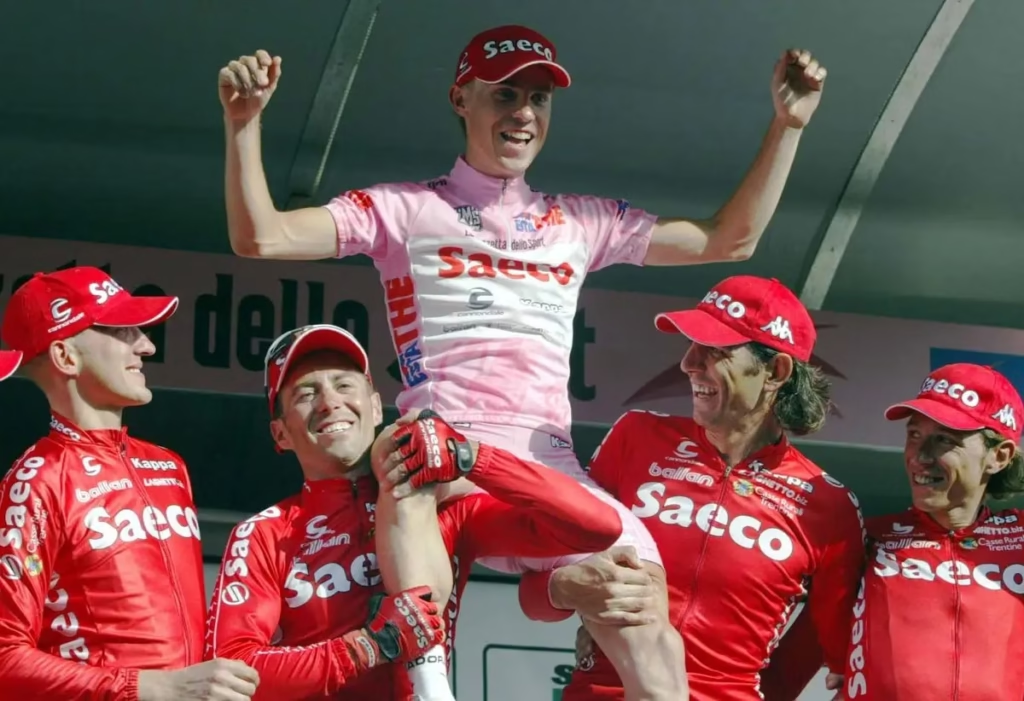
The 2004 Giro d’Italia gave Saeco one of its most fascinating final chapters.
Simoni arrived as defending champion and team leader. Damiano Cunego arrived as a young rider with obvious talent but a different role. By the end of the race, the hierarchy had shifted completely.
Cunego won the Giro at 22. He did not just sneak into the result. He won stages, took the race lead and became the new Italian obsession almost overnight. Simoni, who had expected a team built around him, found himself inside a team story that no longer belonged only to him.
It was awkward, compelling and very revealing.
Saeco had once been built around Cipollini’s certainty. In 2004, the team became interesting because of uncertainty. Who was the leader? Who was riding for whom? Was Cunego the future, or had the team betrayed its defending champion by allowing the race to turn?
Those questions made the 2004 Giro one of the defining Italian cycling dramas of the decade.
Cunego’s later win at Il Lombardia gave the season an even more romantic finish. Saeco were about to disappear as an independent name, but they went out with a young Giro winner, a Classic victory and a story that still feels unresolved.
The best Saeco riders
| Rider | Why he mattered to Saeco |
|---|---|
| Mario Cipollini | Defined the team’s sprint image and red train era |
| Ivan Gotti | Won the 1997 Giro d’Italia |
| Gilberto Simoni | Won the 2003 Giro and made Saeco a mountain force |
| Damiano Cunego | Won the 2004 Giro at 22 and became the team’s final star |
| Salvatore Commesso | Italian champion and valuable aggressive rider |
| Paolo Fornaciari | Key part of the Cipollini lead-out structure |
| Gian Matteo Fagnini | One of Cipollini’s most important lead-out men |
| Danilo Di Luca | Part of the later Saeco roster before his peak years elsewhere |
| Mirko Celestino | Strong one-day rider and part of the team’s Italian depth |
Colour, character and commercial cycling
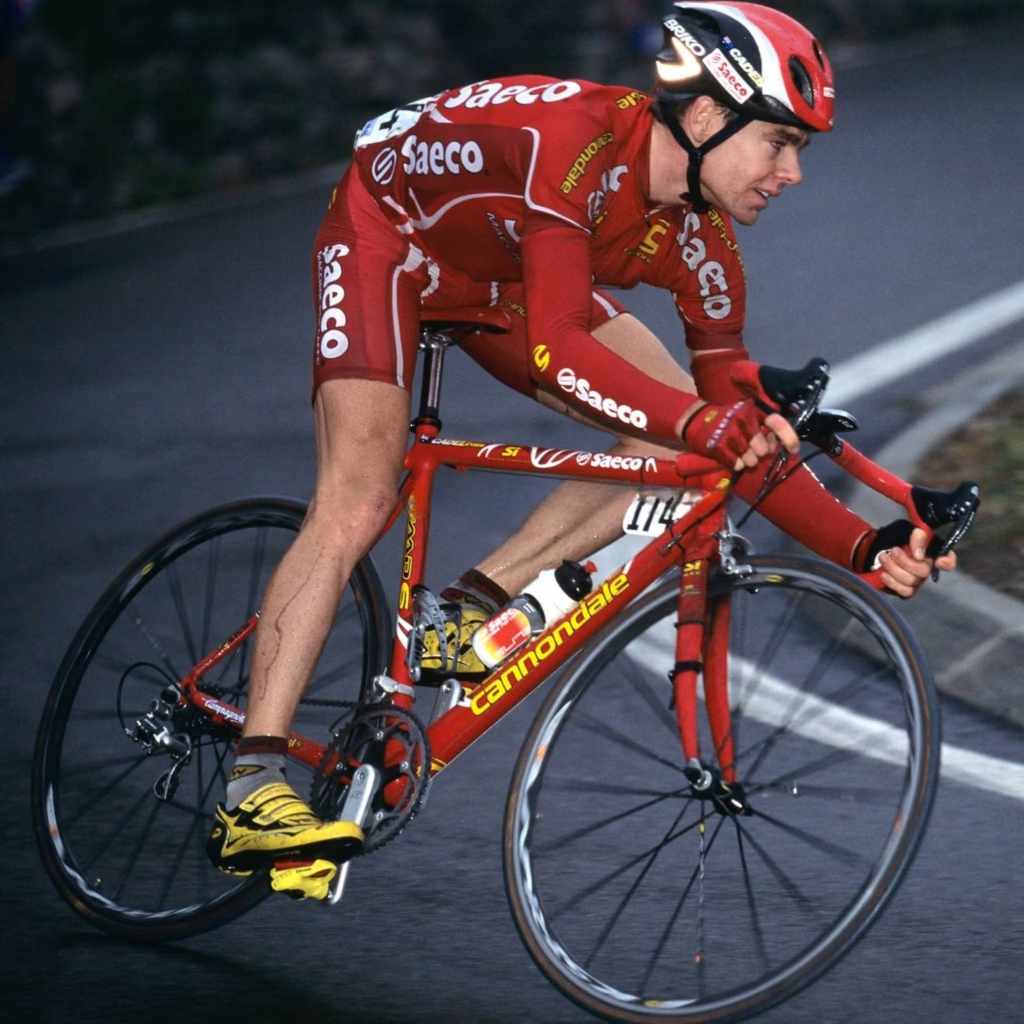
Saeco were a cycling team, but they were also a case study in commercial identity.
The sponsor was not hidden. The kit was not subtle. The riders did not blend in. Cipollini made sure of that, but the team around him helped. Even the Cannondale connection became part of the story, especially when the brand became more visible in European road racing through Saeco’s success.
This matters because cycling sponsorship is fragile. Teams come and go. Names change. Colours vanish. Many good teams are remembered only by results tables. Saeco are remembered visually.
That is rare.
The team had an image that a casual viewer could recall years later: red jerseys, Cipollini in full performance mode, a train at the front of the peloton, and a sense that cycling could be part sport, part theatre and part advertisement without losing its competitive edge.
There is a reason Saeco nostalgia has lasted. The team looked like itself.
The coffee sponsor context also helped. Cycling has often carried brands from everyday life into the peloton, and Saeco was one of the more obvious examples for a generation of fans. Our older feature on coffee and the caffeine boost for cyclists touched on that link between coffee brands and cycling sponsorship.
The end of Saeco
Saeco’s final year as a separate force came in 2004.
The sport was about to move into the UCI ProTour era, and the team landscape was changing. Saeco did not continue as an independent top-level project for 2005. Instead, its structure and riders fed into the Lampre-Caffita set-up, which carried forward the Italian stage-race tradition with Cunego and Simoni among its central names.
That ending feels fitting in one sense and unsatisfying in another.
Fitting, because Saeco’s final season produced a dramatic Giro win and a new Italian star. Unsatisfying, because the team disappeared just as Cunego seemed to offer a fresh storyline. The red jersey, the Cipollini association and the Cannondale era belonged to one phase, while the Cunego story suggested another. The team never got to fully become that second version.
Instead, Saeco became part of a merger story, absorbed into the next structure of professional cycling.
That kind of ending is common in cycling history. Sponsors change, licences move, and team identities are often more fragile than the results they leave behind. It is one reason the long lives of squads such as Molteni and Peugeot feel so different from the shorter, brighter lives of teams like Saeco.
-
 Photo Credit: Canyon SRAM (supplied media release)
 -
 Photo Credit: Park Tool
Saeco’s legacy
Saeco’s legacy sits in two places.
The first is sprinting. The team helped make the lead-out train one of the defining tactical systems of modern road racing. Cipollini was the star, but Saeco’s achievement was collective. They turned the final kilometres into a controlled red formation and made the sprint feel like a planned event rather than a scramble.
That legacy also feeds into the history of the Tour’s points competition. Saeco’s sprint culture belongs to the same wider story as the green jersey specialists who built careers around repeated bunch finishes, as explained in our guide to everything you need to know about the Tour de France green jersey.
The second is Italian Grand Tour drama. Gotti, Simoni and Cunego gave Saeco Giro victories across different phases of the team’s life. That matters. It means the team were not just a showy sprint squad. They had depth, range and major race-winning substance.
The combination is what makes Saeco memorable.
Some teams win and still fade. Saeco won and left images behind: Cipollini’s red train, Simoni climbing in command, Cunego emerging against his own team’s expected order, Cannondale bikes under bright jerseys, and the sense of a squad that understood cycling’s visual language better than most.
Final word
Saeco were not the biggest team of their era, but they were one of the easiest to remember.
They had colour. They had Cipollini. They had the red train. They had Giro winners. They had internal tension, controversy, comeback and theatre. They had an identity strong enough to survive long after the sponsor left the peloton.
That is why their history still matters.
Saeco showed that a cycling team could be tactically serious and commercially bold at the same time. They helped define the modern sprint train, gave Italian cycling some of its most vivid Giro stories, and left behind one of the strongest visual identities of the late 1990s and early 2000s.
They were built to be seen.
And, for a while, they were impossible to miss.

