
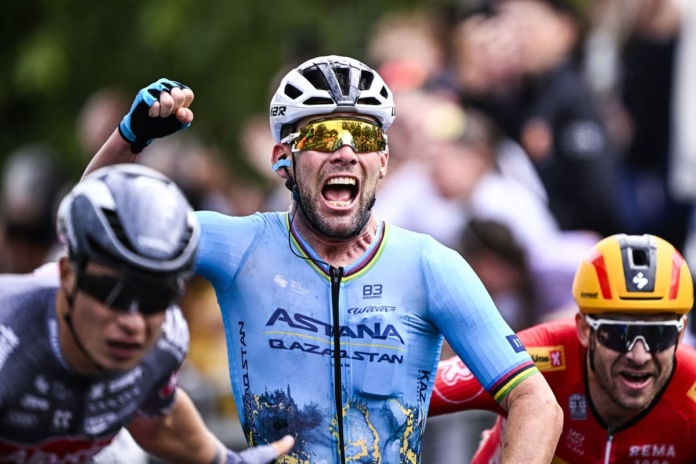
The Tour de France has never belonged only to climbers and general classification riders. Every July, the sprinters give the race its other kind of drama: the long chase, the nervous run-in, the fight for wheels, the lead-out train, the final bend, the last 200 metres and the sudden violence of a finish that can be won or lost by a tyre width.
Ranking the greatest Tour de France sprinters is not as simple as counting stage wins. The purest flat-stage winners matter, but so do green jerseys, Paris victories, lead-out systems, longevity and the ability to survive three weeks of mountains just to contest one more sprint. For the other side of the race, see our guides to the greatest Tour de France winners and the greatest Tour de France climbers.
That makes this a slightly different list from a general ranking of cycling’s fastest riders. It focuses on Tour de France sprint greatness: who won most, who shaped the green jersey, who changed sprinting at the race and who became part of the Tour’s sprinting language.
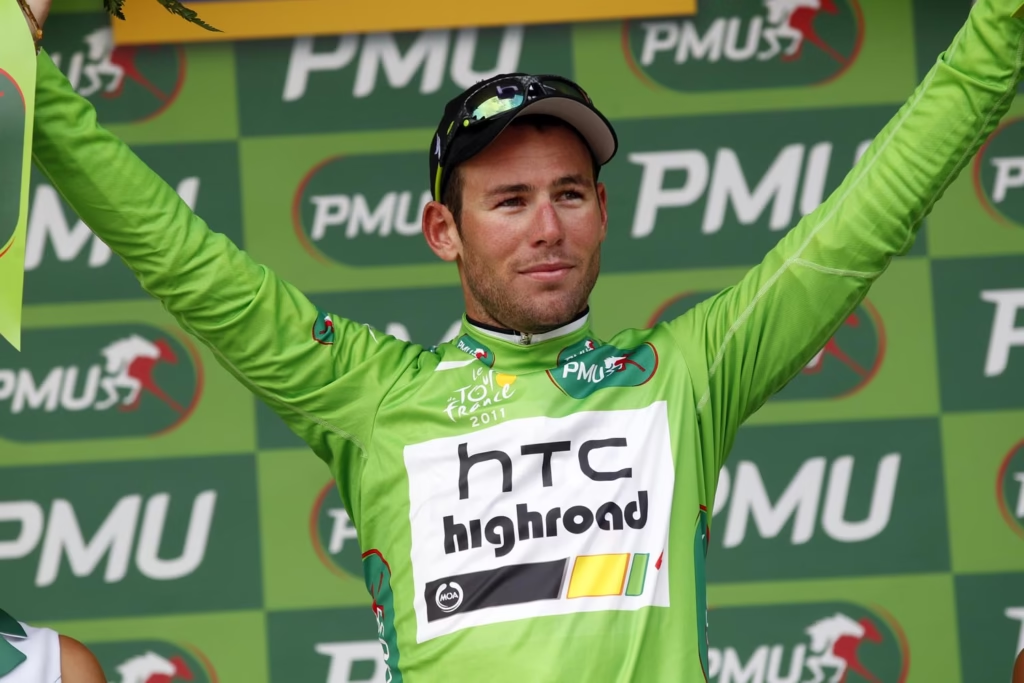
Quick answer: who is the greatest Tour de France sprinter?
Mark Cavendish is the greatest Tour de France sprinter because he holds the all-time record for stage wins with 35 victories, most of them taken in bunch sprints. He also won the green jersey twice and won repeatedly across different teams, lead-out systems and eras. Peter Sagan and Erik Zabel have stronger green jersey records, but Cavendish is the clearest answer for pure sprint-stage greatness.
| Rank | Rider | Tour sprinting claim |
|---|---|---|
| 1 | Mark Cavendish | Record 35 Tour stage wins |
| 2 | Peter Sagan | Record seven green jerseys |
| 3 | Erik Zabel | Six green jerseys and unmatched consistency |
| 4 | André Darrigade | Early benchmark for Tour sprint stage wins |
| 5 | Freddy Maertens | Explosive points winner and stage-winning force |
| 6 | Robbie McEwen | Three green jerseys and one of the sharpest kickers |
| 7 | Marcel Kittel | Modern power sprinting at its most devastating |
| 8 | Mario Cipollini | Lead-out theatre, speed and sprinting image |
| 9 | André Greipel | Durability, power and repeated Tour success |
| 10 | Sean Kelly | Points-classification master with sprinting range |
How to rank the greatest Tour sprinters
Tour sprinting has changed hugely over time. Early editions had different stage formats, roads, equipment and team structures. Later eras brought lead-out trains, specialist sprint squads, intermediate sprints, points classification tactics and much more controlled finales.
The main factors used here are:
| Factor | Why it matters |
|---|---|
| Tour stage wins | The clearest measure of repeated sprint success |
| Green jerseys | Shows consistency across the whole race |
| Paris wins | The Champs-Élysées became the symbolic sprinters’ stage |
| Longevity | Winning across multiple Tours and eras adds weight |
| Pure speed | Some riders were built almost entirely around the final sprint |
| Tactical intelligence | Positioning and timing often matter as much as raw speed |
| Influence | The best sprinters change how teams race flat stages |
That is why this list includes both pure bunch sprinters and points classification specialists. Cavendish, Kittel, Greipel and Cipollini are judged mainly by sprint wins. Sagan, Zabel and Kelly are judged partly by the green jersey, because Tour sprinting is not only about one finish line. It is also about collecting points, surviving mountains and staying relevant every day.
For a fuller breakdown of the points competition, see our guide to the Tour de France green jersey and our explainer on the Tour de France 2026 jerseys.
 Photo Credit: Getty
1. Mark Cavendish
Mark Cavendish is the greatest Tour de France sprinter. The simplest reason is also the strongest: 35 stage wins.
For years, Eddy Merckx’s total of 34 Tour stage victories looked like one of cycling’s most unreachable records. Cavendish first moved towards it through sheer sprinting dominance, then returned from illness, injury, omission and near-retirement to equal it in 2021 and finally surpass it in 2024. That final victory turned an already great Tour career into something historic.
The record-breaking stage to Saint-Vulbas is covered in our report on Cavendish’s 35th Tour de France stage win, while the wider reaction from Merckx is covered in our piece on Eddy Merckx praising Cavendish after the record fell.
Cavendish’s greatness was built on more than speed. At his best, he had a rare ability to read chaos. He could follow a train, improvise without one, squeeze through gaps, choose the right wheel and launch at exactly the moment others hesitated. His sprint was not always the longest or the most obviously powerful, but it was brutally efficient.
His early years with HTC-Columbia changed the way many people thought about the modern lead-out. Mark Renshaw, Bernhard Eisel, Tony Martin, Michael Rogers and others helped build the launchpad, but Cavendish still had to finish it. He did so again and again.
The Champs-Élysées became part of his story too. Winning in Paris is the sprinter’s equivalent of a mountain-top coronation, and Cavendish turned that finish into familiar territory.
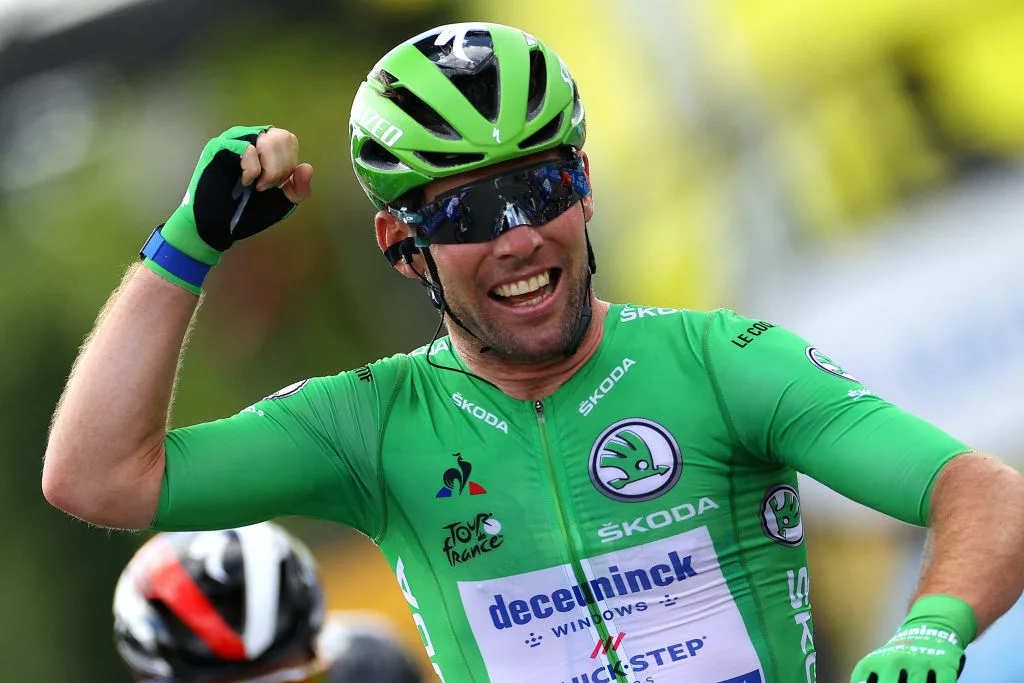
He also won green in 2011 and 2021, proving he was more than a one-day collector. Still, his legacy is stage wins. No sprinter in Tour history has won more often, for longer, or with quite the same combination of precision and emotional force. For more British context, see our feature on every British Tour de France stage winner and our ranking of the greatest British riders at the Tour de France.
2. Peter Sagan
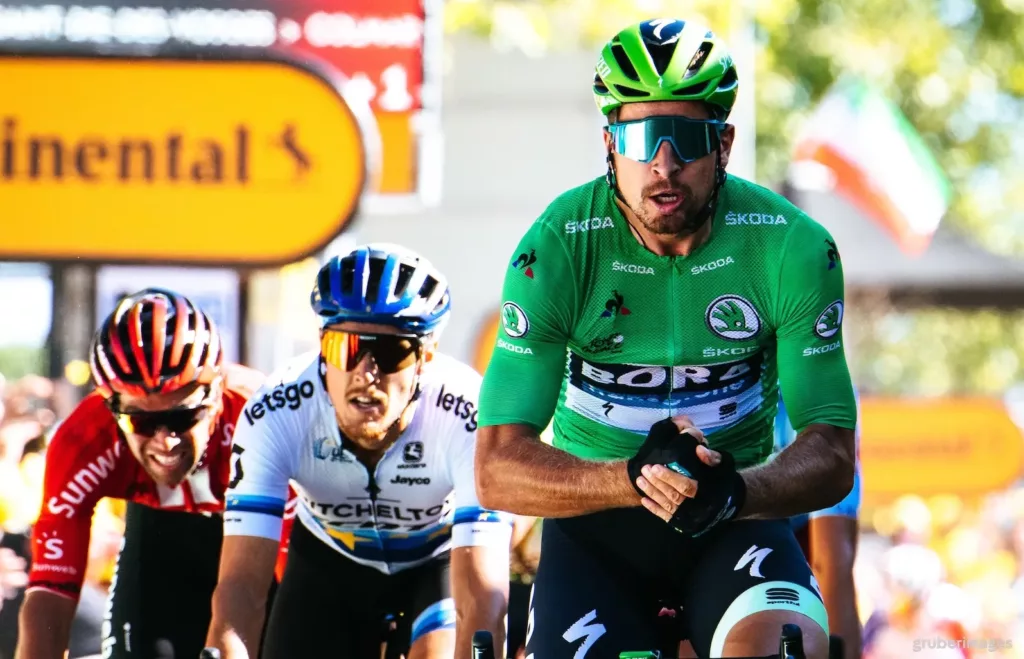
Peter Sagan was not a pure bunch sprinter in the Cavendish mould. That is exactly why his Tour record is so unusual.
Sagan won the green jersey seven times, more than anyone else in Tour history. He was not always the fastest rider in a flat finish, but he was the most complete points rider the Tour has seen. He could score in bunch sprints, reduced sprints, hilly stages, intermediate sprints and awkward days where pure sprinters disappeared out the back.
His Tour identity was based on range. Sagan could survive climbs that eliminated faster men, sprint after hard racing, attack if the stage demanded it and still collect points with almost casual regularity. For much of the 2010s, the green jersey felt less like an open competition and more like something Sagan would win unless circumstances intervened.
That separates him from Cavendish. Cavendish was the greatest sprint-stage winner. Sagan was the greatest green jersey rider.
The question is whether that makes him the greatest Tour sprinter overall. This ranking keeps Cavendish first because pure sprinting and stage wins carry more weight in a sprinter list. But Sagan is second because the Tour’s points classification is part of sprinting history, and nobody has shaped it more.
He also changed the idea of what a sprinter could be. He was a Classics rider, showman, world champion and green jersey machine all at once. The Tour rarely gets riders like that.

3. Erik Zabel
Before Sagan, Erik Zabel was the model of green jersey consistency. He won the points classification six years in a row from 1996 to 2001, a level of sustained Tour performance that defined the late 1990s sprint era.
Zabel was not always the fastest in a straight-line drag race. That was part of what made him so good. He won through positioning, timing, patience and consistency. He was a sprinter who understood that the Tour rewards more than raw acceleration.
His ability to score every day made him the perfect green jersey rider. Flat finish? He could place. Reduced bunch? He could survive. Intermediate sprint? He was there. Bad day? He limited damage. In a three-week points competition, that sort of reliability becomes overwhelming.
Zabel’s sprinting was also tied to the Telekom era. His lead-outs, team structure and repeated green jersey campaigns helped make sprinting feel more organised and professional. He was not merely chasing stage wins. He was building a classification.
His record was eventually broken by Sagan, but that should not reduce Zabel’s standing. For more on the team environment around Zabel, Jan Ullrich and German Grand Tour cycling, see our Telekom team history.
4. André Darrigade
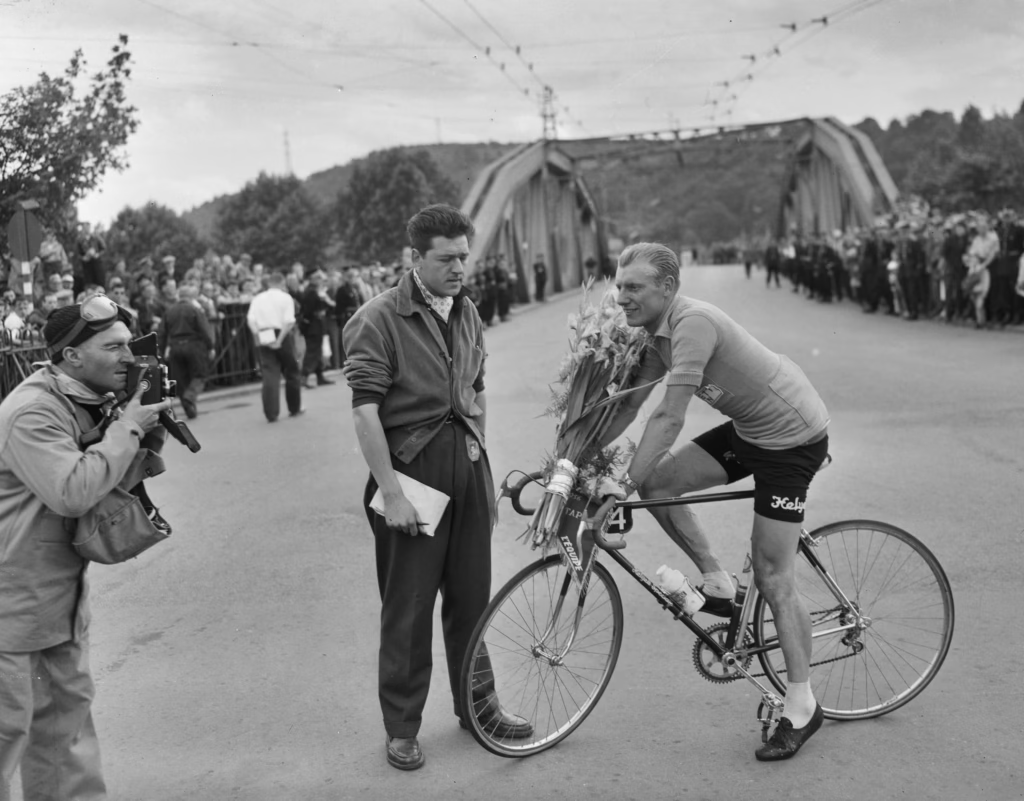
André Darrigade belongs near the top because he was one of the first great Tour de France sprint specialists.
He won 22 Tour stages, a huge number in any era, and became the defining fast finisher of the 1950s and early 1960s. Darrigade’s record is especially important because he raced before sprinting had the fully specialised lead-out structures of the modern Tour. He had to find his way through more chaotic finishes, rougher roads and less controlled race patterns.
Darrigade was also more than a flat-track sprinter. In his era, sprinters often had to be tougher all-rounders, capable of surviving a wider variety of racing conditions. He could win repeatedly because he combined speed with durability.
That is why his record still stands out. Many older champions won multiple Tour stages because they were general classification riders, time triallists or all-round stars. Darrigade’s identity was much closer to what later generations would recognise as a sprinter.
He does not have the modern visibility of Cavendish, Sagan or Zabel, but in Tour sprint history he is a cornerstone figure.
5. Freddy Maertens
Freddy Maertens was one of the most explosive finishers the Tour has seen. His peak was short compared with some others on this list, but it was spectacular.
The central statistic is 1976. Maertens won eight stages at that Tour, a record-equalling haul for a single edition. That alone gives him a permanent place in sprint history. He also won the points classification three times, showing that his Tour impact was not limited to one hot run of form.
Maertens was more than a bunch sprinter. He was a world champion, a powerful Classics rider and a rider who could win from hard racing as well as fast finishes. But at the Tour, his sprinting impact came through the sense that he could win again and again once he found form.
His career later became more complicated, with injuries, decline and the turbulence that often followed riders of that era. But his Tour peak still burns bright. Few riders have ever looked so capable of turning one Tour into a personal stage-win collection.
He ranks below Darrigade because his Tour sprint reign was less sustained, but above many modern specialists because his best was so overwhelming.
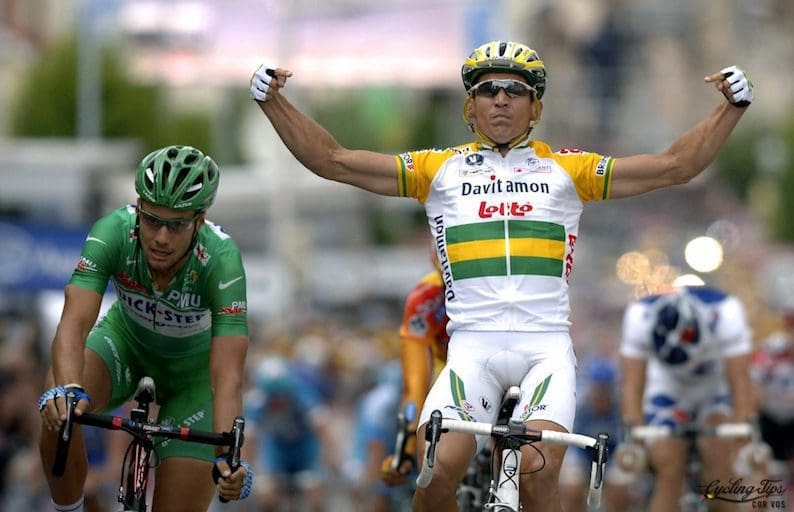
6. Robbie McEwen
Robbie McEwen was one of the sharpest Tour sprinters of the modern era. He did not need the most dominant lead-out train to win. He could surf wheels, appear late, cut through gaps and launch with a compact, violent kick that made him one of the hardest riders to read in a finale.
McEwen won the green jersey three times, in 2002, 2004 and 2006. That matters because the points classification demands consistency as well as speed. He had to survive the whole Tour, score repeatedly and beat some of the strongest sprinters of his era.
His style was different from Cavendish’s HTC train or Kittel’s full-power lead-out. McEwen often looked like a freelancer in the last kilometre, trusting instinct and nerve. That made him thrilling to watch and dangerous even when his team was not fully in control.
He also helped define Australian sprinting at the Tour, paving the way for later Australian fast finishers and points-classification riders. His rivalry with Zabel, Thor Hushovd, Baden Cooke and others gave the early 2000s green jersey battles real texture.
McEwen may not have Cavendish’s win total or Sagan’s record, but as a pure finisher with a Tour-specific record, he belongs high.
 Photo Credit: A.S.O./Pauline Ballet
7. Marcel Kittel
Marcel Kittel’s Tour de France peak was devastating. When he was delivered properly and in full form, very few riders in history have looked faster.
Kittel won 14 Tour stages, many of them through the kind of overwhelming power sprint that left rivals beaten before the line. His breakthrough in 2013 and dominance across 2014 and 2017 made him the leading pure sprinter of the post-Cavendish peak era.
His sprinting was different from Cavendish’s. Cavendish often won through timing, position and acceleration. Kittel won through horsepower, clean lead-outs and a huge finishing surge. If he opened from the right place, the race often looked over.
The limitation is that his Tour career was shorter and less complete. He never won the green jersey, and his peak did not last as long as the riders above him. But pure peak speed matters in a list of sprinters, and Kittel’s peak was extraordinary.
He also helped extend the era of German sprint dominance after Zabel and alongside André Greipel. For a few years, German sprinters were central to the Tour’s flat-stage identity, and Kittel was the sharpest point of that movement.
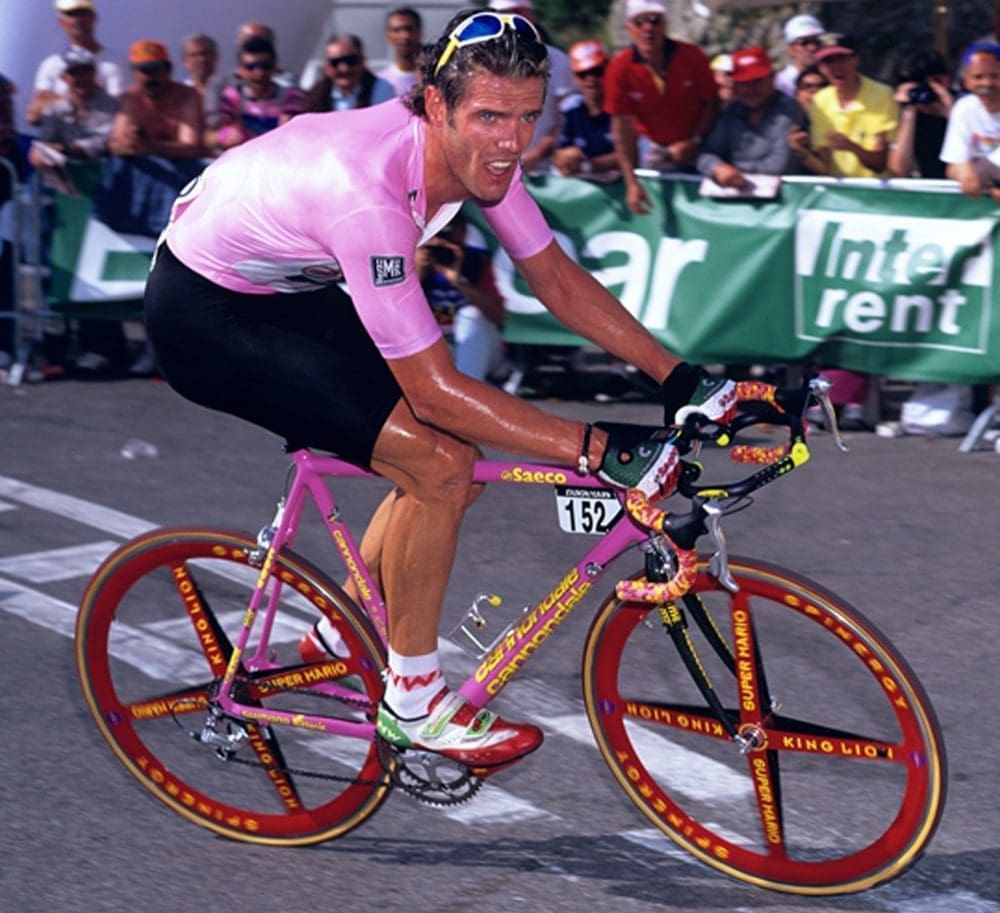
8. Mario Cipollini
Mario Cipollini’s Tour de France record is both brilliant and incomplete.
On one hand, he won 12 Tour stages and brought sprinting a level of theatre, glamour and lead-out precision that changed how people saw fast finishes. On the other, he never won the green jersey and often left the Tour before the mountains became too severe. That makes his overall Tour record less complete than his reputation as one of cycling’s greatest sprinters.
Cipollini was a master of image and intimidation. His teams built powerful lead-out trains, his sprint position was commanding, and his presence could make a flat stage feel like a performance even before the final kilometre.
He was perhaps more dominant at the Giro d’Italia than at the Tour, but his Tour wins still matter. He brought a style of sprinting that was clean, organised and almost regal when it worked. The “Lion King” was not just a nickname. It reflected how he carried himself in the peloton.
He ranks eighth because the Tour demands survival as well as speed. Cipollini’s stage wins were outstanding, but his Tour completeness was limited. As a pure sprinting figure, though, he remains unavoidable.
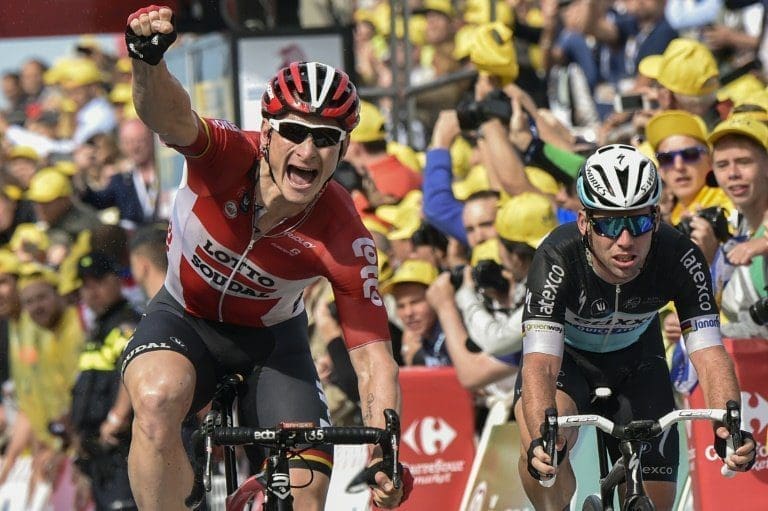
9. André Greipel
André Greipel was one of the most reliable Tour sprinters of his generation. He won 11 Tour stages and did it through power, discipline and repeated execution rather than theatre.
Greipel’s sprint was direct. He was not as improvisational as McEwen, not as culturally dominant as Cavendish and not as flamboyant as Cipollini. But when his lead-out worked and he launched cleanly, he was brutally hard to beat.
His Tour wins came across several years, which is important. Some sprinters have one brilliant edition. Greipel kept coming back and kept winning. That durability makes him more than just a power sprinter. It made him part of the race’s sprint landscape for much of the 2010s.
He also won during a very competitive era. Cavendish, Kittel, Sagan, Kristoff and others were all present across parts of his peak. Greipel’s victories were not soft.
He never built a green jersey legacy to match Zabel, Sagan or McEwen, which keeps him lower in this ranking. But as a Tour stage-winning sprinter, his record is excellent.
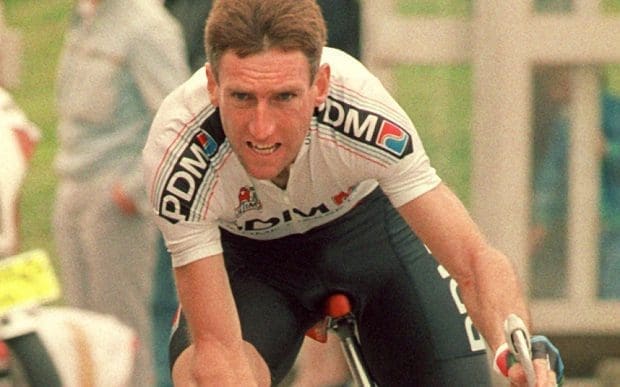
10. Sean Kelly
Sean Kelly was not a pure bunch sprinter in the modern sense, but he was one of the greatest points riders in Tour history.
Kelly won the green jersey four times, in 1982, 1983, 1985 and 1989. That record reflects the kind of rider he was: fast, tough, consistent and able to score on days that were far too hard for pure sprinters. He could win Classics, survive brutal terrain and still contest finishes.
That makes him closer to Sagan than Cavendish. Kelly’s Tour sprinting greatness was not about flat-stage domination. It was about points-classification intelligence, durability and range. He could finish well after hard racing, collect points across different stages and use his all-round strength to beat faster riders over three weeks.
In a list of pure sprinters, he might fall outside the top ten. In a list of Tour de France sprinters, he belongs because the green jersey is part of the race’s sprint culture.
Kelly represents the hardman version of Tour sprinting. Not the fastest over one perfect 200-metre drag, but one of the best at turning the whole race into a points battle.
Honourable mentions
Jasper Philipsen
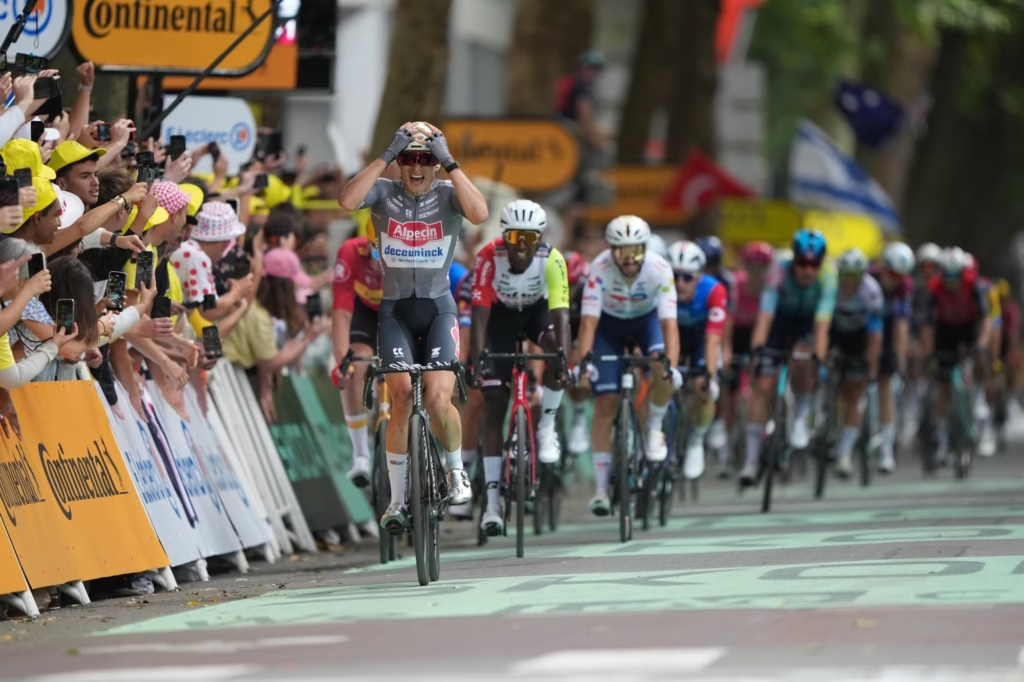
Jasper Philipsen has already built one of the strongest modern Tour sprint records, with double-digit stage wins and a green jersey. His top-end speed, positioning and lead-out support from Alpecin have made him the leading Tour sprinter of the early-to-mid 2020s. He needs more years of dominance to move into the all-time top ten, but he is heading towards that conversation.
His current Tour role is covered in our feature on Jasper Philipsen at the Tour de France 2026.
Thor Hushovd
Thor Hushovd won the green jersey twice and was one of the most durable points riders of his era. He was not always the fastest pure sprinter, but he could survive harder terrain than most and win in ways that pure bunch finishers could not.
Alessandro Petacchi
Alessandro Petacchi won multiple Tour stages and took the green jersey in 2010. His pure sprinting reputation is enormous, especially because of his Giro d’Italia dominance, but his Tour record is not quite deep enough to rank higher here.
Tom Boonen
Tom Boonen won Tour stages and the green jersey in 2007. His wider greatness came more through Classics and world championship racing, but his Tour sprinting record still deserves recognition.
Oscar Freire
Oscar Freire was a brilliant finisher and three-time world champion who also won Tour stages and the green jersey in 2008. He was more of a clever, versatile racer than a pure bunch-sprint machine.
Jan Janssen
Jan Janssen won the green jersey three times before later winning the Tour overall. His career sits between sprinting, points racing and general classification history, making him an important but difficult rider to place.
Eddy Merckx
Eddy Merckx won three points classifications and 34 Tour stages, but he is not ranked here as a sprinter because his Tour wins came across every type of terrain. He was the greatest all-rounder, not a sprint specialist. For more on his place in Tour history, see our Tour de France winners list and our feature on the greatest Tour de France winners.

Who has won the most Tour de France sprint stages?
Mark Cavendish holds the overall Tour de France stage-win record with 35 victories. Not every one of those can be reduced to a simple sprint label, but his record is overwhelmingly built around bunch finishes, making him the most successful Tour sprinter in history.
| Rider | Tour stage wins | Sprinting context |
|---|---|---|
| Mark Cavendish | 35 | Record stage winner and dominant bunch sprinter |
| André Darrigade | 22 | Early sprint-stage benchmark |
| Freddy Maertens | 15 | Explosive sprint and points-classification force |
| Marcel Kittel | 14 | Modern pure power sprinter |
| Peter Sagan | 12 | Points rider, reduced-sprint master and green jersey record-holder |
| Erik Zabel | 12 | Consistency and six green jerseys |
| Robbie McEwen | 12 | Three-time green jersey winner |
| Mario Cipollini | 12 | Pure speed and lead-out theatre |
| André Greipel | 11 | Durable power sprinter |
The numbers need context. A rider like Sagan won many stages that were not traditional flat bunch sprints. A rider like Cipollini had a smaller Tour footprint but a huge sprinting image. Cavendish stands above them because his stage-win volume and sprint identity line up so clearly.
Who has won the most green jerseys?
Peter Sagan holds the record for most Tour de France green jerseys, with seven. Erik Zabel is next with six, while Sean Kelly won four.
| Rider | Green jerseys |
|---|---|
| Peter Sagan | 7 |
| Erik Zabel | 6 |
| Sean Kelly | 4 |
| Jan Janssen | 3 |
| Eddy Merckx | 3 |
| Freddy Maertens | 3 |
| Robbie McEwen | 3 |
The green jersey is often called the sprinters’ jersey, but that is only partly true. It rewards points, not pure speed. That is why Sagan, Kelly and Hushovd could thrive even when they were not the fastest riders in a straight bunch finish.
For the modern points-race picture, see our Tour de France 2026 sprinters guide and our guide to the best sprinters at the Tour de France 2026.
Best Tour de France sprinters by category
| Category | Best choice | Why |
|---|---|---|
| Greatest pure Tour sprinter | Mark Cavendish | Record 35 stage wins |
| Greatest green jersey rider | Peter Sagan | Record seven points classifications |
| Most consistent green jersey sprinter | Erik Zabel | Six consecutive green jerseys |
| Best early Tour sprinter | André Darrigade | Huge stage-win total in a harder era |
| Most explosive single-Tour sprinter | Freddy Maertens | Eight stages in 1976 |
| Best wheel-surfer | Robbie McEwen | Won without always needing a dominant train |
| Best modern power sprinter | Marcel Kittel | Devastating peak speed |
| Most theatrical sprint icon | Mario Cipollini | Speed, image and lead-out showmanship |
| Best durable power sprinter | André Greipel | Repeated Tour wins across years |
| Best all-round points rider | Sean Kelly | Four green jerseys through toughness and range |
Why the green jersey does not always mean “best sprinter”
The Tour de France points classification rewards consistency. Points are available at stage finishes and intermediate sprints, and the weighting has changed over time. That means the green jersey can be won by different types of rider depending on the route and rules.
A pure sprinter can win green by dominating flat stages and surviving the mountains. A versatile rider can win by scoring on hilly stages, reduced sprints and intermediate points. A classics-style rider can sometimes beat faster sprinters because he has more chances to score across the race.
That is why Cavendish can be the greatest Tour sprinter without having the most green jerseys. His strongest claim is stage wins. Sagan’s strongest claim is the points classification. Zabel sits between the two because his entire Tour identity was built on repeat scoring.
The green jersey is not a perfect sprinting ranking. It is a different test.
How Tour sprinting has changed
Early Tour sprints were less controlled and less specialised. Riders had to survive rougher roads, longer stages and less predictable race conditions. That is why Darrigade’s record still carries so much weight.
By the 1990s and 2000s, sprinting became more structured. Teams increasingly built lead-out trains around one fast finisher. Cipollini helped turn that into an art form. Zabel showed how points consistency could be managed across three weeks. McEwen showed that a rider without the most dominant train could still win through instinct.
Then came Cavendish and the HTC era, where lead-out precision reached a new level. Kittel and Greipel brought huge German power to the 2010s. Sagan stretched the definition of the sprinter by turning the green jersey into a competition for versatile attackers as much as flat-stage specialists.
Modern Tour sprinting now sits somewhere between those worlds. A sprinter needs a lead-out, but also positioning intelligence. He needs top-end speed, but also the ability to survive hills. He needs a team, but also the nerve to make decisions alone when the final kilometre goes wrong.
That is why sprinting at the Tour remains so compelling. It looks simple only from a distance. The current importance of those systems is covered in our guide to the best lead-out riders at the Tour de France 2026.
The greatest Champs-Élysées sprinters
The Paris finish has become the symbolic sprinter’s world championship inside the Tour. Winning on the Champs-Élysées carries a special weight because it comes after three weeks of survival and in front of the race’s biggest final-day audience.
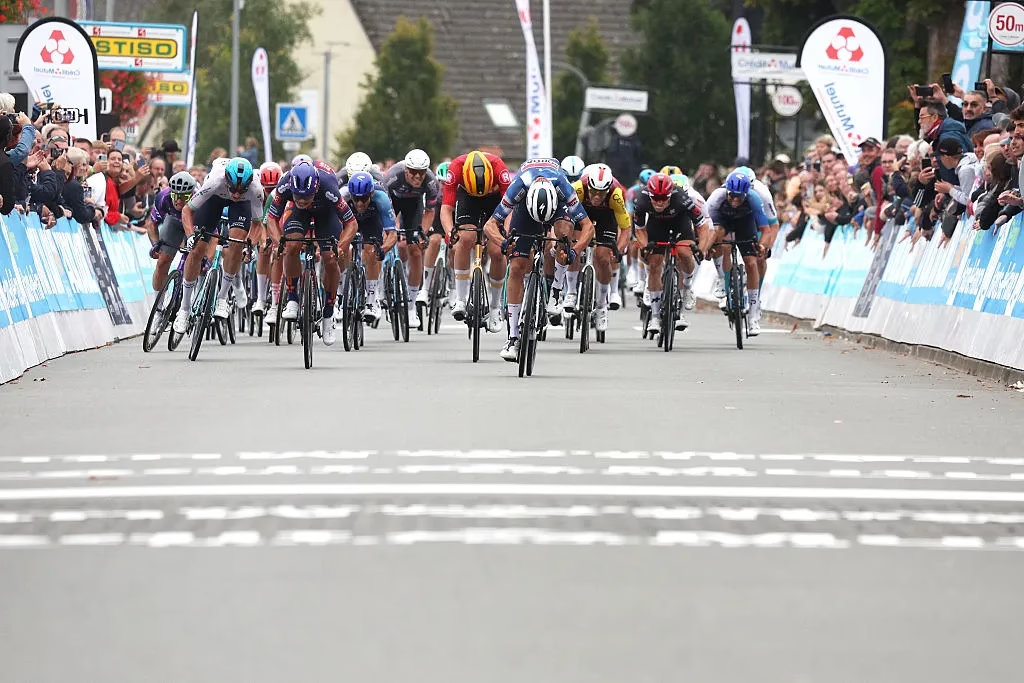
Cavendish is the defining Paris sprinter of the modern era. His repeated wins there helped turn the finish into part of his legend. Kittel also won in Paris, including on stages where his power looked almost untouchable. Greipel, McEwen, Cipollini and others all added to the history of the race’s final sprint.
Paris matters because it asks a different question from an early flat stage. Who still has speed after the mountains? Who still has a team? Who can handle the long wait, the circuits, the nerves and the pressure of the final stage?
The best Tour sprinters are not only fast in week one. They can still win when everyone is exhausted. That is also why the Tour’s flat-stage opportunities matter so much across the route, as shown in our guide to the Tour de France 2026 route’s best days for sprinters.
-
 Photo Credit: Cor Vos
FAQs: greatest Tour de France sprinters
Who is the greatest Tour de France sprinter?
Mark Cavendish is the greatest Tour de France sprinter because he holds the all-time record with 35 stage wins and built that record mainly through bunch sprint victories.
Who has won the most Tour de France stages?
Mark Cavendish has won the most Tour de France stages, with 35 victories.
Who has won the most green jerseys?
Peter Sagan has won the most green jerseys, with seven Tour de France points classification victories.
Is Peter Sagan a sprinter?
Peter Sagan was not a pure bunch sprinter like Mark Cavendish or Marcel Kittel, but he was one of the greatest points riders and reduced-sprint finishers in Tour history.
Is Mark Cavendish better than Peter Sagan?
As a pure Tour sprinter, Cavendish ranks higher because of his record 35 stage wins. As a green jersey rider, Sagan ranks higher because he won the points classification seven times.
Who was the best German Tour sprinter?
Erik Zabel is the greatest German Tour sprinter by green jersey record, while Marcel Kittel had the highest pure sprinting peak and André Greipel had outstanding longevity.
Did Mario Cipollini win the green jersey?
No. Mario Cipollini won 12 Tour stages but never won the green jersey. His Tour legacy is built on sprint victories, image and lead-out dominance rather than three-week points consistency.
Who is the best current Tour de France sprinter?
The 2026 Tour split the answer depending on what is being measured. Tim Merlier was the outstanding pure bunch sprinter, winning three stages before leaving the race, while Mads Pedersen won the green jersey through consistency, breakaway aggression and repeated points scoring. Jasper Philipsen remained among the fastest riders, adding another stage victory and finishing second in Paris.
Final ranking: the greatest Tour de France sprinters
| Rank | Rider |
|---|---|
| 1 | Mark Cavendish |
| 2 | Peter Sagan |
| 3 | Erik Zabel |
| 4 | André Darrigade |
| 5 | Freddy Maertens |
| 6 | Robbie McEwen |
| 7 | Marcel Kittel |
| 8 | Mario Cipollini |
| 9 | André Greipel |
| 10 | Sean Kelly |
Final word
The greatest Tour de France sprinters are not all the same kind of rider.
Cavendish was the record-breaking finisher. Sagan was the green jersey phenomenon. Zabel was the master of consistency. Darrigade was the early benchmark. Maertens was the explosive force. McEwen was the wheel-surfer. Kittel was the power peak. Cipollini was the showman. Greipel was the durable heavyweight. Kelly was the hardman points rider.
That variety is what makes Tour sprinting richer than a simple dash to the line. It is speed, but it is also survival, positioning, team craft, calculation and nerve.
On that measure, Cavendish stands first. He did not just win sprints at the Tour de France. He turned the bunch finish into his own historical record.

