
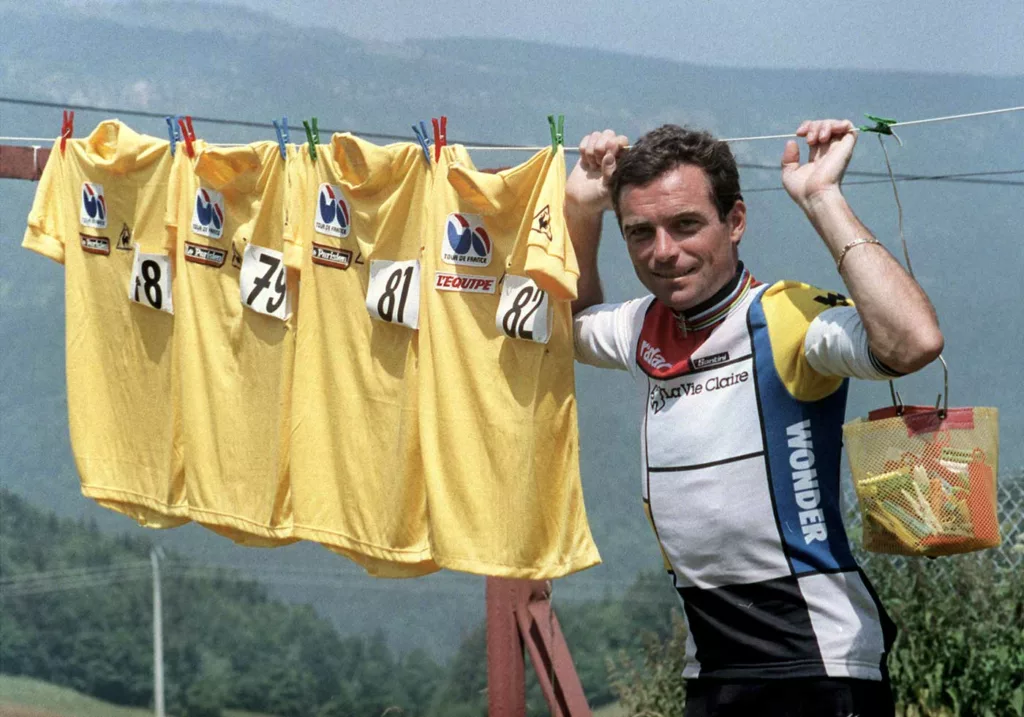
Eddy Merckx leads our ranking of the greatest Tour de France winners, with Bernard Hinault, Miguel Indurain, Jacques Anquetil and Tadej Pogačar completing the top five. All five have won the race five times, but their victories were built on different strengths: Merckx’s range, Hinault’s attacking approach, Indurain’s time-trialling, Anquetil’s control and Pogačar’s combination of climbing and aggression.
Pogačar’s fifth victory in 2026 brings him level with the four riders who previously shared the record. Comparing them requires more than counting titles. The quality of their opposition, how they won, their setbacks and the racing conditions of each era all inform the order below.
This is an editorial ranking of official Tour winners. Lance Armstrong’s seven stripped titles are excluded, and the 1999–2005 editions remain without an official winner.

Quick answer: who is the greatest Tour de France winner?
Eddy Merckx is the greatest Tour de France winner because he combined five overall victories with complete domination of the race. He won the general classification, points classification, mountains classification and combativity award in 1969, then continued to control the Tour across the early 1970s. Bernard Hinault, Miguel Indurain, Jacques Anquetil and Tadej Pogačar complete the leading group.
| Rank | Rider | Tour wins | Why they belong in the conversation |
|---|---|---|---|
| 1 | Eddy Merckx | 5 | The most complete Tour winner |
| 2 | Bernard Hinault | 5 | Aggression, range and authority |
| 3 | Miguel Indurain | 5 | The only rider to win five Tours in a row |
| 4 | Jacques Anquetil | 5 | The first five-time winner and master of control |
| 5 | Tadej Pogačar | 5 | The modern all-rounder redefining Tour dominance |
| 6 | Chris Froome | 4 | The best Tour rider of the 2010s |
| 7 | Greg LeMond | 3 | Talent, comeback and the 1989 epic |
| 8 | Louison Bobet | 3 | The first rider to win three Tours in succession |
| 9 | Fausto Coppi | 2 | One of cycling’s greatest talents, even with fewer Tour wins |
| 10 | Gino Bartali | 2 | Longevity, wartime interruption and historical weight |
How to rank the greatest Tour winners
There is no perfect formula, but a serious ranking needs more than a win total.
The main factors are:
| Factor | Why it matters |
|---|---|
| Number of Tour wins | The simplest measure of repeated success |
| Dominance | How much control the rider had over the race |
| Quality of opposition | Beating great rivals adds weight |
| Range | Climbing, time-trialling, stage wins, tactics and team command |
| Historical importance | Some riders changed the Tour’s direction |
| Context | War, injury, route design, team strength and era all matter |
This is why a rider with fewer wins can still rank highly. Fausto Coppi won the Tour only twice, but his wider stature in cycling and the way he won make him impossible to ignore. Greg LeMond won three, but his 1989 victory remains one of the defining moments in Tour history.
Equally, five wins do not all look the same. Merckx, Hinault, Indurain and Anquetil each reached the same number, but they did it in very different ways. For more on how the race itself developed across those eras, see our brief history of the men’s Tour de France.
1. Eddy Merckx
Eddy Merckx is the clearest answer to the question. He was not just a five-time Tour de France winner. He was the rider who made domination feel total.
Merckx won the Tour in 1969, 1970, 1971, 1972 and 1974. His first victory in 1969 was outrageous even by the standards of the sport’s greatest riders. He won the yellow jersey, green jersey, mountains classification and combativity prize in the same race. That was not simply winning the Tour. It was occupying it.
What separates Merckx from the other five-time winners is range. He could climb, time trial, sprint from reduced groups, attack from distance and win Classics around the same period. At the Tour, he did not only defend a lead. He attacked as if control was not enough.
That made him both loved and feared. Merckx was called “The Cannibal” because he seemed unable to leave anything for anyone else. The nickname could sound excessive, but it described the reality of his racing. If a stage, jersey, time bonus or psychological blow was available, he wanted it.
His Tour record is not just about five overall titles. It is about the feeling that he could have won in almost any way the race asked of him. Even his setbacks became part of Tour mythology, including the famous Puy de Dôme episode explored in our feature on the climb that punched Merckx from his throne.
Merckx’s success across several classifications is easier to appreciate when their different demands are clear. The general classification is decided by cumulative time, while the green jersey rewards points collected at finishes and intermediate sprints. Winning both requires a rider to combine overall race management with repeated scoring opportunities.
2. Bernard Hinault
Bernard Hinault was the last Frenchman to win the Tour de France, and he remains one of the race’s most forceful champions. He won in 1978, 1979, 1981, 1982 and 1985, making him part of the five-time group alongside Anquetil, Merckx and Indurain.
Hinault’s greatness comes from authority. He was not a passive Tour winner. He imposed himself on races, rivals and teams. He could win through time trials, mountain control, tactical violence and sheer refusal to be managed by others.
His 1978 debut win introduced him as a rider of rare confidence. His 1979 victory confirmed the pattern. His 1981 and 1982 wins showed a rider at the centre of a highly effective Renault machine. Then came 1985, when he won a fifth Tour with La Vie Claire while carrying injuries, internal tension and the growing presence of Greg LeMond.
Hinault’s Tour career is also important because it sits at the hinge between two eras. He was old-school in force and personality, but his teams were increasingly modern in preparation and structure. He could look like a throwback and a prototype at the same time. His wider career and personality are covered in more detail in our profile of Bernard Hinault, aggression, authority and the last rider to own the sport this completely.
The case for Hinault over Indurain and Anquetil is simple: he had more visible aggression, greater emotional force and a wider sense of threat across different race situations. When Hinault was in a Tour, the race bent around him. That is also why he sits at the top of our ranking of the greatest French riders at the Tour de France.
3. Miguel Indurain
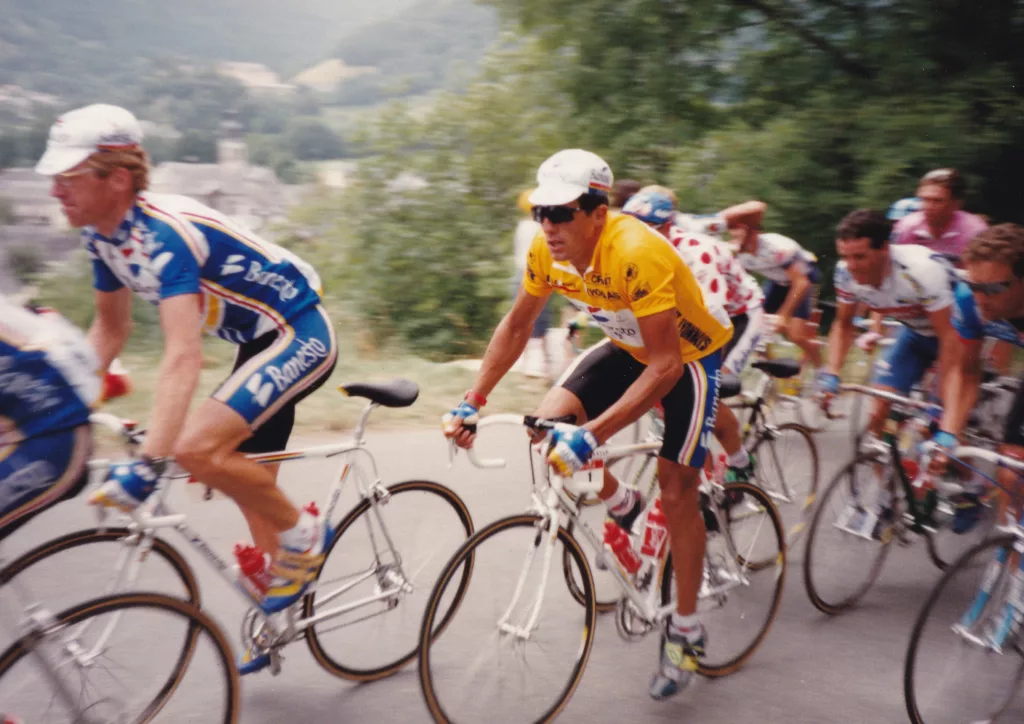
Miguel Indurain won the Tour de France five times in a row from 1991 to 1995. Nobody else has done that.
His dominance was quieter than Merckx’s and less confrontational than Hinault’s, but it was no less imposing. Indurain turned the Tour into a controlled exercise in climbing resilience and time-trial destruction. He did not need to attack constantly because he could build such large advantages against the clock that his rivals were forced into desperation.
That style made him look almost serene. His face rarely gave away much. His body language was smooth, his racing economical, and his control of the Tour often felt inevitable. Yet there was nothing soft about it. Indurain’s rivals knew that one long time trial could effectively decide the race.
His era also marks the peak of the Tour as a battle between mountain survival and time-trial supremacy. Indurain could climb well enough to neutralise the best, then crush them in the race of truth.
The argument against him being first is that his wins were less varied than Merckx’s and less explosive than Hinault’s. The argument for him being very high is just as strong: five consecutive Tour wins remains one of the most extraordinary achievements in the race’s history.
4. Jacques Anquetil
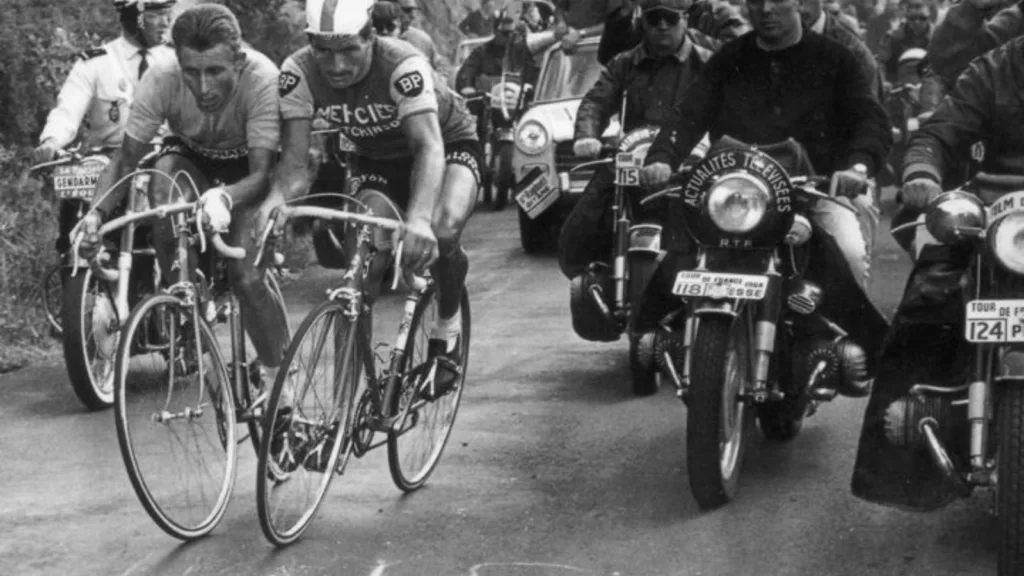
Jacques Anquetil was the first rider to win the Tour de France five times. That alone gives him a permanent place near the top of any serious list.
He won in 1957, then again in 1961, 1962, 1963 and 1964. His greatness was built on control, calculation and supreme time-trialling. If Merckx devoured the Tour and Hinault bullied it, Anquetil measured it. He understood where races were won, where energy could be saved and how to turn the time trial into a weapon that rivals could not answer.
Anquetil’s image was not always universally loved. Raymond Poulidor, his great rival, was often more popular with the French public despite never winning the Tour. That rivalry, especially around the 1964 race, gave Anquetil’s career a dramatic edge. He was the champion of precision, but not always the champion of sentiment.
His importance is partly statistical and partly symbolic. Before Anquetil, five Tour wins was not the standard. He created that ceiling. Everyone who reached it afterwards was measured against him.
He ranks below Merckx, Hinault and Indurain here because his broader dominance feels less complete across the full range of Tour terrain. But as a Tour strategist and time-trial champion, he remains one of the most important winners the race has ever had.
5. Tadej Pogačar
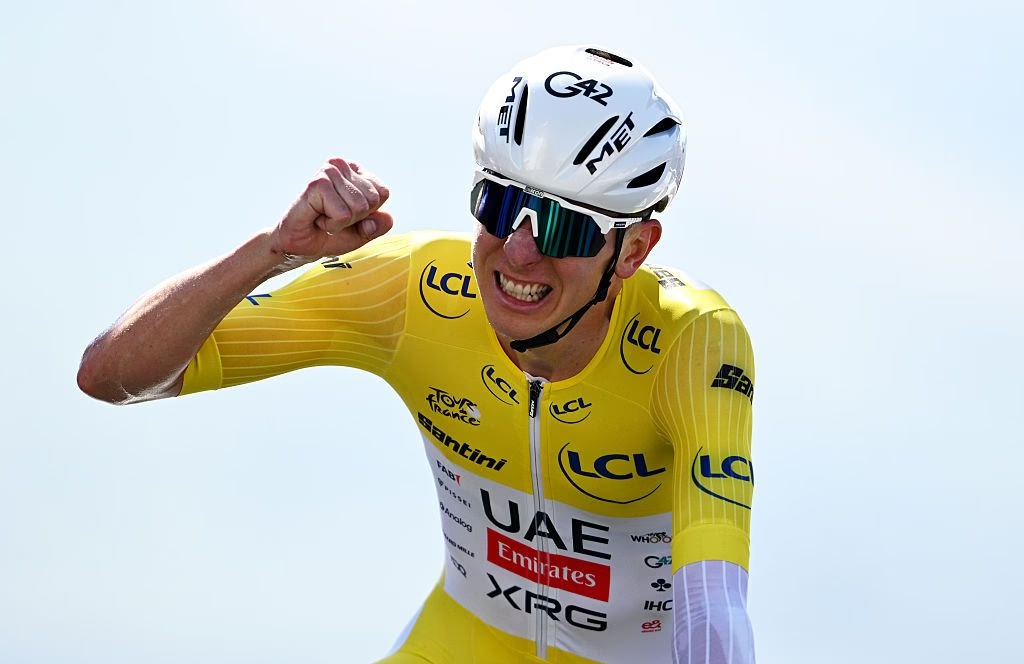
Tadej Pogačar won the Tour de France in 2020, 2021, 2024, 2025 and 2026. His fifth title, secured in Paris, brought him level with Jacques Anquetil, Eddy Merckx, Bernard Hinault and Miguel Indurain at the top of the official winners’ record.
His Tour career already contains several distinct phases. The late reversal against Primož Roglič in 2020 established him as a rider capable of overturning a race when the result appeared settled. He defended his title in 2021, lost to Jonas Vingegaard in 2022 and 2023, then returned to win three consecutive editions.
That response to defeat strengthens his place in this ranking. His success has required changes in preparation and race management as well as exceptional climbing. His willingness to attack across different terrain also makes him difficult to compare directly with champions whose Tours were built more narrowly around time-trial gains and mountain defence.
Fifth place remains an editorial judgement, rather than a distinction in his number of victories. He now matches the four riders above him on titles, and there is a credible argument for placing him higher. We retain the historical order here while recognising that his continuing career can change the comparison further.
6. Chris Froome
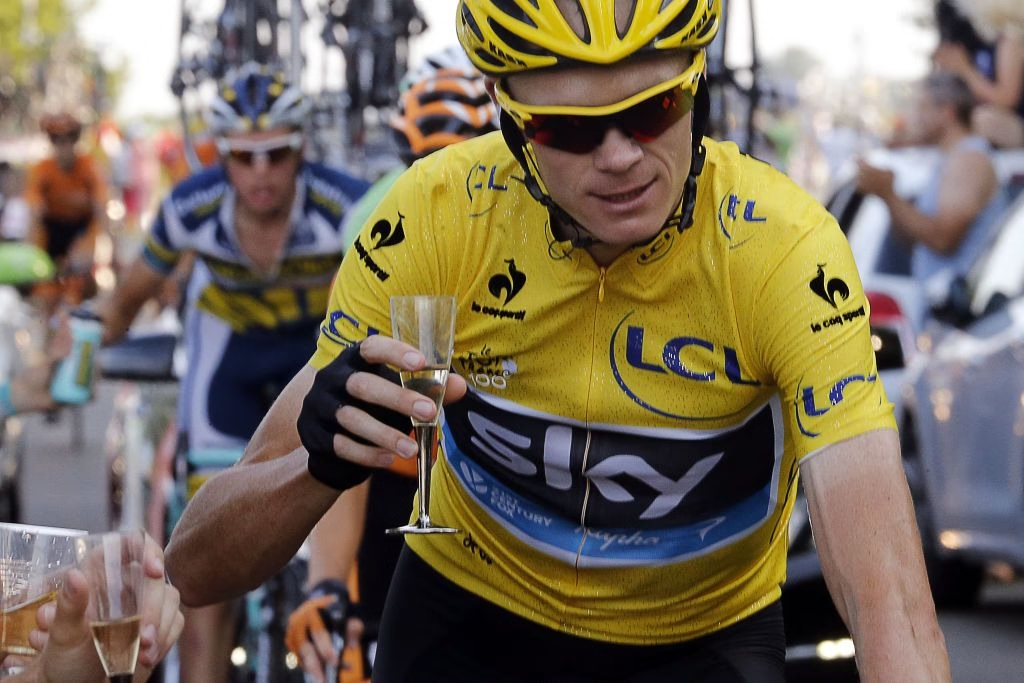
Chris Froome is the greatest Tour de France winner of the 2010s. He won in 2013, 2015, 2016 and 2017, and for several years he was the defining rider of the race.
Froome’s greatness was not romantic in the traditional sense. His Tour dominance came through climbing accelerations, careful pacing, team control and a level of consistency that broke rivals gradually. Team Sky’s strength framed his era, but Froome was not simply a passenger in a machine. He delivered when the race demanded it.
His 2013 victory on Mont Ventoux remains one of the iconic images of his peak. His 2016 win showed tactical variety, including the downhill attack into Bagnères-de-Luchon and the famous running incident on Mont Ventoux. His 2017 victory was narrower and more controlled, but still confirmed his ability to manage pressure.
Froome’s career also carries complexity. His dominance came during an era of suspicion towards team control, medical questions and the legacy of cycling’s damaged past. That affects how some fans remember him. Yet on official record and sporting impact, his place is secure.
Four Tours, a Giro, two Vueltas and a period holding all three Grand Tour titles at once make him one of the most successful stage racers of the modern era. As a Tour winner, only the five-time champions and Pogačar sit above him here. For more British context, see our feature on the greatest British riders at the Tour de France.
7. Greg LeMond
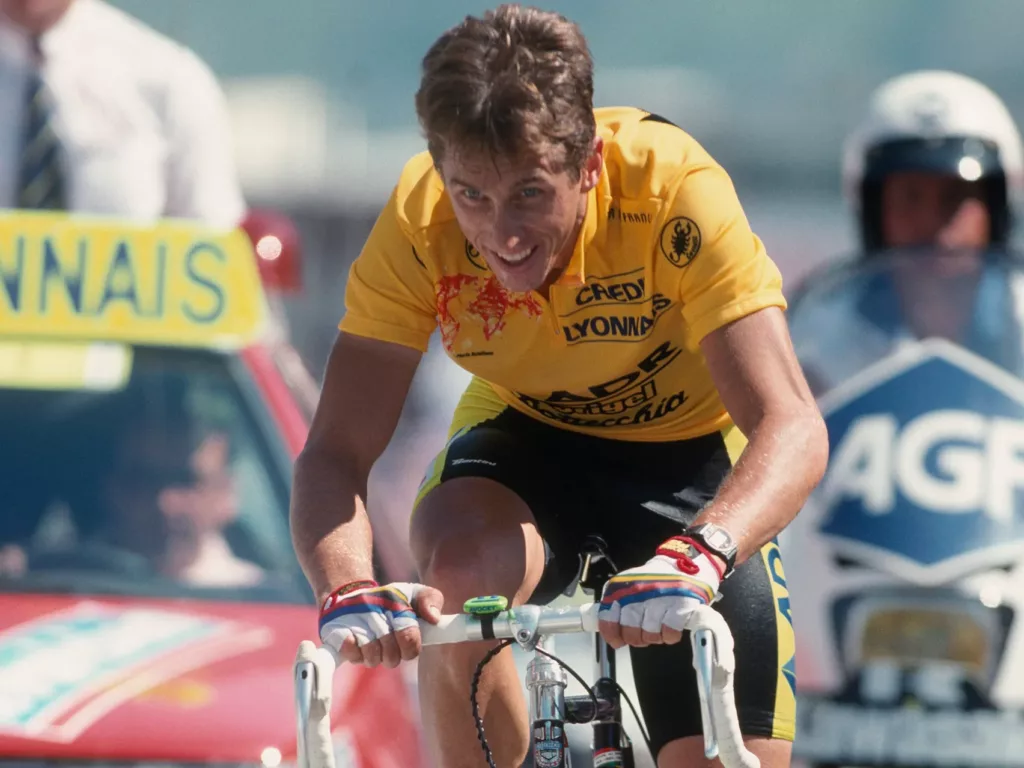
Greg LeMond won the Tour de France three times, in 1986, 1989 and 1990. His place among the greatest winners is not only about the number. It is about what those wins represented.
LeMond was the first non-European rider to win the Tour, changing the race’s geography and imagination. His 1986 victory came after the internal tension of La Vie Claire, where he had to navigate the presence of Bernard Hinault while still proving himself as the team’s strongest future. That win opened the door for a broader, more international Tour.
Then came the hunting accident that nearly killed him. His return to win the 1989 Tour by eight seconds remains one of the greatest comebacks in cycling history and one of the most famous finales in all sport. The final time trial into Paris against Laurent Fignon still carries almost mythic status.
LeMond then won again in 1990, proving that 1989 was not a miracle without continuation. He was a complete rider: smart, aerodynamic, tactically aware, strong against the clock and resilient in the mountains.
He ranks behind Froome because he won one fewer Tour, but his historical importance is arguably greater. LeMond changed who could imagine winning the Tour. His broader story is covered in our profile of Greg LeMond, the American who changed the Tour story, while the team context around Hinault and LeMond is explored in our La Vie Claire team history.
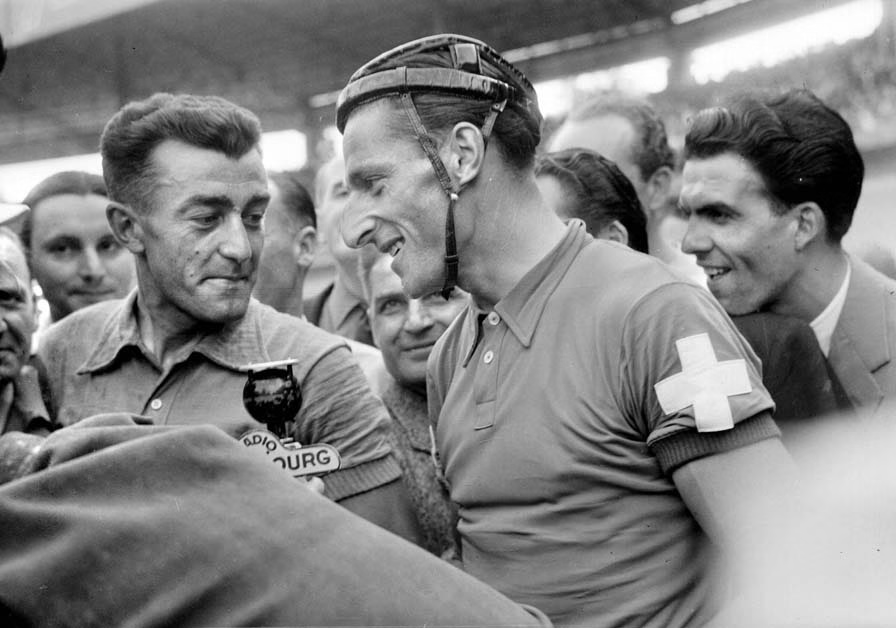 Photo Credit: Roger Viollet/Getty
8. Louison Bobet
Louison Bobet deserves more attention in modern discussions of Tour greatness. He won the race three years in a row, from 1953 to 1955, becoming the first rider to complete a Tour hat-trick in consecutive editions.
That achievement matters. The Tour had already built a deep history by the 1950s, but Bobet gave the post-war race a new kind of champion. He was elegant, determined and increasingly complete, developing from a talented but fragile figure into a rider capable of carrying the expectations of French cycling.
His victories came in an era when the Tour was still physically brutal and tactically unpredictable. Roads, equipment, recovery and team structures were very different from the modern race. Repeating success under those conditions required not only class but durability.
Bobet does not have the global profile of Merckx, Hinault or Coppi, but within Tour history his place is substantial. Three consecutive wins put him among the great repeat champions.
9. Fausto Coppi
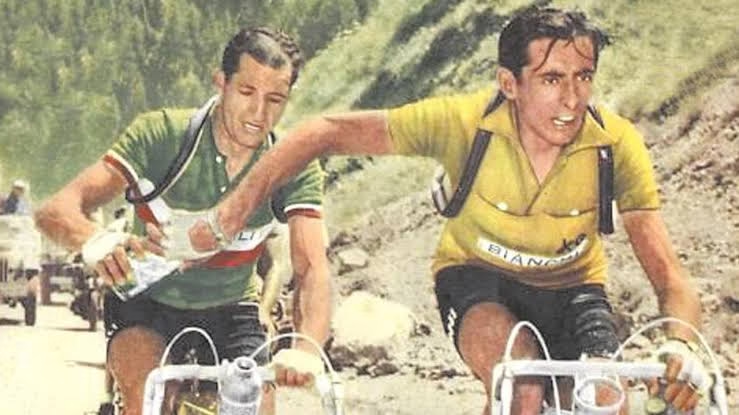
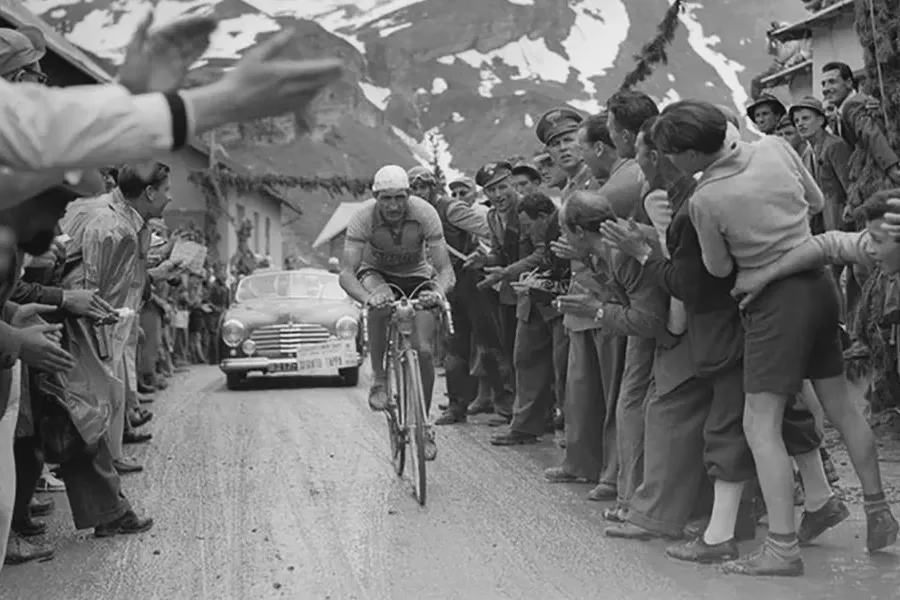
Fausto Coppi won the Tour de France twice, in 1949 and 1952. On win count alone, he should not be this high. On talent, aura and the manner of his victories, he has to be.
Coppi was one of the greatest cyclists who ever lived. His career was interrupted by the Second World War, which makes simple comparisons difficult. Without that lost time, his Tour record might have looked very different.
His 1949 Tour win was part of a Giro-Tour double, and he repeated the double in 1952. That alone shows his range and recovery. Coppi could climb with devastating smoothness, time trial with authority and impose himself in a way that made rivals look limited.
He was not a Tour specialist in the modern sense. He was a complete champion whose greatness spread across the Giro, Tour, Classics and world stage. That is why he belongs in this list despite only two yellow jerseys.
The Tour record book may not place him near the five-time winners, but the sport’s memory does.
10. Gino Bartali
Gino Bartali won the Tour de France in 1938 and 1948. That ten-year gap is one of the most remarkable details in the race’s history.
His career, like Coppi’s, was interrupted by war. That makes his record difficult to judge by modern numbers. Bartali was already a great champion before the war, then returned to win the Tour again a decade later. Few riders in any era have shown that kind of longevity.
His 1948 victory also carried national significance in Italy during a period of political tension. Cycling history often turns riders into symbols, sometimes unfairly, but Bartali’s second Tour win really did feel larger than sport.
As a rider, he was a powerful climber, a resilient competitor and one of the defining figures of the pre- and post-war years. His rivalry with Coppi also helped shape Italian cycling’s golden mythology.
He ranks tenth here because his Tour win total is lower than several others, but his historical weight is immense.
Honourable mentions
Jonas Vingegaard
Jonas Vingegaard won the Tour in 2022 and 2023, beating Pogačar in both editions and producing one of the strongest climbing and time-trial performances of the modern era in 2023. He is already a major Tour winner, but he needs more titles or another defining comeback to climb into the top ten. His 2026 challenge is covered in our feature on Jonas Vingegaard at the Tour de France 2026.
Alberto Contador
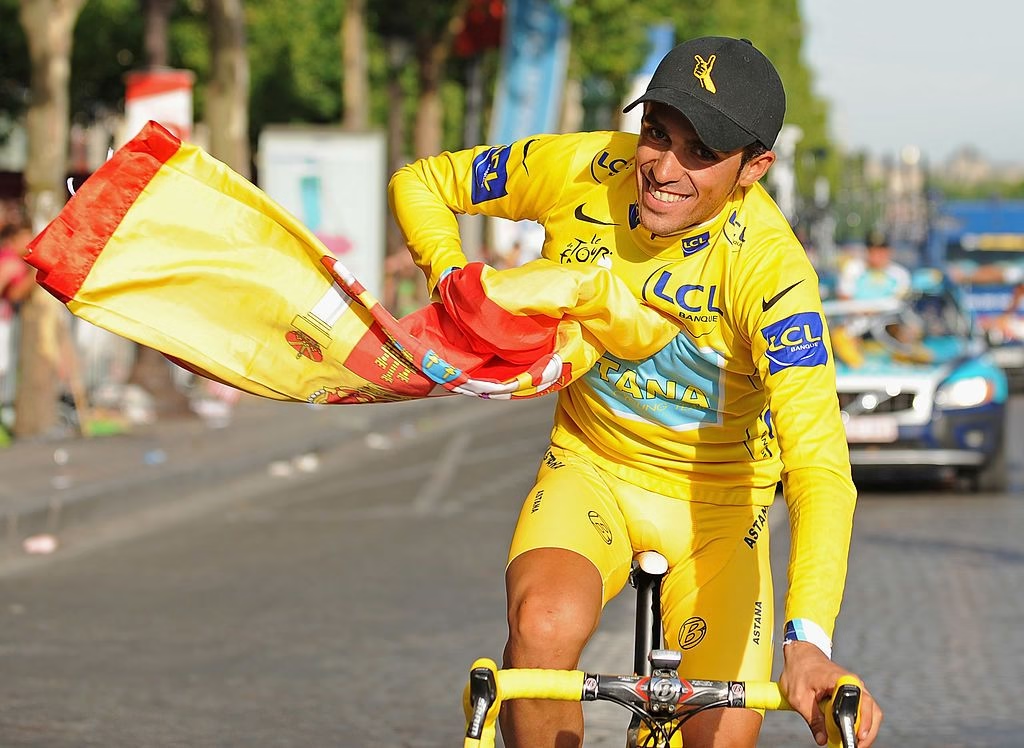
Alberto Contador officially has two Tour de France wins, in 2007 and 2009, after his 2010 title was stripped. At his best, he was one of the most explosive Grand Tour riders of his generation, but his official Tour record and later sanction make his place complicated.
Philippe Thys
Philippe Thys won the Tour three times before the First World War era fully gave way to modern cycling. His place in the early record book is important, but comparisons with later champions are difficult because the race itself was so different.
Laurent Fignon
Laurent Fignon won the Tour in 1983 and 1984, then lost the 1989 edition by eight seconds. His peak was brilliant, stylish and sharp, but injury, rivalry and the narrowest defeat in Tour history left him with two wins rather than three.
Jan Ullrich
Jan Ullrich won the Tour in 1997 and spent much of his career as one of the strongest riders in the race. He had the talent for more than one yellow jersey, but timing, pressure, rivals and controversy define his story as much as his victory. His wider team environment is part of the story told in our Telekom team history.
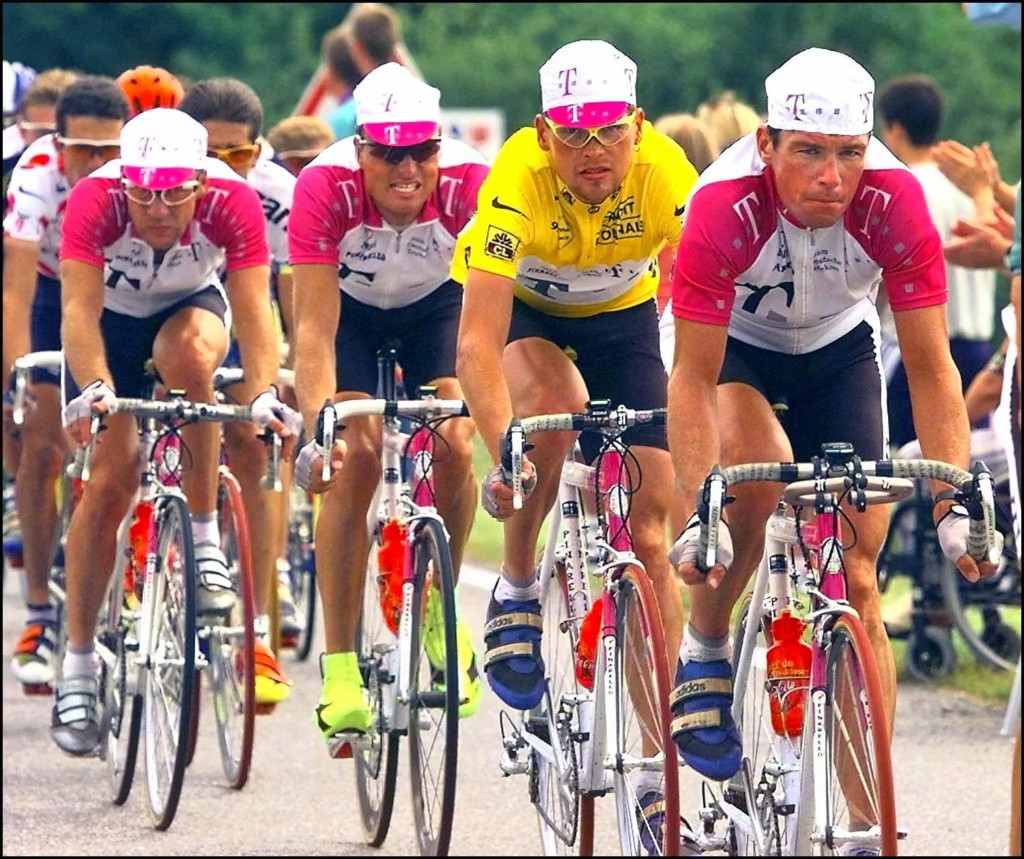 Photo Credit: Getty
Who has won the Tour de France the most times?
Five riders share the official record of five Tour de France victories. Pogačar joined the group in 2026, while Indurain remains the only rider to have won five consecutive editions.
| Rider | Official Tour victories | Winning years |
|---|---|---|
| Jacques Anquetil | 5 | 1957, 1961, 1962, 1963, 1964 |
| Eddy Merckx | 5 | 1969, 1970, 1971, 1972, 1974 |
| Bernard Hinault | 5 | 1978, 1979, 1981, 1982, 1985 |
| Miguel Indurain | 5 | 1991, 1992, 1993, 1994, 1995 |
| Tadej Pogačar | 5 | 2020, 2021, 2024, 2025, 2026 |
Why Lance Armstrong is not included
Lance Armstrong is not included because his seven Tour de France titles from 1999 to 2005 were stripped after the United States Anti-Doping Agency investigation and subsequent UCI action.
That leaves no official winner for those editions. Any ranking of official Tour winners has to exclude Armstrong, regardless of the scale of his influence on the race’s history and public perception.
This is not a footnote. It changed the Tour’s record book, its reputation and how every later champion is judged.
Greatest Tour de France winners by category
| Category | Best choice | Why |
|---|---|---|
| Greatest overall Tour winner | Eddy Merckx | Most complete dominance |
| Greatest French Tour winner | Bernard Hinault | Five wins and unmatched authority |
| Greatest time-trial Tour winner | Miguel Indurain | Built five consecutive wins on time-trial power |
| Greatest tactical Tour winner | Jacques Anquetil | Master of control and calculation |
| Greatest modern Tour winner | Tadej Pogačar | Most expansive modern champion |
| Greatest comeback winner | Greg LeMond | 1989 after near-fatal injury |
| Greatest 21st-century official winner | Tadej Pogačar | Five Tours and peak stage-race consistency |
-
 Photo Credit: Cor Vos
FAQs: greatest Tour de France winners
Who is the greatest Tour de France winner?
Eddy Merckx is usually the strongest answer. He won the Tour five times and dominated the race in more ways than any other rider, including overall victory, stages, points, mountains and aggressive racing.
Who has won the most Tour de France titles?
Jacques Anquetil, Eddy Merckx, Bernard Hinault, Miguel Indurain and Tadej Pogačar share the official record with five Tour de France victories each.
Has anyone won six Tours de France?
No rider has officially won six Tour de France titles. The official record is five.
Why is Lance Armstrong not listed as the greatest Tour winner?
Lance Armstrong is not listed because his seven Tour de France titles were stripped. He is not an official Tour de France winner.
Who is the greatest modern Tour de France winner?
Tadej Pogačar has the strongest claim among current and recent riders because of his five Tour wins after 2026, his attacking style and his wider dominance across the sport. Chris Froome remains the defining Tour winner of the 2010s.
Who was the first five-time Tour de France winner?
Jacques Anquetil was the first rider to win the Tour de France five times.
Who is the only rider to win five Tours in a row?
Miguel Indurain is the only rider to win five consecutive Tours, from 1991 to 1995.
Final ranking: the greatest Tour de France winners
| Rank | Rider | Tour wins |
|---|---|---|
| 1 | Eddy Merckx | 5 |
| 2 | Bernard Hinault | 5 |
| 3 | Miguel Indurain | 5 |
| 4 | Jacques Anquetil | 5 |
| 5 | Tadej Pogačar | 5 |
| 6 | Chris Froome | 4 |
| 7 | Greg LeMond | 3 |
| 8 | Louison Bobet | 3 |
| 9 | Fausto Coppi | 2 |
| 10 | Gino Bartali | 2 |
Final word
The greatest Tour de France winners are not only the riders with the most yellow jerseys. They are the riders who changed what winning the Tour meant.
Anquetil made five wins possible. Merckx made domination total. Hinault made authority feel physical. Indurain made control almost mathematical. Froome made the modern team era brutally efficient. LeMond made the Tour global. Pogačar has brought back the sense that a Tour winner can also be the most adventurous rider in the sport.
That is why Merckx still stands first. He did not simply win the Tour de France. He consumed it. Until another rider matches that breadth of dominance, the Cannibal remains the greatest Tour winner of them all.

