The Flandriencross at Hamme has been part of Belgian cyclocross since 2002, when the event began as the Bollekescross in the village of Zogge. Its history links two generations of the Nys family, a long period of dominance by Mathieu van der Poel and the modern X²O Badkamers Trofee. The race has also changed its place on the calendar and its competitive character, which makes a simple list of winners only part of the story.
The 2025 edition illustrated why Hamme still matters. Thibau Nys beat Cameron Mason after a close contest on a muddy circuit, with Joris Nieuwenhuis recovering from an early crash to finish third. In the women’s race, Lucinda Brand defeated Inge van der Heijden and Aniek van Alphen. Those results added another chapter to an event that had already been won by Sven Nys, Wout van Aert, Van der Poel and several generations of leading women’s riders.
From Bollekescross to Flandriencross
The first edition was held in 2002, organised by Jurgen Mettepenningen. The name Bollekescross came from the De Koninck beer brand, known for its Bolleke, which was associated with the event’s early sponsorship. Zogge is part of the municipality of Hamme in East Flanders, so references to Hamme and Hamme-Zogge describe the same broader race location rather than separate international events.
Sven Nys won that inaugural race ahead of Bart Wellens and Mario De Clercq. It was a striking opening podium, placing three major names in Belgian cyclocross at the front of the first edition. The event quickly established a place on the winter calendar, benefiting from Belgium’s appetite for technically demanding races and a strong local audience.
The Bollekescross became associated with the Superprestige series for much of its early history, before moving into the competition now known as the X²O Badkamers Trofee. The switch mattered because the two competitions reward riders differently. The Superprestige is traditionally a points-based series, whereas the X²O overall classification is based on accumulated race times, with time bonuses and penalties affecting the standings.
The Flandriencross name was adopted in 2014, connecting the event with the image of the Flandrien, the hard-riding Belgian cyclist associated with resilience in difficult conditions. The name also reflected the connection with Greg Van Avermaet, who grew up in Hamme and had received the Flandrien of the Year award. The change gave the race a more distinctive identity than its original sponsor-led title.
Sven Nys and the first generation of winners
Sven Nys’s seven victories make him one of the central figures in the history of the men’s race. His first win in 2002 set the tone, and his later success reflected the consistency that made him a defining cyclocross rider over more than a decade. Hamme was not a one-off appearance on his palmarès: it was a race to which he repeatedly returned as a contender.
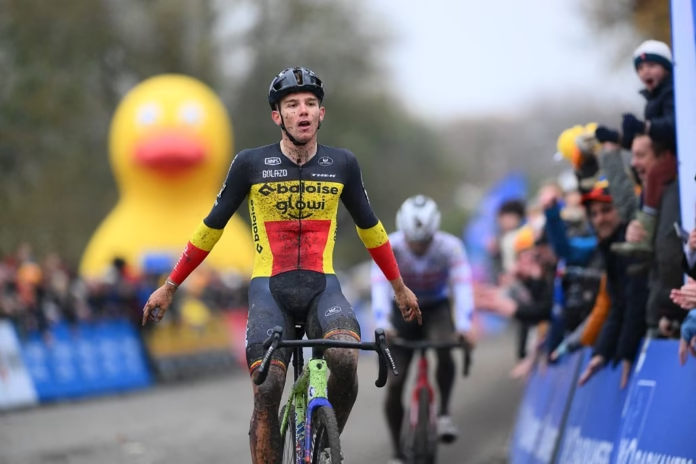
That history gained a new dimension in November 2025 when his son Thibau won the elite men’s Flandriencross. It was a connection across generations rather than a ceremonial moment. Thibau had to beat one of the strongest British cyclocross riders, Cameron Mason, in a genuinely contested race.
The venue has never belonged to a single rider. Bart Wellens, Mario De Clercq and other Belgian specialists helped shape its early reputation, while the later arrival of Van der Poel and Van Aert turned the race into another setting for the sport’s best-known rivalry.
The continuity is significant because cyclocross events often depend on the same local infrastructure and organisers for years. Hamme has retained an identity even as its sponsor, competition and calendar slot have changed.
Van der Poel’s long winning run
Mathieu van der Poel won the men’s Flandriencross repeatedly through the second half of the 2010s. His victories in 2016, 2017, 2018 and 2019 formed an uninterrupted sequence across the editions held in those years. He returned to win in 2021 and again at the January 2024 edition.
The run says something about Van der Poel’s ability to adapt. A race that becomes slippery and difficult rewards technical confidence; a faster version rewards acceleration and the capacity to recover between corners. Van der Poel had both. His victories were not simply the result of a superior sprint after a quiet race.
Wout van Aert’s wins in 2014, 2015 and 2023 provide a useful counterpoint. The two riders’ success at Hamme reflects how the race remained relevant during the period when their rivalry shaped the elite men’s winter calendar. Van Aert’s 2023 victory interrupted the more recent sequence of winners and added another notable name to the record.
The list of winners can be confusing because two Flandriencross editions took place in the calendar year 2024. Van der Poel won in January, during the 2023–24 winter, while Niels Vandeputte won in November, during the following 2024–25 season. Both results are genuine; they are not duplicate entries or a mistake in the historical records.
The two 2024 races and Vandeputte’s breakthrough
The January 2024 men’s race went to Van der Poel, ahead of Michael Vanthourenhout and Eli Iserbyt. In the women’s race, Fem van Empel was dominant, attacking early and winning ahead of Brand and Manon Bakker. Those results belonged to the 2023–24 winter even though the date was in January.
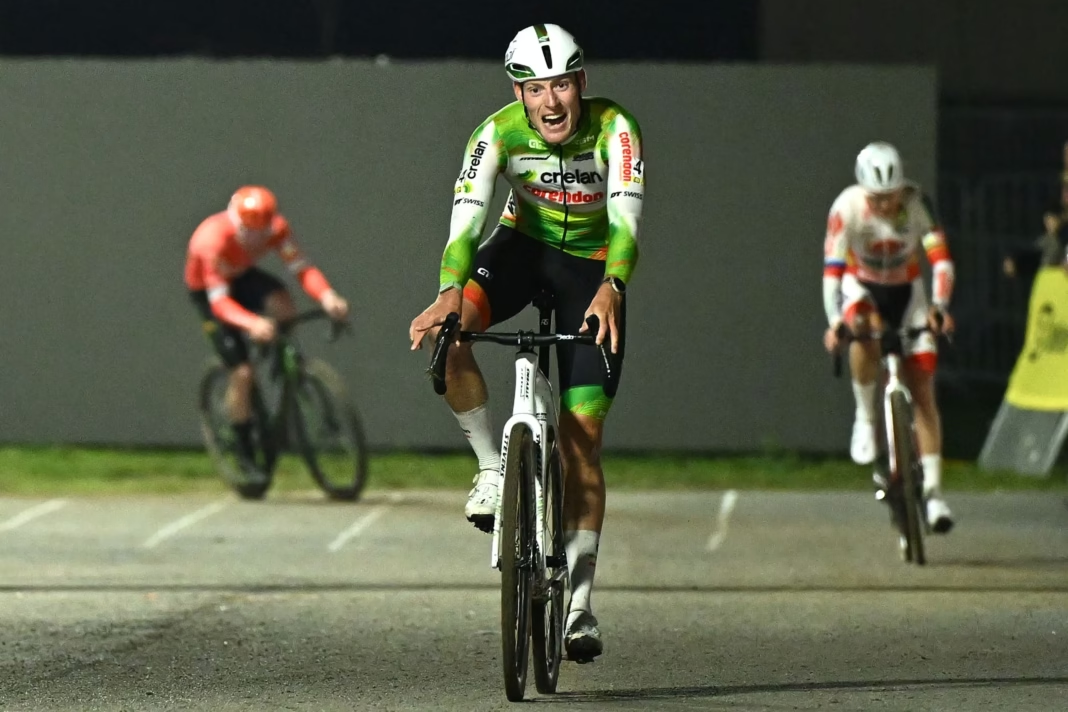
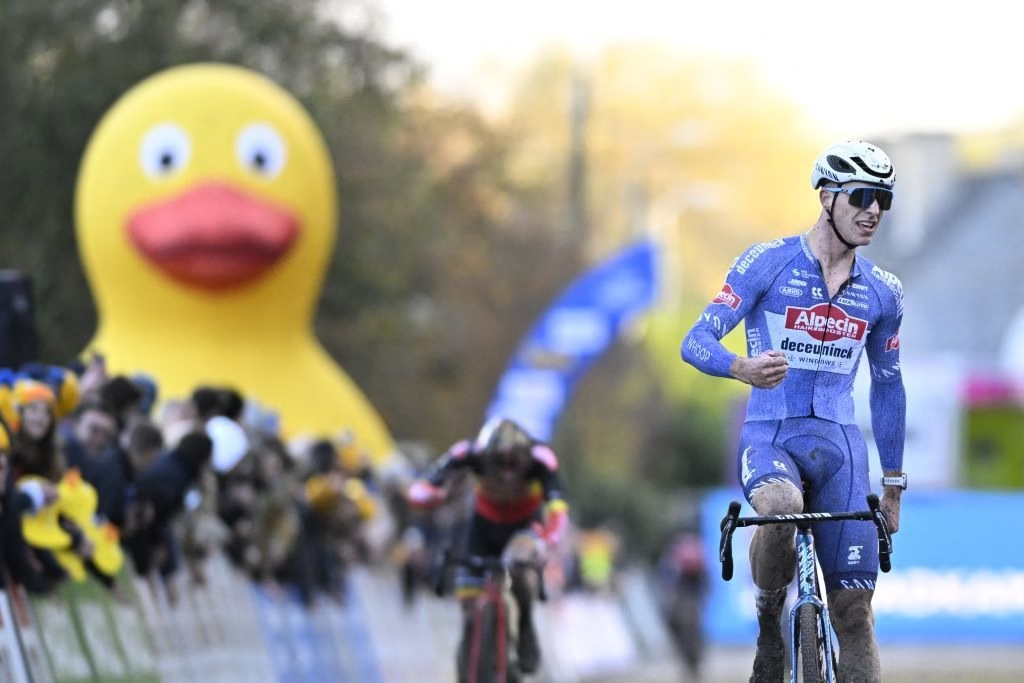
The November 2024 edition produced a different men’s winner. Niels Vandeputte defeated Eli Iserbyt after a close final lap, with Felipe Orts taking third. Organiser reporting described Vandeputte as a rider who had often come close without securing the victory he wanted. At Hamme, he finally converted his form into a major classification-race win.
The women’s race in November 2024 was won by Ceylin del Carmen Alvarado, ahead of Brand and Sara Casasola. The double entry for 2024 therefore appears in both men’s and women’s winners’ lists, but each race had a separate field, conditions and place in the seasonal calendar.
For readers comparing past winners, the clearest approach is to identify the month or season alongside the year. A simple table with two rows marked 2024 can otherwise suggest a data error. The distinction is also important when discussing form, because riders were at different points of their winter campaigns.
Thibau Nys and Cameron Mason’s 2025 duel
The 2025 Flandriencross was held on Sunday, 16 November. Cameron Mason made an aggressive move around the middle of the elite men’s race, putting the leading group under pressure. Thibau Nys was the rider able to follow and eventually beat the British champion.
Nys did not leave the decision until a conventional sprint on the finishing straight. He forced the separation before the asphalt section, aware that a slippery final bend could make a head-to-head sprint uncertain. Mason was close enough to finish just one second behind, while Nieuwenhuis completed the podium twelve seconds back after recovering from an early crash.
The result mattered for Mason because it showed he could make the strongest Belgian riders respond to his pace. It also mattered for Nys, who added his name to the winners of a race his father had won repeatedly. The family connection was an appealing headline, but the contest itself was sufficiently strong to stand on its own.
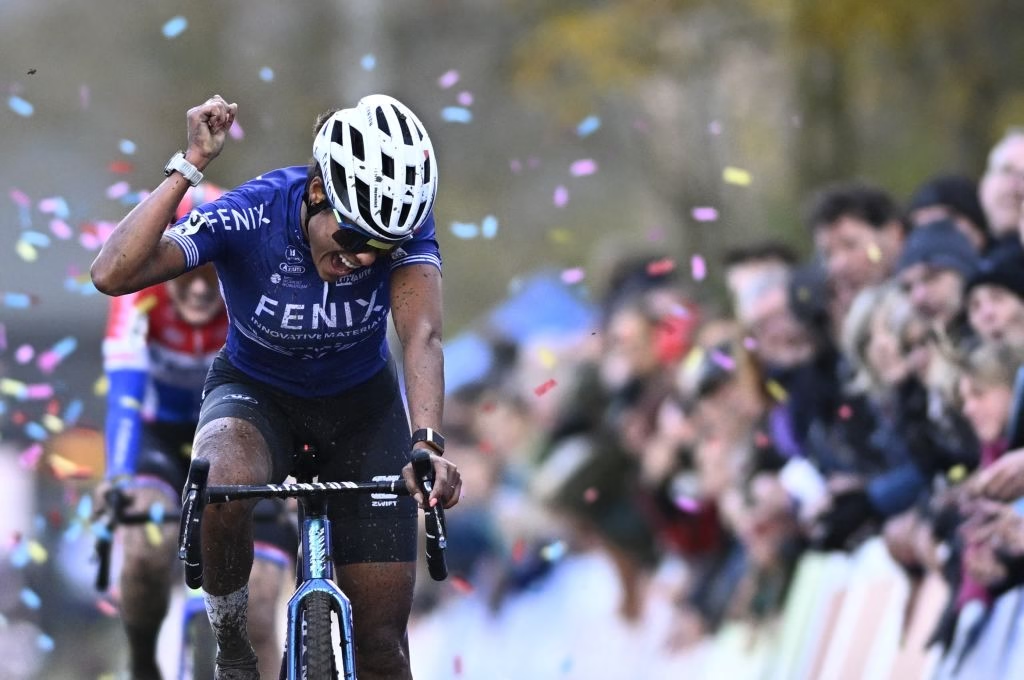
In the women’s event, Brand continued an excellent spell of form by beating Inge van der Heijden and Aniek van Alphen. The race was another example of how the women’s Flandriencross has become a regular contest between leading Dutch specialists rather than a supporting event with little competitive depth.
The women’s race has its own history
The women’s Flandriencross began in 2007, five years after the men’s first edition. Loes Sels was the inaugural winner. Its subsequent history includes Belgian champion Sanne Cant, British riders and a series of Dutch winners who have shaped the modern women’s cyclocross calendar.
Cant won in 2014, 2016 and 2017, giving her three victories at Hamme. Helen Wyman won in 2015, while Nikki Harris, later known as Nikki Brammeier, won in 2013. Those British victories are an important part of the race’s history and show that the women’s competition was never exclusively a contest between Belgian and Dutch riders.
Annemarie Worst won in 2018 and 2019, followed by Ceylin del Carmen Alvarado in 2021. Brand won in 2022, Fem van Empel in 2023 and January 2024, Alvarado again in November 2024, and Brand in 2025. The succession illustrates the depth of Dutch women’s cyclocross across several generations.
It is tempting to describe Hamme as a specialist’s race with a fixed winning formula, but the list of champions argues against that. Cant’s ability to manage difficult technical conditions, Van Empel’s explosive acceleration and Brand’s sustained pace have all proved effective. The surface and the race situation determine which qualities matter most.
What makes the Hamme course distinctive
Hamme is a classic Flemish cyclocross setting, but the course should not be reduced to a stock description of mud and grass. The 2025 edition became particularly demanding because the circuit was slippery and the leaders had to keep making decisions about lines and timing. The event’s course can be modified between seasons, so precise obstacles and lap distances should be taken from the technical information for the edition being discussed.
The decisive racing in 2025 demonstrated how the course can reward a rider willing to accelerate before the finish rather than wait for the straight. Nys’s attack ahead of the slippery final bend was a tactical response to the conditions, not proof that the same move will work every year. Mason’s ability to force the selection earlier in the race was equally revealing.
A difficult circuit creates a balance between aggression and control. Pushing hard into a corner can produce a gap, but an error can cost more than the acceleration gains. Riders who can recover quickly from short bursts of power and maintain their handling as fatigue builds are well suited to the challenge.
The event is part of the X²O Badkamers Trofee, where the overall standings are based on accumulated times rather than simply counting victories. A rider chasing the series title may need to limit losses even when a race win is out of reach. That creates tactical decisions that do not arise in exactly the same way at a standalone championship.
Previous winners and the X²O Trophy context
The recent men’s winners are Thibau Nys in 2025, Niels Vandeputte in November 2024, Mathieu van der Poel in January 2024, Wout van Aert in 2023, Laurens Sweeck in 2022 and Van der Poel in 2021. There was no 2020 edition in the commonly published sequence of recent winners. Van der Poel also won in 2016, 2017, 2018 and 2019.
The recent women’s winners are Lucinda Brand in 2025, Ceylin del Carmen Alvarado in November 2024, Fem van Empel in January 2024 and 2023, Brand in 2022 and Alvarado in 2021. Annemarie Worst won the 2018 and 2019 editions, while Sanne Cant’s three victories remain a notable Belgian benchmark.
Those lists are useful because they show two separate historical patterns. The men’s race was dominated for several years by Van der Poel, but recent editions have produced a wider range of winners. The women’s event has seen several Dutch champions alternate, with Brand and Alvarado prominent in the current era.
For an explanation of how the time-based competition works, read our X²O Badkamers Trofee guide. The 2026–27 cyclocross calendar provides the wider programme of major series and championship races.
-
 Photo Credit: David Pintens / BELGA MAG/AFP via Getty Images
-
 Photo Credit: Getty Images