
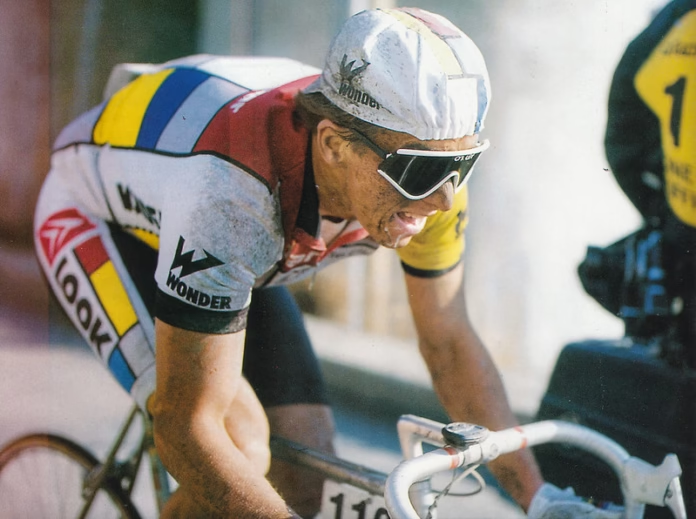
La Vie Claire was never just another 1980s cycling team. It looked different, sounded different and carried itself with a kind of modern confidence that stood apart from the more traditional European squads around it. In an era still shaped by old sponsor models, conservative kit design and familiar team hierarchies, La Vie Claire arrived with bold colours, big personalities, new money and a sense that professional cycling could be presented with more style and sharper commercial ambition.
The team existed for only a relatively short period at the top of the sport, but its influence still feels outsized. La Vie Claire brought together Bernard Hinault, Greg LeMond, Paul Köchli, Bernard Tapie and a supporting cast strong enough to dominate Grand Tours. It helped reshape the image of the professional team, placed sports science and rider preparation closer to the centre of the conversation, and gave cycling one of its most famous internal rivalries.
At its peak, La Vie Claire was both brilliant and unstable. It won the Tour de France twice, shaped the careers of two of the defining riders of the 1980s, and produced one of the most discussed team conflicts in cycling history. It was modern before the sport was ready to be modern, but it was also a team built around personalities too powerful to sit quietly inside a single structure.
The birth of La Vie Claire
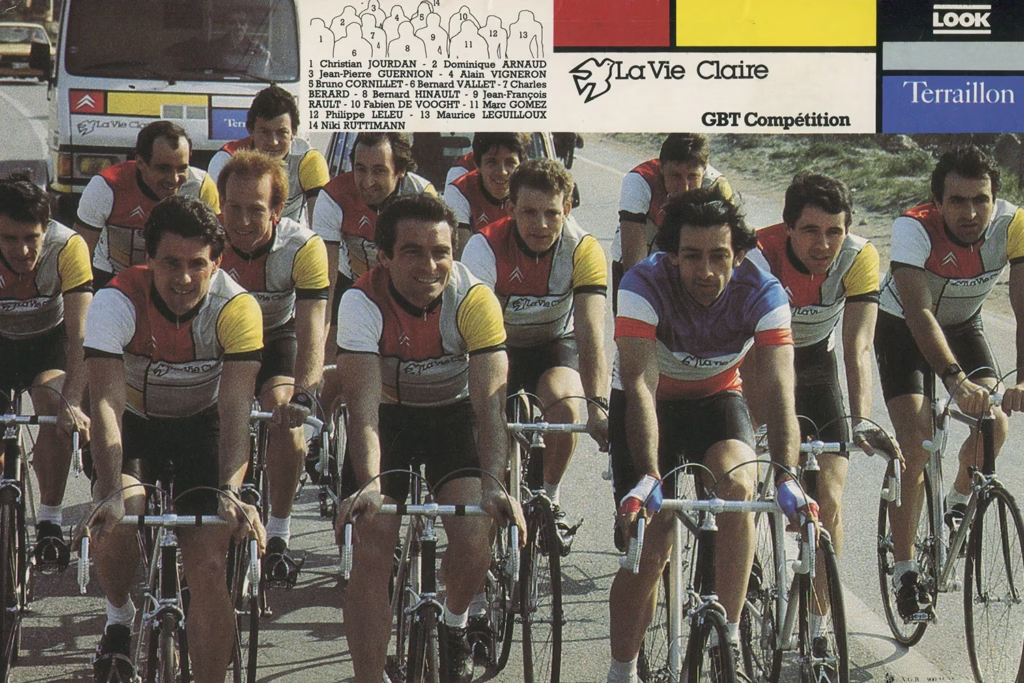
La Vie Claire was created in 1984, backed by French businessman Bernard Tapie and named after the health food retail chain he had acquired. Tapie was not interested in building a modest cycling team. He wanted visibility, prestige and impact, and he understood that cycling, with its roadside crowds and television presence, could offer all three.
The team was built around Hinault, who had left Renault-Elf after disagreements with long-time directeur sportif Cyrille Guimard. Hinault was already one of the most formidable riders in the sport, a four-time Tour de France winner by that point, and still the dominant reference for Grand Tour racing. Signing him gave La Vie Claire instant credibility.
It also gave the team a clear identity from day one. This was not a development project. It was a team designed to win immediately, to look powerful immediately, and to challenge the structures that had shaped French cycling through the previous decade.
A team that looked like the future
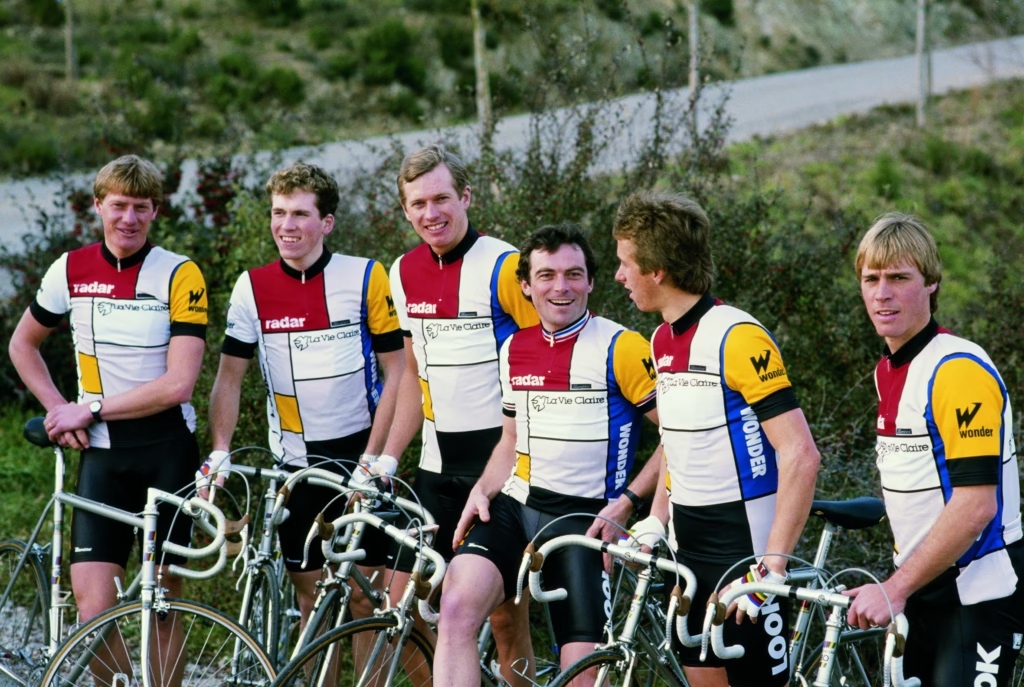
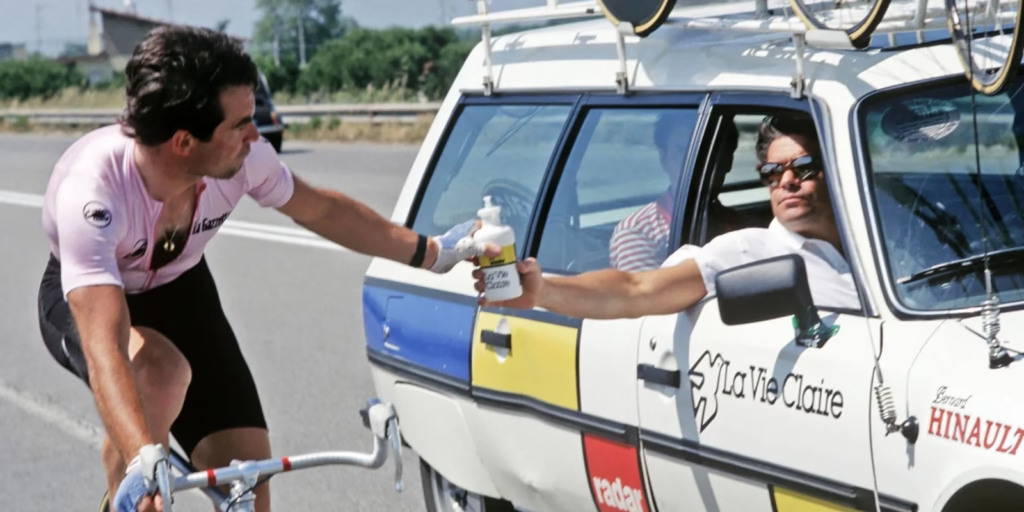
The La Vie Claire kit remains one of the most recognisable in cycling history. Designed with a Mondrian-inspired block pattern, it was bright, geometric and unmistakable. In a peloton still full of more conventional sponsor designs, La Vie Claire looked like it had arrived from a different decade.
That mattered because the kit reflected the team’s wider personality. La Vie Claire understood image. The jersey was not only a set of sponsor colours. It was branding, attitude and identity all at once. It made riders instantly visible in the peloton and gave the team a visual legacy that has lasted far beyond its competitive lifespan.
The same was true of the equipment and presentation around the squad. La Vie Claire became associated with new thinking, cleaner design and a more professionalised approach to preparation. It was not the only team experimenting, but it helped make innovation feel central to a top-level racing project.
Paul Köchli and the scientific edge
One of La Vie Claire’s most important figures was Swiss coach and directeur sportif Paul Köchli. His methods were often seen as more analytical than the old-school instincts that still dominated much of the sport. He paid close attention to training structure, physiology, recovery and tactical detail, helping give the team a more modern framework.
That did not mean La Vie Claire was a neat laboratory project. It still depended on strong riders, hard racing and the brutal realities of the road. But Köchli’s presence added another layer. The team was not simply built on money and names. It wanted to be smarter, more organised and more precise than its rivals.
For LeMond, that environment was especially important. He had already brought a different perspective into European cycling, shaped by American training ideas, technology and a willingness to question tradition. At La Vie Claire, that outlook found a natural home, at least at first.
Hinault’s comeback and the 1985 Tour de France
The 1985 Tour de France was La Vie Claire’s first great triumph. Hinault came into the race chasing a fifth Tour victory, which would put him alongside Jacques Anquetil and Eddy Merckx. He had returned from injury and was determined to reassert himself as the strongest stage racer in the world.
LeMond, who had joined La Vie Claire from Renault, arrived as an extraordinary talent in his own right. He was younger, explosive, tactically alert and already capable of winning the Tour. Officially, however, the hierarchy was clear. Hinault was the leader.
The race became complicated. Hinault crashed heavily on stage 14 into Saint-Étienne, breaking his nose and leaving his face bloodied and swollen. He continued, but he was weakened. LeMond looked strong enough to challenge for the race himself, and on the road to Luz Ardiden he was told not to chase when Hinault came under pressure.
LeMond obeyed. He later said he believed he could have taken significant time that day, but the team ordered him to wait. Hinault won the Tour, claiming his fifth and final overall victory. LeMond finished second, 1 minute 42 seconds behind.
That result gave La Vie Claire the top two places in the Tour de France, a remarkable achievement. It also planted the seed for the conflict that would define the following year.
The promise of 1986
After the 1985 Tour, Hinault publicly indicated that he would help LeMond win the 1986 Tour de France. That promise became one of the most famous and contested lines in modern cycling history.
On paper, the arrangement seemed simple. Hinault had his fifth Tour. LeMond had sacrificed his own chance in 1985. The following year, the Frenchman would support the American.
But Hinault was not built to ride quietly in support. He was the Badger, a rider whose entire identity was rooted in domination, intimidation and control. Even when he claimed he was helping, he did it in a way that looked very much like attacking. That ambiguity became the central drama of the 1986 Tour.
La Vie Claire entered the race with two riders capable of winning, and with a team strong enough to shape the race around them. The problem was that strength did not bring clarity. It made the internal tension more visible.
Hinault vs LeMond at the 1986 Tour
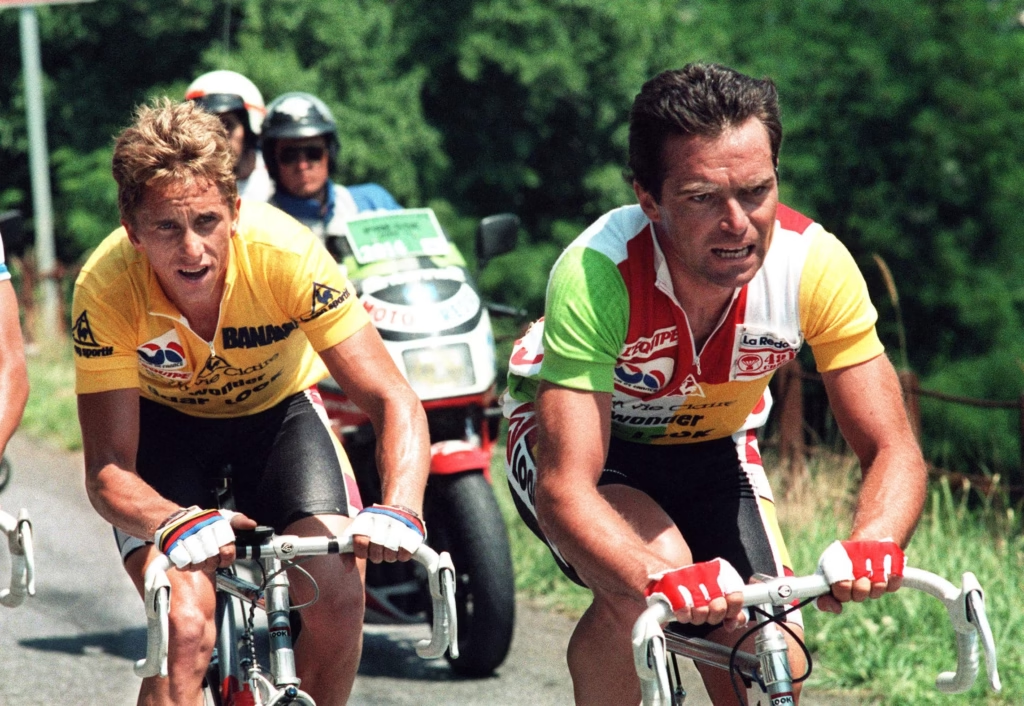
The 1986 Tour de France is remembered as one of the great intra-team battles. Hinault attacked repeatedly, sometimes presenting his aggression as a way of weakening rivals, sometimes appearing to threaten LeMond’s own position. LeMond had to manage external rivals and internal uncertainty at the same time.
Hinault took yellow early in the race and rode with the force of a man who had no intention of becoming a ceremonial teammate. LeMond, meanwhile, had to decide how much trust to place in a rider who had promised support but continued to race like a leader.
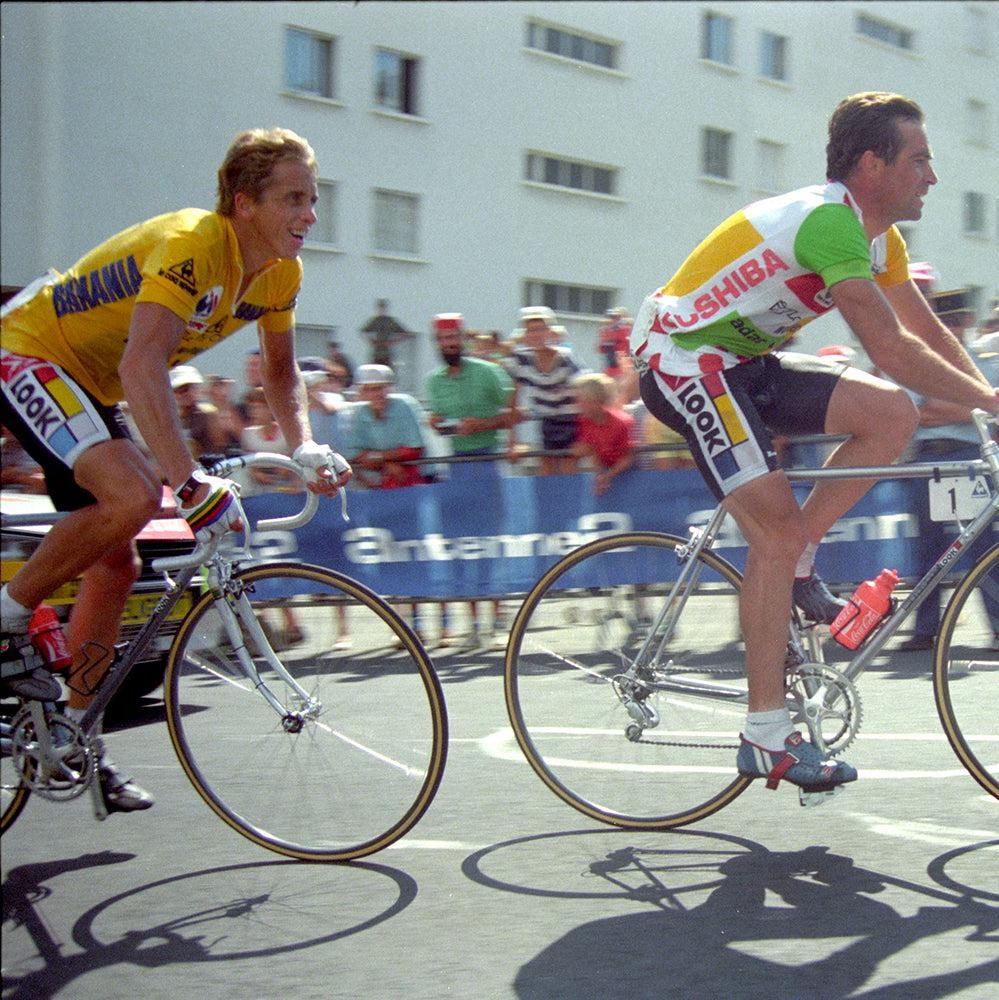
The conflict reached its symbolic peak in the Alps. On the stage to Alpe d’Huez, Hinault and LeMond arrived together, crossing the line arm in arm. It remains one of the most famous images in Tour de France history. On the surface, it looked like unity. Underneath, it carried tension. Hinault won the stage. LeMond moved closer to overall victory.
By Paris, LeMond had become the first American winner of the Tour de France. Hinault finished second. La Vie Claire had again taken first and second overall, but this time the emotional centre of the race was not domination. It was suspicion, rivalry and the unclear border between help and hostility.
A team too big for one leader
The Hinault-LeMond years showed both the strength and weakness of La Vie Claire. Most teams would have been transformed by having one rider of that calibre. La Vie Claire had two, and for a brief period that made it almost unbeatable in the Tour de France.
Yet cycling teams depend on hierarchy. Riders can share leadership for certain races, but the Tour de France usually exposes any ambiguity. La Vie Claire had the strongest pair in the race, but it also had two riders whose ambitions could not be neatly separated.
Hinault was nearing the end of his career but still raced with the authority of a champion who expected the sport to bend around him. LeMond represented the next era, not just because he was younger, but because he brought a different style of professionalism and a more international future. Their rivalry was personal, tactical and symbolic.
The team’s brilliance came from that collision. So did much of its instability.
The LeMond shooting accident and what might have followed
LeMond’s 1986 Tour victory should have opened the door to a period of dominance. He was still young, already a world champion, and now a Tour winner. With Hinault retiring at the end of 1986, the team could have become fully built around him.
Instead, LeMond’s career was nearly ended by a hunting accident in April 1987. He was accidentally shot by his brother-in-law and suffered serious injuries, with shotgun pellets lodged in his body. His recovery was long and uncertain, and he missed the 1987 Tour de France.
That changed the direction of both his career and the team’s story. La Vie Claire had lost Hinault to retirement and then lost LeMond from competition at the very moment he should have been entering his prime. The team continued, but the central drama that had made it so powerful was gone.
LeMond eventually returned to win the Tour again in 1989 and 1990, but by then the La Vie Claire chapter had closed. His later victories added to the mythology of his resilience, while also leaving an unanswered question: how many more Tours might he have won without that interruption?
Beyond Hinault and LeMond
Although La Vie Claire is usually remembered through Hinault and LeMond, the team was more than a two-man story. It had major depth and attracted riders who fitted its high-status identity. Andrew Hampsten, Niki Rüttimann, Steve Bauer, Jean-François Bernard and others gave the squad strength across Grand Tours, Classics and stage races.
Hampsten’s development was particularly important. He rode strongly in support roles and would later become the first American to win the Giro d’Italia in 1988, after leaving the team. Jean-François Bernard also carried French hopes after Hinault, with his time trialling and climbing ability making him one of the country’s great what-if riders of the late 1980s.
The team’s collective strength was never in doubt. It was one of the most talented squads of its period. But its identity was so tied to Hinault, LeMond and Tapie that once those central forces moved on, the project lost some of its original intensity.
Tapie, money and the changing face of cycling
Bernard Tapie’s role in La Vie Claire should not be underestimated. He brought money, ambition and a certain theatrical quality to the team. He understood that elite cycling could be more than riders in sponsor colours. It could be a media product, a prestige vehicle and a statement of modern French commercial power.
That approach foreshadowed later developments in the sport. Teams would become more brand-conscious, more internationally built and more closely tied to wider business identity. La Vie Claire was not the first sponsored team to understand publicity, but it did it with unusual force.
Tapie’s style also added pressure. The team was expected to win, to be visible and to behave like a major sporting institution. That brought resources, but it also magnified every internal dispute. In the Hinault-LeMond years, La Vie Claire did not have quiet disagreements. It had public drama at the centre of the biggest race in the world.
The fading of the La Vie Claire name
The La Vie Claire name did not last long after the team’s peak. Sponsorship changed, the structure evolved, and by the late 1980s the team’s original identity had faded. Toshiba became the main sponsor, and while the team continued to compete at a high level, the specific La Vie Claire era was over.
That short lifespan is part of the fascination. Some teams build history through decades of continuity. La Vie Claire built its legend through intensity. It burned brightly, won the Tour twice, reshaped expectations, created one of cycling’s most memorable kits, and placed two champions into a rivalry that still defines how the 1985 and 1986 Tours are discussed.
The team did not need a long existence to leave a deep mark. In some ways, its brevity made the story cleaner: arrival, innovation, domination, conflict, disappearance.
-
 Photo Credit: Cor Vos
The legacy of the Mondrian jersey
The jersey remains central to the team’s afterlife. Decades later, the La Vie Claire kit is still reproduced, referenced and admired. It is one of the few cycling jerseys that can be recognised far beyond the results attached to it.
That visual legacy matters because cycling is a sport of memory and images. Fans remember attacks, climbs and podiums, but they also remember colour. La Vie Claire’s design gave the team a lasting identity that survived sponsor changes and rider departures.
It also captured something about the project itself. The jersey was confident, structured and modern, but also slightly chaotic in its boldness. That is not a bad description of the team as a whole.
Why La Vie Claire still matters
La Vie Claire still matters because it condensed so many themes of modern cycling into one short period. It was about money entering the sport with sharper intent. It was about design and image becoming part of team identity. It was about sports science and preparation gaining ground. It was about the Tour de France as both a sporting contest and a psychological theatre.
Above all, it was about Hinault and LeMond. Their partnership produced two Tour de France victories for the team, but it never felt simple. Hinault’s force of will and LeMond’s emerging greatness created a rivalry that was compelling because it sat inside the same jersey. They were teammates, rivals, symbols of different cycling worlds, and for two summers the road could barely contain both of them.
La Vie Claire was innovative, glamorous, volatile and hugely successful. It gave cycling one of its most recognisable images and one of its most argued-over stories. For a team that existed at the top for such a short time, that is a remarkable legacy.

