
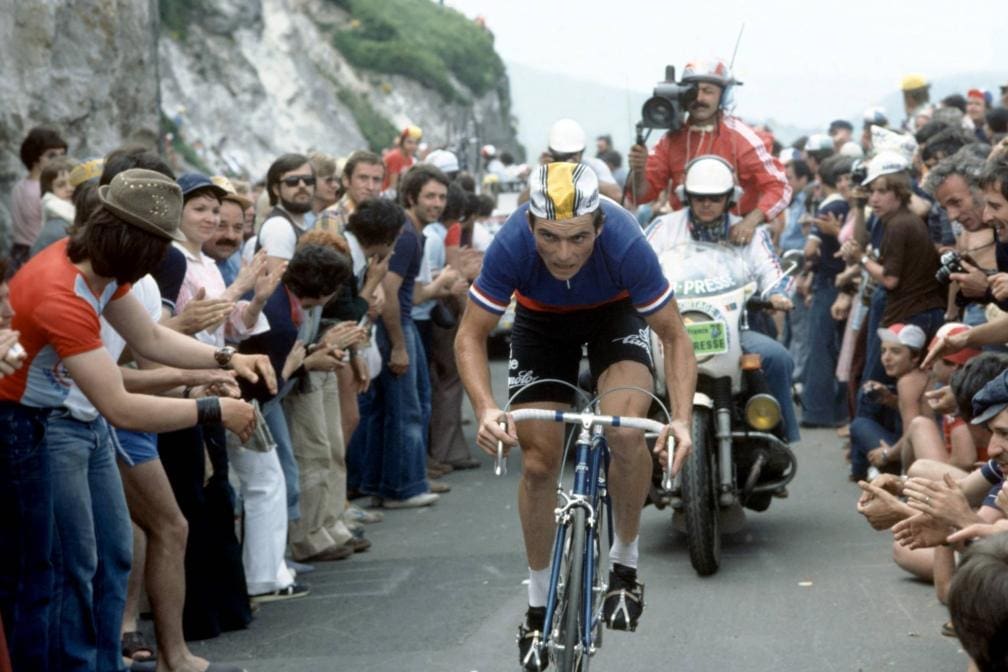
French cycling and the Tour de France are almost impossible to separate. The race began as a French newspaper project in 1903, travelled first across French roads, built its mythology in the Alps and Pyrenees, and turned the yellow jersey into one of the country’s great sporting symbols.
For much of the Tour’s early life, French riders did more than host the race. They dominated it. Maurice Garin won the first edition. Lucien Petit-Breton became the first double winner. André Leducq, Antonin Magne and Georges Speicher carried French success through the inter-war years. Louison Bobet then restored post-war French authority with three consecutive victories in the 1950s.
The two greatest French Tour riders came later. Jacques Anquetil became the first five-time winner, changing the race through time-trialling, control and calculation. Bernard Hinault became France’s last Tour winner in 1985 and remains the country’s most complete modern champion: aggressive, versatile, ruthless and successful across every type of terrain.
Since Hinault, the French Tour story has been different. There have been great climbers, stage winners, breakaway artists and podium challengers, but no French overall winner since 1985. That long wait has made each new generation carry more expectation, from Richard Virenque and Laurent Jalabert to Thibaut Pinot, Romain Bardet, Julian Alaphilippe, David Gaudu, Kévin Vauquelin, Lenny Martinez and Paul Seixas.
This ranking looks at the greatest French riders in Tour de France history, weighing overall victories, stage wins, jerseys, historical impact and the way each rider shaped the national relationship with the race.
For wider race context, see our brief history of the Men’s Tour de France, every Tour de France winner since 1903 and Tour de France winners list.
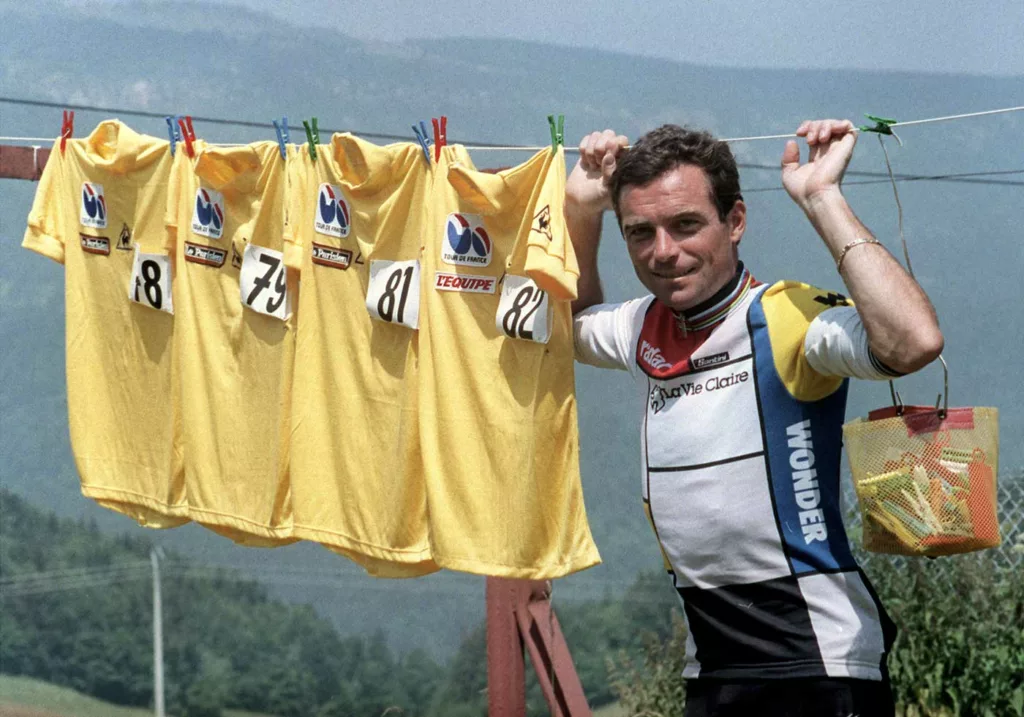
Greatest French Tour de France riders ranked
| Rank | Rider | Best Tour achievement | Why they matter |
|---|---|---|---|
| 1 | Bernard Hinault | Five overall victories | France’s last winner and most complete modern Tour champion |
| 2 | Jacques Anquetil | Five overall victories | First five-time winner and master of control |
| 3 | Louison Bobet | Three overall victories | Post-war French icon and first rider to win three Tours in a row |
| 4 | Laurent Fignon | Two overall victories | Brilliant 1980s champion and central figure in the 1989 drama |
| 5 | Raymond Poulidor | Eight podium finishes | The greatest French rider never to wear yellow |
| 6 | André Leducq | Two overall victories | Inter-war winner and prolific stage-winning force |
| 7 | Antonin Magne | Two overall victories | Tactical champion and bridge between eras |
| 8 | Lucien Petit-Breton | Two overall victories | First double Tour winner |
| 9 | Bernard Thévenet | Two overall victories | The rider who finally beat Eddy Merckx |
| 10 | Richard Virenque | Seven mountains classifications | France’s defining polka-dot jersey rider |
| 11 | Jean Robic | 1947 overall victory | First post-war winner and one of the Tour’s great characters |
| 12 | Laurent Jalabert | Green jersey, polka-dot jersey and stage wins | Versatile champion who reinvented himself |
| 13 | Thomas Voeckler | Long spells in yellow and cult status | Modern French emotional reference point |
| 14 | Thibaut Pinot | Stage wins, podium and mountain romance | The nearly man of modern French cycling |
| 15 | Julian Alaphilippe | Stage wins and 14 days in yellow in 2019 | Modern attacking star and yellow jersey symbol |
This list is not only about victories. Hinault and Anquetil stand at the top because five Tour wins is the highest official standard the race has. But French Tour history is also full of riders whose importance cannot be reduced to the final classification. Poulidor never wore yellow, yet became one of France’s most loved Tour figures. Virenque never came close to winning the race, but turned the polka-dot jersey into part of French July culture. Alaphilippe’s 2019 yellow jersey run did not end in victory, but it gave the modern race one of its most emotional French stories.
For the current French picture, see best French riders to watch at the Tour de France 2026 and Paul Seixas and the next French Tour de France generation.
1. Bernard Hinault
Bernard Hinault is the greatest French rider in Tour de France history because he combined results, dominance, range and personality in a way no other French Tour rider quite matches.
Hinault won the Tour five times: 1978, 1979, 1981, 1982 and 1985. That places him alongside Jacques Anquetil, Eddy Merckx and Miguel Indurain in the official five-win club. What makes Hinault’s record so strong is not only the number of wins, but the way he won. He could time-trial, climb, sprint from small groups, attack in terrible weather and impose himself psychologically on the race.
His nickname, the Badger, fitted him. Hinault was not a passive champion. He raced with force, authority and sometimes anger. He wanted control, but he was also willing to attack when control was not enough. That made him different from Anquetil, whose genius was often built around calculation and precision.
Hinault’s first Tour win in 1978 announced him as the new French force. His 1979 victory confirmed it. His 1981 and 1982 wins placed him above most champions of his generation. His 1985 win became historically heavier because no French rider has won the Tour since.
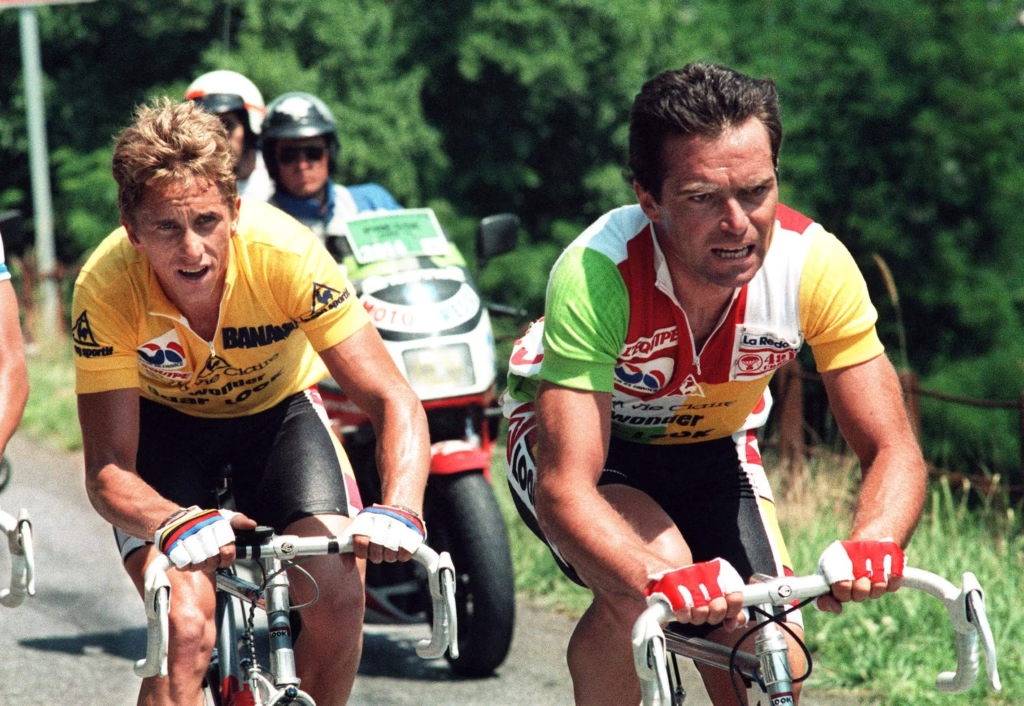
The 1986 Tour, when Hinault rode alongside Greg LeMond, also shapes his legacy. He did not win, but his attacks and internal team tension made that race one of the most discussed Tours of the modern era. It showed Hinault’s pride, competitiveness and refusal to become a quiet outgoing champion.
France has produced older icons and more romantic figures, but Hinault is the complete package. He was a five-time winner, a champion across all terrains and the last Frenchman to stand in Paris wearing yellow.
For more on how Tour winners are measured across eras, see every Tour de France winner since 1903 and how the Tour de France general classification works.
2. Jacques Anquetil
Jacques Anquetil was the first rider to win the Tour de France five times, and his place in French cycling history is enormous.
Anquetil won in 1957, then four years in a row from 1961 to 1964. That sequence changed the Tour’s idea of dominance. Before him, no one had made five overall victories look possible. After him, five became the benchmark against which the greatest Tour riders are judged.
His style was based on control. Anquetil was a superb time-triallist, one of the best the race has ever seen, and he understood how to win Tours without unnecessary movement. He did not need to attack wildly every day. He needed to take time where he was strongest, defend intelligently, and let rivals make mistakes.
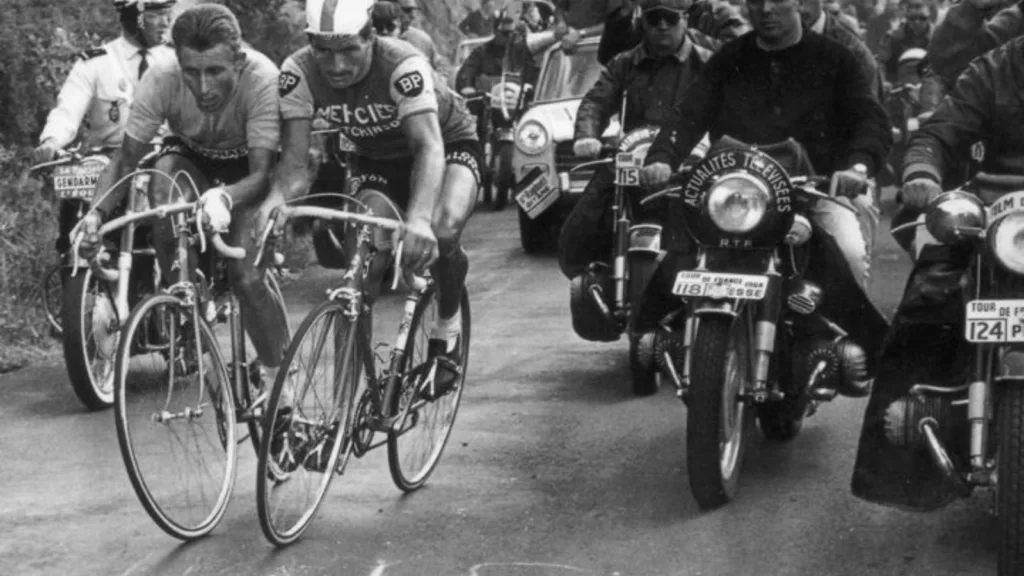
That sometimes made him less loved than more dramatic riders. Raymond Poulidor, his great French rival, had the emotional connection with many fans. Anquetil had the results. The contrast between them became one of the great cultural divides in French cycling: the cool winner against the unlucky hero.
Anquetil’s greatness is that he helped modernise Tour winning. He made the race feel more mathematical, more controlled, more shaped by time trials and energy management. That approach influenced later champions, including Miguel Indurain and even the Team Sky era in a much later form.
He ranks just behind Hinault here because Hinault’s range and aggression give him the broader Tour profile. But Anquetil’s record is unimpeachable. He was the first five-time winner, one of the finest riders against the clock in Tour history, and one of the men who changed how the race was won.
For more on the clock-based side of Tour racing, see best time-triallists at the Tour de France 2026 and A history of team time trials at the Tour de France.
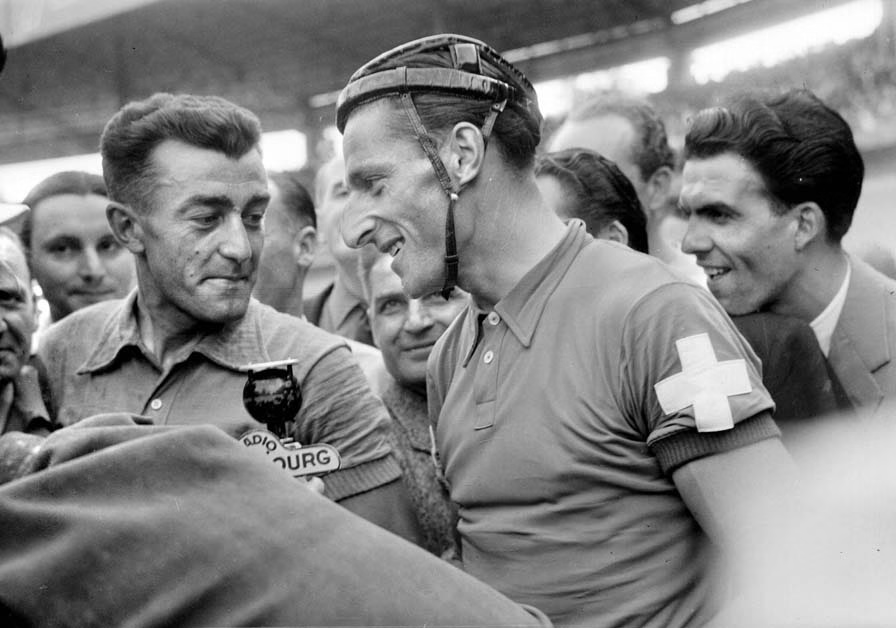 Photo Credit: Roger Viollet/Getty
3. Louison Bobet
Louison Bobet was the great French Tour champion of the post-war years. His three consecutive victories from 1953 to 1955 gave France a champion around whom the race could rebuild its identity.
Bobet was not an instant Tour winner. His early attempts were marked by setbacks, criticism and questions over whether he had the toughness to win the race. That makes his eventual dominance more interesting. He had to grow into the Tour, then became its central figure.
His 1953 victory was the breakthrough. His 1954 win proved he was not a one-off. His 1955 victory made him the first rider to win three Tours in a row. In an era when the race was still physically brutal, with long stages, difficult roads and less controlled support, that was an extraordinary achievement.
Bobet’s importance is also symbolic. He helped restore French pride in the Tour after the Second World War. Jean Robic had won in 1947, but Bobet became the more sustained national champion. He carried the expectations of a country that saw the Tour as part sporting event, part cultural institution.
He was also a stylish champion, associated with dignity, professionalism and ambition. If Anquetil later made Tour winning colder and more calculated, Bobet still belonged to a more heroic post-war age.
He ranks behind Hinault and Anquetil because he won fewer Tours, but three consecutive victories put him far above most French champions. In the long French Tour story, Bobet is the bridge between the early legends and the modern masters.
For more Tour history around the race’s biggest champions, see Tour de France winners list and every Tour de France winner since 1903.
4. Laurent Fignon
Laurent Fignon’s Tour career contains glory, brilliance and one of the most painful near misses in cycling history.
Fignon won the Tour in 1983 and 1984. His first victory came after Bernard Hinault’s absence opened the race, but Fignon still had to prove he was more than a beneficiary of circumstance. In 1984, he did exactly that, beating Hinault decisively and looking like the new French force.
At that point, Fignon seemed capable of building a long Tour era of his own. He had style, intelligence, climbing quality and time-trial strength. He was also a rider with edge, self-belief and a strong tactical mind. He did not carry Hinault’s raw physical authority, but he had his own sharpness.
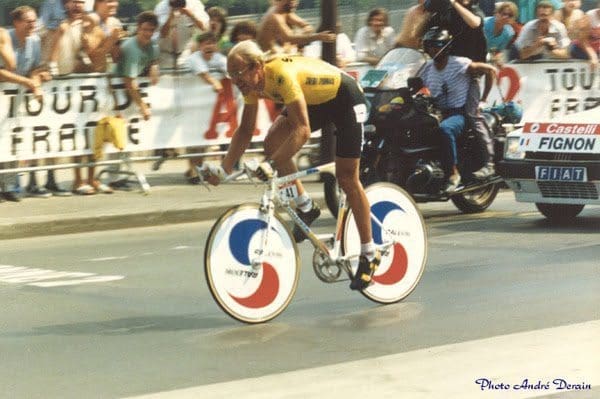
Then came 1989. Fignon lost the Tour to Greg LeMond by eight seconds, the smallest winning margin in race history. That final time trial into Paris became one of the Tour’s defining images: LeMond using aerodynamic equipment and Fignon losing yellow at the last possible moment.
The near miss has sometimes overshadowed Fignon’s achievements, which is unfair. He was not only the man who lost by eight seconds. He was a double Tour winner, a rider who beat Hinault, and one of the most gifted French riders of the 1980s.
Fignon ranks above several two-time winners because his peak was so high and because his Tour story remains central to the race’s mythology. Victory made him great. Defeat made him unforgettable.
For more on the race’s winners and margins across history, see every Tour de France winner since 1903 and a brief history of the Men’s Tour de France.
5. Raymond Poulidor
Raymond Poulidor never won the Tour de France and never wore the yellow jersey, yet he remains one of the greatest French riders in the race’s history.
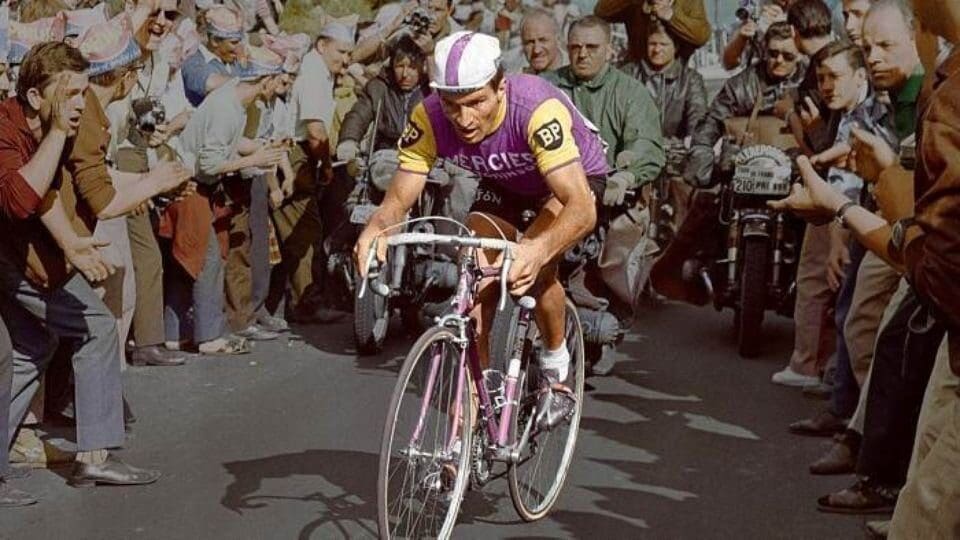
That sounds contradictory, but Poulidor’s Tour record explains it. He finished on the podium eight times between 1962 and 1976. He was second three times and third five times. He kept returning, kept challenging, kept falling just short, and became the most loved nearly man in French cycling.
His rivalry with Jacques Anquetil defined the 1960s. Anquetil was the cool, elegant winner. Poulidor was the stubborn, emotional challenger. Many French fans saw themselves more easily in Poulidor than in Anquetil. He suffered visibly, attacked with heart, and seemed repeatedly blocked by fate.
The 1964 Tour, especially the Puy de Dôme duel with Anquetil, became one of the great moments in French cycling memory. Poulidor gained time but not enough. That pattern followed him through his Tour career. He was always close, rarely lucky, never broken.
His greatness lies in consistency and connection. Winning the Tour is the highest achievement, but the Tour is also built on stories of pursuit, frustration and loyalty. Poulidor embodied that better than almost anyone.
He ranks above several Tour winners because his place in the race is larger than his palmarès. France has had many yellow jerseys. It has only had one Poulidor.
For more on what the yellow jersey represents, see Tour de France 2026 jerseys explained.
6. André Leducq
André Leducq was one of the great French riders of the inter-war Tour, winning the race twice and becoming one of its most prolific stage winners.
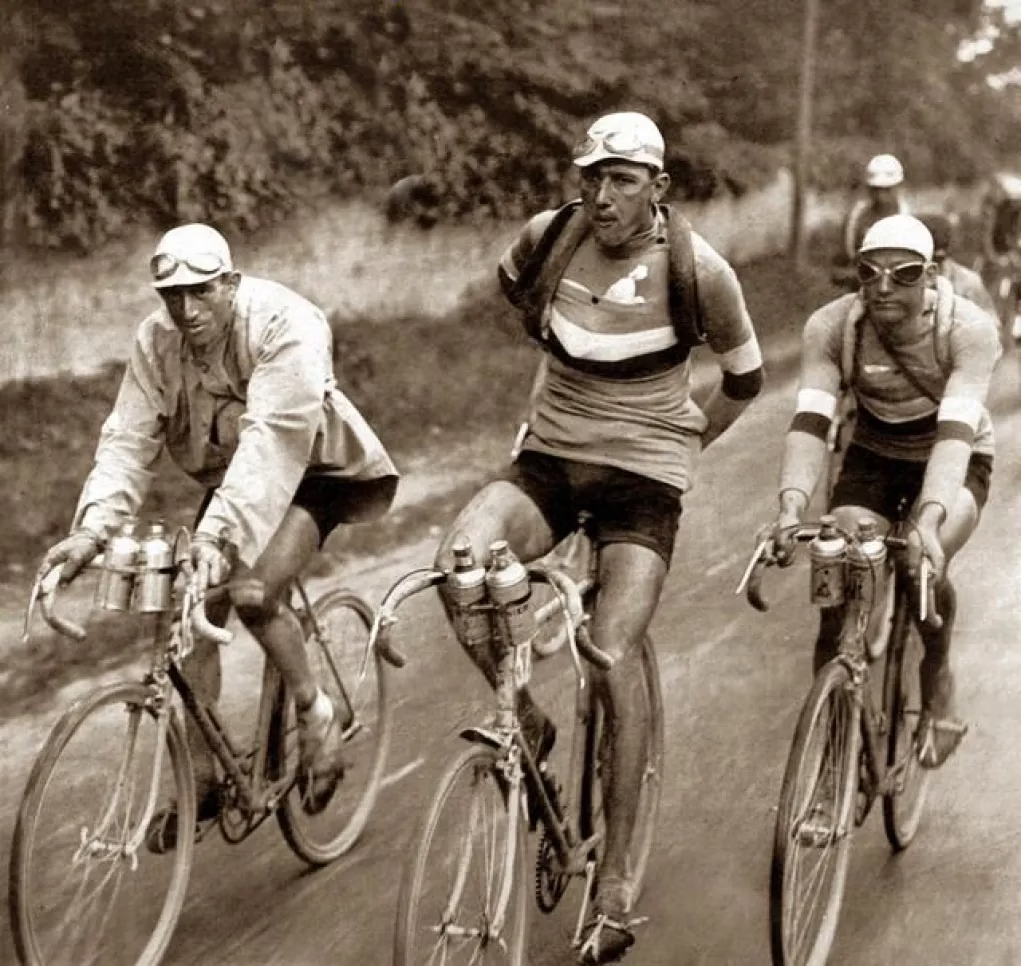
Leducq won the Tour in 1930 and 1932. His victories came during a period when the race was changing, with national teams, different tactical structures and a growing sense of the Tour as a modern national sporting drama. He was a strong, popular French winner at a time when the home nation expected to shape the race.
His stage-winning record adds weight to his place. Leducq won 25 Tour stages, one of the highest totals in race history. That matters because he was not only a general classification rider. He could win repeatedly, across different contexts, and became one of the defining faces of the race during his era.
Leducq’s 1930 win was especially important because it came in the first Tour run under national teams rather than trade teams. That format increased the symbolic weight of French success. When Leducq won, he was not only a rider winning for himself. He was a French rider winning in a Tour now framed more directly around national identity.
He may not have the modern recognition of Hinault, Anquetil or Fignon, but his record is stronger than many casual fans realise. Two overall wins and 25 stage victories put him firmly among the greatest French Tour riders.
For more on how the Tour moved from early chaos towards modern structure, see a brief history of the Men’s Tour de France.
7. Antonin Magne
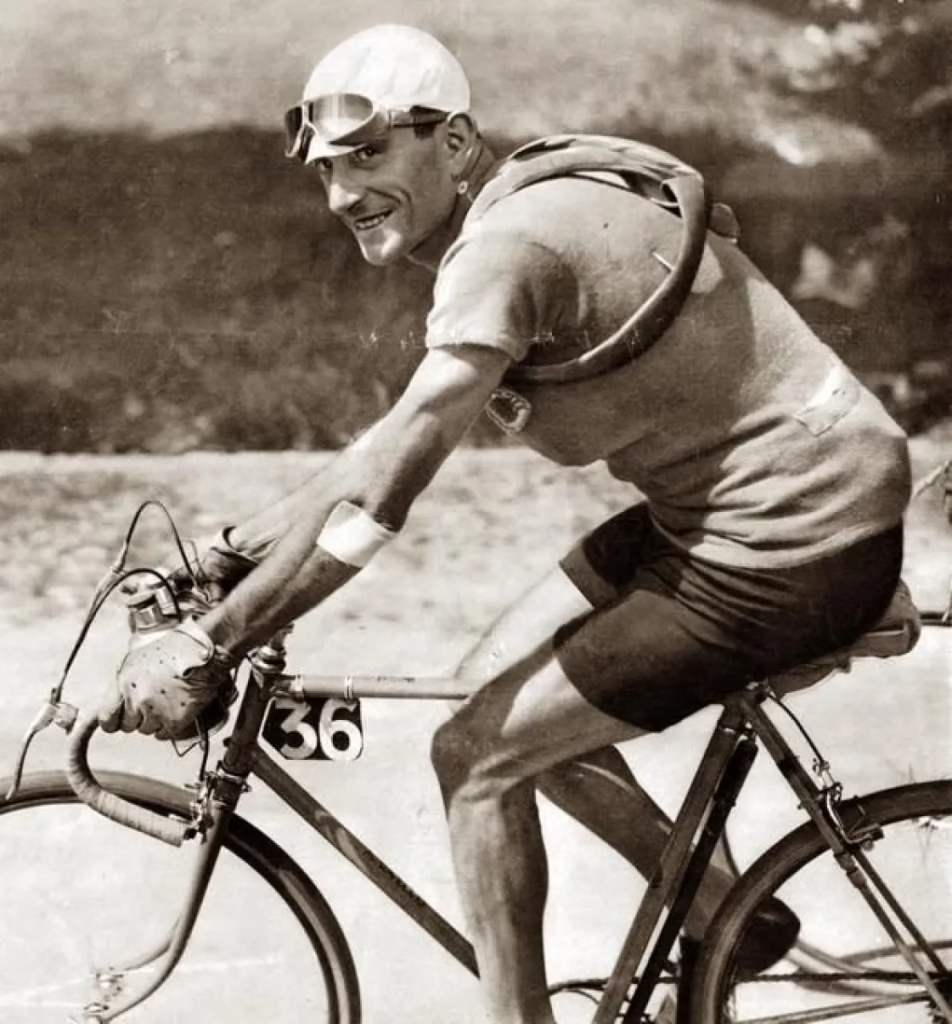
Antonin Magne won the Tour twice, in 1931 and 1934, and belongs among the most important French riders of the inter-war period.
Magne was not as prolific a stage winner as Leducq, but he was a more controlled general classification figure. His Tour victories showed tactical discipline, endurance and the ability to manage the race across long, difficult stages.
His 1931 win came in the middle of a strong French period. His 1934 victory confirmed his status and gave him a second place among the great French champions. The 1934 Tour also mattered because of the introduction of the individual time trial, a discipline that would later become central to Tour winning. Magne’s success belongs to a race that was beginning to resemble the modern Tour more clearly.
Magne later became an important directeur sportif, guiding riders after his racing career. That gives him a wider place in French cycling culture beyond his own wins. But even judged only as a rider, two Tour victories put him in elite company.
He ranks just behind Leducq because Leducq’s stage-winning record was so strong, but Magne’s GC quality was exceptional. He was a serious, intelligent Tour champion and one of the men who helped carry French authority through the 1930s.
For more on the general classification that Magne mastered, see how the Tour de France general classification works.
8. Lucien Petit-Breton
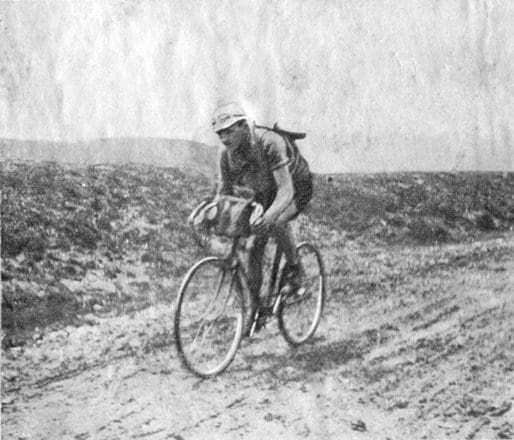
Lucien Petit-Breton was the first rider to win the Tour de France twice, taking victory in 1907 and 1908.
That alone makes him historically essential. In the early years, the Tour was still establishing what kind of race it was. Distances were enormous, roads were rough, support was limited and the event was far less standardised than it is today. Winning once was hard enough. Winning twice made Petit-Breton the race’s first true repeat champion.
His victories came after the chaos of the earliest editions, when the Tour was still emerging from controversy and instability. Petit-Breton gave the race a stronger sporting identity. He was not simply a survivor of an experiment. He was a champion who could repeat success.
His life was later cut short during the First World War, which adds a tragic note to his place in cycling history. Like many riders of that generation, his career and legacy were shaped by forces far beyond sport.
Petit-Breton’s record may look distant now, but he deserves his place high on any French Tour list. Before Bobet, Anquetil, Hinault or Fignon, he was the first rider to prove that Tour greatness could be repeated.
For the wider early roll of honour, see every Tour de France winner since 1903.
9. Bernard Thévenet
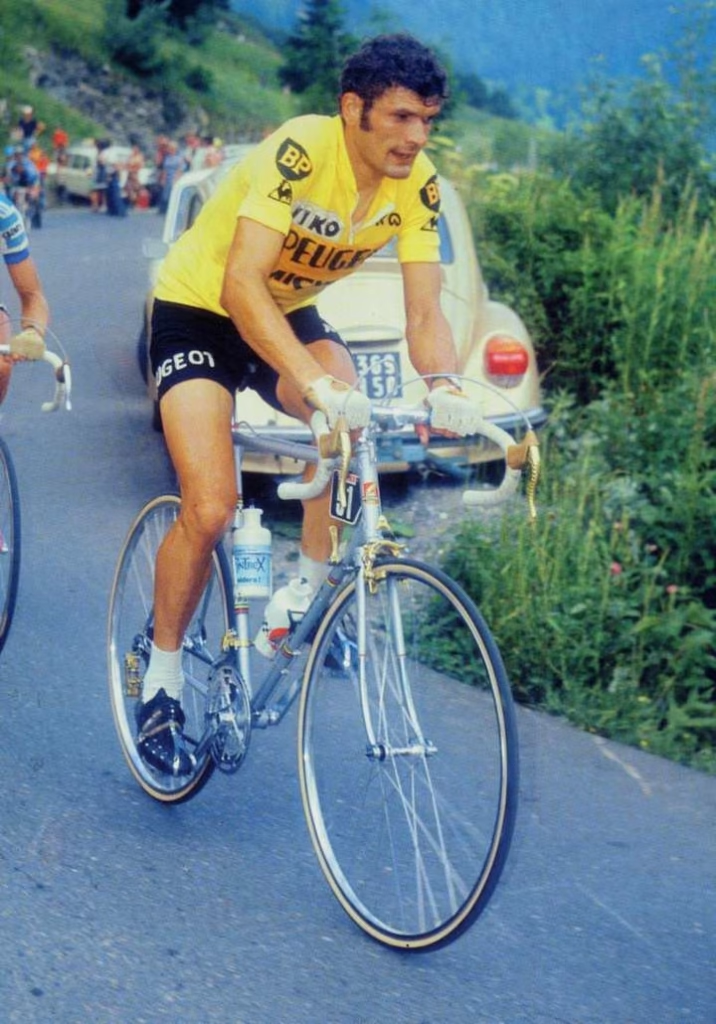
Bernard Thévenet won the Tour twice, in 1975 and 1977, but his place in history is defined above all by 1975. That was the year he ended Eddy Merckx’s reign.
Merckx had won five Tours and was the dominant rider of his generation. Beating him was not just a sporting result. It was a change of era. Thévenet attacked in the mountains, exposed Merckx’s vulnerability and became the first rider to defeat him at the Tour after years of Belgian control.
His 1975 victory also carried emotional weight for France. The home nation had not won the Tour since Roger Pingeon in 1967. Thévenet restored French victory and did so by beating the greatest rider in the world.
His second win in 1977 confirmed that he was more than the man who caught Merckx at the right moment. He was a genuine Tour champion in his own right. He could climb, endure and manage a three-week race at the highest level.
Thévenet does not rank higher because Hinault, Anquetil, Bobet and Fignon had stronger overall Tour legacies, while Poulidor and some inter-war riders carry different historical weight. But any French rider who beats Merckx and wins the Tour twice belongs among the country’s greats.
For more on how the Tour’s mountain stages decide champions, see what is a summit finish in the Tour de France?, A history of Alpe d’Huez at the Tour de France and Tour de France 2026 summit finishes guide.
10. Richard Virenque
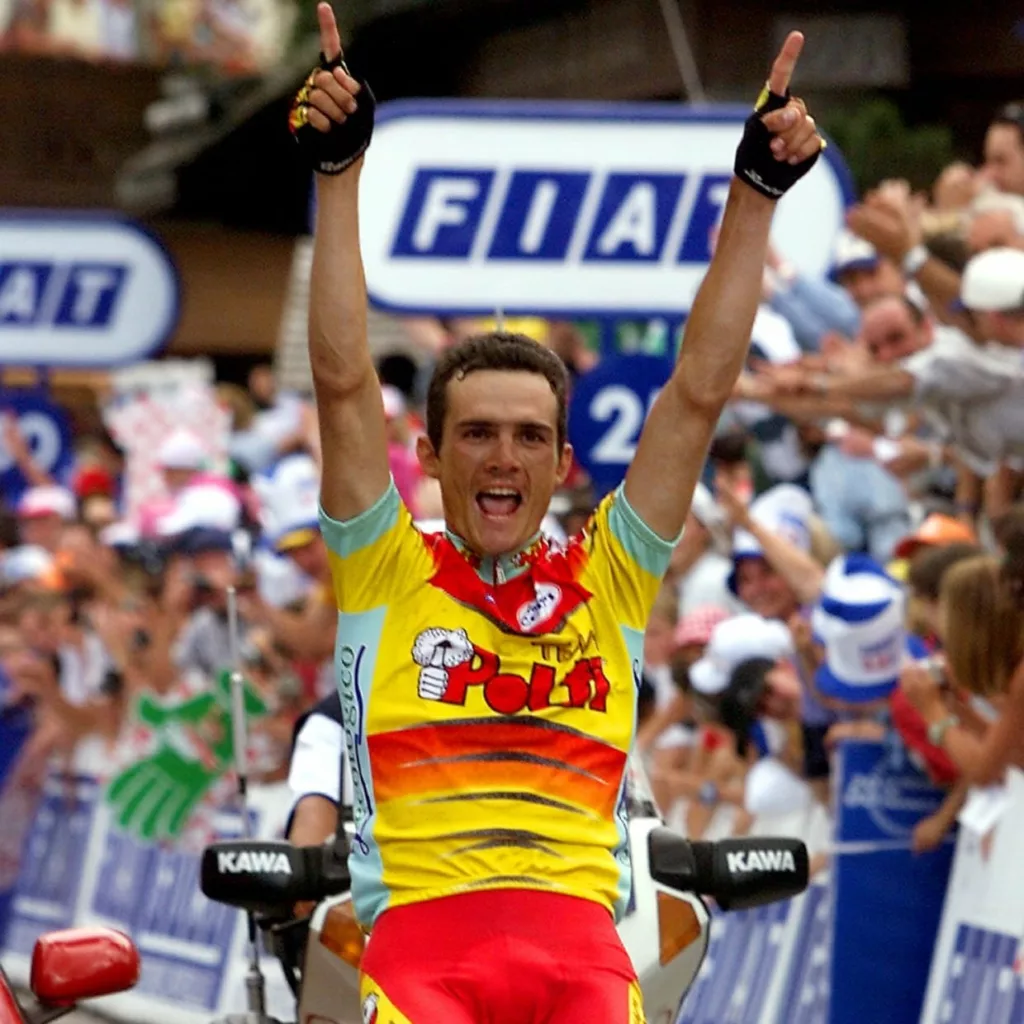
Richard Virenque is the defining French polka-dot jersey rider of the modern Tour.
He won the mountains classification seven times, a record that made him inseparable from the jersey. For French fans of the 1990s and early 2000s, Virenque attacking in the mountains became one of the Tour’s familiar images. He was expressive, aggressive and deeply connected to the public.
His overall record was also strong. He finished third in 1996 and second in 1997, placing him closer to the yellow jersey than many remember. But his true identity was built around climbing attacks, mountain points and emotional racing.
The complication is obvious. Virenque’s career was tied to the Festina affair, one of the defining doping scandals in Tour history. That cannot be ignored. It affects how his achievements are viewed and how his era is remembered.
Even with that caveat, his place in French Tour culture is significant. He turned the polka-dot jersey into a national obsession and gave French fans a rider who seemed to attack the mountains with visible feeling. He was not Hinault or Anquetil. He was not a Tour-winning champion. But he was one of the most recognisable French riders of his era.
For more on the modern mountains classification, see Tour de France 2026 climbers guide, best climbers at the Tour de France 2026 and Tour de France 2026 jerseys explained.
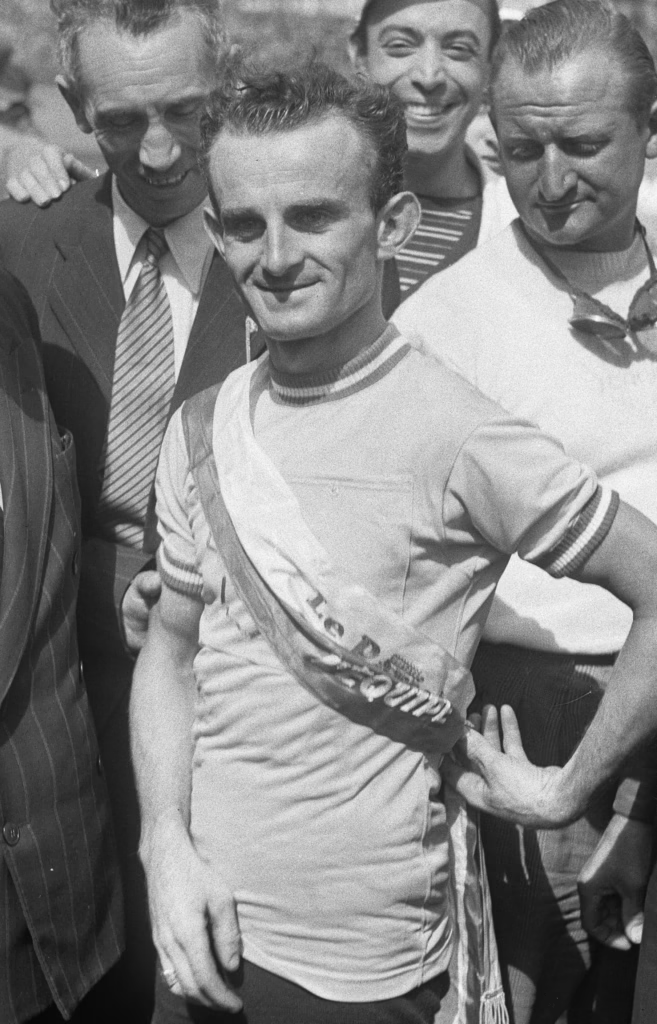
11. Jean Robic
Jean Robic won the 1947 Tour de France, the first edition after the Second World War, and that alone gives his victory major historical weight.
Robic’s win was dramatic. He took the yellow jersey only on the final stage, overturning the race late and giving the returning Tour a memorable champion. In a post-war France still rebuilding, the race carried symbolic power. Robic’s victory became part of that moment.
He was a small, tough rider with a distinctive personality and a combative racing style. He did not build a dynasty like Bobet after him, but his 1947 win mattered because of timing and manner. It restarted the Tour’s winners list after the long wartime gap.
Robic also won stages and remained a visible figure, but his place is based mainly on that one Tour. Some single-win champions are remembered lightly. Robic is not, because 1947 was not just another edition.
He ranks outside the top 10 only because France has such a deep Tour history. In many countries, a post-war Tour winner would sit near the very top. In France, Robic has to compete with five-time winners, three-time winners, two-time winners and cultural giants.
For the wider list of Tour winners, see every Tour de France winner since 1903.
 Photo Credit: Pascal Pavani/AFP/Getty
12. Laurent Jalabert
Laurent Jalabert’s Tour de France legacy is built on versatility rather than overall victory.
He won stages, wore the green jersey, won the polka-dot jersey twice and reinvented himself during his career. Early on, he was one of the best fast finishers and points-classification riders in the race. Later, he became a more attacking, climbing-focused rider, capable of shaping mountain stages and chasing the polka-dot jersey.
His 1995 green jersey showed his sprint and consistency qualities. His later mountains classification wins in 2001 and 2002 showed a very different rider: more selective, more opportunistic and more focused on attacking days.
Jalabert never won the Tour and was never really the French answer to the long wait for yellow. His best Grand Tour overall victory came at the Vuelta a España. But at the Tour, he still had a long and varied influence.
His strength was that he could matter in several races within the race. He could win stages, contest points, chase mountain points and carry French hopes without being a pure GC rider. That makes him one of the most complete French Tour figures of the modern era.
He belongs below Virenque because Virenque’s Tour identity was stronger and more specific, but Jalabert’s range was arguably greater.
For more on the green jersey side of the race, see Tour de France 2026 sprinters guide: who can win green? and best sprinters at the Tour de France 2026.
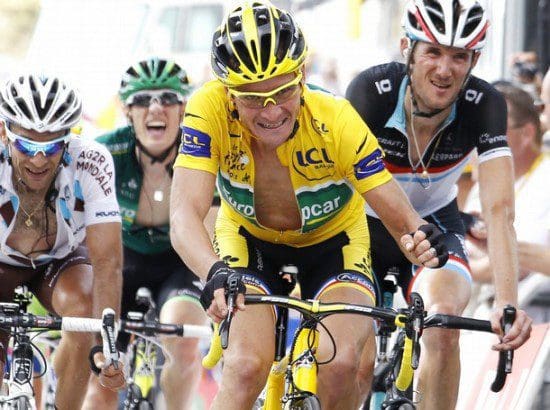
13. Thomas Voeckler
Thomas Voeckler did not win the Tour de France, but few modern French riders captured the race’s emotional side as strongly.
His 2004 Tour changed his career. Voeckler took the yellow jersey from a breakaway and held it for 10 days, far longer than expected. He defended with everything he had, becoming a national story even though overall victory was never realistic.
Then came 2011, when he again wore yellow deep into the race and finished fourth overall. That performance gave his Tour career another level. It was not just an early breakaway fairytale. Voeckler had carried yellow into the mountains and resisted far longer than many thought possible.
Voeckler’s appeal was based on expression and refusal. He looked like he was suffering, fighting, bargaining with the race in real time. French fans recognised that. He was not the strongest rider of his era, but he knew how to make the Tour feel alive.
He also won stages and later the mountains classification in 2012, adding substance to the emotion. Still, his main legacy is yellow jersey theatre. He gave France days of belief during a period when an overall home winner felt distant.
That matters. The Tour is not only won by champions. It is remembered through riders who make the race feel personal. Voeckler did that better than almost anyone in modern French cycling.
For more on how breakaways can reshape the race, see what is a breakaway in the Tour de France? and Tour de France 2026 route: best days for breakaways.
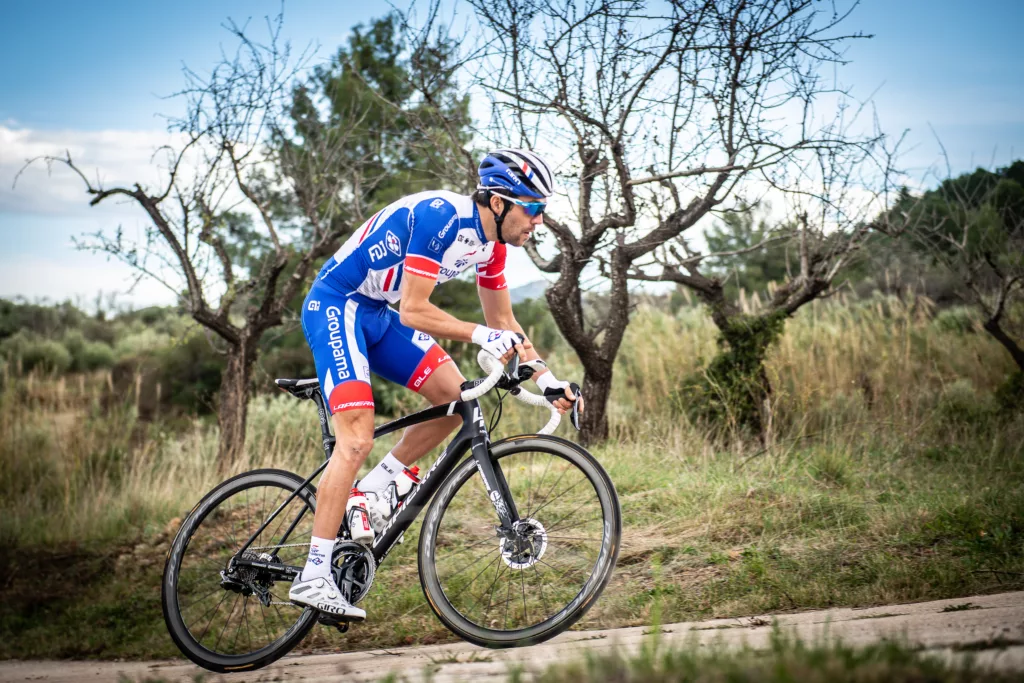
14. Thibaut Pinot
Thibaut Pinot was the great romantic French Tour figure of the 2010s. His career had stage wins, podium quality, heartbreak, pressure and deep public affection.
His first Tour stage win came in 2012, when he won at Porrentruy as a young rider. That victory made him a symbol of French renewal. He finished third overall in 2014, reaching the podium and giving France real hope that the long wait for a home winner might eventually end.
Pinot’s best Tour chance may have come in 2019. He won on the Tourmalet and looked like one of the few riders capable of winning the race. Then injury forced him out before the Alps. The image of Pinot crying in the team car became one of the most painful modern French Tour moments.
That emotional weight is part of his legacy. Pinot was loved because he was talented and vulnerable. He could climb beautifully, win major mountain stages and look like a genuine yellow jersey threat, but his Tour story kept slipping away.
His farewell Tour in 2023 added one more layer, especially with the huge crowds supporting him on the Petit Ballon. By then, Pinot’s chance of winning the Tour had passed, but his connection with the race and French fans was stronger than ever.
He ranks below Voeckler because Voeckler spent more time in yellow and had a longer Tour-specific narrative. But Pinot’s best climbing level was higher, and his 2019 peak remains one of the great what-ifs of modern French cycling.
For the next French generation trying to carry that expectation, see Paul Seixas and the next French Tour de France generation and best French riders to watch at the Tour de France 2026.
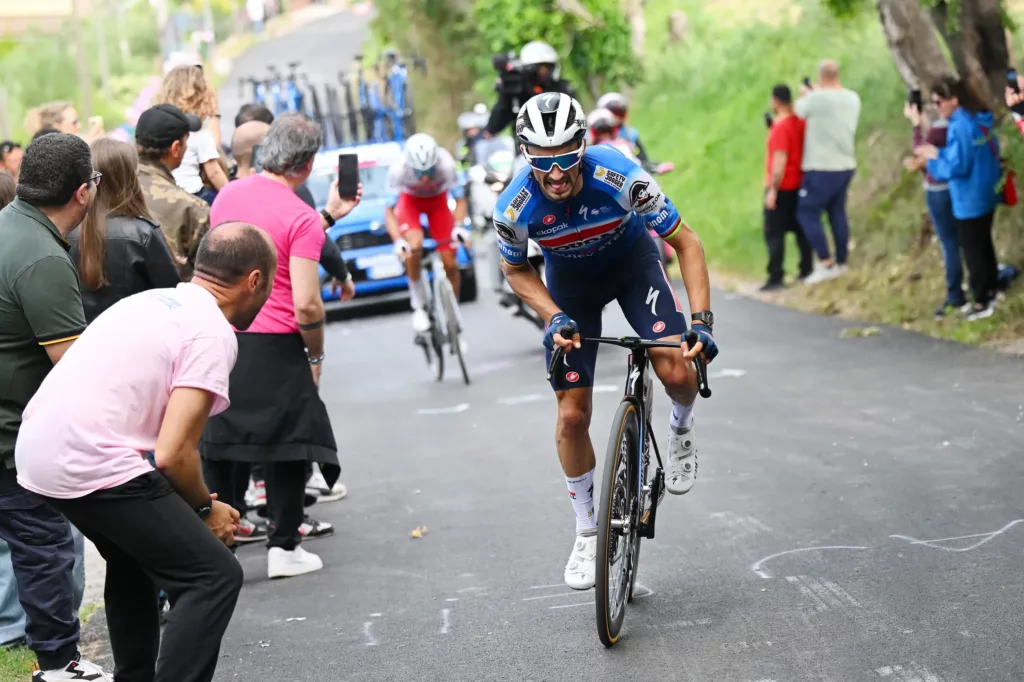
15. Julian Alaphilippe
Julian Alaphilippe’s 2019 Tour de France run was one of the great modern French yellow jersey stories.
He won stage 3 in Épernay, took yellow, lost it, then won the Pau time trial and carried the jersey deep into the race. For two weeks, France believed. Alaphilippe was not expected to win the Tour overall, but he kept exceeding the limits placed on him. He climbed better than expected, time-trialled brilliantly and turned each day in yellow into a national event.
He eventually finished fifth overall, but the result hardly captures the impact. The 2019 Tour felt different because of him. His attacks, emotion and refusal to fade gave the race a French centre at a time when home GC hopes had often been fragile.
Alaphilippe also has multiple Tour stage wins and a style that suits the race’s rolling, punchy and transitional days. He is not a pure Tour GC rider, but he is one of the most exciting French riders the race has had in the modern era.
His place on this list is based on peak impact rather than depth. He does not have the Tour record of Virenque, Jalabert, Voeckler or Pinot across multiple editions, but his 2019 yellow jersey spell was too important to ignore.
In the current era, Alaphilippe remains a stage-hunting name rather than a GC contender. That may actually suit him. His best Tour identity has always been instinct, aggression and timing rather than defensive control.
For the modern French stage-hunting picture, see best French riders to watch at the Tour de France 2026, Tour de France 2026 stage hunters to watch and Tour de France 2026 breakaway specialists to watch.
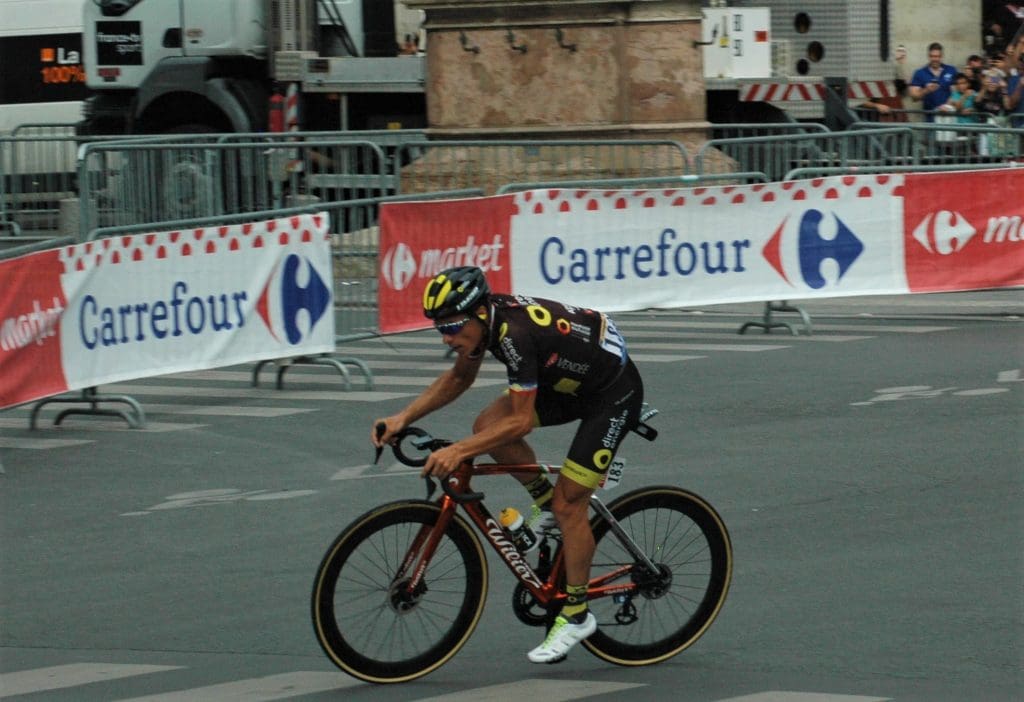
Other French Tour de France riders who deserve mention
French Tour history is too deep for a top 15 to capture everyone.
Maurice Garin won the first Tour de France in 1903 and will always have a foundational place in the race. His 1904 disqualification complicates his legacy, but no list of French Tour history can ignore the first winner.
Henri Cornet became the official winner of the 1904 Tour after disqualifications and remains the youngest winner in race history. Octave Lapize won in 1910, the first year the Tour crossed the high Pyrenees. Gustave Garrigou, Henri Pélissier, Roger Lapébie, Roger Pingeon and Lucien Aimar all belong in the wider roll of French Tour winners.
René Vietto is another major figure, remembered more for sacrifice, climbing and emotional Tour mythology than overall victory. Eugène Christophe, the first rider to wear the yellow jersey in 1919, also deserves mention for his place in the race’s symbolism.
In more recent decades, Jean-François Bernard briefly looked like a possible French Tour winner in the 1980s, while Christophe Moreau, Sandy Casar, Pierrick Fédrigo, Sylvain Chavanel, Warren Barguil, Romain Bardet and David Gaudu all added important chapters.
Bardet deserves particular note. He finished second in 2016 and third in 2017, making him one of the strongest French GC riders of the post-Hinault era. He also won mountain stages and helped keep French podium hopes alive before Pinot’s 2019 surge and the current younger generation.
For more on the modern race landscape that today’s French riders face, see Tour de France 2026 contenders preview and Tour de France 2026 GC favourites ranked.
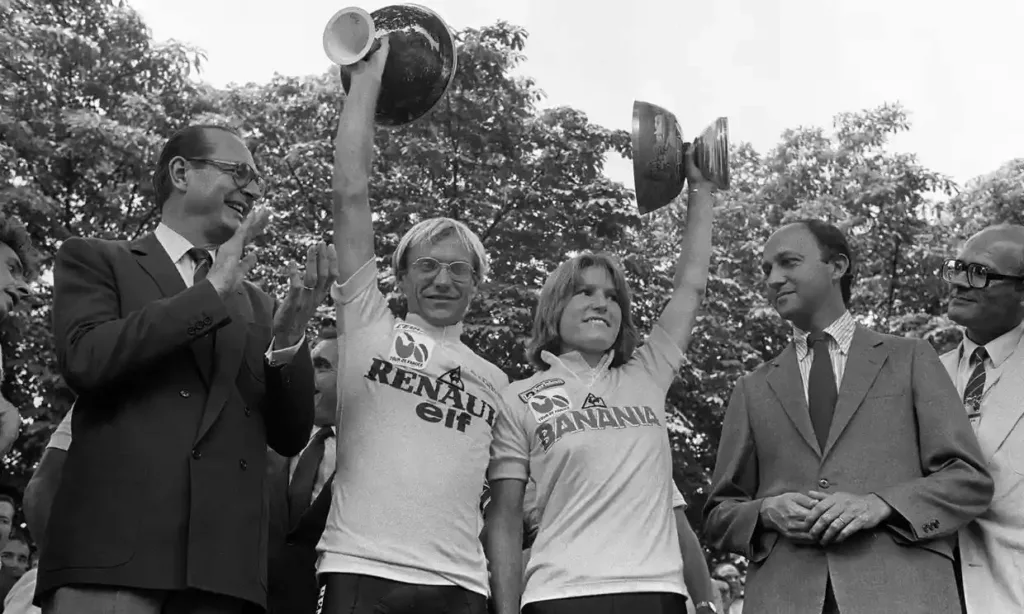
French Tour de France winners
France has produced more Tour de France winners than any other nation, though the long wait since Bernard Hinault’s 1985 victory remains one of the race’s defining storylines.
| Rider | Tour wins |
|---|---|
| Maurice Garin | 1903 |
| Henri Cornet | 1904 |
| Louis Trousselier | 1905 |
| René Pottier | 1906 |
| Lucien Petit-Breton | 1907, 1908 |
| Octave Lapize | 1910 |
| Gustave Garrigou | 1911 |
| Henri Pélissier | 1923 |
| André Leducq | 1930, 1932 |
| Antonin Magne | 1931, 1934 |
| Georges Speicher | 1933 |
| Roger Lapébie | 1937 |
| Jean Robic | 1947 |
| Louison Bobet | 1953, 1954, 1955 |
| Roger Walkowiak | 1956 |
| Jacques Anquetil | 1957, 1961, 1962, 1963, 1964 |
| Lucien Aimar | 1966 |
| Roger Pingeon | 1967 |
| Bernard Thévenet | 1975, 1977 |
| Bernard Hinault | 1978, 1979, 1981, 1982, 1985 |
| Laurent Fignon | 1983, 1984 |
That list shows both France’s dominance and its modern drought. French riders won many of the early Tours and produced two five-time champions, yet no Frenchman has won since Hinault. That gap now gives every promising French rider extra symbolic weight.
For the full winners list, see every Tour de France winner since 1903 and Tour de France winners list.
Greatest French Tour de France climber
Richard Virenque has the strongest claim as the greatest French Tour de France climber by mountains classification record. Seven polka-dot jerseys is the defining statistic.
But the answer changes depending on the terms. Hinault was a stronger all-round rider and won the Tour through the mountains as well as time trials. Bobet, Fignon, Thévenet, Robic, Vietto, Poulidor, Pinot and Bardet all had major mountain identities.
If the question is pure polka-dot success, it is Virenque. If the question is the greatest French climber who also won the Tour, Hinault has the strongest case. If the question is emotional mountain connection, Pinot and Poulidor are central.
The modern French climbing story now passes towards riders such as Lenny Martinez, David Gaudu, Kévin Vauquelin and Paul Seixas. None has yet reached the level of the older giants at the Tour, but the route to French relevance is still most likely to run through the mountains.
For current context, see best climbers at the Tour de France 2026, Tour de France 2026 climbers guide and Tour de France 2026 mountain stages ranked by difficulty.
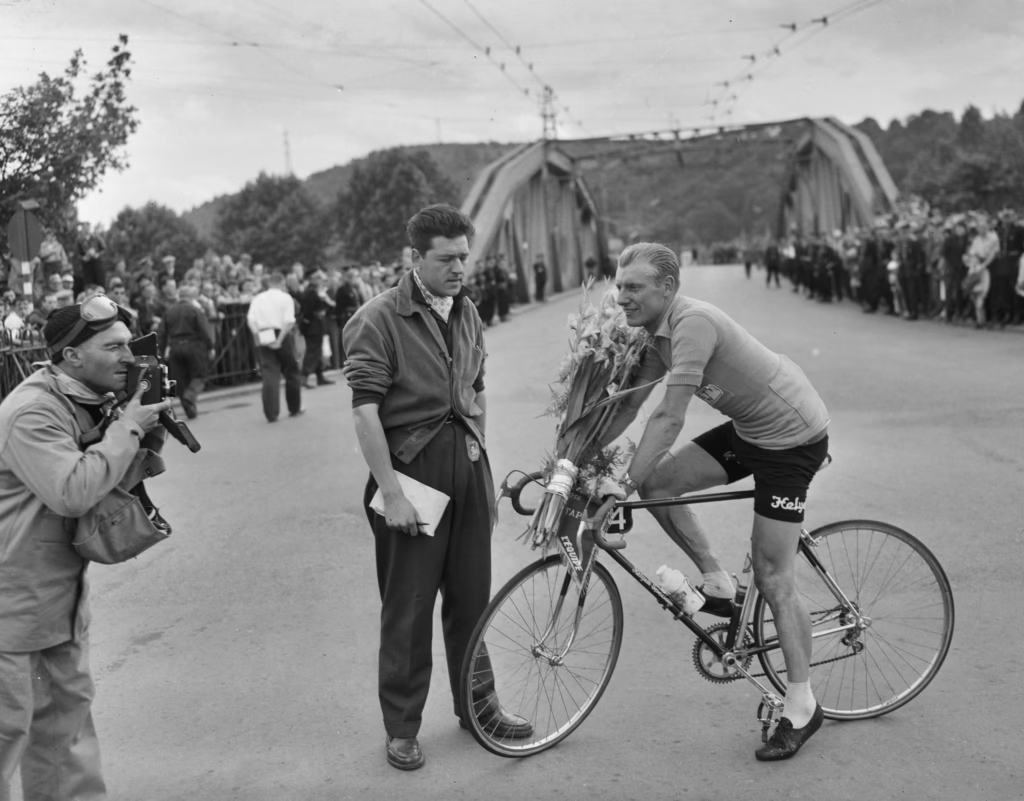
Greatest French Tour de France sprinter
André Darrigade has the strongest claim as France’s greatest Tour de France sprinter. He won 22 Tour stages and was one of the race’s defining fast men of the 1950s and 1960s.
Darrigade’s stage-winning record puts him ahead of most French sprinters in Tour history. He could win repeatedly, handle the pressure of the race and deliver in an era when sprinting was less specialised than it is now.
Jean-Paul van Poppel was Dutch rather than French, so the French sprint line runs more clearly through Darrigade, Charles Pélissier, André Leducq’s fast-finishing ability, Jean Stablinski, Jean Forestier and later riders such as Jean-Patrick Nazon, Jimmy Casper, Arnaud Démare and Bryan Coquard.
Démare and Coquard have both carried modern French sprint hopes, but neither has built a Tour record close to Darrigade’s. The modern sprint field is more specialised and more international, which has made French sprint dominance harder to sustain.
If judging the whole history of the race, Darrigade is the French sprint reference point.
For the current sprint landscape, see Tour de France 2026 sprinters guide, best sprinters at the Tour de France 2026 and Tour de France 2026 route: best days for sprinters.
Greatest French Tour de France stage hunter
The greatest French Tour stage hunter is harder to define because so many French riders have built their reputations through breakaways, opportunism and emotional stage wins.
Thomas Voeckler has one of the strongest modern cases. He could turn ordinary stages into national dramas and was at his best when the race gave him space. His 2012 mountains classification also came from that ability to choose the right days.
Julian Alaphilippe is another leading modern answer. His Tour stage wins have come through timing, punch and courage on rolling terrain. He can read a finish, attack before the obvious moment and make the race feel unstable.
Laurent Jalabert also belongs here because he won in several ways and reinvented himself into an attacking mountain rider. Pierrick Fédrigo, Sandy Casar, Sylvain Chavanel and Christophe Riblon all added to the modern French breakaway tradition.
In the current Tour landscape, French stage hunting may be more realistic than overall victory. Alaphilippe, Grégoire, Vauquelin, Turgis, Martinez, Gaudu, Jegat and Seixas all offer different routes to French success in 2026.
For more on that tactical side, see what is a breakaway in the Tour de France?, Tour de France 2026 stage hunters to watch and Tour de France 2026 breakaway stages ranked.

The French drought since 1985
No French rider has won the Tour de France since Bernard Hinault in 1985. That is one of the race’s great modern facts, and it shapes almost every French Tour story.
The drought is not due to a lack of talent. France has produced podium riders, stage winners, climbers, world champions and yellow jersey wearers during that period. But winning the Tour has become harder, more international and more specialised.
The 1990s and 2000s were complicated by the sport’s doping era. The 2010s brought real hope through Thibaut Pinot and Romain Bardet, but neither turned podium or mountain promise into overall victory. Alaphilippe’s 2019 yellow jersey run gave France a different kind of dream, but he was never built as a three-week Tour winner.
Now the focus has shifted again. David Gaudu has already carried GC expectations. Kévin Vauquelin has emerged as a serious modern stage-race talent. Lenny Martinez brings climbing promise. Paul Seixas may be the most important long-term hope.
The problem is the level at the top. To win the Tour now, a French rider has to beat Pogačar, Vingegaard, Evenepoel and the strongest teams in the world. That is a much higher bar than simply producing a good climber.
For the current race picture, see Tour de France 2026 contenders preview, Tour de France 2026 GC favourites ranked and Tour de France 2026 dark horses for the general classification.
French riders at the Tour de France 2026
The 2026 Tour de France is unlikely to begin with a French rider among the top favourites for yellow, but the home nation still has several routes into the race.
Paul Seixas is the long-term name. He is unlikely to carry full yellow jersey expectation yet, but his presence matters because French cycling needs a new GC reference point. The best-case scenario is probably a strong mountain showing, controlled development and signs that he can grow into a future Tour leader.
Julian Alaphilippe remains the emotional stage-hunting headline. He is not a GC contender, but on rolling or punchy terrain he can still shape a stage. Romain Grégoire gives Groupama-FDJ United a younger attacking card. Kévin Vauquelin can target stages, support GC plans or chase a strong overall position depending on how Netcompany INEOS use him.
Lenny Martinez gives Bahrain Victorious a climbing option, while David Gaudu remains part of the wider French mountain conversation. Anthony Turgis, Jordan Jegat, Mattéo Vercher, Quentin Pacher and others can all matter in breakaways.
That is the realistic French picture for 2026: stage wins, mountain attacks, breakaway days, maybe a strong top-10 push, and long-term hope around Seixas. A French yellow jersey win would be a major surprise. A French stage win would be much more realistic.
For the full current breakdown, see best French riders to watch at the Tour de France 2026, Paul Seixas and the next French Tour de France generation and full start list for Tour de France 2026.
-
 Photo Credit: Cor Vos
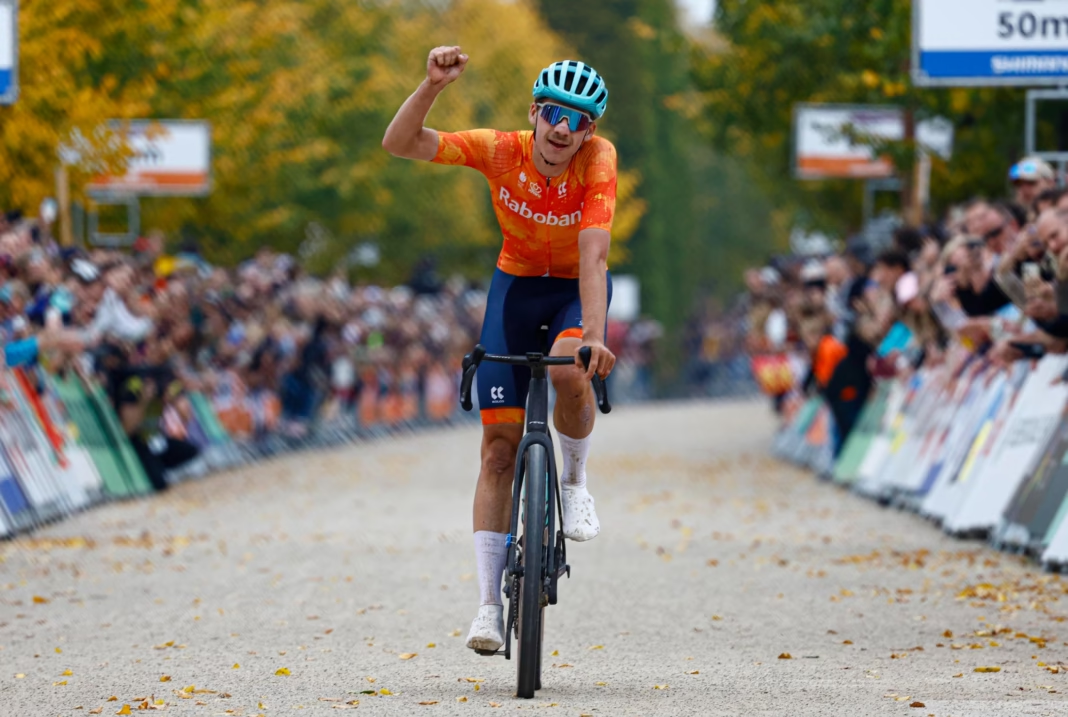
Who is the greatest French rider at the Tour de France?
Bernard Hinault is the greatest French rider at the Tour de France. The case is simple: five overall victories, modern-era dominance, all-round strength, aggression, time-trial ability, climbing quality and the fact that he remains the last French winner.
Jacques Anquetil is close. He was the first five-time winner and one of the most important riders in the race’s history. If the ranking is based only on control and historical innovation, Anquetil can be placed first. But Hinault’s wider racing range gives him the edge.
Louison Bobet is the clear third name because of his three consecutive wins and post-war importance. Fignon, Poulidor, Leducq, Magne, Petit-Breton and Thévenet then fill out the core of the French Tour canon.
The emotional answer may be different. Some French fans would choose Poulidor, Pinot, Voeckler or Alaphilippe because the Tour is not only about winning. It is also about attachment, suffering and belief.
But as a sporting judgement, Hinault stands alone. France has waited since 1985 for another rider like him.
For more on the modern race that French riders now have to solve, see Tour de France 2026 full route guide and Tour de France 2026 route analysis.
French Tour de France greatness explained simply
The greatest French Tour de France riders fall into several groups.
The early founders came first: Maurice Garin, Lucien Petit-Breton, Octave Lapize, Henri Pélissier and others. They helped build the race’s first mythology.
The inter-war champions followed: André Leducq, Antonin Magne, Georges Speicher and Roger Lapébie. They kept French riders central as the Tour became more structured and nationally symbolic.
The post-war and modern champions then defined the highest level: Jean Robic, Louison Bobet, Jacques Anquetil, Bernard Thévenet, Bernard Hinault and Laurent Fignon.
Then came the long wait after Hinault: Poulidor’s legacy remained powerful, Virenque ruled the polka-dot jersey, Jalabert reinvented himself, Voeckler made yellow emotional, Pinot carried the modern climbing dream, and Alaphilippe brought French attacking flair back to the centre of the race.
That is why French Tour history is not only a list of winners. It is the story of the race itself: invention, dominance, rivalry, tragedy, waiting, hope and the constant search for the next home champion.
For more Tour de France coverage, visit our Tour de France hub, Tour de France 2026 full route guide and beginner’s guide to Men’s Tour de France 2026.

