
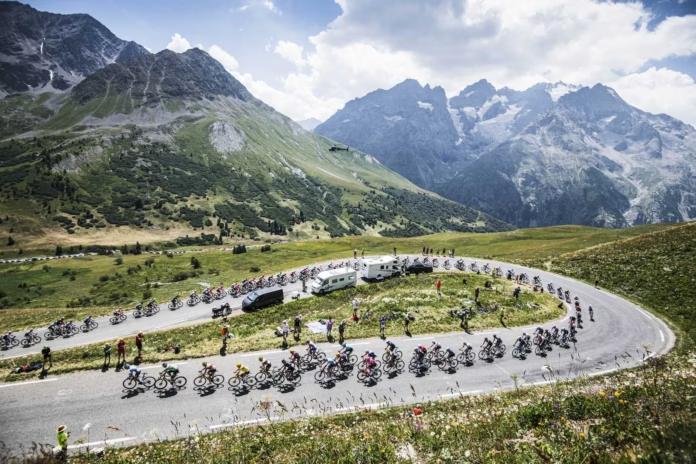
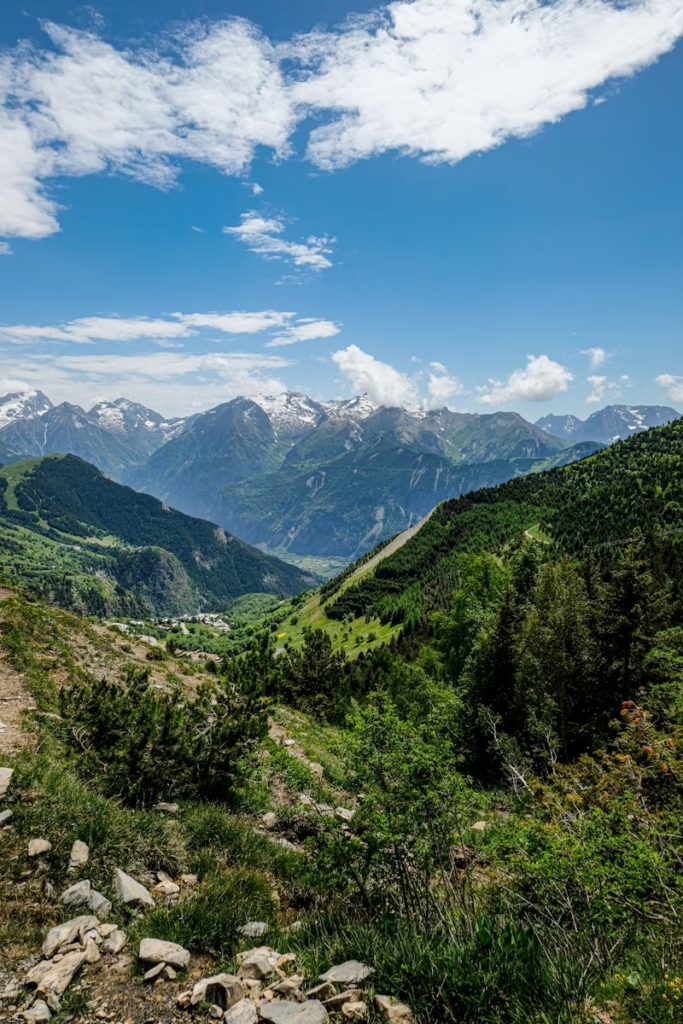
Alpe d’Huez is not the longest climb in the Tour de France. It is not always the hardest. It is not even used every year. Yet few places in cycling carry the same weight. Its 21 hairpins have turned into a shorthand for Tour de France drama, from Fausto Coppi’s first summit win in 1952 to Tom Pidcock’s descending-led victory in 2022.
The climb has become famous because it combines a simple sporting test with a very public setting. The road rises from Bourg d’Oisans to the ski resort above, twisting through numbered bends that have become part of Tour history. The gradient is hard enough to split the best climbers, the crowds are close enough to make the climb feel enclosed, and the finish has often arrived late enough in the race to matter.
In 2026, Alpe d’Huez returns with unusual force. The Tour will finish there on consecutive mountain stages, first from Gap on Stage 19, then again from Le Bourg d’Oisans on Stage 20 after a much harder Alpine route. It gives the climb a central place in the final weekend and brings one of the Tour’s most recognisable stages back into the general classification fight.
For the full 2026 race context, see our Tour de France 2026 full route guide, Tour de France 2026 Alps guide and Tour de France 2026 queen stage guide.
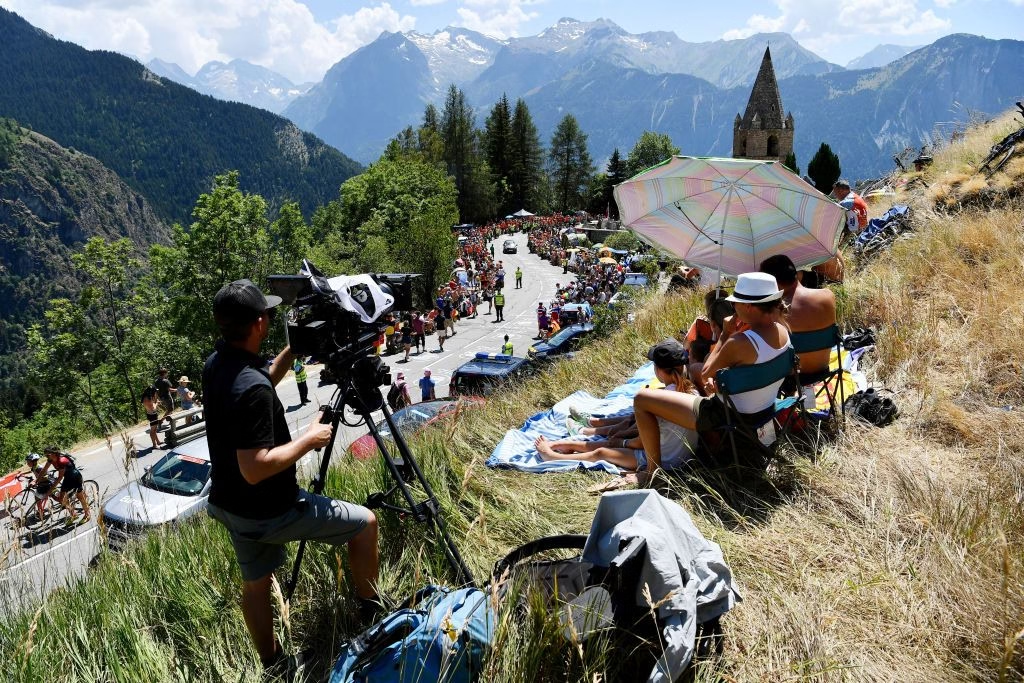 Photo Credit: Getty
Why Alpe d’Huez matters
Alpe d’Huez matters because it is easy to understand and hard to survive. The climb has 21 famous hairpins, a steep opening section, and a final approach that can feel endless when riders are already deep into a mountain stage.
It is also a climb that creates images. Riders weaving through crowds. Leaders isolated. Domestiques dropping away. Attacks on the lower slopes. Riders looking across at rivals with the finish still far above them. It is a road that makes the Tour visible in a way that television, roadside fans and history all recognise.
The climb is often described through emotion, but its sporting value is straightforward. It is long enough for the best climbers to make a difference, steep enough to expose weakness, and famous enough to change how riders and teams behave. Nobody wants to crack on Alpe d’Huez. Nobody wants to waste a chance to win there.
That pressure changes the race. Some riders attack too early. Others ride within themselves and hope rivals make the first mistake. Teams try to control the lower slopes, but once the climb opens up, the strongest riders usually find their own level.
For more on the wider place of the climb in Tour history, see our feature on Alpe d’Huez: why the Tour still fears the 21 bends and its history. For the 2026 climbing context, see our Tour de France 2026 mountain stages ranked by difficulty and how the Tour de France general classification works.
1952: Fausto Coppi and the first mountain-top finish
Alpe d’Huez entered Tour history in 1952, when Fausto Coppi won the stage and helped define a new kind of mountain racing. The finish is widely remembered as the Tour’s first true mountain-top finish, and Coppi’s victory immediately gave the climb status.
That matters because before then, the Tour’s mountain mythology was built largely around passes and descents. Riders climbed major cols, but the decisive finish was not always at the top. Alpe d’Huez changed the shape of the race. It allowed the climb itself to become the finish line.
Coppi was the ideal first winner. He was already one of cycling’s defining figures, a rider whose climbing and style made him look suited to grand gestures. His win gave the climb instant credibility. Alpe d’Huez did not need decades to become important. It arrived with one of the sport’s great names already attached to it.
The Tour did not immediately return every year, but the link was made. Alpe d’Huez had shown what a summit finish could do.

A long wait before the climb returned
After 1952, Alpe d’Huez disappeared from the Tour for more than two decades. That absence is part of its story. The climb did not become iconic because of constant repetition. It became iconic because when it returned, it arrived as something different from the rest of the race.
The Tour came back to Alpe d’Huez in the 1970s, just as television, bigger roadside crowds and modern stage design were changing how the race was watched. The climb was no longer just a difficult road to a ski station. It was a natural amphitheatre for the Tour.
That return also created the foundation for the climb’s Dutch identity. Dutch riders began winning there often enough that the mountain became linked with orange crowds, camping fans and one of cycling’s most recognisable roadside cultures.
By the end of the 1970s and into the 1980s, Alpe d’Huez was no longer only Coppi’s climb. It had become one of the Tour’s central stages.
For a wider race-history overview, see our brief history of the Men’s Tour de France.
The Dutch mountain
Alpe d’Huez is often called the Dutch mountain. That nickname comes from the number of Dutch winners during the climb’s formative Tour years and from the fans who turned hairpin seven into Dutch Corner.
Joop Zoetemelk, Hennie Kuiper, Peter Winnen, Steven Rooks and Gert-Jan Theunisse all helped build the Dutch story on the climb. Those wins came when the Tour was developing into a more international television event, and Dutch supporters made Alpe d’Huez their own.
Dutch Corner became part of the experience. It is not just a place on the climb. It is a symbol of how Alpe d’Huez turns spectators into part of the stage. The orange crowds, noise and density create one of the most intense fan environments in the sport.
That atmosphere is part of why the climb can feel different from other Alpine finishes. On many climbs, the mountain dominates. On Alpe d’Huez, the crowd often feels just as important as the gradient. Riders are not only climbing a road. They are passing through a corridor of expectation.
Why the 21 hairpins became famous
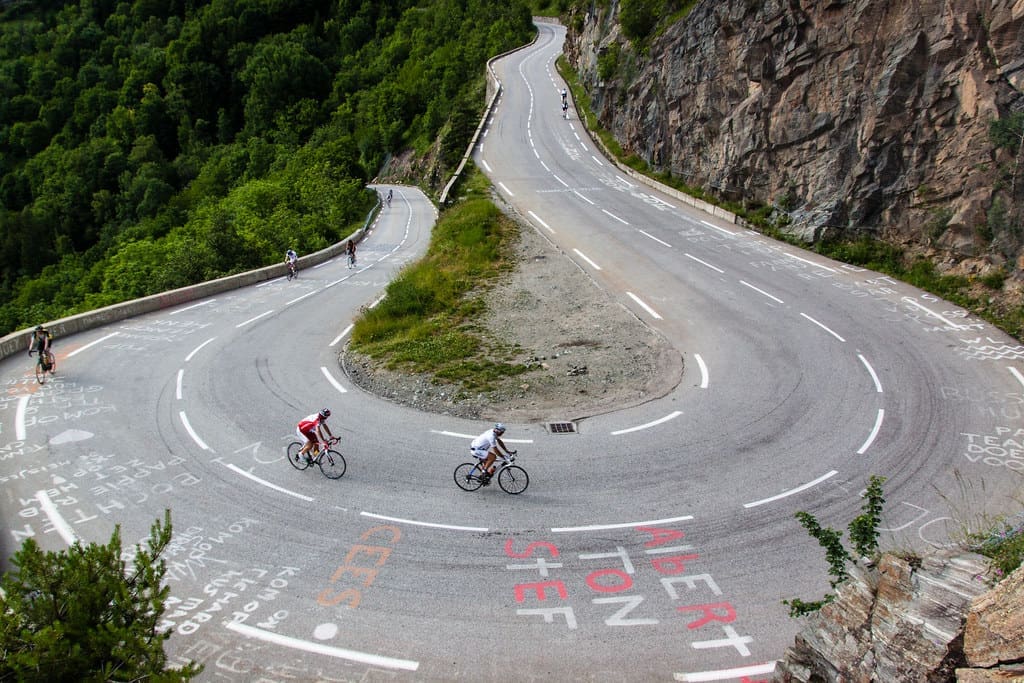
The 21 hairpins are central to the climb’s identity. They give Alpe d’Huez a structure that fans can follow and riders can feel. Each bend becomes a marker of suffering, progress and history.
The lower bends are often the hardest psychologically. The climb begins steeply from Bourg d’Oisans, and riders quickly understand whether they are having a good day or a bad one. The road then opens into a rhythm of turns, ramps and crowd sections.
The hairpins also make the climb visually clear. Television cameras can show the road stacked above itself, with riders turning from one level to the next. Fans can see the race approaching and hear the noise build. The numbered bends give the climb a sense of countdown.
That matters for storytelling. Many climbs are harder on paper. Few are easier to recognise instantly. The official Alpe d’Huez tourism guide to the 21 bends gives the climb’s basic shape: 21 bends, a start in Bourg d’Oisans, a finish at Alpe d’Huez, and more than 1,100m of height gain.
1976: Joop Zoetemelk and the modern Alpe d’Huez era
Joop Zoetemelk’s 1976 victory helped begin the modern Alpe d’Huez era. It was the first Tour finish on the climb since Coppi, and it confirmed that the road could still shape the race more than two decades later.
Zoetemelk was already one of the major Tour riders of his time. His win connected the climb to a new generation and helped start the Dutch run that would define the following years. Alpe d’Huez became not only a historic return but a recurring stage with its own identity.
The 1970s and 1980s were crucial because they established the climb as a place where the Tour expected something important to happen. It was not just a difficult finish. It was a stage that carried weight before the riders even reached the bottom.
From that point, Alpe d’Huez became one of the roads the Tour could use when it wanted a mountain stage to feel bigger than the ordinary race pattern.
1984: Luis Herrera and Colombia’s breakthrough
Luis Herrera’s victory on Alpe d’Huez in 1984 became one of the great international moments in Tour history. He was a Colombian climber racing in an era when South American riders were beginning to change how European cycling understood the mountains.
Herrera’s win mattered because it showed a different climbing culture arriving at the Tour. Colombian riders had grown up at altitude and brought a natural rhythm to long climbs that made them dangerous in the high mountains. Alpe d’Huez was the perfect stage for that talent to be seen.
The victory also helped widen the mythology of the climb. Coppi had given it Italian grandeur. The Dutch had made it orange. Herrera gave it a Colombian chapter and showed that the climb could introduce new cycling worlds to the Tour audience.
That became part of Alpe d’Huez’s appeal. It was not only a place for established champions. It could also be a place where cycling’s geography expanded.
1986: Hinault, LeMond and one of the Tour’s defining images
The 1986 Alpe d’Huez stage produced one of the most famous images in Tour history: Bernard Hinault and Greg LeMond crossing the line together. Hinault won the stage, LeMond strengthened his path towards overall victory, and the finish became wrapped in the complicated politics of team leadership.
The image looked like unity. The story beneath it was more complicated. Hinault, already a five-time Tour winner, had promised to support LeMond, but the 1986 race was full of tension between ambition, loyalty and control. Alpe d’Huez became the place where that tension was frozen into one photograph.
It remains one of the reasons the climb still matters historically. Alpe d’Huez did not simply produce a stage result. It revealed a team dynamic, a generational shift and the psychology of the yellow jersey battle.
Many climbs decide time gaps. Alpe d’Huez often seems to expose relationships.
For more on how team roles shape the Tour, see our how Tour de France teams work and what is a domestique at the Tour de France?.
The Italian years and the Pantani legend
Alpe d’Huez has also been a major Italian stage. Gianni Bugno won there twice in the early 1990s, Roberto Conti won in 1994, Marco Pantani won in 1995 and 1997, and Giuseppe Guerini added another Italian victory in 1999.
Pantani’s place in the climb’s history is especially strong. His climbing style, acceleration and aura made him look made for Alpe d’Huez. His 1997 ascent is still widely cited as the fastest recorded climb of the Alpe, though exact times can vary depending on the start and finish points used for measurement.
Pantani’s Alpe d’Huez performances sit in a complicated period of cycling history, but they remain central to how many fans remember the climb. He did not merely win there. He attacked the climb in a way that made the road feel explosive.
That is one reason Alpe d’Huez has such a strong hold on cycling memory. It has often rewarded riders whose style matched the scale of the stage. Pantani’s style did.
For the modern climbing comparison, see our best climbers at the Tour de France 2026 and Tour de France 2026 climbers guide.
1999: Giuseppe Guerini and the spectator collision
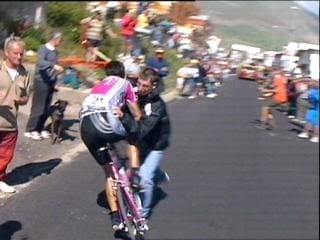
Giuseppe Guerini’s 1999 victory is remembered for one of the strangest incidents in Alpe d’Huez history. Riding alone towards the finish, Guerini collided with a spectator who had stepped into the road while trying to take a photograph.
The crash could have ruined the stage. Instead, Guerini got back up, continued and still won. It became a classic Alpe d’Huez moment because it showed both the energy and danger of the climb’s crowd culture.
Alpe d’Huez is famous partly because fans are so close to the riders. That closeness creates atmosphere, but it can also create risk. The 1999 incident remains one of the clearest reminders that the Tour’s great roadside theatre depends on restraint as well as passion.
Guerini’s win survived the chaos. The image of the crash became part of the climb’s mythology.
The Armstrong era and its difficult legacy
The early 2000s gave Alpe d’Huez more famous images, but they now sit inside one of cycling’s most difficult periods. Lance Armstrong’s performances on the climb, including the 2001 stage and the 2004 mountain time trial, were once central to modern Alpe d’Huez mythology. They are now part of a stripped and discredited era.
That does not mean the stages disappear from history. They happened, they shaped how people watched the Tour, and they influenced how Alpe d’Huez was remembered at the time. But they cannot be discussed as simple sporting achievements.
The climb has carried cycling’s beauty and its baggage. That is part of the truth of Alpe d’Huez. It has seen clean emotion, racing intelligence, crowd chaos, national celebration and the darker side of the sport’s past.
Any serious history of Alpe d’Huez has to hold those things together rather than pretend the difficult chapters were not there.

2011: Pierre Rolland and a French revival
Pierre Rolland’s victory in 2011 gave France one of its most popular modern Alpe d’Huez moments. Riding for Europcar, Rolland attacked on the climb and won the stage, also securing the white jersey as best young rider.
It mattered because French fans had waited a long time for a home winner on one of the Tour’s most famous mountain finishes. Rolland’s win came with the kind of emotion that Alpe d’Huez can generate better than almost anywhere else.
The stage also showed how the climb can reward riders outside the narrow group of overall winners. Rolland was not winning the Tour, but his victory became one of the defining French moments of that edition.
Alpe d’Huez does not always need to decide yellow to matter. Sometimes it creates a stage victory that lasts in the national memory.
For the current French angle, see our best French riders to watch at the Tour de France 2026.
2013: the double ascent and Christophe Riblon
The 2013 Tour de France used Alpe d’Huez in a different way by climbing it twice on the same stage. The route descended via the Col de Sarenne between the two ascents, creating a rare double encounter with the mountain.
Christophe Riblon won the stage, giving France another emotional victory on the Alpe. The double ascent also showed how the Tour could still find new ways to use a familiar climb. Alpe d’Huez was not only a classic finish. It could be redesigned into something more demanding and unpredictable.
That stage remains important when looking ahead to 2026. The Tour has shown a willingness to use the Alpe creatively, not just as the standard final climb from Bourg d’Oisans. When the race returns with back-to-back finishes, it continues that pattern of trying to make a known climb feel fresh.
For the 2026 version of that final Alpine block, see our Tour de France 2026 queen stage guide and why back-to-back Alpe d’Huez finishes could define the Tour de France 2026.
2018: Geraint Thomas wins in yellow
Geraint Thomas won on Alpe d’Huez in 2018 while wearing the yellow jersey. It was a major moment in his Tour-winning campaign and one of the clearest signs that Team Sky’s leadership balance had shifted.
Thomas did not just defend on the climb. He won the stage. That mattered because Alpe d’Huez victories carry extra symbolic value. Winning there in yellow suggested control, confidence and superiority in one of the race’s most visible settings.
The stage also came during a period when Alpe d’Huez remained a test of team strength as much as individual climbing. Strong squads could control the approach, place their leaders and reduce the options for rivals. But once the road steepened, the leader still had to finish the work.
Thomas did that. His win remains one of the defining British moments on the climb.
For the current British Tour picture, see our best British riders to watch at the Tour de France 2026.
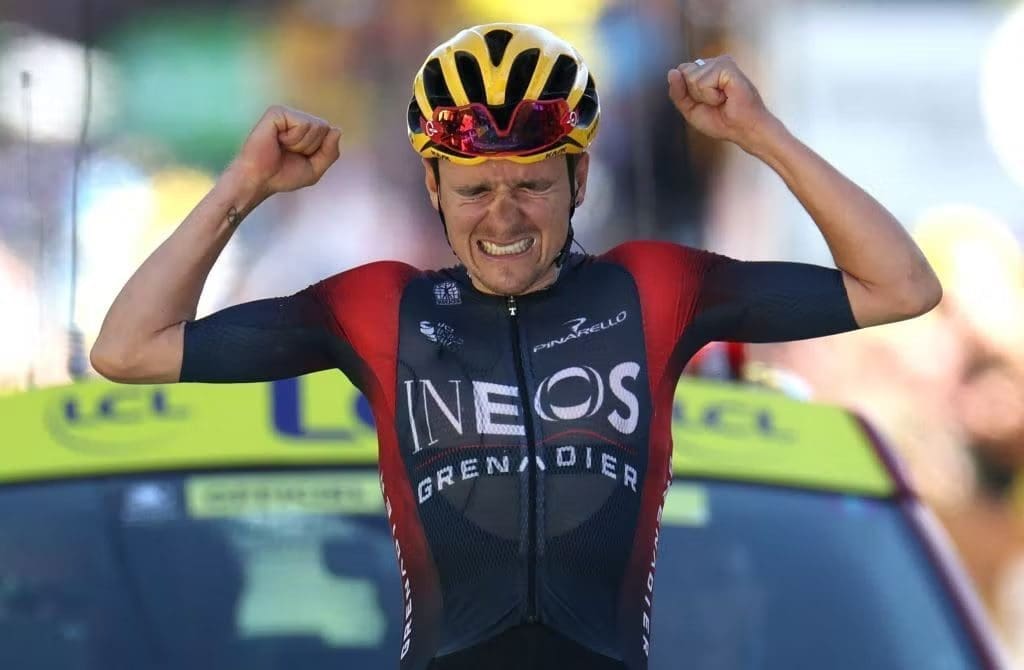 Photo Credit: A.S.O./Charly López
2022: Tom Pidcock and the modern Alpe d’Huez
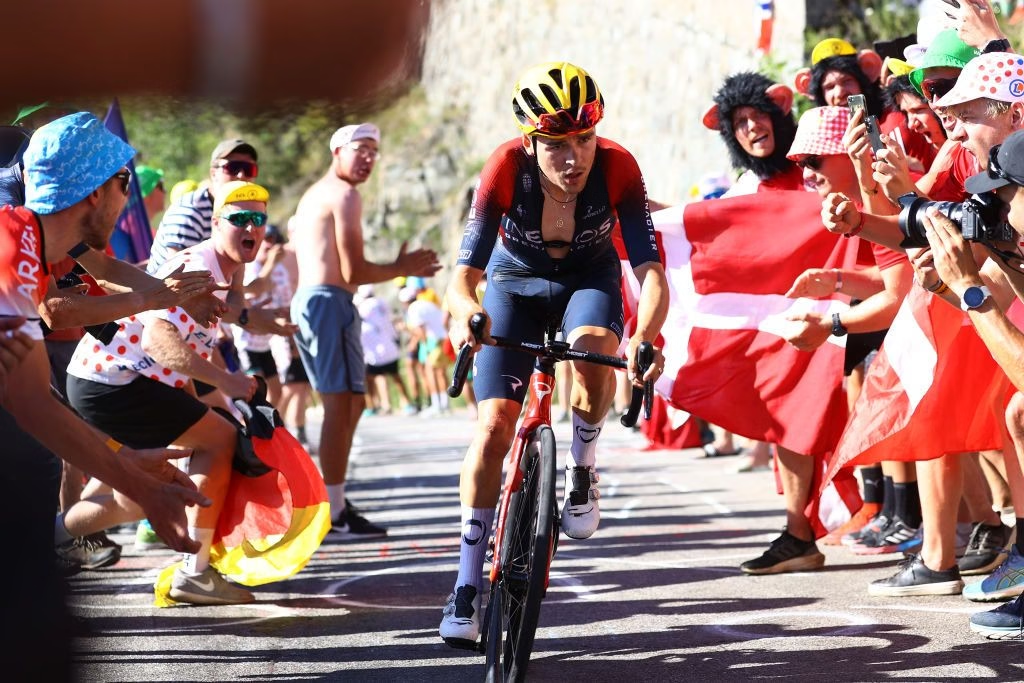
Tom Pidcock’s 2022 victory gave Alpe d’Huez a very different kind of modern winner. He attacked from the breakaway, used his descending skill to help shape the stage, then climbed strongly enough to win on one of cycling’s most famous roads.
Pidcock’s win stood out because it showed another way to win on Alpe d’Huez. It was not a classic yellow jersey duel. It was a breakaway performance built on descending, tactical timing and climbing ability. He became the youngest rider to win a Tour stage on the climb, and the victory gave Britain another major Alpe d’Huez chapter after Thomas.
The stage also underlined how the climb can still reinvent itself. In the past, Alpe d’Huez was often viewed as a pure GC arena. In 2022, it became a place where a multi-discipline rider could use a wider skill set to win.
That is part of why the climb remains relevant. It does not only belong to the old pattern of mountain racing.
For more on Pidcock’s 2026 Tour role, see our Tom Pidcock at the Tour de France 2026 and our 2022 report on Tom Pidcock winning on Alpe d’Huez.
Alpe d’Huez and the general classification
Alpe d’Huez is famous for stage wins, but its bigger role is often psychological. A rider can lose the Tour there without losing the stage by minutes. The climb is so public, so loaded and so late in the race that weakness feels amplified.
GC riders know that any bad moment on Alpe d’Huez will be replayed. Teams know that isolation on the lower slopes can look like a warning sign. Rivals know that attacks on the climb carry more meaning than attacks on a lesser-known mountain.
That is why Alpe d’Huez can affect the race even before the riders reach it. Teams plan around it. Leaders try to save energy for it. Fans expect it to matter. The climb sits in the minds of riders long before the first hairpin.
In pure time terms, other climbs can be harder. In Tour terms, few climbs apply pressure in the same way.
For more on the overall battle, see our how the Tour de France general classification works, Tour de France 2026 GC favourites ranked and Tour de France 2026 route: best days for GC attacks.
The climb’s most famous winners
Alpe d’Huez has produced winners from different eras, countries and rider types. Some were Tour champions. Some were stage hunters. Some won from the breakaway. Some were already wearing yellow.
| Year | Winner | Why it mattered |
|---|---|---|
| 1952 | Fausto Coppi | First Tour mountain-top finish on Alpe d’Huez |
| 1976 | Joop Zoetemelk | Restarted the modern Alpe d’Huez story |
| 1984 | Luis Herrera | Colombian climbing breakthrough |
| 1986 | Bernard Hinault | Famous finish with Greg LeMond |
| 1995 | Marco Pantani | Part of Pantani’s Alpe d’Huez legend |
| 1997 | Marco Pantani | Widely cited fastest ascent |
| 1999 | Giuseppe Guerini | Won despite colliding with a spectator |
| 2011 | Pierre Rolland | Major modern French victory |
| 2013 | Christophe Riblon | Won the double-ascent stage |
| 2018 | Geraint Thomas | Won on Alpe d’Huez in yellow |
| 2022 | Tom Pidcock | Youngest winner on the climb |
The list shows why the climb carries so much weight. It links Coppi, Dutch dominance, Colombian climbing, French emotion, British success and the modern breakaway era in one place.
Why Alpe d’Huez is different from other Tour climbs
The Tour has harder climbs than Alpe d’Huez. The Col du Galibier is higher. The Col du Tourmalet has deeper history. Mont Ventoux is more exposed and more isolated. The Col de la Loze is more extreme in modern gradient terms.
Alpe d’Huez is different because it combines difficulty, repetition, crowd culture and finish-line status. It is not just a pass on the way somewhere else. It is usually the destination. The stage is built around arriving there.
The climb is also visually compact. The hairpins give it rhythm. The resort finish gives it space for a major stage ending. The crowds give it noise. The history gives it meaning before the racing even begins.
That combination is rare. Many climbs can hurt the riders. Fewer can carry the weight of the Tour’s past at the same time.
For the wider 2026 climbing picture, see our Tour de France 2026 climbs guide.
The 2026 double Alpe d’Huez return
The 2026 Tour will bring Alpe d’Huez back in an unusually strong form. Stage 19 finishes there from Gap over 127.9km, with 3,500m of climbing. Stage 20 then returns to Alpe d’Huez from Le Bourg d’Oisans over 170.9km, with 5,450m of climbing.
That second stage is the bigger GC test. It comes on the penultimate competitive day before Paris and includes a huge amount of climbing. The route is designed to make the final Alpe d’Huez finish more than a ceremonial return. It could decide the Tour.
Back-to-back finishes also change the psychology. Riders will not only climb Alpe d’Huez once and move on. They will have to face it, recover, then face it again after an even harder route. That creates a different kind of pressure. A rider who survives Stage 19 may still crack on Stage 20. A rider who loses time on the first Alpe finish may have one last chance the next day.
That is why the 2026 edition feels like a deliberate use of history. The Tour is not simply including Alpe d’Huez. It is putting the climb at the centre of the final mountain argument. The official Tour de France Stage 20 page confirms the Le Bourg d’Oisans to Alpe d’Huez route as 170.9km with 5,450m of climbing.
For the route detail, see our Tour de France 2026 Alps guide, Tour de France 2026 summit finishes guide and Tour de France 2026 queen stage guide.
-
 Photo Credit: Cor Vos
 -
 Photo Credit: Zac Williams/AusCycling

What Alpe d’Huez means for fans
For fans, Alpe d’Huez is one of the most recognisable places to watch the Tour de France. It is accessible compared with some high Alpine passes, has a clear road structure, and offers a full day of atmosphere before the riders arrive.
But it also requires planning. The climb becomes crowded early. Roads close. Movement is limited. Dutch Corner and the most famous bends can be packed long before the race reaches the mountain. Anyone visiting needs to treat it as a full-day commitment rather than a casual roadside stop.
That is part of the appeal. Alpe d’Huez is a cycling pilgrimage. Fans go there not only to watch a stage, but to stand on a road where so many Tour stories have happened.
In 2026, with two consecutive finishes, the crowds should be even greater. That will make the atmosphere bigger, but it will also make logistics more difficult. The Alpe will be the place many fans want to be, and that means early planning will matter.
For wider fan planning, see our Tour de France 2026 in Catalonia: what fans need to know, how to visit the Tour de France 2026 Grand Départ in Barcelona and how to watch Tour de France 2026 in the UK.
Why Alpe d’Huez still defines the Tour
Alpe d’Huez still defines the Tour because it does what the race needs its great climbs to do. It creates selection, emotion, fear, noise and memory. It gives riders a chance to become part of history and gives the race a stage that casual fans recognise instantly.
It is also a climb that can absorb different eras. Coppi made it historic. The Dutch made it theirs. Hinault and LeMond gave it politics. Pantani gave it speed. Guerini gave it chaos. Rolland gave it French emotion. Thomas and Pidcock gave it modern British wins. The 2026 route will give it a new double-stage chapter.
That is why Alpe d’Huez is more than a mountain finish. It is one of the Tour’s great recurring tests. Every return adds another layer, but the basic challenge stays the same: reach Bourg d’Oisans, turn onto the climb, and find out who has something left.
For more Tour de France 2026 coverage, visit our Tour de France hub, beginner’s guide to Men’s Tour de France 2026 and Tour de France 2026 route analysis.

