
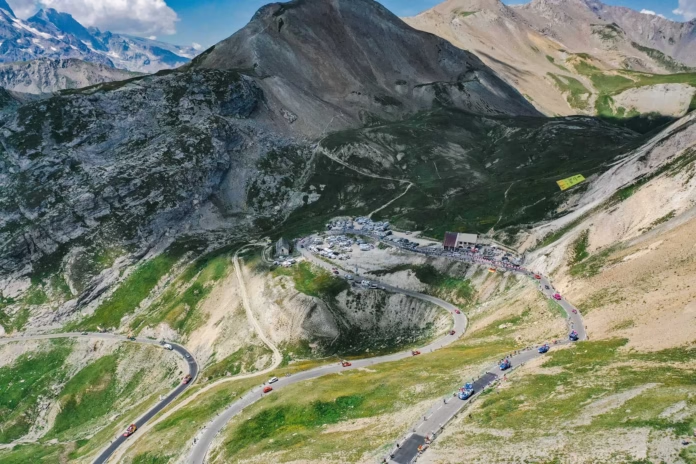
The Tour de France 2026 route saves its biggest mountain stage for the penultimate day. Stage 20 from Le Bourg d’Oisans to Alpe d’Huez is the queen stage of the race, taking the riders over the Col de la Croix de Fer, Col du Télégraphe, Col du Galibier, Col de Sarenne and one final climb to Alpe d’Huez.
It is the stage that gives the 2026 Tour its final mountain climax. The Galibier is the highest point of the race at 2,642m, Alpe d’Huez is the Tour’s most recognisable summit finish, and the Col de Sarenne adds a rare late Alpine obstacle before the final ascent. At 170.9km, with more than 5,000m of climbing, stage 20 is both the hardest day on paper and the last major chance to reshape the general classification before Paris.
The stage also follows another finish on Alpe d’Huez the previous day. That back-to-back structure gives the final Alpine weekend a very different feel from a standard summit-finish finale. Stage 19 offers a shorter, sharper route from Gap to Alpe d’Huez. Stage 20 returns to the same ski station, but only after a huge Alpine loop built around the Croix de Fer, Télégraphe, Galibier and Sarenne. As covered in our feature on why back-to-back Alpe d’Huez finishes could define the Tour de France 2026, the repeat finish is not just a route-design flourish. It changes how the whole final week may be raced.
For the yellow jersey contenders, this is the last mountain stage with enough terrain to create a major swing. For the rider defending yellow, it is a day full of risk. The route is long enough for team strength to matter, high enough for altitude to bite, and late enough in the race that fatigue could turn a small weakness into a decisive crack.
 Photo Credit: A.S.O./Aurélien Vialatte
What is the Tour de France 2026 queen stage?
The queen stage of the Tour de France 2026 is stage 20, from Le Bourg d’Oisans to Alpe d’Huez. It comes on Saturday, 25th July, the penultimate day of the race, and is the final major mountain test before the Tour reaches Paris.
The stage is 170.9km long and includes five major climbs:
Col de la Croix de Fer, 24km at 5.2 per cent
Col du Télégraphe, 11.9km at 7.1 per cent
Col du Galibier, 17.7km at 6.9 per cent
Col de Sarenne, 12.8km at 7.3 per cent
Alpe d’Huez, final summit finish
That sequence is why stage 20 stands apart from the other Tour de France 2026 mountain stages. The race has already crossed the Pyrenees, Massif Central, Vosges, Jura and Alps by this point, but no other stage combines this level of altitude, climbing depth and final-week consequence.
The queen stage is not always the day that produces the biggest time gaps, but it is usually the most demanding mountain stage. In 2026, the label is clear. Stage 20 has the highest climb of the race, one of cycling’s most famous summit finishes, and the pressure of the penultimate day.
Why is stage 20 the queen stage of the 2026 Tour?
Stage 20 is the queen stage because of its climbing load, altitude and position in the race. It is not simply a hard mountain day. It is a hard mountain day after almost three weeks of racing, after the individual time trial, after Orcières-Merlette, and after the first Alpe d’Huez finish on stage 19.
The Col de la Croix de Fer immediately sets the tone. It is long, irregular and difficult to manage because the gradient keeps changing. The Télégraphe and Galibier then create the classic high Alpine combination. By the time the riders reach the top of the Galibier, they will be at the roof of the 2026 Tour and deep into a stage where recovery between climbs is limited.
The stage could already be fractured by then, but it still will not be close to finished. The Col de Sarenne comes late, and although it does not have the same fame as the Galibier or Alpe d’Huez, it may become one of the most important climbs of the day. It adds another hors catégorie effort before the final summit finish and stops the race from becoming a simple approach to Bourg d’Oisans before the classic Alpe d’Huez road.
That is what makes the design so severe. Riders do not simply climb Alpe d’Huez at the end of a hard day. They climb it after the Croix de Fer, Télégraphe, Galibier and Sarenne. The final ascent becomes a judgement point after everything that has come before.
What route does stage 20 take?
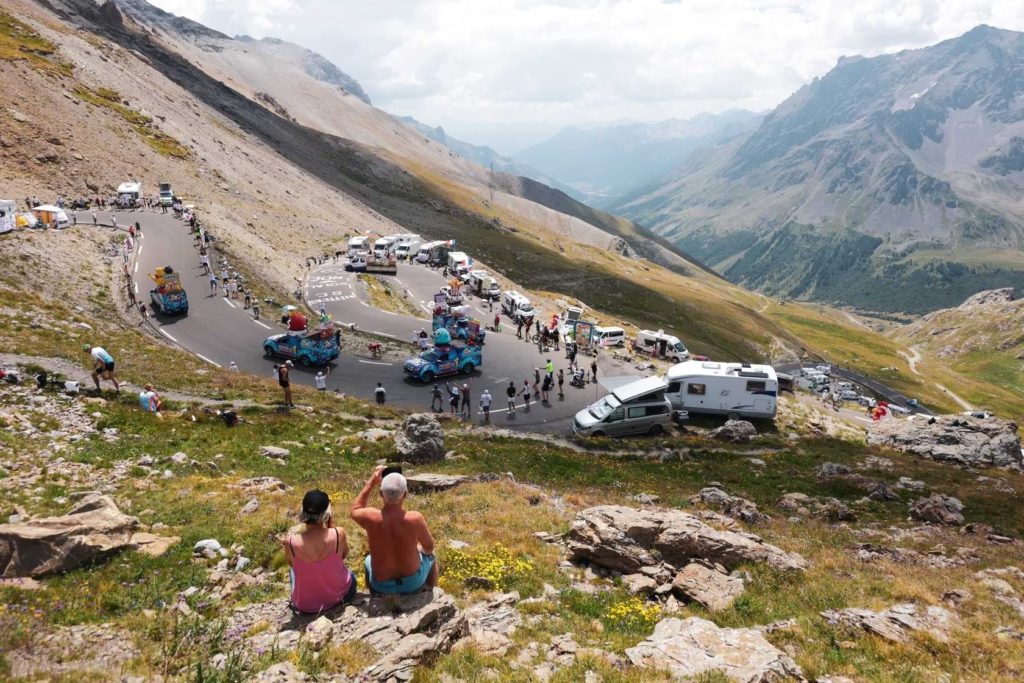
Stage 20 starts in Le Bourg d’Oisans, one of the great Tour towns at the foot of Alpe d’Huez, but the route does not head straight up the 21 hairpins. Instead, it sends the peloton away from the finish and into a much larger Alpine loop.
The early part of the stage is defined by the Col de la Croix de Fer. At 24km, it is the longest single climb of the day and comes early enough to create immediate pressure. It may not be where the GC favourites attack, but it is exactly the sort of climb where weaker teams can start losing riders.
After that, the race moves towards the Télégraphe and Galibier. This is one of the great linked climbing tests in Tour history. The Télégraphe is hard enough to reduce the group before the Galibier begins, and the Galibier then adds altitude, length and prestige. At 2,642m, it is the highest point of the race and the climb that could expose anyone already close to their limit.
The route then drops from the high mountains before beginning the late sequence towards Sarenne and Alpe d’Huez. The Col de Sarenne is 12.8km at 7.3 per cent, which would be a serious climb in any context. Coming late on stage 20, it becomes much more dangerous. It can be used as a launchpad, a point of isolation or simply the place where riders run out of legs.
Only after Sarenne does the race turn towards Alpe d’Huez. The final climb gives the stage its headline finish, but the stage’s real difficulty is everything that comes before it.
How hard is the Col de la Croix de Fer?
The Col de la Croix de Fer is the first major climb of the queen stage. It is 24km at 5.2 per cent, which makes it more about endurance than explosive climbing. The average gradient also hides some of the difficulty because the climb is irregular, with changing rhythm and sections where riders have to keep re-finding their tempo.
Its position early in the stage makes it tactically important. If a strong breakaway goes here, the yellow jersey team will have to decide whether to chase immediately or allow the race to develop. If a GC team wants satellite riders up the road for later, this is an obvious place to put them.
The Croix de Fer may not produce the decisive attack from a Tour favourite, but it can shape the rest of the day. A leader who loses teammates here could be exposed on the Télégraphe, Galibier and Sarenne. A team that burns through domestiques too early could find itself unable to control the final two climbs.
That makes it the first stress point. The stage may not be decided on the Croix de Fer, but riders who suffer there will carry that cost all the way to Alpe d’Huez.
 Photo Credit: A.S.O./Romain Laurent
Why are the Télégraphe and Galibier so important?
The Col du Télégraphe and Col du Galibier form the central block of the queen stage. The Télégraphe is 11.9km at 7.1 per cent, while the Galibier follows with 17.7km at 6.9 per cent. Together, they create one of the most demanding high mountain sequences in the Tour.
The Télégraphe is often treated as the road to the Galibier, but that can understate its role. At nearly 12km and over 7 per cent, it is hard enough to make a reduced group smaller before the highest climb of the race begins. If the pace is high there, the Galibier will start with the peloton already under pressure.
The Galibier then brings altitude and scale. It reaches 2,642m, making it the roof of the 2026 Tour. High altitude changes the feel of a race. The strongest climbers may still look composed, but riders just below the level can suddenly lose their rhythm. Breathing becomes harder, gaps open more quickly, and chasing after the summit can become complicated.
This is the part of stage 20 where the race could begin to break long before the finish. A rider chasing yellow may not wait for Alpe d’Huez if the defending leader is isolated on the Galibier. Equally, a team with several strong climbers could use the Télégraphe-Galibier combination to turn the stage into a long-range offensive.
The Galibier is not the final climb, but it may be the point where the final climb becomes impossible for some riders.
Could the Col de Sarenne decide the stage?
The Col de Sarenne gives stage 20 its distinctive shape. Without it, the route would already be hard, but more familiar: a long Alpine day before a classic finish on Alpe d’Huez. With Sarenne included, the final hour becomes more complicated and more draining.
The climb is 12.8km at 7.3 per cent and comes after the Croix de Fer, Télégraphe and Galibier. That makes it a dangerous late-stage filter. It is long enough to create proper gaps and steep enough to punish riders already running low on energy.
It also changes the tactical approach to Alpe d’Huez. Riders cannot simply save everything for the 21 hairpins because Sarenne comes first. A leader who is isolated there may be forced to respond before the final climb. A challenger with teammates or enough strength to attack could use Sarenne to make Alpe d’Huez the final phase of an already broken race.
Sarenne has not been a regular Tour climb, which adds to its appeal. Riders and teams know Alpe d’Huez intimately. Sarenne is less predictable in Tour conditions, especially this late in the race. It may not be the most famous climb on the profile, but it could decide who reaches Alpe d’Huez with anything left.
Why does Alpe d’Huez matter so much on stage 20?
Alpe d’Huez is the final climb of stage 20 and the last major mountain test of the Tour de France 2026. It is the second consecutive day that the race finishes there, after stage 19’s shorter mountain stage from Gap.
That repeat finish is important. Riders will have climbed Alpe d’Huez the day before, but stage 20 is a completely different test. Stage 19 is sharper and more direct. Stage 20 is longer, heavier and more attritional. By the time the riders reach Alpe d’Huez for the second time, they will have already climbed four major passes and spent another day under final-week pressure.
Alpe d’Huez carries its own mythology. The 21 hairpins, crowds, exposed ramps and history make it one of cycling’s defining climbs. But on stage 20, the climb is not just about spectacle. It is the final verdict after a brutal day.
A rider who is still strong can use the climb to win the Tour. A rider who is weakening can lose everything there. That is why the final ascent will feel different from most summit finishes. There is no later mountain stage to repair the damage. Once the race reaches Alpe d’Huez, the yellow jersey battle is almost out of road.
 Photo Credit: A.S.O./Charly López
How could stage 20 decide the yellow jersey?
Stage 20 is built for a close GC battle. If the top riders are separated by less than two minutes, the queen stage offers enough terrain for the race to change hands. The key is that the route provides several possible launch points rather than one obvious moment.
A rider who needs a small gain may wait for Alpe d’Huez. A rider who needs more time may try Sarenne. A rider who needs to completely overturn the race may have to attack on the Galibier, especially if they have teammates up the road. That variety makes the stage difficult to defend.
The yellow jersey team will have to manage its resources carefully. Chasing too early on the Croix de Fer could leave the leader isolated later. Waiting too long could allow satellite riders or dangerous GC threats to get up the road. The defending team will need to decide which attacks matter and which ones can be controlled by pacing.
This is also where the Tour de France 2026 GC favourites will need more than one strength. It will not be enough to climb well for 20 minutes. The winner of the Tour will need to handle altitude, repeated efforts, descending, fuelling, team tactics and the mental pressure of the penultimate day.
Stage 20 is not designed for a single acceleration. It is designed for accumulation. Every climb makes the next one harder.
Could the queen stage decide the polka-dot jersey?
The queen stage could also decide the mountains classification. The Tour de France 2026 climbers guide highlights stage 20 as one of the most important days in the polka-dot jersey battle because it contains so many major climbs and so many high-value points.
That creates two possible race patterns. If the mountains classification is still open, a breakaway specialist may try to go long on the Croix de Fer and collect points before the GC race ignites. But if the yellow jersey battle is close, the GC riders may end up absorbing most of the key points themselves.
The Galibier is especially important because it is the highest point of the 2026 Tour. That brings extra prestige and a major points opportunity. The Col de Sarenne and Alpe d’Huez then add further chances for the climbers’ classification to shift late.
This is why stage 20 could blur the line between the polka-dot jersey and the yellow jersey. In a race with this many summit finishes and high mountain points, the strongest GC riders may also become the strongest mountains contenders.
Where could the decisive attack come?
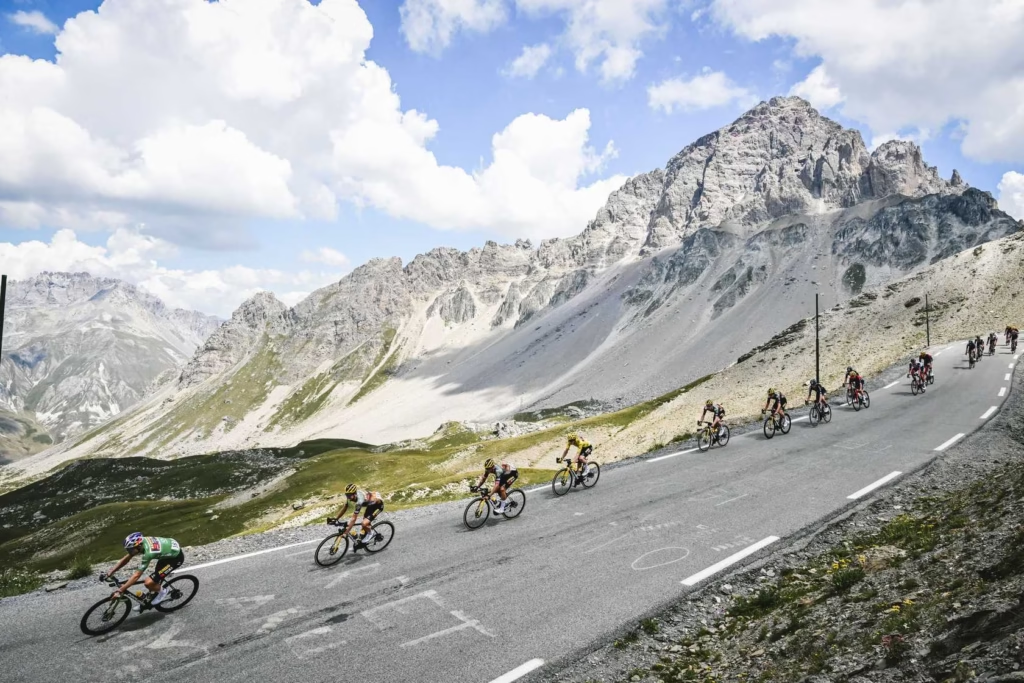
The most obvious place for the decisive attack is Alpe d’Huez, but that does not mean it will be the first important move. If the GC gaps are small, the favourites may wait for the final climb and let the stage turn into a direct summit-finish contest.
If someone needs to gain a minute or more, Sarenne is the more interesting launchpad. It comes close enough to the finish to make a move realistic, but far enough out to make it more than a final-kilometre acceleration. A rider who attacks there and crests with a gap could reach Alpe d’Huez with the race already split.
The Galibier is the long-range option. It is the kind of climb where a rider can change the Tour, but only if the situation demands it. An attack there would be risky because there is still a lot of racing left, but that is why it could be so damaging. If the yellow jersey is isolated on the Galibier, a rival team may have no better opportunity.
The Croix de Fer is more likely to shape the race indirectly. It can form the break, place teammates up the road and reduce support. It is probably too early for a serious yellow jersey attack, but not too early for the foundations of one.
What type of rider does stage 20 favour?
Stage 20 favours a complete climber rather than a one-climb specialist. The winner will need endurance for the Croix de Fer, rhythm for the Télégraphe and Galibier, durability for Sarenne, and either explosive strength or controlled pacing for Alpe d’Huez.
It also favours riders with strong teams. A leader isolated before the Galibier could spend the second half of the stage reacting rather than racing. A leader with teammates up the road can attack earlier, bridge across or use support between climbs. On a stage this long and this hard, team structure can decide whether an ambitious move is possible.
Recovery will be another major factor. Stage 20 comes after stage 19 to Alpe d’Huez, stage 18 to Orcières-Merlette and the stage 16 individual time trial. The rider who looks strongest on paper may not be the rider with the most left by the penultimate day.
This is a stage for repeatability. It rewards riders who can climb hard again and again, not just those who can produce one spectacular effort.



How does stage 20 compare with the other 2026 Tour climbs?
Stage 20 is the hardest stage of the Tour de France 2026 because it combines so many of the race’s defining climbs in one day. Plateau de Solaison may be the steepest major summit finish. Stage 19 to Alpe d’Huez may be more explosive. Gavarnie-Gèdre may provide the first major GC test. Le Markstein may be more tactically awkward. But stage 20 is the full mountain examination.
It also comes after all of those earlier tests. That is the crucial point. The queen stage is not being raced in isolation. It is the final mountain consequence of everything that has happened before.
A rider who has spent too much energy in the Pyrenees may pay here. A team that has lost mountain domestiques may be exposed here. A rider who struggled in the time trial may need to attack here. A leader who has defended well for two and a half weeks still has to survive the Tour’s hardest mountain day before Paris.
That is why stage 20 is the obvious queen stage. It has the names, the numbers and the timing.
Why the 2026 queen stage could define the whole Tour
The queen stage could define the whole Tour because it sits at the point where tactics, fatigue and ambition collide. By stage 20, there is no reason for caution if a rider still needs time. There is also nowhere to hide if a leader is beginning to weaken.
The route creates pressure in layers. The Croix de Fer can weaken teams. The Télégraphe and Galibier can isolate leaders. Sarenne can force early decisions. Alpe d’Huez can finish the job. Each climb has its own purpose, and together they make the stage more than just a famous summit finish.
The Tour de France 2026 has plenty of important climbing days, but stage 20 is the one that offers the fullest test. It is long, high, historic and placed at the end of the race. It asks whether the strongest riders still have the legs, whether the best teams still have numbers, and whether anyone chasing yellow is brave enough to attack before Alpe d’Huez.
By the time the riders reach the 21 hairpins for the second time in two days, the Tour may already be broken open. If it is not, Alpe d’Huez will have one last chance to do it.

