

The Pointe du Raz Ladies Classic is still one of the newer races on the international women’s cycling calendar, but it has developed a distinctive identity remarkably quickly. Coastal roads, relentless short climbs and Breton ribinoù, the rough tracks and narrow lanes scattered across this part of Brittany, make it unlike most conventional one-day races.
The 2026 edition marks another significant step. After becoming a UCI 1.1 race for the first time in 2025, the Pointe du Raz Ladies Classic moves up to UCI 1.Pro level and takes place on Sunday 6 September 2026. That places it within the Women’s ProSeries, immediately below the Women’s WorldTour in the UCI hierarchy.
There is more to the weekend than one race this year as well. A separate UCI 1.1 event takes place on Saturday before the headline Pointe du Raz Ladies Classic on Sunday, effectively creating a two-day festival of professional women’s racing in western Finistère.
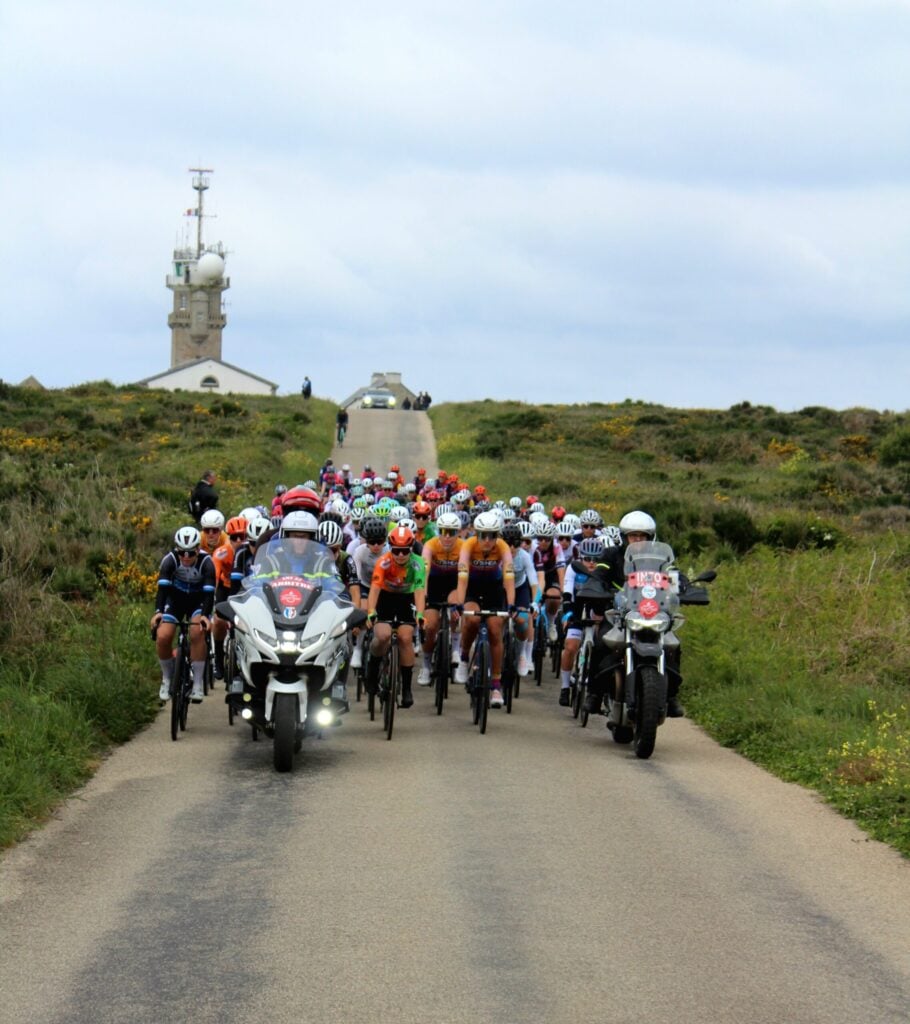
For anyone discovering the event for the first time, the important thing to understand is that this is not simply another rolling French Classic. The rough roads fundamentally change how the race is ridden.

Pointe du Raz Ladies Classic 2026 at a glance
| Detail | Pointe du Raz Ladies Classic 2026 |
|---|---|
| Date | Sunday 6 September 2026 |
| Country | France |
| Region | Finistère, Brittany |
| Start | Plogoff |
| Finish | Plouhinec |
| Distance | 130.7km |
| Climbing | Around 1,440 metres |
| Ribinoù | Around 18km |
| Classified climbs | 3 |
| UCI classification | 1.Pro |
| Race type | Women’s one-day Classic |
The organisers have designed a 130.7km route with approximately 1,440 metres of climbing and 18km of ribinoù, considerably increasing the importance of the rough-road element. The race starts in Plogoff near Pointe du Raz before eventually finishing on Rue Jean Guillou in Plouhinec.
Where is Pointe du Raz?
Pointe du Raz sits on the exposed western edge of Finistère, where the Cap Sizun peninsula reaches into the Atlantic.
Its location explains much of the character of the race.
This is not mountainous country. Instead, the road continually rises and falls across rolling terrain close to the coastline. There are narrow lanes, exposed sections, short climbs and frequent changes of direction.
Add rough tracks and the possibility of Atlantic winds and the result is a race where the profile never tells the entire story.
A relatively modest amount of total climbing can become considerably harder when riders are repeatedly accelerating out of corners, fighting for position and hitting unsealed sectors at racing speed.
What are ribinoù?
This is the most important piece of terminology for anyone watching the Pointe du Raz Ladies Classic for the first time.
Ribinoù is a Breton term used for the small tracks and lanes that cross the countryside.
Their surfaces vary. Some resemble gravel roads, others are compacted stone or rough agricultural tracks. They can be narrow, uneven and substantially more difficult to ride quickly than normal tarmac.
They are one of the defining characteristics of racing in Brittany and are also famously associated with Tro Bro Leon.
The Pointe du Raz Ladies Classic takes the concept into women’s professional racing.
Around 18km of the 2026 course will be on ribinoù, meaning they represent a significant portion of a 130.7km race rather than an occasional novelty.
Each sector creates another opportunity for:
- attacks
- punctures
- crashes
- mechanical problems
- gaps within the peloton
- riders becoming isolated
- favourites being caught badly positioned
The accumulated effect matters as much as any single sector.
Why positioning matters before the rough roads
One of the easiest mistakes for a new viewer is concentrating only on what happens after the race reaches a ribin.
The battle often begins several kilometres earlier.
Imagine a narrow gravel sector where only two or three riders can comfortably ride side by side.
Entering fifth is ideal.
Entering 70th is dangerous.
A rider at the back has to deal with every small hesitation ahead of them. If someone loses traction, punctures or leaves a gap, everybody behind can become delayed.
Meanwhile, the favourites at the front may be accelerating.
That is why the biggest teams will fight aggressively for position before every important sector.
If several squads suddenly bring their leaders towards the first 15 or 20 positions while nothing obvious appears to be happening, look ahead on the course.
A ribin is probably coming.
Is Pointe du Raz a gravel race?
Not really.
It contains a substantial amount of unsealed racing, but the Pointe du Raz Ladies Classic remains fundamentally a road Classic.
Most of the route is still raced on conventional roads and riders use road-racing equipment rather than approaching the event as a standalone gravel competition.
The distinction matters because technical ability on loose surfaces is only one part of the challenge.
A potential winner also needs to deal with:
- short climbs
- exposed coastal roads
- high-speed positioning
- repeated accelerations
- narrow corners
- attacks between the gravel sectors
- fatigue from constantly changing rhythm
A cyclocross or gravel background certainly helps, but it does not guarantee success.

Paula Blasi showed how to win Pointe du Raz in 2025
The first UCI edition provided a useful illustration of how the race can develop.
The 2025 Pointe du Raz Ladies Classic stepped up from the French domestic calendar to UCI 1.1 level and immediately attracted a substantially stronger field.
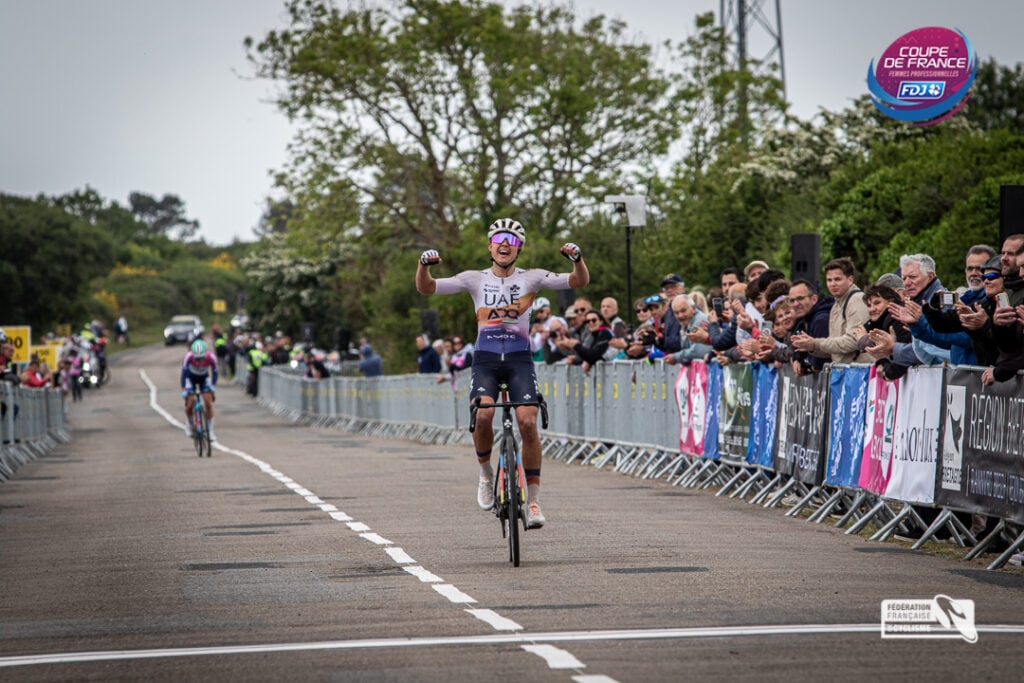
Its 143km route included ten rough-road sectors and eventually produced a five-rider winning move containing Paula Blasi, Lauren Dickson, Anneke Dijkstra, Sarah van Dam and Célia Gery.
Dickson attacked from that group and briefly appeared capable of riding alone to victory.
Blasi had another plan.
The Spaniard counter-attacked, bridged across to Dickson and then rode past her before continuing alone to the finish.
The full 2025 Pointe du Raz Ladies Classic race report shows how thoroughly the rough terrain had broken the race apart. The main peloton eventually finished almost three minutes behind the leading riders.
Blasi’s victory came despite mechanical problems
Blasi’s ride was also a useful reminder that success here requires more than simply having good legs.
Her race included both a bike change following contact with another rider and a later puncture.
She recovered from both incidents before making the decisive selection.
That resilience was particularly notable because Blasi had already demonstrated her attacking ability earlier in 2025. Her first professional victory came at the GP della Liberazione PINK, where another long-range move ultimately ended with her riding solo to victory.
Pointe du Raz required something different.
Rather than simply overpowering the peloton, she had to survive a chaotic mixed-surface race, recover from setbacks and then judge the decisive moment correctly.
Lauren Dickson’s second place became part of a breakthrough season
The rider Blasi caught was also significant.
Lauren Dickson was still racing for Handsling Alba Development Road Team when she finished second at Pointe du Raz in 2025.
Dickson had only switched seriously into cycling in 2024 after competing in trail running and triathlon, yet within a year she was fighting for victory against established professional riders in Brittany.
Her performances through the rest of the season were strong enough to earn a step into the top level, with Lauren Dickson signing for FDJ-SUEZ ahead of 2026.
That provides another indication of what Pointe du Raz can become.
For major teams it is a difficult race worth winning. For emerging riders, it can also provide a platform to demonstrate that they belong at a higher level.
The race itself only began in 2023
Despite its rapid rise, the Pointe du Raz Ladies Classic has a very short history.
The inaugural edition took place in 2023, initially as a French domestic event rather than an international UCI race.
Its format was also different.
Riders competed across two days, beginning with a short individual time trial before completing a road race.
Élyne Roussel emerged as the first overall winner.
The event expanded again in 2024, when Ema Comte won the opening time trial and Marie-Morgane Le Deunff took the road race. Clémence Latimier accumulated the strongest combined performance across the two days and won the overall classification.
The transformation came in 2025.
Rather than continuing with a two-day GC competition, organisers turned Pointe du Raz into a single international one-day Classic.
That decision allowed the rough roads, coastal landscape and aggressive style of racing to become the event’s central identity.
ProCyclingUK’s 2025 Pointe du Raz Ladies Classic preview looked at that transition before the first UCI edition.
What does 1.Pro mean?
Race classifications can appear unnecessarily complicated when first following professional cycling.
Pointe du Raz is relatively simple.
The 1 means it is a one-day race.
Stage races instead begin with 2.
The Pro identifies its competitive level.
For 2026, Pointe du Raz sits within the UCI Women’s ProSeries, one level below the Women’s WorldTour.
That represents another substantial promotion after only one season at UCI 1.1 level. The event has therefore moved from a domestic race to the second tier of international women’s road cycling in only a few years.
It does not carry the same status as winning Paris-Roubaix Femmes, Tour of Flanders or Strade Bianche.
It does, however, sit significantly higher in the international calendar than a standard 1.1 race and should attract a deeper professional field as a result.
A stronger field is coming to Brittany in 2026
The organisers currently list 18 teams and 112 riders for the Sunday race.
Among the announced teams are UAE Team ADQ, FDJ SUEZ, Visma | Lease a Bike, EF, Uno-X Mobility, Team Picnic PostNL and Human Powered Health, alongside a substantial collection of ProTeam and Continental-level squads.
That is a significant change in only a couple of seasons.
The 2025 race had already attracted six WorldTour teams for its first professional edition. Promotion to ProSeries level gives the organisers an opportunity to build on that immediately.
The final rider start list can still change before September, so individual favourites should not be treated as confirmed simply because their teams are attending.
The quality of the team list already shows where the race is heading.
What type of rider can win Pointe du Raz?
The ideal rider is probably an all-terrain Classics specialist.
Pure sprinters have a problem. There are too many opportunities to become detached before the finish.
Pure climbers face a different issue. None of the climbs is sufficiently long for climbing ability alone to guarantee separation.
Instead, the winner needs a broad collection of skills:
- excellent positioning
- strong bike handling
- confidence on loose surfaces
- good short-climb acceleration
- repeated high-power efforts
- endurance
- tactical awareness
- the ability to attack from a small group
That is why riders with cyclocross and gravel experience become particularly interesting here.
Célia Gery demonstrated the connection in 2025. Her cyclocross background translated naturally onto the Breton tracks and helped her make the decisive five-rider selection before eventually finishing fourth.
Why punctures matter more here
A puncture is inconvenient in every professional road race.
At Pointe du Raz it can be decisive.
If a rider punctures on a wide main road, the team car can usually reach them quickly. A wheel is changed, teammates may wait and the rider begins chasing back.
Now imagine the same problem in the middle of a narrow ribin.
Team vehicles may be delayed behind the race.
Other riders can block the road.
The leading group may already be attacking.
A 20-second mechanical problem can therefore become a minute-long sporting problem.
That places greater importance on tyre choice, pressure and reliability.
Teams have to find a balance between rolling speed on the normal roads and protection, grip and control on the rougher sections.
Why 1,440 metres of climbing could feel much harder
Around 1,440 metres of elevation gain over 130.7km does not sound exceptional compared with the hardest races in women’s cycling.
The way that climbing is accumulated changes things.
There is no 40-minute Alpine ascent where riders settle into a steady rhythm.
Instead, the effort might look more like this:
Accelerate onto a climb.
Fight for position.
Recover briefly.
Enter a ribin.
Close a gap.
Sprint out of a corner.
Climb again.
Repeat.
The physiological demand becomes highly irregular.
A rider who is comfortable riding at a steady threshold for an hour may still struggle with dozens of shorter surges spread across more than three hours of racing.
The three officially identified climbing points consequently tell only part of the story.
Atlantic winds can create another problem
The Cap Sizun coastline is exposed enough that wind cannot be ignored.
Crosswinds could create significant gaps even before the riders reach the rough-road sectors.
If conditions are favourable, stronger teams may attempt to split the race into echelons on exposed roads.
That creates an uncomfortable combination.
A rider who has already spent several kilometres fighting through a crosswind then reaches a narrow ribin with considerably less energy available.
Equally, a rider caught in a second echelon may never even get the opportunity to contest the decisive gravel sectors with the leaders.
The weather forecast will therefore be particularly important when assessing the race shortly before 6 September.
What should beginners watch during the race?
You do not need to understand every sector or know every rider to follow what is happening.
There are four particularly useful things to watch.
The kilometres before each ribin
Do not wait for the television graphic announcing the rough road.
Watch the teams beforehand.
If several squads simultaneously start fighting for the front, the next sector is probably important.
How many teammates remain with each leader
Repeated rough sectors gradually strip away support riders.
A contender with three teammates late in the race has far more tactical freedom than someone completely isolated.
That difference becomes particularly important when attacks begin.
Mechanical problems
Pay attention to where a puncture occurs.
A mechanical on a quiet piece of wide road may cost little.
The same problem immediately before or during a decisive ribin can end a rider’s chances.
Small groups going clear
Do not automatically assume a five or six-rider group will be caught.
The 2025 race was effectively decided when Blasi, Dickson, Dijkstra, van Dam and Gery escaped with around 40km remaining.
Once several major teams have representation at the front, the incentive to chase behind can disappear very quickly.
There are two women’s races in Finistère in 2026
Another important change is the addition of professional racing on Saturday 5 September.
That event is a separate UCI 1.1 race, rather than the opening stage of Pointe du Raz. The organiser lists it independently from Sunday’s 1.Pro event.
That distinction matters.
There is no combined general classification.
Times do not carry from Saturday into Sunday.
A rider could therefore win on Saturday and start Sunday’s Pointe du Raz Ladies Classic in exactly the same sporting position as everybody else.
The structure effectively creates a weekend of two separate Classics.
Why two races in the same weekend makes sense
For teams, travelling to western Brittany requires riders, mechanics, soigneurs, vehicles and accommodation.
Providing two opportunities to race makes that journey more attractive.
For the organisers and region, it creates a larger cycling event rather than concentrating everything into a single afternoon.
It should also provide opportunities for different types of teams.
Saturday’s 1.1 race occupies a more accessible level of the international calendar, while Sunday’s ProSeries Pointe du Raz acts as the headline event.
For a young race attempting to establish itself quickly, the structure gives the weekend considerably more weight.
-
 Photo Credit: A.S.O./Gaëtan Flamme


Who has won the Pointe du Raz Ladies Classic?
The race is young enough that its entire list of overall winners remains very short.
| Year | Winner | Format |
|---|---|---|
| 2023 | Élyne Roussel | Two-day domestic event |
| 2024 | Clémence Latimier | Two-day domestic event |
| 2025 | Paula Blasi | UCI 1.1 one-day race |
| 2026 | TBC | UCI 1.Pro one-day race |
The comparison between editions needs context.
Roussel and Latimier won general classifications decided across two days.
Blasi won a standalone professional Classic.
From 2026 onwards, the event takes another step upwards as a ProSeries one-day race.
Why Pointe du Raz Ladies Classic 2026 is worth watching
The speed with which Pointe du Raz has developed is unusual.
It began as a domestic event in 2023.
Two years later it reached the UCI international calendar.
A year after that it has moved into the Women’s ProSeries.
The appeal is not difficult to see.
Women’s cycling already has plenty of rolling one-day races. Pointe du Raz has found a characteristic that immediately distinguishes it.
The Breton ribinoù are not Tuscan sterrato and they are not the cobbles of Paris-Roubaix. Combined with the short climbs, narrow roads and exposed Atlantic landscape, they create a race with its own identity.
For beginners, it is also relatively straightforward to understand.
There is no general classification to calculate and no need to wait for one enormous mountain.
Watch the fight for position.
Watch who reaches each ribin near the front.
Watch which favourites still have teammates.
And when a small group containing several strong riders suddenly gains 20 or 30 seconds, pay attention.
At Pointe du Raz, that apparently modest gap can very quickly become the winning move.

