
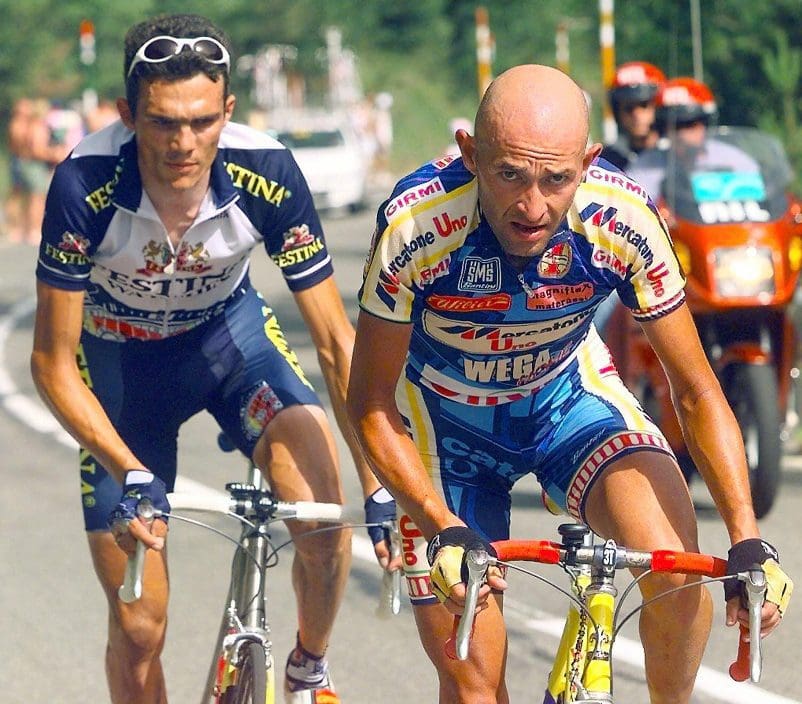
The Tour de France has always been shaped in the mountains. The yellow jersey can be won in time trials, defended on flat roads and protected by teams, but the race’s deepest mythology comes from the climbs: the Tourmalet, Galibier, Alpe d’Huez, Ventoux, Aubisque, Izoard, Puy de Dôme and the high roads where riders are stripped back to their simplest form.
Ranking the greatest Tour de France climbers is not the same as ranking the greatest Tour de France winners. Some riders climbed brilliantly because they were fighting for yellow. Others built their careers around the mountains classification. Some produced only a handful of Tour-defining ascents, but did so with such force that their place in the race’s memory is permanent.
This list focuses on Tour de France climbing greatness. That means mountain jerseys, mountain stage wins, iconic attacks, high-altitude authority, influence on the general classification and the way each rider changed how the Tour’s climbs are remembered. For the wider race background, see our brief history of the men’s Tour de France.
Quick answer: who is the greatest Tour de France climber?
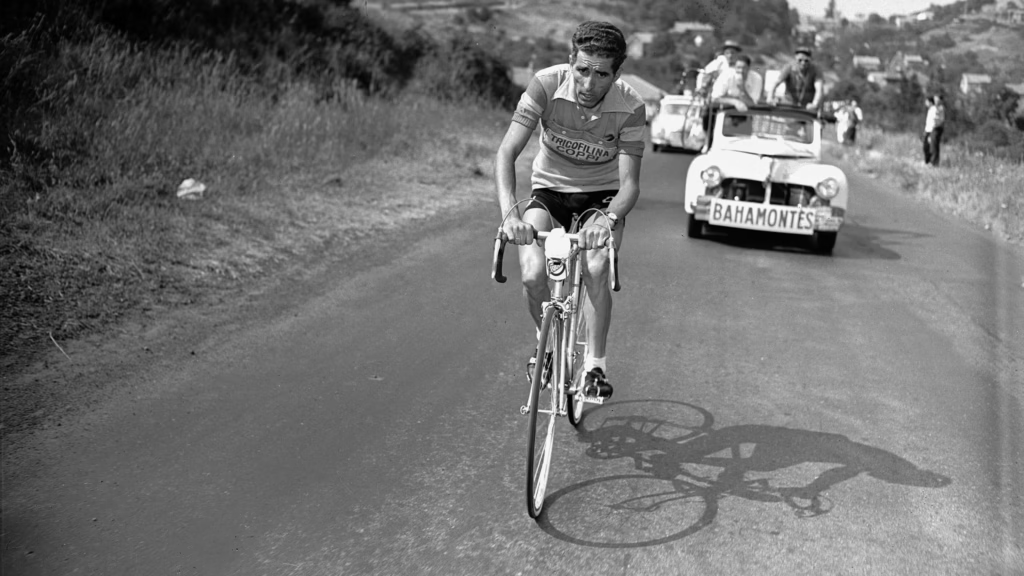
Federico Bahamontes is the greatest Tour de France climber because his identity was built almost entirely around the mountains. The “Eagle of Toledo” won the mountains classification six times, won the 1959 Tour de France and became the benchmark against which later climbing specialists were measured. Richard Virenque won the most mountains titles, with seven, but Bahamontes remains the purest climbing legend in Tour history.
| Rank | Rider | Tour climbing claim |
|---|---|---|
| 1 | Federico Bahamontes | Six mountains classifications and the purest climbing reputation |
| 2 | Lucien Van Impe | Six mountains classifications and a Tour win |
| 3 | Richard Virenque | Record seven mountains classifications |
| 4 | Marco Pantani | Most explosive modern pure climber |
| 5 | Charly Gaul | Legendary high-mountain and bad-weather climber |
| 6 | Fausto Coppi | Climbing elegance, Tour wins and early mountain mythology |
| 7 | Eddy Merckx | Complete domination, including the mountains |
| 8 | Luis Herrera | Colombia’s breakthrough Tour climbing icon |
| 9 | Tadej Pogačar | Modern attacking climber with multiple mountain-defining rides |
| 10 | Alberto Contador | Explosive Grand Tour climber and repeated Tour aggressor |
How to rank Tour de France climbers
A good Tour climber ranking needs more than one measure. The polka-dot jersey matters, but it does not always identify the strongest climber in the race. Sometimes the mountains classification is won by a breakaway specialist who targets points. Sometimes the best climber is also the yellow jersey contender who is focused on the overall race.
The main factors here are:
| Factor | Why it matters |
|---|---|
| Mountains classification wins | The clearest Tour-specific climbing record |
| Mountain stage wins | Proof a rider could finish the job uphill |
| GC influence | Climbers who decided the yellow jersey battle carry extra weight |
| Iconic climbs | Alpe d’Huez, Ventoux, Tourmalet and Galibier performances matter |
| Style | Some climbers changed the emotional feel of the Tour |
| Era context | Roads, bikes, nutrition, teams and route design vary hugely |
This is why the list mixes pure climbers, Tour winners and mountain specialists. Bahamontes and Van Impe belong because the mountains were their kingdom. Merckx and Pogačar belong because they could dominate climbs while also winning everything else.
For newer fans, our guide to Tour de France 2026 jerseys explained breaks down how the yellow, green, polka-dot and white jerseys work across the race.
1. Federico Bahamontes
Federico Bahamontes is the archetype. If the Tour de France created the idea of the pure climber, Bahamontes gave it wings.
Nicknamed the “Eagle of Toledo”, he won the Tour mountains classification six times and took overall victory in 1959. His reputation was not built on calculation or defensive control. It was built on climbing as a separate art form. Bahamontes looked at mountains differently from other riders. They were not obstacles to survive, but places where he could express himself.
That is why he sits first despite Richard Virenque later surpassing his mountains classification record. Virenque won more polka-dot titles, but Bahamontes still feels like the purer symbol of climbing greatness. He came from an era when the Tour’s mountains were less managed, less predictable and often more brutal in their conditions.
There are famous stories of Bahamontes reaching mountain summits with such confidence that he could afford to wait, recover or even take an ice cream while others suffered behind. Whether every detail has been polished by legend almost does not matter. The myth fits the rider.
He was not the most complete Tour champion. That is part of the point. Bahamontes belongs here because the mountains were not just where he won. They were who he was.
2. Lucien Van Impe
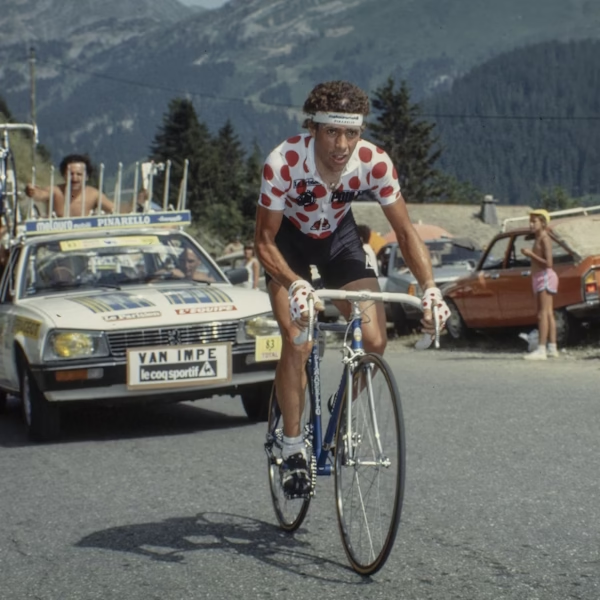
Lucien Van Impe is the most natural challenger to Bahamontes in any Tour climbing ranking. Like Bahamontes, he won the mountains classification six times. Unlike many pure climbers, he also won the Tour overall, taking yellow in 1976.
Van Impe’s greatness lies in consistency. He was not only a rider who had one or two mountain explosions. He was a repeated presence in the high climbs across more than a decade, collecting mountains titles in 1971, 1972, 1975, 1977, 1981 and 1983.
His climbing style was smooth, light and persistent. He could suffer deep into the final climbs and still keep pressure on rivals. He was also the first great embodiment of the polka-dot jersey era after the distinctive jersey was introduced in 1975.
That detail matters. The mountains classification existed before the jersey, but the red spots gave the competition a face. Van Impe helped define what that jersey meant: not just points, but identity, courage and a willingness to race the Tour through its climbs.
He ranks just behind Bahamontes because Bahamontes still carries the stronger mythic weight. But Van Impe’s record is every bit as substantial.
3. Richard Virenque
Richard Virenque holds the record for the most Tour de France mountains classification wins, with seven. On that statistic alone, he has to rank very high.
His victories came in 1994, 1995, 1996, 1997, 1999, 2003 and 2004. That span shows remarkable endurance as a Tour mountain specialist. Virenque understood the polka-dot jersey better than almost anyone. He knew when to attack, where to collect points and how to turn the mountains classification into a long campaign rather than a side contest.
There is a difference, though, between being the best climber and being the best mountains classification rider. Virenque was often brilliant uphill, but he was also tactically astute in a competition where points, timing and breakaway selection matter. He did not always have to be the strongest climber in the race to win the jersey.
His legacy is also complicated by the Festina affair and the wider doping era in which he raced. That cannot be ignored. But the Tour’s official mountains record still has his name at the top, and the emotional bond between Virenque, the polka-dot jersey and French roadside crowds was real.
He is not first here because Bahamontes and Van Impe more clearly represent pure climbing greatness. But as a polka-dot specialist, Virenque is unmatched.
4. Marco Pantani
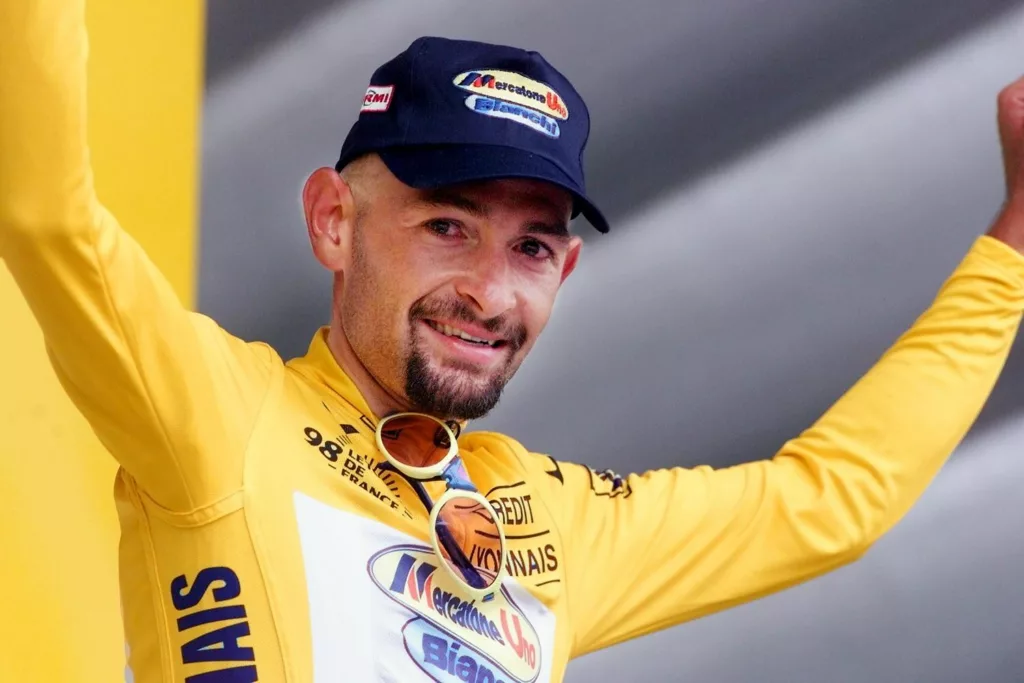
Marco Pantani won the Tour de France only once, in 1998, and he never won the mountains classification. Yet no serious list of Tour climbers can leave him out.
Pantani’s case is based on impact. At his peak, he was the most explosive pure climber of the modern era. His attacks were violent, seated and then suddenly out of the saddle, rhythm broken, rivals forced into panic. He did not grind climbs down. He detonated them.
Alpe d’Huez is central to his Tour legend. His 1997 ascent remains one of the most famous climbing performances in cycling history, still widely cited as the benchmark time on the climb. But Pantani was more than one mountain. His 1998 Tour victory, shaped through the Alps and the collapse of Jan Ullrich under pressure, made him the last rider to win the Giro d’Italia and Tour de France in the same season.
The shadow is obvious. Pantani’s career sits deep inside cycling’s most troubled period, and his story became tragic beyond sport. That makes clean celebration difficult.
Even so, as a Tour climber in the narrow sense of what he could do on a mountain when at his best, Pantani belongs close to the very top. Few riders have ever made climbing look so savage.
For more on the climb most closely associated with his Tour legend, see our feature on Alpe d’Huez at the Tour de France.
5. Charly Gaul
Charly Gaul was known as the “Angel of the Mountains”, but there was nothing gentle about what he did to opponents when the road rose.
Gaul won the Tour de France in 1958 and twice won the mountains classification. His reputation is tied to climbing in extreme conditions, especially cold, rain and mountain weather that broke stronger-looking riders. He was small, light and capable of producing astonishing rides when the race seemed to become more survival test than sport.
His 1958 Tour victory remains his defining French July achievement, but his wider climbing legend extends across the Giro d’Italia and the high mountains of European cycling. He was one of those riders whose climbing identity felt almost separate from normal racing.
Gaul ranks high because of aura as much as record. He did not collect as many Tour mountains titles as Bahamontes, Van Impe or Virenque, but his name still carries the sense of a rider uniquely suited to the most hostile mountain days.
If Bahamontes was the eagle, Gaul was the climber for storms.
6. Fausto Coppi
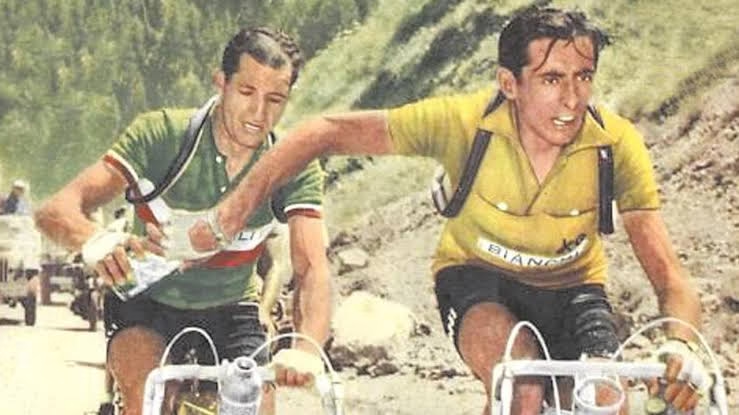
Fausto Coppi’s Tour de France record is shorter than it might have been because of the Second World War and the structure of his career. He won the Tour in 1949 and 1952, completing the Giro-Tour double in both years. That alone places him among the sport’s greatest stage racers.
As a climber, Coppi represented elegance and distance. His attacks could feel inevitable rather than frantic. He climbed with a long, smooth authority that seemed to stretch the race until rivals simply disappeared from the picture.
His mountain greatness cannot be separated from his all-round brilliance. Coppi was not a polka-dot specialist because the modern mountains classification culture had not yet fully taken shape. He was a champion whose climbing helped make him unbeatable when he was at his best.
The Tour’s mountain mythology owes much to riders like Coppi because they made the high passes feel like the places where greatness was revealed. His 1952 win on Alpe d’Huez, the first time the Tour finished there, helped begin the climb’s long relationship with cycling legend.
He ranks below the pure Tour mountain specialists because his Tour sample is smaller. But as a climber of historical importance, he is essential.
7. Eddy Merckx
Eddy Merckx was not a pure climber. He was everything. That is exactly why his place on this list is slightly different.
Merckx won the Tour de France five times and also won the mountains classification twice. In 1969, he did not merely win yellow. He won the yellow jersey, green jersey, mountains classification and combativity award. That remains one of the most complete acts of domination in Tour history.
As a climber, Merckx was not as stylistically romantic as Bahamontes or as featherweight as Van Impe. But he could destroy races uphill because he could destroy races anywhere. His climbing mattered because it formed part of total control. If rivals hoped the mountains would expose him, they were often disappointed.
His 1971 duel with Luis Ocaña, including Ocaña’s extraordinary ride to Orcières-Merlette, showed that even Merckx could be put under pressure in the mountains. But the wider record still points to a rider who could win on the hardest climbs while also time-trialling, sprinting and attacking from distance.
Merckx ranks lower here than he does among the greatest Tour winners because this list gives extra weight to pure climbing identity. But leaving him out would be absurd. He climbed well enough to make the greatest race in cycling look like his private territory.
Even his mountain setbacks became part of Tour mythology, including the Puy de Dôme episode covered in our feature on the climb that punched Merckx from his throne.
8. Luis Herrera
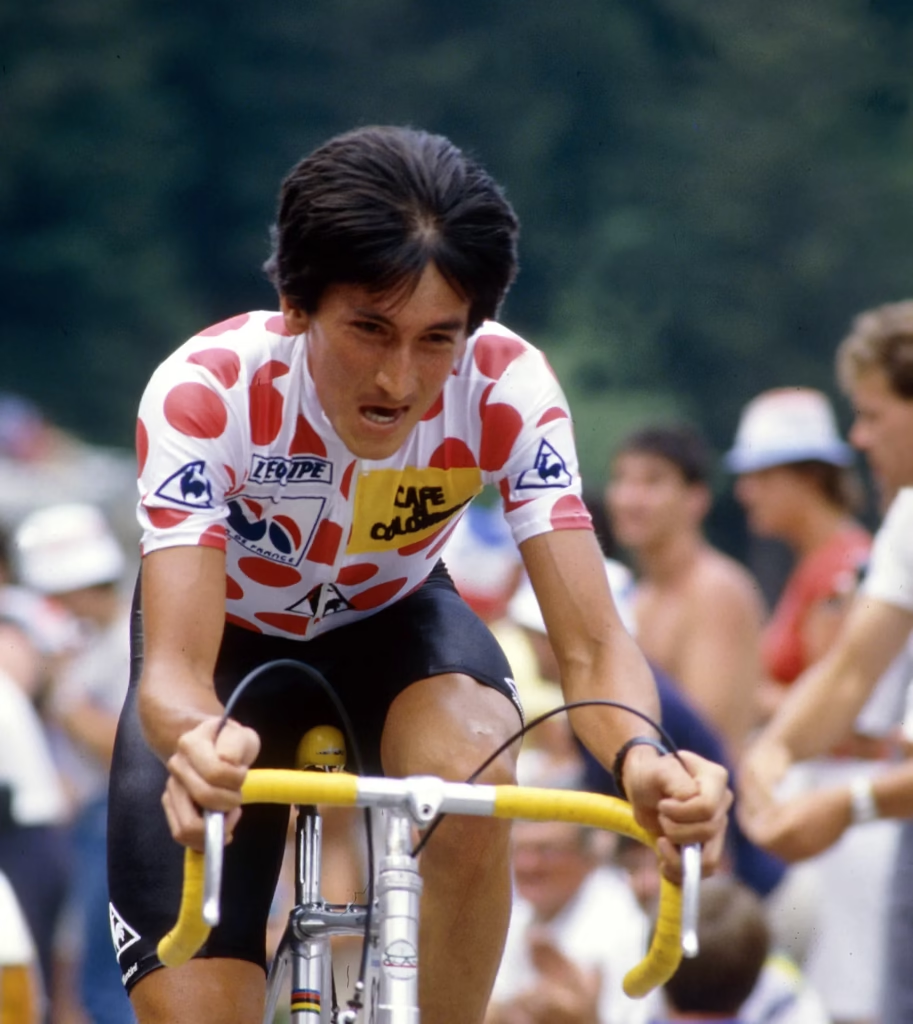
Luis Herrera changed what Colombian climbing meant at the Tour de France.
Known as “Lucho”, Herrera was the first Colombian rider to win a Tour stage, doing so at Alpe d’Huez in 1984. That victory was more than a result. It announced a new climbing culture to the Tour, one built around high-altitude riders from the Andes who could challenge Europe’s established order in the mountains.
Herrera won the Tour mountains classification twice, in 1985 and 1987, and his influence reached beyond the numbers. Colombian climbers had a different rhythm, a different background and a different symbolic importance. Herrera made the Tour’s mountains feel more global.
His best performances came when the race was steep, hard and selective. He could float uphill in a way that made the biggest European names look heavy. He did not become a Tour winner, but he became one of the most important climbers the race has seen.
Modern Colombian Tour history, from Nairo Quintana to Egan Bernal, has roots in what Herrera made visible.
9. Tadej Pogačar
Tadej Pogačar is still writing his Tour climbing story, but he already belongs among the greatest.
He enters the 2026 Tour with four overall victories and multiple mountains classification wins. More importantly, he has produced repeated mountain performances that have shaped the modern race: La Planche des Belles Filles in 2020, the Pyrenean and Alpine dominance of 2021, his duels with Jonas Vingegaard in 2022 and 2023, then his return to Tour-winning control in 2024 and 2025.
Pogačar’s climbing is unusual because it is not narrow. He can win on long climbs, short steep finishes, hilly classics-style terrain and mountain stages where the attack comes far from the line. He is not built like a traditional featherweight climber, but that makes him more interesting. He climbs with explosive power and tactical freedom rather than pure specialist fragility.
His rivalry with Vingegaard has also lifted his mountain status. Great climbers are often defined by opposition. Pogačar has had to attack, crack, recover and return against one of the strongest climbing rivals of the modern era.
If he continues on this path, he will climb higher on this list. For now, the historical specialists still sit above him, but the gap is closing. His 2026 route fit is covered in our feature on Tadej Pogačar at the Tour de France 2026.
10. Alberto Contador
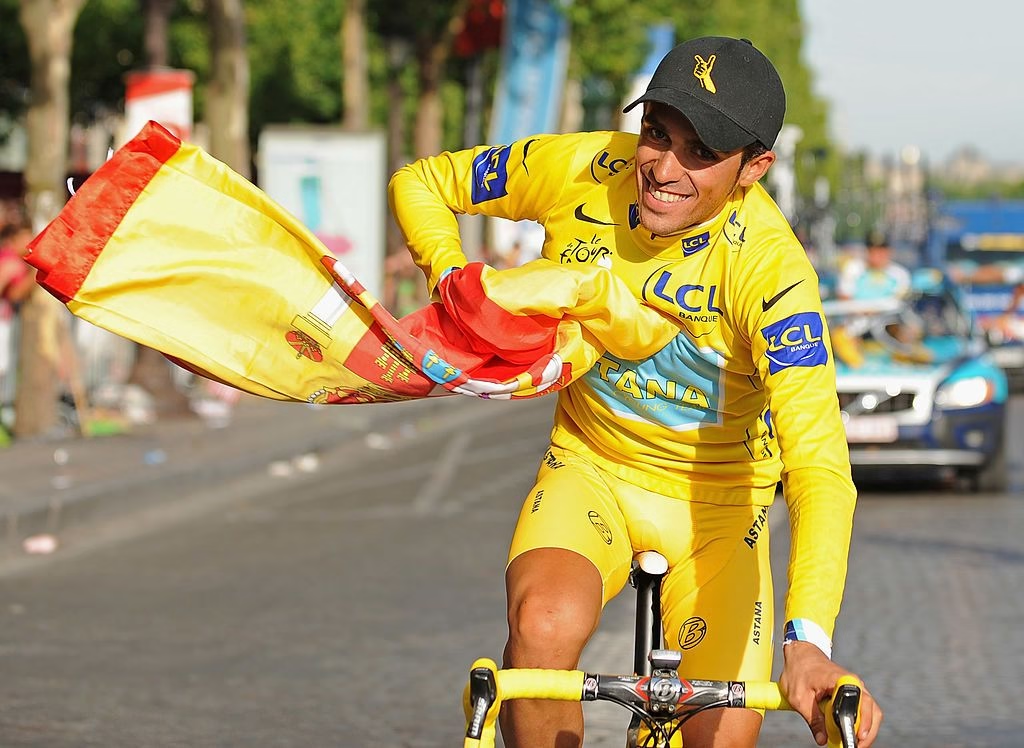
Alberto Contador was one of the most explosive Grand Tour climbers of the 21st century. He won the Tour de France officially in 2007 and 2009, with his 2010 title later stripped. His climbing style was instantly recognisable: sharp accelerations, repeated changes of pace and the ability to attack when others were already at their limit.
Contador was not a polka-dot jersey collector in the classic sense. His climbing was tied to winning Grand Tours. That makes his Tour mountain record less obvious than Virenque’s or Van Impe’s, but his best uphill performances were of the highest level.
He was especially dangerous because he did not need perfect terrain. He could attack on steep ramps, long climbs, medium mountains and even from unexpected points in a stage. That unpredictability made him one of the most exciting GC climbers of his era.
His career is complicated by the 2010 clenbuterol case and the resulting sanction. That affects how his record is read. But if the question is who climbed with the greatest force and imagination at the Tour, Contador still belongs in the top ten.
Honourable mentions
Jonas Vingegaard
Jonas Vingegaard is already one of the strongest Tour climbers of the modern era. His performances in 2022 and 2023, especially when he distanced Pogačar in the high mountains, belong in any serious discussion. He needs more years of Tour climbing dominance to move into the very top group, but his peak level is exceptional.
His latest Tour challenge is covered in our feature on Jonas Vingegaard at the Tour de France 2026.
Nairo Quintana
Nairo Quintana was one of the defining Tour climbers of the 2010s. He finished on the podium, won mountain stages and carried Colombian hopes deep into the Froome era. His best climbing was smooth, patient and high-altitude sharp, though he never managed to turn it into a Tour victory.
Julio Jiménez
Julio Jiménez won the Tour mountains classification three times in the 1960s and was one of Spain’s great climbing specialists. He lacks Bahamontes’ wider fame but deserves recognition as a repeated Tour mountain force.
Gino Bartali
Gino Bartali’s Tour career was interrupted by war, but his climbing quality was immense. He won the Tour in 1938 and 1948, and his mountain strength was central to both victories.
René Vietto
René Vietto belongs to the older mythology of French climbing. He won the mountains classification before the polka-dot jersey existed and became associated with sacrifice, suffering and the emotional drama of the Tour.
Michael Rasmussen
Michael Rasmussen was one of the most visible Tour climbers of the 2000s and won the mountains classification twice. His Tour legacy is heavily complicated by removal from the 2007 race and later doping admissions, but in pure climbing terms he was a major presence.
Chris Froome
Chris Froome deserves mention because his Tour victories were built on repeated climbing control. He was not a romantic polka-dot specialist, but his attacks on climbs such as La Planche des Belles Filles and Mont Ventoux helped define the Team Sky era. For more on his place in Tour history, see our feature on the greatest British riders at the Tour de France.
Who has won the most Tour de France mountains classifications?
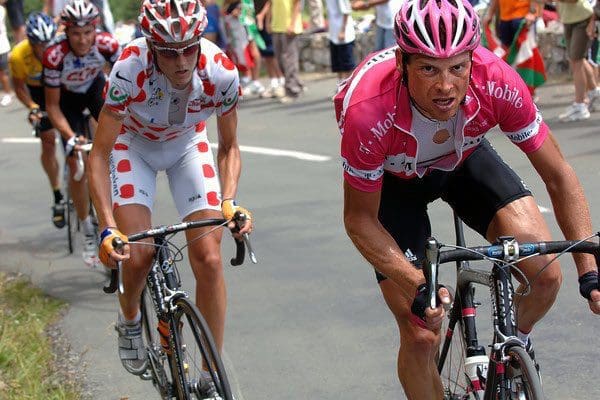
Richard Virenque holds the record with seven Tour de France mountains classification victories. Federico Bahamontes and Lucien Van Impe are next with six each.
| Rider | Mountains classification wins |
|---|---|
| Richard Virenque | 7 |
| Federico Bahamontes | 6 |
| Lucien Van Impe | 6 |
| Julio Jiménez | 3 |
| Eddy Merckx | 2 |
| Charly Gaul | 2 |
| Luis Herrera | 2 |
| Gino Bartali | 2 |
| Tadej Pogačar | 2 |
The exact meaning of this table needs care. The mountains classification is a points competition, not a direct measure of climbing speed. Still, over time, repeated success in it is one of the clearest signs that a rider made the Tour’s mountains his territory.
For the current race context, see our Tour de France 2026 climbers guide and our ranking of the best climbers at the Tour de France 2026.
Best Tour de France climbers by category
| Category | Best choice | Why |
|---|---|---|
| Greatest pure Tour climber | Federico Bahamontes | The original benchmark |
| Best polka-dot jersey rider | Richard Virenque | Record seven titles |
| Best modern pure climber | Marco Pantani | Explosive, iconic and unmatched at his peak |
| Best high-mountain specialist | Lucien Van Impe | Six mountains titles and a Tour win |
| Best bad-weather mountain rider | Charly Gaul | Legendary in brutal conditions |
| Best Colombian Tour climber | Luis Herrera | Changed the Tour’s climbing geography |
| Best current Tour climber | Tadej Pogačar | Most complete active mountain attacker |
| Best GC climber of the 2010s | Chris Froome | Repeated Tour-winning climbing control |
| Best 2020s climbing rivalry | Pogačar v Vingegaard | The defining modern mountain duel |
Why the polka-dot jersey does not always mean “best climber”
The Tour de France mountains classification rewards points collected over categorised climbs. That sounds simple, but the competition does not always crown the strongest uphill rider in the race.
A rider can win the polka-dot jersey by joining breakaways, targeting early climbs and collecting points before the GC contenders fight later in the stage. A yellow jersey contender may be the strongest climber overall but ignore the mountains classification because the general classification matters more.
That is why some riders with few or no polka-dot titles still rank among the greatest climbers. Marco Pantani, Alberto Contador and Jonas Vingegaard were not defined by mountain-points campaigns. Their climbing mattered because it decided the race itself.
The best Tour climbers, then, are not only those who wore the spots most often. They are the riders who made the mountains feel decisive. For more on how the overall race is decided, see our guide to how the Tour de France general classification works.
The greatest climbing stages in Tour memory
Some climbs and stages carry riders into legend. Alpe d’Huez made Coppi, Herrera, Pantani and many others part of its story. Mont Ventoux has exposed champions and created some of the race’s starkest images. The Tourmalet remains the great Pyrenean reference point. The Galibier and Izoard belong to the older heroic language of the Tour. Puy de Dôme, because of its shape, isolation and history, has a different kind of drama.
The greatest climbers are often tied to one or more of those places. Bahamontes belongs to the Pyrenees and high passes of the 1950s and 1960s. Van Impe belongs to the first great polka-dot era. Pantani belongs to Alpe d’Huez. Herrera belongs to Colombian cycling’s arrival on European mountains. Pogačar and Vingegaard are building their own map now.
That is why climbing greatness is more emotional than statistical. Fans remember where it happened.
For the 2026 race, the main climbing landmarks are covered in our guide to the Tour de France 2026 climbs and our Tour de France 2026 summit finishes guide.
FAQs: greatest Tour de France climbers
Who is the greatest Tour de France climber?
Federico Bahamontes is the greatest Tour de France climber because he won the mountains classification six times, won the 1959 Tour and became the original benchmark for pure climbing greatness.
Who has won the most Tour de France mountains jerseys?
Richard Virenque has won the most Tour de France mountains classifications, with seven victories.
Who was the first great polka-dot jersey rider?
Lucien Van Impe was the first great rider of the polka-dot jersey era. The mountains classification existed before 1975, but Van Impe helped define the jersey after it was introduced.
Was Marco Pantani the greatest climber?
Marco Pantani may have had the highest pure climbing peak of the modern era, especially on Alpe d’Huez, but his Tour record is shorter than Bahamontes, Van Impe and Virenque. He is one of the greatest climbers, but not the clear number one.
Is Tadej Pogačar one of the greatest Tour climbers?
Yes. Tadej Pogačar already belongs among the greatest Tour climbers because of his repeated mountain-stage dominance, Tour wins and rivalry with Jonas Vingegaard. His final place will depend on how much more he wins.
Is Jonas Vingegaard one of the greatest Tour climbers?
Jonas Vingegaard is one of the best modern Tour climbers. His peak performances in 2022 and 2023 were exceptional, but he needs more years of Tour climbing dominance to move into the all-time top ten.
Why is Richard Virenque not ranked first?
Virenque holds the record for mountains classification wins, but this ranking separates polka-dot success from pure climbing greatness. Bahamontes and Van Impe rank higher because their climbing identities feel more central to Tour history.
Final ranking: the greatest Tour de France climbers
| Rank | Rider |
|---|---|
| 1 | Federico Bahamontes |
| 2 | Lucien Van Impe |
| 3 | Richard Virenque |
| 4 | Marco Pantani |
| 5 | Charly Gaul |
| 6 | Fausto Coppi |
| 7 | Eddy Merckx |
| 8 | Luis Herrera |
| 9 | Tadej Pogačar |
| 10 | Alberto Contador |
Final word
The greatest Tour de France climbers are not all the same type of rider.
Bahamontes was the pure mountain artist. Van Impe was the great early king of the polka-dot jersey. Virenque turned the mountains classification into a record-breaking personal domain. Pantani gave modern cycling its most explosive climbing image. Gaul made weather and altitude part of his legend. Coppi gave the mountains elegance. Herrera opened a Colombian pathway. Pogačar is making the modern Tour feel attacking again.
That variety is why the Tour’s mountains matter so much. They do not only decide races. They create identities.
On that measure, Bahamontes remains first. The Eagle of Toledo did not simply climb well at the Tour de France. He made climbing itself the story.

