
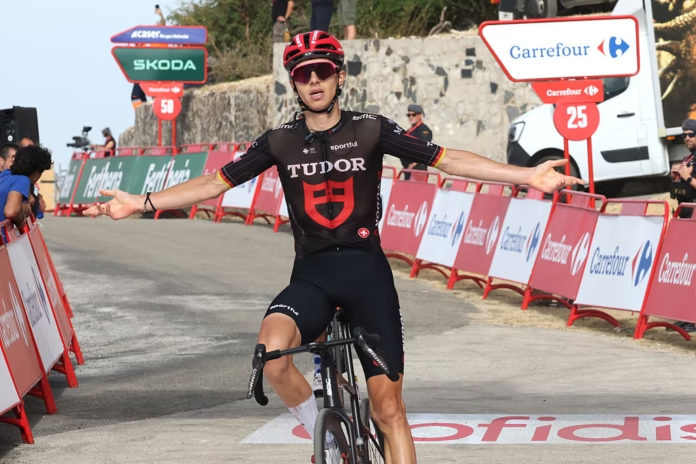
Marco Brenner won stage 14 of the 2026 Vuelta a España on Sierra de La Pandera, beating Santiago Buitrago by a single second after the strongest riders from a huge early breakaway came back together on the final climb.
The Tudor Pro Cycling Team rider had briefly been distanced by Buitrago on the steepest part of La Pandera but worked his way back, followed the Colombian when he attacked again inside the final kilometre and came past him on the final run to the line. Cristián Rodríguez finished third at 11 seconds, with Iván Sosa fourth at 14 seconds.
Several minutes later, the general classification fight produced another important change. Enric Mas and Felix Gall dropped Primož Roglič inside the final two kilometres, allowing Gall to move ahead of the Slovenian into second overall. Mas remains in the red jersey with his advantage over Gall unchanged at 2:06, while Roglič slips to third at 2:10.
A huge breakaway gets away
The stage 14 route to Sierra de La Pandera always gave the breakaway a realistic chance, but getting into it was a race in itself.
Attacks started almost immediately after the flag dropped in Jaén. Groups repeatedly went clear and were brought back as riders tried to position themselves for a second half containing Puerto de Los Villares, Puerto de Locubín and the summit finish on La Pandera.
Eventually a group of 44 riders established itself at the front.
Bahrain Victorious had Buitrago and Pello Bilbao, while UAE Team Emirates-XRG placed João Almeida, Kevin Vermaerke and Ivo Oliveira in the move. Brenner was accompanied by Tudor teammates Will Barta and Larry Warbasse. XDS Astana had Rodríguez, Lorenzo Fortunato and Alessandro Romele, while Valentin Paret-Peintre, Filippo Zana, Clément Berthet, Georg Steinhauser, Sosa and Mario Aparicio added considerable climbing strength.
There was enough GC interest in the group to keep Movistar working behind. Berthet and Rodríguez had started the day 10th and 11th overall at just over 11 minutes from Mas, so the Spanish team could not simply allow the escape unlimited freedom.
They did not need to catch it either.
Once the advantage moved towards eight minutes during the second half of the stage, there were effectively two separate races: one for the stage and another for the red jersey.
Vermaerke commits from more than 50 kilometres out
Buitrago took maximum mountains points over Puerto de Los Villares ahead of Fortunato and Vermaerke, strengthening his position in the mountains classification before the race descended towards the next part of the stage.
Vermaerke then went alone.
The American attacked with around 53 kilometres remaining and quickly established a meaningful advantage over a breakaway that was too large to organise an immediate chase. His lead moved beyond a minute through the rolling roads towards Puerto de Locubín.
Vermaerke collected maximum points at the intermediate sprint and began the 8.8-kilometre climb with around 1:40 over the chasers. Movistar were still controlling the peloton several minutes further back, with no urgency to bring the stage back together.
The gap began to fall on Locubín.
Vermaerke reached the summit first and collected the six bonus seconds on offer, but Rodríguez was only 45 seconds behind after taking second place and four seconds. Berthet crossed third for another two bonus seconds.
The front of the race was beginning to compress again.
Steinhauser takes over before La Pandera
Georg Steinhauser was next to commit.
The EF Education-EasyPost rider accelerated from the chase and caught Vermaerke on the steep wall through Valdepeñas de Jaén. He continued at the front as the race approached the official start of Sierra de La Pandera, where 11.9 kilometres at an average of 7.2 per cent remained.
The average gradient did not tell the full story. Sections reaching 15 per cent and beyond repeatedly interrupted the steadier climbing, making it difficult for any rider to establish a comfortable rhythm.
Steinhauser initially held his advantage while Guillaume Martin-Guyonnet tried to bridge from behind. Aparicio then moved across as the large breakaway began breaking into smaller groups.
With around eight kilometres remaining, only the strongest riders from the original escape were still in realistic contention.
Aparicio eventually attacked again and established himself alone at the front. Behind him, Brenner, Zana and Paret-Peintre began moving through the fragments of the break, while Buitrago, Rodríguez and Sosa were also closing.
Steinhauser’s earlier work began to tell. The race for the stage was being reset again.
Buitrago attacks but Brenner comes back
Aparicio still had around 30 seconds with four kilometres remaining, but his advantage was disappearing quickly.
Brenner closed before Buitrago accelerated from behind. The Colombian caught the German and the pair reached Aparicio on some of the hardest gradients of the climb.
Buitrago then tried to settle the stage.
With around 3.5 kilometres remaining, he increased the pace and initially dropped Brenner. It looked like the decisive move, particularly with the road still pitching into double figures, but Brenner never allowed the gap to become substantial.
He gradually came back.
Rodríguez and Sosa were doing the same from behind. With 1.5 kilometres remaining, the four riders were together at the front, while Paret-Peintre had been unable to make the final junction.
Sosa moved to the front as they approached the final kilometre. Nobody wanted to commit too early after such a difficult climb.
Buitrago attacked from the back of the group.
Brenner reacted immediately and was the only rider able to follow. Buitrago led through the final bends, but the road eased slightly approaching the finish and Brenner remained close enough to challenge.
This time Buitrago could not shake him.
Brenner came through in the closing metres to win in 4:15:09, one second ahead of the Colombian.
Rodríguez completed the podium at 11 seconds, with Sosa fourth at 14 seconds and Paret-Peintre fifth at 22. Berthet was sixth at 27 seconds, followed by Jørgen Nordhagen at 39 seconds and Filippo Zana at 43. Walter Calzoni finished ninth at 1:06, with Almeida completing the top 10 at 1:09.
It was another day when the breakaway controlled the fight for the stage, following Wout van Aert’s victory from the escape on stage 13 in Loja.


Mas and Gall finally distance Roglič
The stage victory had been decided long before the GC group reached the finish, but La Pandera still had the potential to change the balance behind Mas.
Movistar had spent much of the day controlling rather than chasing. Iván Romeo set the pace as the favourites reached the final climb before Netcompany INEOS began working for Oscar Onley and EF Education-EasyPost increased the pressure ahead of Richard Carapaz.
Mas was the first of the leading GC riders to attack, accelerating with a little over three kilometres remaining.
The move did not immediately create a decisive gap. Carapaz countered soon afterwards and Gall reacted, with Mas and Roglič bridging across. Onley could not match the acceleration.
For a moment, the four leading contenders were back together.
Gall then attacked. Mas followed and Roglič again managed to close the gap, but the Austrian’s repeated accelerations were beginning to make the difference.
The decisive pressure arrived inside the final two kilometres.
Raúl García Pierna, who had spent much of the day in the breakaway, was still available to help Mas and produced a long turn at the front. Gall remained with the Movistar pair.
Roglič and Carapaz were dropped.
Roglič eventually left Carapaz behind and continued alone towards the finish, but he was unable to regain contact with Mas and Gall.
Gall moves into second overall
Mas and Gall sprinted to the line together, ensuring there was no change between the top two riders on the road.
There was, however, a change immediately behind them.
Mas remains the Vuelta leader with an overall time of 49:28:12. Gall is now second at 2:06, replacing Roglič, who drops to third at 2:10.
Only four seconds therefore separate Gall and Roglič, but Mas has again come through one of the race’s major mountain stages without surrendering any of his advantage.
The red jersey had already strengthened his position when Jakob Omrzel won stage 12 on Calar Alto, where Mas attacked his rivals and added more time to Roglič, Gall and Carapaz. La Pandera produced a different type of defence. Gall could stay with him, but Roglič could not.
That leaves the wider Vuelta general classification battle increasingly centred on whether Gall or Roglič can find a way to start taking time back from Mas.
For Brenner, stage 14 required a different calculation. He survived one of the largest breakaways of the race, refused to panic when Buitrago initially rode him off the wheel and still had enough left when the Colombian made one final attempt to win inside the last kilometre.
Vuelta a España 2026 stage 14 result
| Position | Rider | Team | Time/gap |
|---|---|---|---|
| 1 | Marco Brenner | Tudor Pro Cycling Team | 4:15:09 |
| 2 | Santiago Buitrago | Bahrain Victorious | +0:01 |
| 3 | Cristian Rodríguez | XDS Astana Team | +0:11 |
| 4 | Iván Sosa | Equipo Kern Pharma | +0:14 |
| 5 | Valentin Paret-Peintre | Soudal Quick-Step | +0:22 |
| 6 | Clément Berthet | Groupama-FDJ United | +0:27 |
| 7 | Jørgen Nordhagen | Visma | Lease a Bike | +0:39 |
| 8 | Filippo Zana | Soudal Quick-Step | +0:43 |
| 9 | Walter Calzoni | Pinarello-Q36.5 Pro Cycling Team | +1:06 |
| 10 | João Almeida | UAE Team Emirates-XRG | +1:09 |
Main photo credit: Getty

