The men’s elite time trial closes the 2026 European Championships on Wednesday 7 October with a field that is unusually open. Defending champion Remco Evenepoel is absent, Filippo Ganna is not racing and Paul Seixas is also missing, removing the three riders who filled the World Championships podium in Montréal.
That leaves Stefan Küng, Jakob Söderqvist, Callum Thornley, Primož Roglič, Kasper Asgreen and Iván Romeo among the strongest candidates for the European title. The course also changes the normal hierarchy. At only 22.1km it is short, but 367 metres of climbing and the steep Možjanca ascent mean this is not a simple power test for the biggest time-trial specialists.
Küng brings the clearest recent winning form after taking the Vuelta a España time trial in Jerez, three seconds ahead of Thornley. Söderqvist, Küng, Asgreen and Thornley then all finished inside the top 10 at the World Championships, while Roglič was fourth in the Vuelta time trial and has the climbing ability to make more of the hardest section than most of the pure specialists.
The main uncertainty surrounds how much the climb changes the balance. Riders who can carry speed through the opening flat kilometres still need to avoid going too deep before Možjanca, while the strongest climbers cannot afford to give away too much time on the final flat run back to Šenčur. It is a course that rewards a complete effort rather than one outstanding section.
Previous winners
2025 – Remco Evenepoel
2024 – Edoardo Affini
2023 – Joshua Tarling
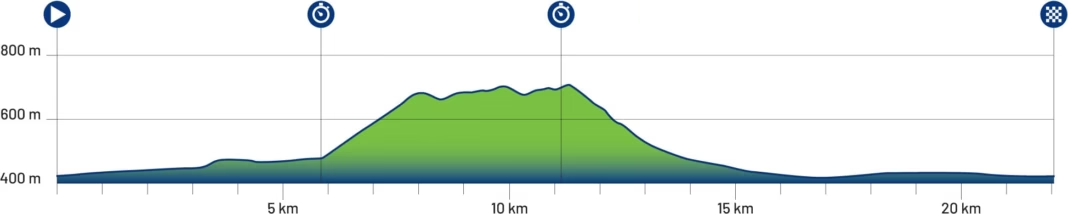
Men’s European Championships time trial route
The 22.1km course starts and finishes in Šenčur and uses the same circuit that decided the road races. The difference is that the riders face Možjanca only once, with no teammates and nowhere to hide if they get the pacing wrong.
The first 5.8km are relatively flat and should favour riders such as Küng, Söderqvist and Thornley, who can settle immediately into a high aerodynamic speed. The first timing point comes before the climb, so the early split will give a useful indication of which riders have taken the biggest risks before the decisive section.
Možjanca then changes the race. The climb is 2.1km at around 10.2%, with the steepest ramps approaching 16%. That is long enough for Roglič, Romeo and the lighter specialists to take meaningful time, but short enough that a rider such as Küng can still limit the damage if he arrives with something left.
The summit does not lead directly into a full descent. The road continues to rise and roll for several kilometres before the faster drop back towards the valley. With roughly 7km remaining the course flattens again, leaving a final section where sustained power becomes important once more.
The pacing problem is therefore obvious. Attack the first flat section too hard and Možjanca becomes expensive. Hold too much back for the climb and riders such as Küng or Söderqvist can build a gap before it starts. The full circuit is covered in our 2026 European Championships route guide.
Stefan Küng has the strongest recent time-trial result
Stefan Küng starts as the most obvious reference point. He won stage 18 of the Vuelta a España over 32.1km, averaging 54.4km/h and beating Thornley by three seconds. He then finished seventh at the World Championships in Montréal, 1:44 behind Evenepoel but only 18 seconds away from Brandon McNulty in fourth.
The Slovenian course is less naturally suited to Küng than the flatter Vuelta test. Možjanca is steep enough to expose the extra weight of a pure time-trial specialist, and the rolling section after the summit gives him less opportunity to recover immediately. The counterargument is that the race is only 22.1km. He does not have to carry that climbing cost for another 30km afterwards.
Küng is also a two-time European champion, winning in 2020 and 2021. With Evenepoel absent, he is the only rider in the field who has already won this elite title.
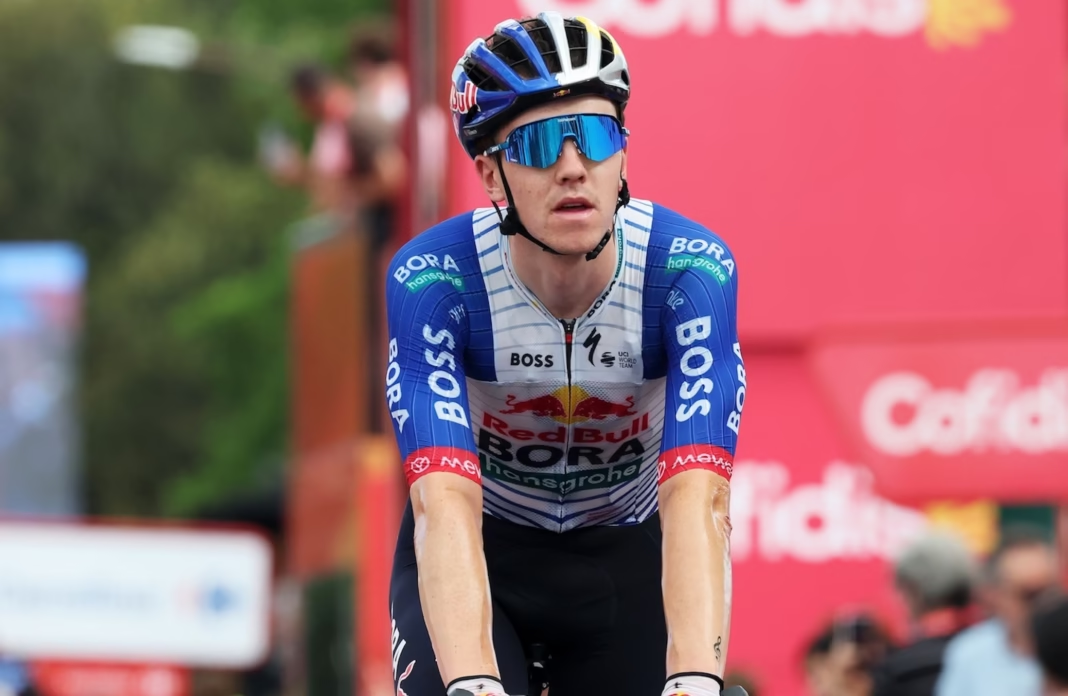
Callum Thornley has moved from outsider to genuine medal contender
Callum Thornley is the sole British rider and his recent results make him much more than an outside top-10 pick. He came within three seconds of beating Küng in the Vuelta time trial and was faster than João Almeida over the final section after losing ground through the middle of the course.
Ten days later he finished 10th in the World Championships time trial, only 18 seconds behind Kasper Asgreen in eighth and less than two minutes from second place once Evenepoel’s winning margin is taken out of the equation.
Šenčur could suit him better than Montréal. Thornley has the power for the flat sections but is also lighter than some of the established specialists, making the 2.1km climb less damaging. His challenge is execution. On such a short course, losing five or six seconds by starting too conservatively can be as costly as over-pacing the climb.
Jakob Söderqvist is ready for an elite title
Jakob Söderqvist finished fifth in the World Championships time trial, only one second behind McNulty and ahead of Küng, Asgreen and Thornley. That is the strongest Montréal result among the riders starting here.
The Swede was already the under-23 world time-trial champion in 2025, but his 2026 results have removed any need to frame him as a rider waiting for the future. He is already competitive with the best elite specialists.
The question is how he handles Možjanca. Söderqvist’s strength is sustained power, and the short distance works in his favour, but this is a more irregular effort than the World Championships. If he can reach the top of the climb close to the fastest time, the final 7km should bring him back towards the front.
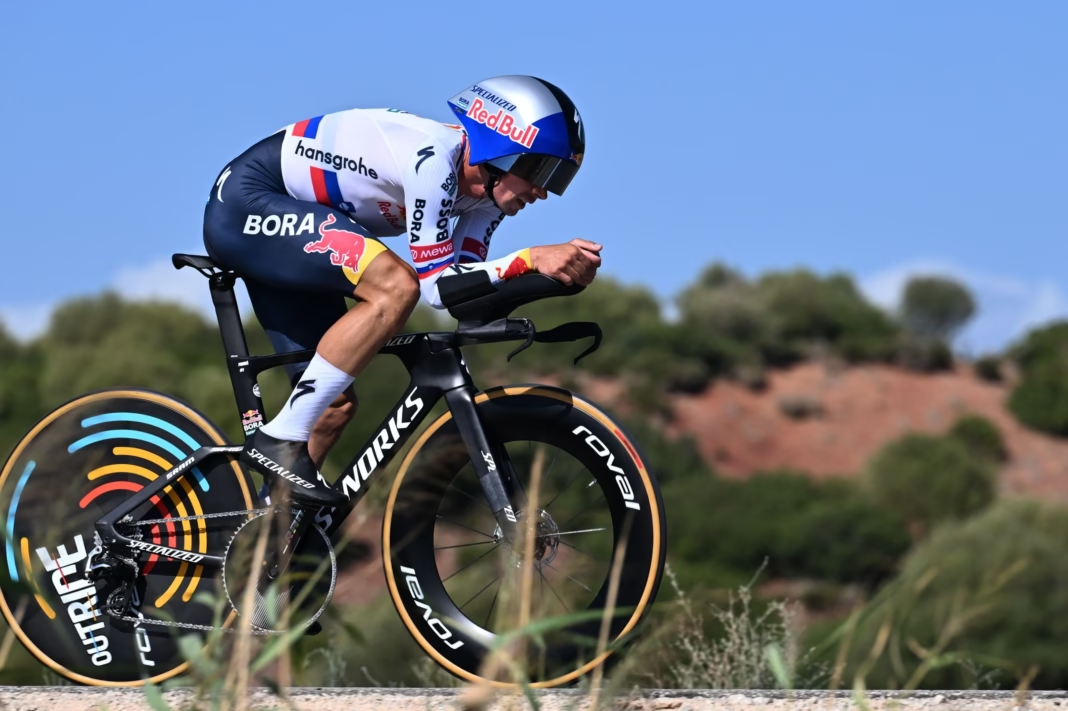
Primož Roglič has the best course, but not the clearest form
Primož Roglič is the rider most likely to turn Možjanca into a bigger part of the race than the specialists would like. He was Olympic time-trial champion in Tokyo and remains capable of producing elite numbers against the clock when the course rewards climbing as much as aerodynamics.
His fourth place in the Vuelta time trial is the encouraging result. He finished 19 seconds behind Küng over 32.1km, but a much steeper 22.1km course should reduce the Swiss rider’s advantage on the flat.
The concern is Sunday’s road race. Roglič finished ninth and said afterwards that he was not at his best, describing simply reaching the top 10 as his own win for the day. Three days is enough time to recover from a road race, but not enough to assume the legs will be completely different.
Home roads still matter. Roglič knows the terrain, the climb gives him an obvious place to gain time and the short distance reduces the penalty for not having the same pure time-trial speed as Küng or Söderqvist. If his road-race performance was a bad day rather than a wider form problem, he can win.
Iván Romeo could be the rider who benefits most from the route
Iván Romeo is easy to overlook because his elite palmarès against the clock is still developing, but this course fits him well. He won the under-23 world time-trial title in 2024 and has since developed into a rider capable of producing long efforts on rolling and climbing terrain rather than only flat time trials.
The combination of a hard two-kilometre climb, a fast descent and a relatively short overall distance should allow Romeo to use his road-racing strength without giving up too much to the bigger specialists. A medal would be no surprise, and a win is possible if the main favourites misjudge the first half of the course.
Kasper Asgreen, Mikkel Bjerg and Ilan Van Wilder add depth
Kasper Asgreen finished eighth at the World Championships, four seconds ahead of Thornley, and remains one of the strongest pure power riders in the field. The climb is the obvious weakness, but the short distance keeps him in the medal discussion.
Mikkel Bjerg has a similar problem. He can take time on the opening and closing flat sections, but he cannot afford to lose too much on Možjanca. Denmark therefore have two strong options without either being an obvious favourite.
Ilan Van Wilder is more interesting because the course should suit his balance of climbing and time-trial ability. Bruno Armirail, Mauro Schmid, Mattia Cattaneo, Nelson Oliveira and Mathias Vacek also have realistic top-10 chances, while Jan Tratnik gives Slovenia another experienced rider on home roads.
What will decide the 2026 European time trial?
The race is likely to be decided by how much speed each contender is willing to sacrifice before Možjanca. Küng, Söderqvist and Thornley can build an early advantage, but none can afford to arrive at the climb already close to the limit. Roglič and Romeo can gain more on the steep section, but they need to keep the deficit small enough that the final flat kilometres do not undo the work.
The descent could also create meaningful differences. Riders who are confident enough to carry speed through the technical section will recover some of the seconds spent on the climb without using extra power. On a race this short, a two-second hesitation at several corners can become a double-digit loss by the finish.
That is why the route is more open than a conventional 40km championship time trial. There is no long flat section where one rider can simply settle into the highest sustainable wattage and gradually pull away. The winner needs a good aerodynamic opening, a controlled climb, a clean descent and enough left to accelerate again over the final kilometres.
How to watch the men’s European Championships time trial
The men’s elite time trial starts at 16:15 CEST on Wednesday 7 October, which is 15:15 BST. The final rider, Söderqvist, starts at 16:58 CEST, 15:58 BST.
UK coverage is available through TNT Sports and HBO Max. Our European Championships TV guide has the full broadcast schedule.
Top 3 prediction
1. Stefan Küng
2. Callum Thornley
3. Jakob Söderqvist