The Eneco Tour Women moves to Tilburg on Thursday 15 October for a 13.6km individual time trial that could reshape the general classification. The first rider is scheduled to leave at 09:00 BST (10:00 local time), with the leading contenders appearing towards the end of the women’s start order. UK viewers can look for the race on HBO Max and through TNT Sports’ cycling coverage, with streaming listed from approximately 09:35 BST.
Wednesday’s stage in Ede left the overall contest finely balanced. Sandrine Tas took the road-stage victory and moved into the leader’s jersey, one second ahead of prologue winner Lieke Nooijen. Charlotte Kool sits close enough to remain relevant to the classification, but Thursday’s longer time trial should place greater weight on sustained power and pacing than the sprint that decided the previous day.
This is the second race against the clock in three days, although the demands are considerably different. The opening prologue in The Hague measured only 3.1km. Tilburg gives riders over four times that distance, more room to settle into a position, and a much greater opportunity for genuine time differences to develop.
Eneco Tour Women Stage 2 start times and UK television coverage
Date: Thursday 15 October 2026. Start and finish: Stappegoorweg, Tilburg, Netherlands. Distance: 13.6km, individual time trial. First rider: Christina Schweinberger, 09:00 BST / 10:00 CEST. Final scheduled starters: Lieke Nooijen at 10:26 BST and Sandrine Tas at 10:27 BST. Start times are local race timings converted to British Summer Time.
The listed women’s stream begins at around 09:35 BST, or 10:35 CEST, through HBO Max. TNT Sports is the UK’s broadcaster for the integrated Eneco Tour, although individual television channel allocations can change across a busy morning of sport. If a conventional TNT channel is not showing the women’s time trial, the dedicated cycling listing on HBO Max is the sensible first check.
The first riders will already be on the road when coverage begins. That matters on a short time trial because early benchmarks can establish whether the course is riding faster or slower than expected. Anyone mainly interested in the contest for the leader’s jersey should be watching by 10:15 BST, ahead of the final GC riders. These are rider start times rather than the beginning of a televised programme.
For replays, look up the women’s Stage 2 session specifically rather than the men’s race, which also uses the Tilburg circuit later in the day. The two events share branding and much of the same staging, but their results and general classifications remain separate. The full Eneco Tour Women route guide explains the remaining stages.
The Tilburg course: wide roads, very little climbing
Start and finish are on Stappegoorweg, south of central Tilburg. The route heads out towards Abcoven and turns through roads including Beeksedijk, Goirlsedijk and Groot Westerwijksestraat before running towards the Beekse Bergen area. A long straight section near the N269 brings the riders back towards Tilburg, with the finish again on Stappegoorweg.
The profile is almost completely flat, with barely thirty metres of total climbing in 13.6km. That puts a premium on maintaining a high speed in the time-trial position and managing changes of direction cleanly. There are relatively few corners, so riders should spend most of the distance producing a steady effort rather than repeatedly accelerating out of tight bends.
It is still possible to lose useful seconds through small errors. One left-right sequence around the middle of the lap, and a sharper turn as riders enter the final kilometre, interrupt the longest sustained efforts. Entering a corner too cautiously costs speed, but attempting to carry too much speed can be more expensive if it forces the rider off the intended line.
The straight roads around Beekse Bergen should suit riders who can hold an aerodynamic position under pressure. With a forecast of generally dry conditions and a light south-westerly breeze, the day appears more likely to be settled by power and execution than by major weather changes. A small wind shift can still affect an individual ride, particularly on exposed sections. The 2026 course overview places Tilburg between the flat stage at Ede and Friday’s hillier ride towards Watersley.
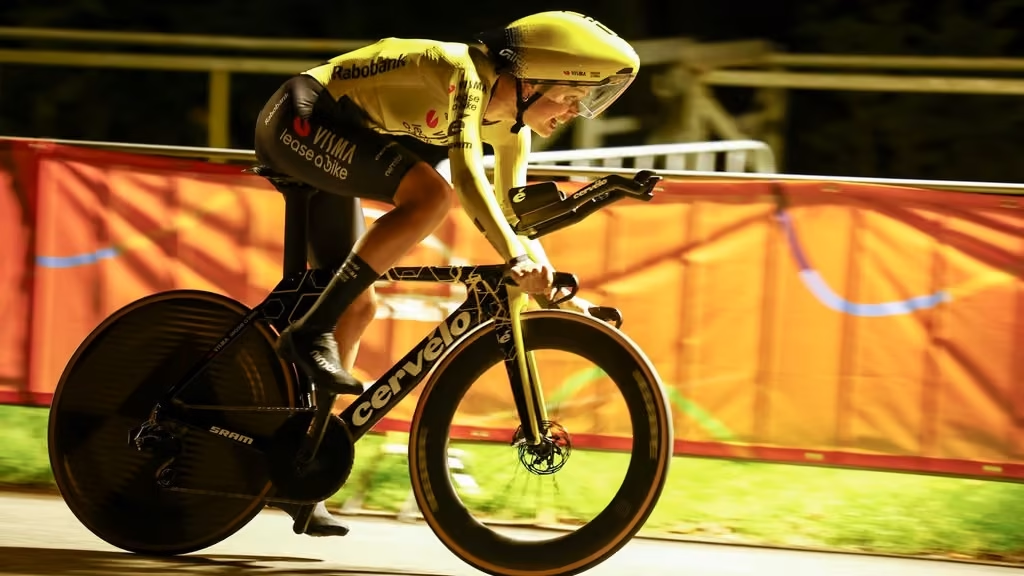 Photo Credit: Cor Vos
Why Nooijen is the reference for the time trial
Nooijen has already shown how valuable her aerodynamics and acceleration can be this week. She won the prologue in The Hague in 3:51, finishing about eight seconds clear of Kool and Lonneke Uneken. That was a very short effort, however, and Thursday requires a different distribution of energy. Strong riders must avoid starting so quickly that their speed collapses over the final third.
Her position near the end of the start order provides a useful advantage. By the time she sets off, many specialist riders will have put times on the board, and team staff should have a clearer picture of how the course is riding. She can judge her pace against established checkpoints rather than relying only on pre-race estimates. The key question is whether her prologue margin reflects an advantage she can extend over a longer effort.
Tas took the overall lead on Wednesday through a sprint victory and time bonuses, a very different route to the top of the standings. Beginning the time trial just one second clear of Nooijen leaves almost no room for error. A fast opening kilometre or a careful corner could be enough to decide the jersey, especially with the margins so small. The prologue report offers the background to that contest.
Nienke Vinke is another rider worth monitoring, with a strong under-23 time-trial record and a starting position late enough to have useful reference times. Femke de Vries, Christina Schweinberger and Pfeiffer Georgi are also capable of producing meaningful individual efforts. The race contenders guide looks at the wider classification rather than treating Tilburg as an isolated stage.
Which start times matter most?
Schweinberger is first off at 09:00 BST and should give viewers an early measure of the course. The time trial is not organised into an extended team-by-team procession: riders leave individually and the differences are visible at the intermediate checkpoints and the finish. Early riders can remain in the hot seat for a surprisingly long period, particularly if conditions are similar throughout the morning.
The start order becomes increasingly interesting after 10:00 BST. De Vries is listed for 10:14 BST, Letizia Borghesi for 10:19, Vinke for 10:20, and Uneken for 10:24. Kool follows at 10:25, Nooijen at 10:26 and Tas at 10:27. These scheduled departures are useful for planning viewing, but the live race clock and organisers’ updates should take precedence if there are last-minute changes.
Kool’s time will be revealing even if she is better known for her sprinting. She performed well in the short prologue and has stayed close in the classification; maintaining that position through a longer time trial would strengthen her prospects for the rest of the week. A loss of several tens of seconds would instead shift her attention towards the remaining opportunities for stage wins.
The rider leaving last does not automatically win or retain the lead. Each competitor’s elapsed time is measured from her own start, so the standings can change once someone still on the course completes the distance. For viewers, the useful reference is the fastest finishing time and its relationship to the final riders’ intermediate splits, rather than the order in which riders cross the line.
How the time trial affects the rest of the Eneco Tour
Tilburg creates the first prolonged individual test of the women’s six-day race. Wednesday offered bonuses, positioning and the threat of splits in the bunch, while the prologue gave specialists a chance over only a few minutes. A 13.6km time trial strips away much of the protection normally provided by a team. Riders are responsible for their own pace and for every second spent negotiating the course.
The next two days will ask different questions. Friday finishes on more selective roads towards Watersley, and Saturday’s route towards the VAMberg introduces another chance for attackers to unsettle the classification. A rider who loses time in Tilburg may still have opportunities to recover it, but she will need to race more aggressively than someone who leaves the time trial in the leader’s jersey.
The gaps from Thursday should therefore change how teams approach those stages. A leader with a clear buffer can respond to attacks rather than initiate them, while riders within seconds may gamble on a small move or a bonus sprint. This is why the middle of the finishing order matters almost as much as the fastest time: GC rivals separated by a handful of seconds can emerge with very different tactical options.
If you are joining only for the decisive portion of the broadcast, begin with the final half-hour of the women’s session, when Vinke, Nooijen, Tas and the other leading riders are due to start. Those rides should establish both the stage order and the direction of the general classification before the race moves to hillier terrain.