The race formerly known as the Simac Ladies Tour returns from Tuesday 13 October to Sunday 18 October 2026 in a very different format. Now officially part of the relaunched Eneco Tour, the women have six race days covering 368.2km, beginning with a short evening prologue in The Hague and ending with a compact circuit race in Arnhem.
The name has changed, the race has moved from September into October and it is no longer part of the Women’s WorldTour, dropping to UCI 2.1 level for 2026. The sporting ingredients are still recognisable. There are two individual tests against the clock, a flat day around Ede, a short hilly stage in Limburg and a penultimate stage finishing on the VAMberg.
The organisers have now published detailed routes for most of the race. The exception is the Hoogeveen to VAMberg stage. Its 114.1km distance, summit finish and use of multiple climbs on the VAMberg are confirmed, but the detailed women’s route around Drenthe has not yet been published in the same form as the other stages.
That leaves some uncertainty over exactly how often and by which roads the women will tackle the VAMberg. The hill itself is very familiar from the Ronde van Drenthe, Dutch championships and 2023 European Championships, so we already know what sort of difficulty awaits once the race reaches the former landfill site.
For the wider background to the new format, see ProCyclingUK’s beginner’s guide to the Simac Ladies Tour 2026 and its transformation into the Eneco Tour Women.
Simac Ladies Tour 2026 route at a glance
| Day | Stage | Route | Distance | Type |
|---|---|---|---|---|
| Tuesday 13 October | Prologue | The Hague – The Hague | 3.1km | Individual time trial |
| Wednesday 14 October | Stage 1 | Ede – Ede | 79.5km | Flat |
| Thursday 15 October | Stage 2 | Tilburg – Tilburg | 13.6km | Individual time trial |
| Friday 16 October | Stage 3 | Sittard – Watersley | 87.8km | Hilly |
| Saturday 17 October | Stage 4 | Hoogeveen – VAMberg | 114.1km | Hilly / summit finish |
| Sunday 18 October | Stage 5 | Arnhem – Arnhem | 70.1km | Flat circuit stage |
Total distance: 368.2km
Classification: UCI 2.1
Defending champion: Lorena Wiebes
Previous name: Simac Ladies Tour
2026 name: Eneco Tour Women
The distances are noticeably shorter than those found in the final years of the standalone Simac Ladies Tour. Four of the five road stages are below 115km, while the prologue and Tilburg time trial together account for 16.7km against the clock.
That gives the week a compressed feel. There are fewer kilometres in which a GC rider can simply sit in the bunch and wait.
Prologue: The Hague to The Hague, 3.1km
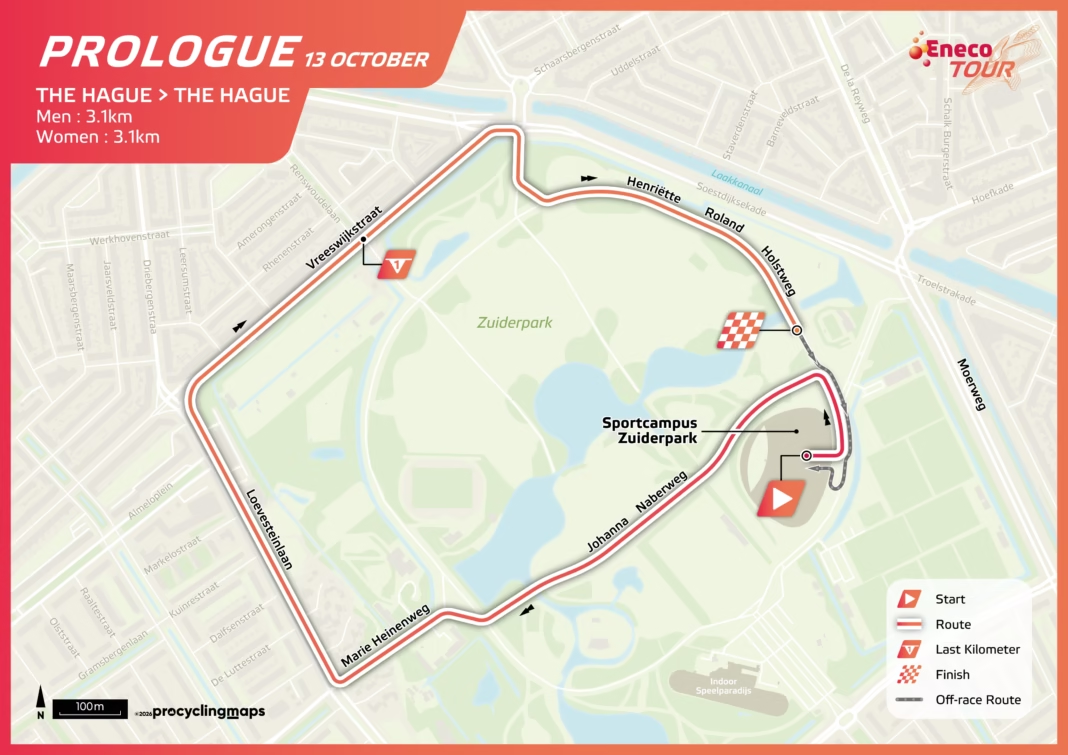
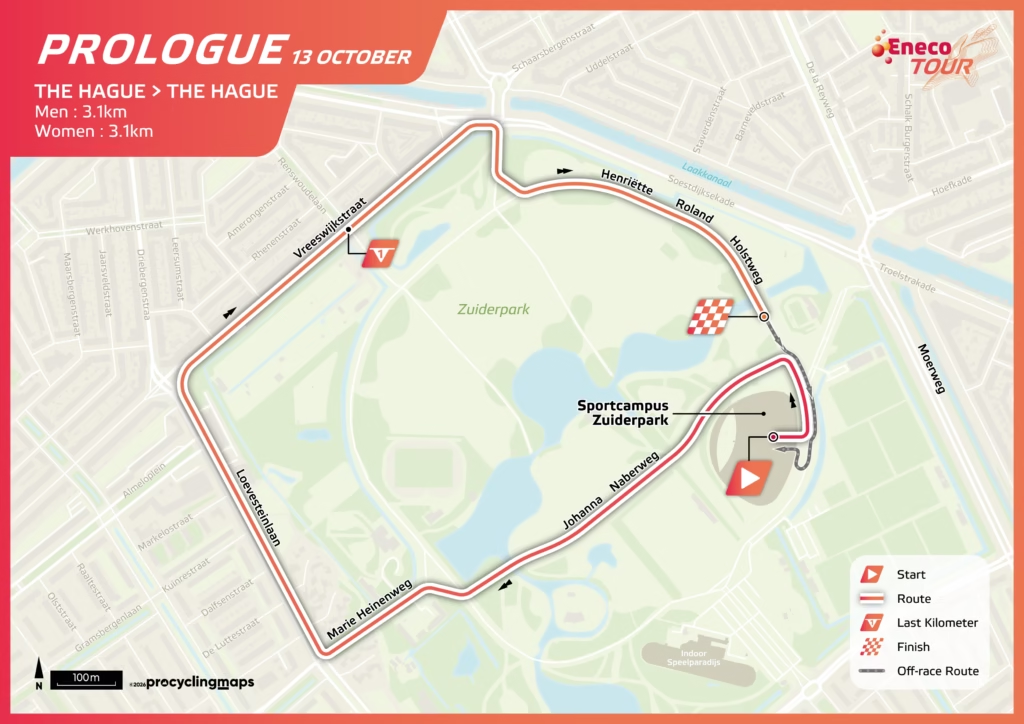
The race begins on Tuesday evening with a 3.1km prologue around the Sportcampus Zuiderpark in The Hague.
It is extremely short, even by prologue standards. The fastest women should spend only a few minutes racing, which puts far more emphasis on explosive power and technical execution than conventional time trial pacing.
The start is at the Sportcampus before the route loops through the roads immediately around Zuiderpark and returns to the same area for the finish.
There are several changes of direction packed into the short course, so this is not simply a straight-line power test. Riders need to accelerate repeatedly, judge braking points accurately and get back up to speed quickly.
One of the more unusual features of the opening evening is that the men and women will start alternately rather than completing separate sessions. Both competitions use the same 3.1km course.
The GC gaps should still be small. Even five or ten seconds will be meaningful over such a short distance, but nobody is likely to win the race outright here.
What the prologue can do is immediately create pressure. Riders who lose more time than expected will know that a substantially longer time trial is coming only two days later.
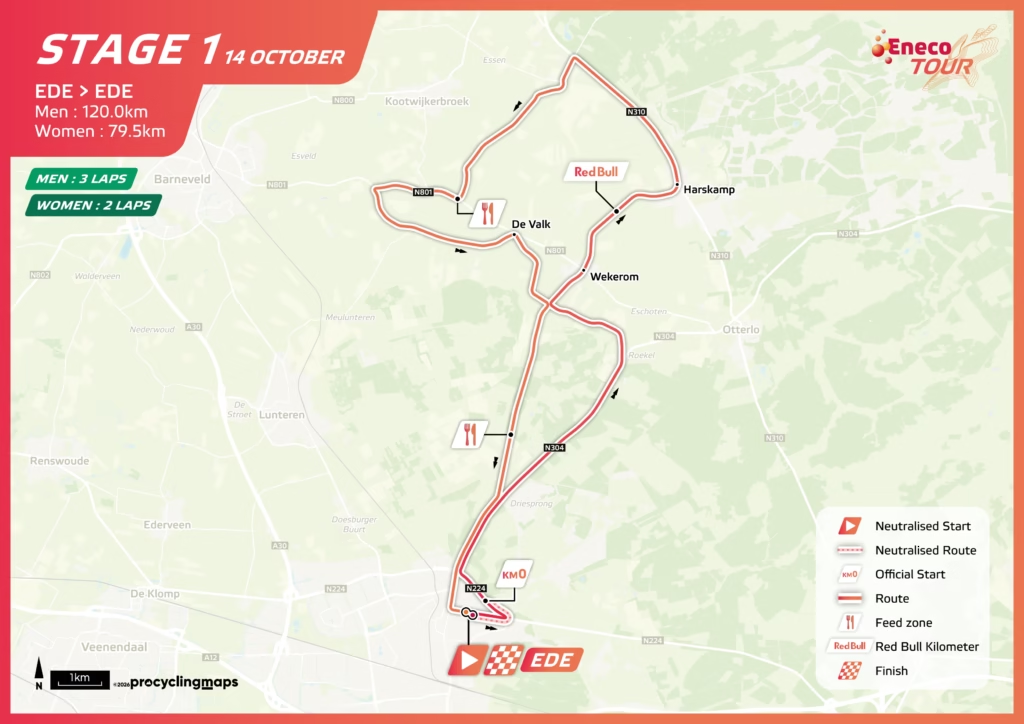
Stage 1: Ede to Ede, 79.5km
The first road stage is a compact 79.5km race around Ede and the Veluwe.
The women complete two laps of the main circuit, compared with three for the men. After leaving Ede, the route heads north through the countryside towards Wekerom and Harskamp before turning west and returning via the De Valk area.
There is no serious climbing and the organisers classify the stage as flat.
That should make this the first clear opportunity for the sprinters, but describing a Dutch stage as flat never tells the full story. Much of the route runs across open rural roads where wind direction can become much more important than gradient.
The final outcome could therefore vary dramatically depending on the weather.
In calm conditions, the strongest sprint teams should have little difficulty controlling a breakaway over 79.5km. Add a strong crosswind and the short distance encourages teams to attack early because there is little time for dropped groups to reorganise.
The 2025 Simac Ladies Tour provided a particularly sharp reminder. Stage 2 was reduced to an 11-rider front group after crosswind splits, while the following day saw another major GC selection when the race broke apart in Flevoland.
Ede may look like the easiest stage on the route. If the wind arrives, it could become one of the most important.
There is also a Red Bull Kilometre bonus during the stage, offering six, four and two bonus seconds to the first three riders. With relatively small expected gaps elsewhere, those seconds are worth taking seriously.
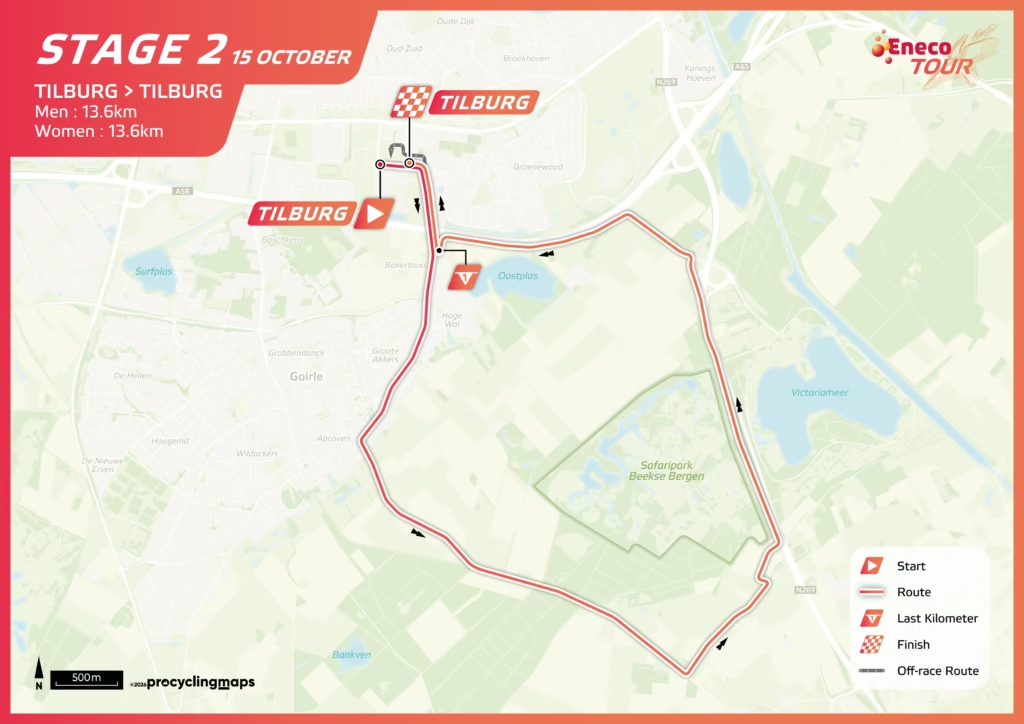
Stage 2: Tilburg individual time trial, 13.6km
The GC gets its first substantial test on Thursday with a 13.6km individual time trial around Tilburg.
Start and finish are both on Stappegoorweg, with the route heading south-east out of the city before looping around the area beside the Beekse Bergen and returning through the southern suburbs.
The roads are predominantly flat and fast, but this is not an uninterrupted drag-strip time trial.
There are enough bends and changes of direction to reward riders who can carry speed through corners rather than repeatedly braking and accelerating. The opening and closing sections around Tilburg are particularly more technical than the long straights further out on the course.
At 13.6km, the distance is substantial enough to create proper GC differences.
The best specialists could take 30 seconds or more from riders who rely primarily on sprinting or short climbing. In a race with no long mountain stage to claw that time back, Tilburg may prove the single most important stage in determining the overall classification.
Time trials have often played that role in this race.
Zoe Bäckstedt won the 10.2km test during the 2025 edition, while Lorena Wiebes did enough to retain control of the GC before winning overall. ProCyclingUK’s report from Bäckstedt’s 2025 Simac Ladies Tour time trial victory showed how a rider can lose significant time against the specialists without necessarily falling out of overall contention.
The equation is slightly different this year because the most selective road stages come immediately afterwards.
Anyone who loses heavily in Tilburg will have two days to attack.
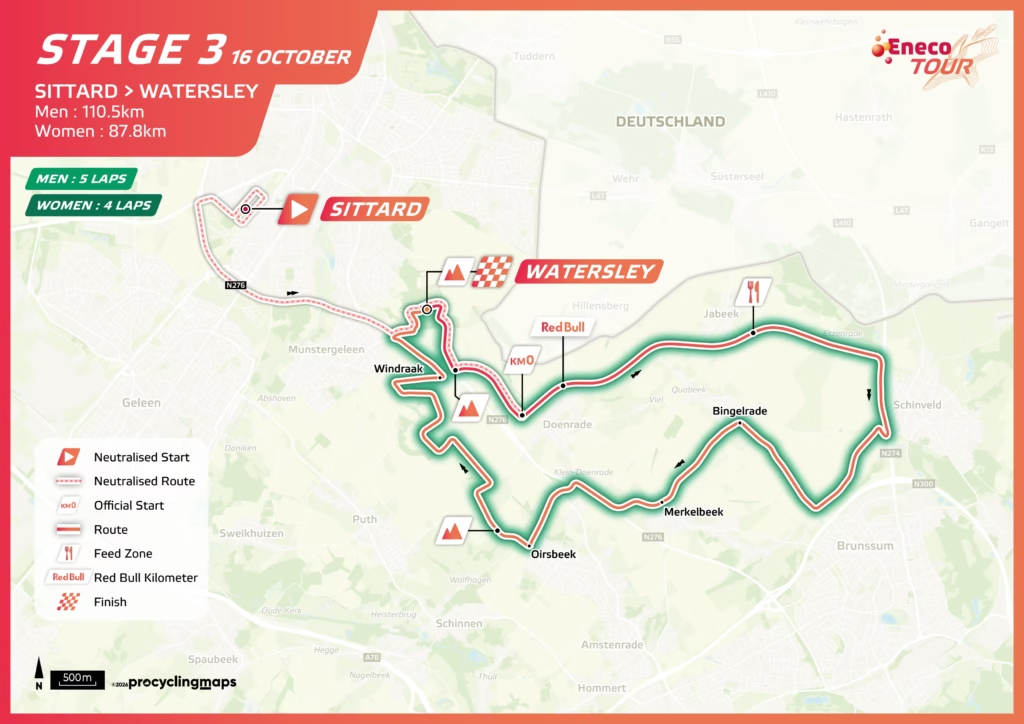
Stage 3: Sittard to Watersley, 87.8km
The character of the race changes completely on Friday.
Stage 3 starts at the Tom Dumoulin Bike Park in Sittard and finishes at Watersley Sports & Talentpark after 87.8km through South Limburg.
This is the first stage where climbing is deliberately built into the route rather than something the peloton encounters incidentally.
The women complete four laps of the main circuit, travelling through the countryside east of Sittard around places including Windraak, Oirsbeek, Merkelbeek, Bingelrade and Schinveld before returning towards Watersley.
There are several short climbs within each lap. None is long enough to create the kind of gaps seen in a conventional mountain stage, but repeating them four times changes the race considerably.
The roads around South Limburg also twist constantly. There are frequent corners, small changes in gradient and narrow sections where positioning before each climb matters.
At only 87.8km, there is little incentive to ride conservatively.
A rider who lost 20 or 30 seconds in the Tilburg time trial cannot wait for a distant mountain later in the week. This is one of the obvious places to start attacking the GC leader.
The women pass the Watersley finish area three times before the actual finish, making the stage particularly well suited to repeated attacks. Teams learn the final roads during the race itself, and there should be little mystery about where the strongest moves can be made on the last lap.
A sprint from a reduced group remains entirely possible, but this should be much more selective than Ede.
Why the Limburg stage could be more important than its profile suggests
The temptation is to look ahead to the VAMberg as the main climbing stage.
Limburg may offer more room to make a genuinely tactical difference.
The VAMberg is steep but short. A strong rider can potentially survive one hard acceleration and limit losses.
Stage 3 contains repeated opportunities to attack, counter-attack and isolate a GC leader.
Teams with several strong Classics riders can make the race difficult long before the final circuit. Riders who are strong against the clock but less comfortable with constant accelerations could find themselves exposed even without losing contact on any single climb.
The timing also helps.
After Thursday’s time trial, everybody knows exactly how much time they need.
That should make Friday one of the most aggressive days of the race.
Stage 4: Hoogeveen to VAMberg, 114.1km
Saturday brings the stage everyone will immediately recognise from the profile: 114.1km from Hoogeveen to a summit finish on the VAMberg.
It is the longest women’s stage of the race and the final major opportunity to change the general classification.
There is an important caveat.
The organisers have confirmed the 114.1km distance, Hoogeveen start, VAMberg finish and multiple climbs of the hill, but the detailed women’s route through Drenthe has not yet been properly published. The route material available for the other stages gives a clear circuit map; the equivalent detail for the women’s VAMberg stage is still missing.
That means the exact number and sequence of ascents should be treated as TBC for now.
What is not uncertain is the nature of the VAMberg itself.
What is the VAMberg?
The VAMberg is one of the strangest established climbs in professional cycling.
It is not a natural hill. The site near Wijster was created from a former landfill operated by the Vuil Afvoer Maatschappij, from which the VAM name originates.
Once the landfill was closed and landscaped, roads were constructed over it and the site developed into a cycling facility.
The result is effectively a collection of short, very steep climbs rising abruptly from otherwise flat Drenthe countryside.
The original cycling network contains several different routes up the hill, with the complete climbing roads totalling around 2.1km and averaging roughly 10%. Some individual sections are considerably steeper.
The most recognisable feature is the short cobbled section near the top of one route. It runs for around 150 metres at approximately 15%, enough to create immediate separation if the race approaches it at full speed.
A newer extension reaches the higher Dak van Drenthe section, with gradients also moving well into double figures.
Exactly which combination the Eneco Tour uses remains to be confirmed.
Previous races give us a good idea of how the VAMberg behaves
The lack of a final 2026 route map does not make the climb an unknown quantity.
The VAMberg was central to the Ronde van Drenthe for years and became even more important during the final edition of the women’s race in 2024.
That route was redesigned around repeated VAMberg laps before finishing at the summit. Lorena Wiebes still won, despite a course which looked considerably harder for a pure sprinter on paper.
ProCyclingUK’s 2024 Ronde van Drenthe preview covers the different ascent options and why the climb rewards explosive riders rather than conventional mountain specialists.
The final Ronde van Drenthe finished with Wiebes beating Elisa Balsamo and Puck Pieterse from a reduced group at the top.
That is probably the most useful comparison for the 2026 Eneco Tour stage.
The VAMberg is steep enough to create gaps, but short enough that powerful Classics riders and even exceptional sprinters can survive.
Repeated ascents are what make it much harder.
How the VAMberg stage could decide the GC
Much depends on the detailed route when it is finally published.
If the women complete several laps containing different VAMberg ascents, the stage becomes far more than a final uphill sprint. Repeated accelerations could reduce the group progressively and allow attacks before the last climb.
If most of the difficulty is concentrated close to the finish, the advantage moves back towards riders capable of surviving one explosive effort.
Either way, positioning will be crucial.
The VAMberg roads are narrow and short. A rider beginning an ascent 30 places back cannot simply settle into a climbing rhythm and gradually move forward. By the time space opens, the leaders may already be over the steepest section.
There is also almost nowhere to hide from the wind. The artificial hill rises abruptly above otherwise open countryside, leaving riders exposed when conditions are poor.
This is why the stage has the potential to produce more time gaps than its modest altitude suggests.
We will know considerably more once the full women’s route around the VAMberg is released.
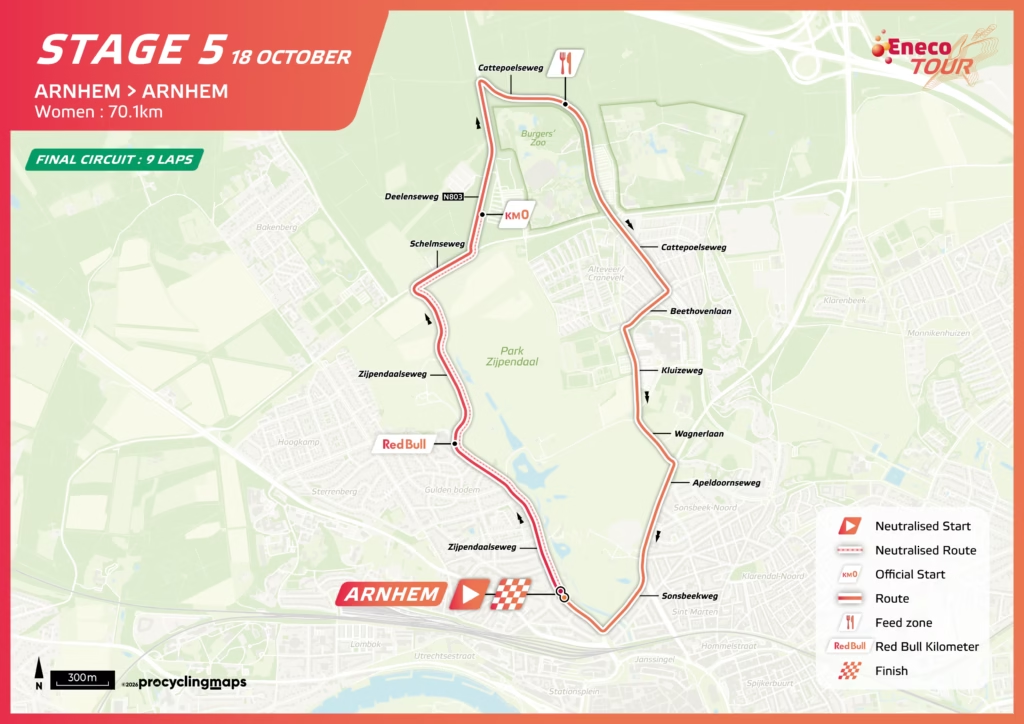
Stage 5: Arnhem to Arnhem, 70.1km
The race finishes with its shortest road stage: just 70.1km around Arnhem.
The women begin on Zijpendaalseweg before completing nine laps of a compact final circuit around the northern side of the city.
The loop passes through the area around Park Zijpendaal and Burgers’ Zoo, using roads including Cattepoelseweg, Beethovenlaan, Kluizeweg, Wagnerlaan, Apeldoornseweg and Sonsbeekweg.
The official classification is flat, although the constant changes of direction and gently rolling terrain around northern Arnhem should make it more demanding than an open-road sprint stage.
Nine laps also create a very different rhythm.
There is little time for a conventional breakaway to settle into several minutes of advantage. The peloton repeatedly sees the same corners and positioning points, making the stage closer to a long circuit race than a traditional point-to-point finale.
The overall contenders also cannot treat it as a ceremonial final day.
Bonus seconds are available through the Red Bull Kilometre, and the winner’s bonus at the finish could still change a close classification.
This race has previous form for exactly that.
Lotte Kopecky overturned Franziska Koch’s GC lead on the final day in Arnhem in 2024 by winning the stage and taking the accompanying bonus seconds.
If the gaps remain small after the VAMberg, the same possibility exists in 2026.
The 2026 route puts unusual weight on time trialling
The race contains 16.7km of individual time trialling across only 368.2km in total.
That is a substantial proportion.
The 3.1km prologue will probably create only minor gaps, but Tilburg is long enough to establish a clear hierarchy.
There is no equivalent of a long Alpine climb later in the race where a pure climber can automatically recover a minute.
Instead, anyone losing ground against the clock must use the much shorter climbs of Limburg and Drenthe to attack.
That should favour riders who can combine several qualities rather than dominate one discipline.
A rider who can time trial, handle crosswinds and survive short climbs begins with a major advantage.
Bonus seconds could matter throughout the week
The Red Bull Kilometre returns on stages 1, 3, 4 and 5.
The first three riders receive six, four and two seconds.
That creates another route into the GC battle, particularly for riders with enough speed to collect bonuses repeatedly.
A rider could theoretically gain more from several well-targeted bonus sprints than another contender manages to take in the prologue.
Finish bonuses add another layer.
That combination has always helped explain why riders such as Wiebes, Kopecky and Marianne Vos can be genuine GC contenders in this race despite not fitting the conventional image of a stage-race specialist.
Crosswinds remain the unknown seventh stage
The route profile cannot show the factor which has often had the biggest effect on this race.
Wind.
The 2025 edition demonstrated the point dramatically. Stage 2 split into an 11-rider front group and stage 3 produced another major echelon selection, with some GC contenders losing minutes on roads that appeared almost completely flat.
The 2026 distances make the threat even greater.
Short stages mean there is less time to recover after being caught behind a split. Once a strong group has 20 or 30 seconds, the finish can arrive surprisingly quickly.
Ede is the obvious stage to watch, but exposed roads around Drenthe can produce the same problem.
What sort of rider does the 2026 route favour?
The route does not obviously favour a conventional climber.
There simply is not enough sustained climbing.
A pure time trial specialist has a clearer route to gaining time, particularly in Tilburg, but still needs to survive Limburg and the VAMberg without being isolated.
The most convincing profile is the familiar one for this race: a powerful all-rounder who can time trial well, handle exposed roads, position herself reliably and accelerate on short climbs.
Sprint speed is an additional advantage because of the available bonus seconds.
That is why the history of the race contains riders as varied as Vos, Annemiek van Vleuten, Ellen van Dijk, Kopecky and Wiebes. ProCyclingUK’s history of the Simac Ladies Tour follows that evolution from the original Holland Ladies Tour through to the end of the standalone Simac era in 2025.
Where will the Simac Ladies Tour 2026 be decided?
Tilburg should create the clearest measurable GC differences.
Limburg then gives anyone who lost time an immediate opportunity to attack.
The VAMberg is the final obvious climbing test, although the precise scale of that challenge will remain uncertain until the full women’s route is released.
Arnhem then keeps the door open for bonus seconds on the last afternoon.
The unusual part of the route is that none of those stages exists in isolation. A rider who gains 30 seconds in Tilburg still has to survive two aggressive hilly days. Someone who dominates the VAMberg can still lose the race through poor positioning in a crosswind or a handful of bonus seconds.
That is the character the old Simac Ladies Tour built over almost three decades.
Its name is now Eneco Tour Women, its calendar position and UCI status have changed, and the men’s and women’s events are being brought together for the first time.
The route has nevertheless kept the most important part of the old formula: there is no single type of rider who can simply wait for her terrain and assume the race will come to her.