
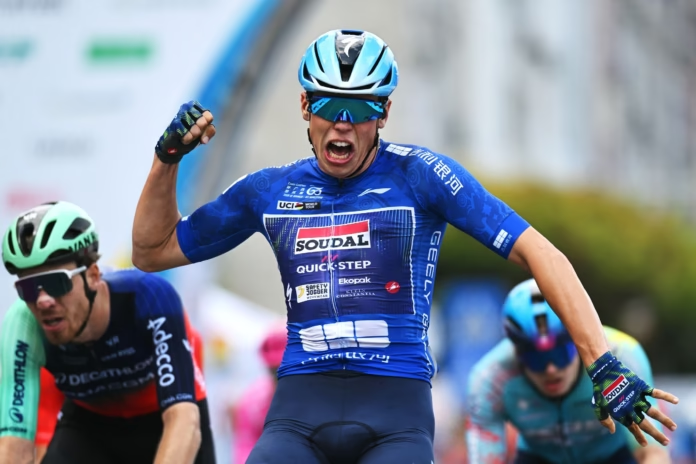
Paul Magnier won stage four of the 2026 Tour of Guangxi in 3:41:55, with Cees Bol and Max Kanter completing the podium on the same time. The result came from a day that steadily reduced the number of available sprinters before a late sequence of attacks and a crash reshaped the final kilometre.
Magnier’s route to victory was not straightforward. He was listed among the riders dropped from the peloton with 77km remaining, while several established sprint options had already been distanced. Yet the closing events place him back in the winning group, and he finished ahead of a broad group that also included Bol and Kanter.
How it unfolded
The early phase was marked by the repeated sprint points involving Baptiste Veistroffer, but the more important development was the gradual pressure on the peloton. By 88km to go, riders were being dropped from the rear, signalling that the stage was becoming less predictable for the pure sprinters.
Two kilometres later, Fabio Jakobsen was named among the riders distanced, alongside Erlend Blikra, Arvid De Kleijn, Matteo Moschetti, Joshua Giddings, Kaden Groves, Oded Kogut, Luke Lamperti, Juan Sebastián Molano and Rotem Tene. The size of that group made the attrition more consequential than any one individual’s setback.
At 77km, Magnier and Milan Fretin were also reported dropped. That left Magnier needing to return to the race’s principal group if he was to contend for the finish, and the later chronology confirms that his day continued through the final run-in.
Attrition changes the shape of the sprint
The race did not settle after the first wave of losses. Veistroffer contested another KOM sprint with 76km remaining, while Pinarello Q36.5 Pro Cycling Team contributed to the work in the peloton. The next phase continued to reduce the number of riders able to influence the outcome.
With 61km left, the breakaway was on a 7.1-kilometre climb averaging four per cent. The climb added another test to a race already marked by riders being detached, although the event sequence does not identify the composition of the breakaway or quantify its advantage.
Fretin was dropped again at 57km, followed shortly afterwards by Lamperti. EF Education EasyPost was reported working in the peloton, and by 52km EF and Lidl Trek were both contributing to the chase. The consequence was a race in which the surviving group was being organised behind the breakaway while individual sprint candidates continued to disappear.
Veistroffer was again recorded at a KOM sprint with 51km remaining. Those repeated sprint points were part of the day’s structure, but the more meaningful trend was the narrowing field. The later stage would be contested by riders who had survived the cumulative selection, rather than by the full list of early sprint contenders.
The chase begins to close
The first clear acceleration from the chasing race came with 36km to go, when a rider from Netcompany INEOS attacked. Four kilometres later, the gap between the breakaway and the first chase group was decreasing, providing the first direct indication that the escape was losing its buffer.
Pinarello Q36.5 Pro Cycling Team continued to pull with 30km remaining. At 24km, Nickolas Zukowsky and Reuben Thompson were identified among those working, giving the chase a more sustained shape as the race moved towards its final section.
The work then broadened. UAE Team Emirates XRG, Team Picnic PostNL and Soudal Quick-Step were all reported pulling with 18km left, and Marc Soler was named among the UAE riders working at 12km. The sequence matters because several teams were now invested in bringing the race to a contested finish rather than allowing the late moves to remain clear.
UAE continued the chase with 9.7km remaining. At that point the day had moved beyond the earlier attrition and into a more conventional battle for position, but the attacks that followed meant the final outcome still depended on how the reduced field handled the closing kilometres.
Late attacks fail to break the reduced group
A rider from Movistar Team attacked with 5.4km to go. Soudal Quick-Step was pulling just under a kilometre later, indicating that the move had not immediately removed the team from the front of the race.
Rune Herregodts then worked for UAE Team Emirates XRG with 3.4km remaining. The continued presence of organised pursuit after the Movistar attack showed that the front group was still being controlled, although the names of those directly involved in the chase were not given for every phase.
Jan Maas attacked for Cofidis at 2.8km, followed by Alexey Lutsenko of NSN Cycling Team at 2.3km. These moves came too late to transform the official result, but they added another layer of uncertainty to a finish that had already seen the field reduced and several sprint specialists removed from contention.
Decathlon CMA CGM Team was pulling with 2km left. That response kept the late attacks within the closing race narrative and helped preserve the possibility of a group finish, with Magnier, Bol and Kanter ultimately occupying the first three places.
A chaotic final kilometre
The most serious incident came with 800 metres remaining, when 15 riders were reported to have crashed. The event does not identify the riders involved or state that the crash determined any individual’s final position, so its effect on the result cannot be assigned beyond the disruption it introduced so close to the finish.
Daan Hoole was then reported pulling with 600 metres left. That detail places organised movement back at the front after the crash, with the remaining riders continuing towards the line rather than the stage being decided by a named escapee.
Magnier won with 200 metres still remaining in the event chronology. His victory completed a notably difficult recovery through the stage: he had been among those listed as dropped at 77km, but was back in the contest by the finish and ended the day ahead of Bol and Kanter.
Why Magnier won
The result was shaped first by survival. Jakobsen, Groves, Molano and other recognised sprint options were already among the riders dropped at 86km, while Magnier’s own setback came later. That distinction matters: Magnier was not insulated from the attrition, but he remained capable of returning and competing after being distanced.
The chase structure also favoured a group finish. Pinarello Q36.5, EF Education EasyPost, Lidl Trek, UAE Team Emirates XRG, Soudal Quick-Step and Decathlon CMA CGM Team all appeared in the work across the middle and late phases. Their combined effort reduced the breakaway’s advantage and limited the ability of the late attacks to stay clear.
Magnier’s win therefore came from a combination of recovery and presence in the final contest. The narrative does not provide a winning gap or describe a separate decisive move by him. Instead, the race narrowed through repeated drops, the breakaway was brought closer, and the late attacks were answered before Magnier took the finish.
Bol and Kanter reached the same finishing time, making the podium a group-result contest rather than a race decided by a recorded time gap. Frits Biesterbos and Pau Miquel Delgado followed in fourth and fifth, also on the same recorded time, while Sebastian Kolze Changizi, Brady Gilmore and Loe Van Belle completed the next three places.
Juan Sebastian Molano was ninth and Marijn van den Berg tenth. Molano had been listed among the riders dropped at 86km, another indication of how the stage’s early attrition contrasted with the group that eventually contested the finish.
Magnier’s stage victory was consequently the product of a complicated day rather than a clean, uninterrupted sprint build-up. He survived a difficult middle section, returned after being dropped, and came through a late phase containing several attacks and a 15-rider crash. Bol and Kanter were close enough to share his finishing time, but the stage belonged to Magnier.
Tour of Guangxi Stage 4 2026 Result
| Pos. | Rider | Team / nation | Time / gap |
|---|---|---|---|
| 1 | Paul Magnier | SOQ | 3:41:55 |
| 2 | Cees Bol | DCT | Same time |
| 3 | Max Kanter | XAT | Same time |
| 4 | Frits Biesterbos | TPP | Same time |
| 5 | Pau Miquel Delgado | TBV | Same time |
| 6 | Sebastian Kolze Changizi | TUD | Same time |
| 7 | Brady Gilmore | NSN | Same time |
| 8 | Loe Van Belle | TVL | Same time |
| 9 | Juan Sebastian Molano Benavides | UEX | Same time |
| 10 | Marijn Van den Berg | EFE | Same time |

