
Friday’s fourth stage of the 2026 Tour of Guangxi takes the peloton from Bama to Tian’e on the most demanding climbing day of the race so far. The distance is approximately 165km, with more than 2,500 metres of ascent and a succession of hills in the final 50km. For UK viewers, racing begins around 04:00 BST on Friday 16 October, while the TNT Sports 1 broadcast is listed from 06:30 BST and HBO Max from approximately 06:35 BST.
The morning viewing schedule matters because most of the selective terrain comes late. A rider who looks comfortable on the opening climbs could be under pressure after repeated efforts on the approach to Tian’e. There is no summit finish, so the decisive attack may need to survive a descent and a fast run towards the line rather than finish on the steepest gradient.
The route is new to the 2026 Tour of Guangxi and gives the general-classification riders a serious examination before Sunday’s familiar finish at Nongla. The race started with opportunities for the sprinters, including wins for Paul Magnier, Frits Biesterbos and Milan Fretin on the first three stages. Friday looks less straightforward for the riders who have been contesting the bunch finishes.
Tour of Guangxi Stage 4 UK start time and live coverage
Date: Friday 16 October 2026. Route: Bama to Tian’e, Guangxi, China. Distance: roughly 165km. Race start: around 11:00 China Standard Time, or 04:00 BST, with TNT Sports’ race schedule placing its start close to 04:08 BST. UK television: TNT Sports 1 from approximately 06:30 BST. Streaming: HBO Max’s Stage 4 window is listed at approximately 06:35 BST. Expected finish: around 08:00 BST, subject to race speed.
China is seven hours ahead of Britain during the Tour of Guangxi. A start at 11:00 in Bama therefore corresponds to 04:00 in the UK, but that does not mean live pictures will be available from the first kilometre. The television feed is expected to join much later, at the stage’s most interesting point, when the final climbing begins to shape the race.
TNT Sports 1 is the channel named in the current British listings, while HBO Max provides the online alternative. HBO Max replaced the former discovery+ arrangement for TNT Sports subscribers in the UK, so looking in an old discovery+ app or trying to use a previous cycling-only subscription can cause confusion. For the wider calendar and possible schedule changes, our Tour of Guangxi UK viewing guide covers all six stages.
The best practical plan is to open the television or streaming guide a few minutes before 06:30 BST. If the session does not appear under the main sports carousel, search directly for Tour of Guangxi Stage 4. On-demand availability and channel allocation can vary by territory, and the listed time is the beginning of the broadcast rather than a guaranteed indication that the leaders are about to reach a particular kilometre marker.
Bama to Tian’e: where the route becomes difficult
The 2026 route brings a new connection through the mountainous west of Guangxi, passing the Fengshan area before reaching Tian’e. Instead of a relatively predictable sprint stage, the riders face repeated changes in gradient. Depending on the route profile used, estimates put the climbing total somewhere around 2,600 to 2,800 metres, a substantial amount for a stage that does not finish at the top of a mountain.
The organisers have included sustained category climbs as well as short, steeper slopes. One climb is listed at about 7.3km averaging 5.3 per cent, while another is around 7.1km at 4.0 per cent. Neither should be considered decisive in isolation, but the accumulated cost could reduce the group and leave teams with fewer domestiques for the final hour.
With just under 50km remaining, the road rises for approximately 2km at 7 per cent within a longer uphill section. That is a useful launch point for a well-organised attack, particularly if a team has already made the preceding terrain hard. For the favourites, the challenge is deciding whether to respond immediately or trust that the roads still allow a chase before the finish.
The sharpest late test comes at approximately 23km to go: 1.7km at about 8.5 per cent. A gradient of that severity is short enough for explosive riders to attack but steep enough to remove some of the remaining sprinters. The route then trends downhill towards Tian’e, which makes positioning at the summit and the quality of the descent as important as the climbing effort itself.
Unlike a conventional uphill finish, a split here can shrink again before the line. A small group that clears the top together may work efficiently on the descent, while a lone attacker has to judge the energy spent gaining the gap against the cost of defending it on faster roads. Our full 2026 route guide explains how this redesigned western section fits into the six-day race.
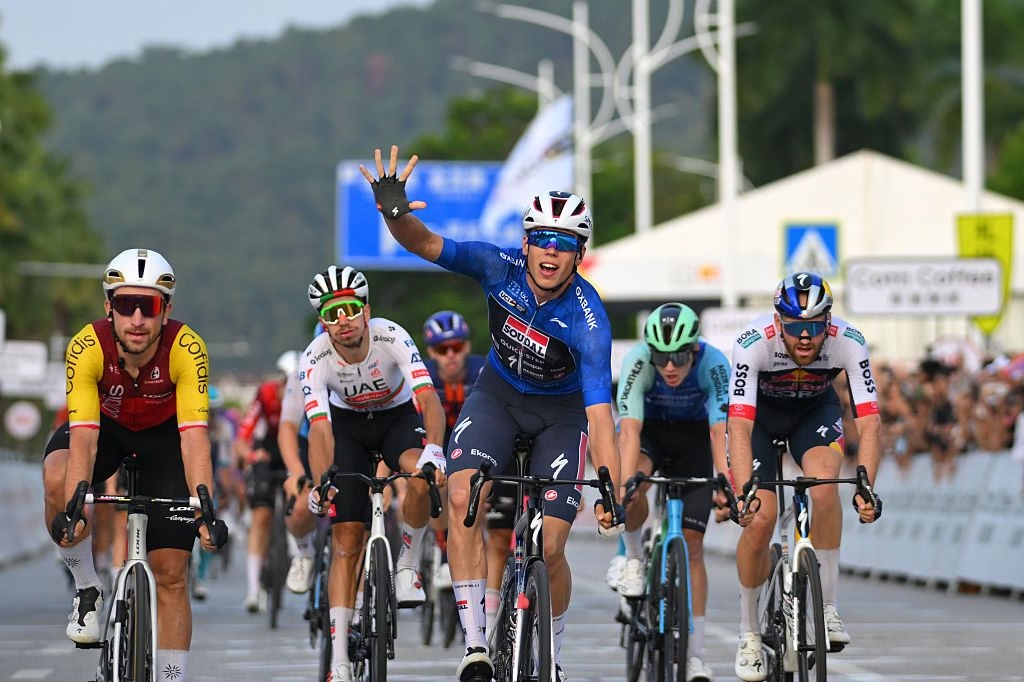 Photo Credit: Getty
What kind of rider can win Stage 4?
A pure sprinter faces a difficult morning, although the descending finish means the stage cannot simply be assigned to the strongest climber. The likely winner needs to tolerate the accumulated climbing and still have either the acceleration to attack or the speed to finish from a reduced group. A breakaway could also stay clear if the teams protecting their GC riders decide that stage victory is not worth a costly chase.
Tom Pidcock has the explosive climbing and technical ability suited to a short, steep hill followed by descending roads. Kévin Vauquelin offers another option from a selection made late in the stage, while Jarno Widar has the climbing strength to make the decisive group. Those names appeared in the race’s pre-event favourites discussion, but tactics and positioning may be more important here than a simple ranking of riders on their best form.
There is also a case for the strong one-day specialists who can go clear before the final hill. The earlier climb at roughly 50km to go is far enough from the finish to create uncertainty, especially if a group containing several teams establishes a lead. A chaser on the steep 1.7km slope might be able to cross to such an escape, but it will be difficult to recover a large deficit entirely on the descent.
The race’s early stages have already shown that a fast finish is not automatically controlled by the most obvious sprint teams. Magnier won the opening stage, Biesterbos took Stage 2, and Fretin led home the group on Stage 3 after the breakaway was brought back. Stage 4 should place more responsibility on the GC squads and the climbers who have deliberately saved energy for the hillier half of the event. Our contenders preview explains the main overall candidates.
How Stage 4 could change the general classification
The Tour of Guangxi is only six stages long, which gives riders limited opportunities to regain lost time. Friday will not settle the overall contest on its own, but a small split among the favourites could be carried into the final two days. The absence of a summit finish creates an unusual tactical balance: climbers may attack on the hills, while stronger descenders and small groups can neutralise a move before the finish.
Teams with a protected GC rider have to decide where to spend their support riders. Driving the pace over an early climb might expose the leader if rivals attack again with 23km remaining. Sitting back could allow a dangerous breakaway to gain so much time that the chase becomes a problem. That calculation becomes harder if several riders within a few seconds of one another are prepared to take a risk.
The intermediate climbs might therefore prove more useful as a way to remove helpers than as winning attacks in their own right. If a team accelerates hard through the 7.3km ascent, rivals could reach the final rise with fewer options for pacing or chasing. A late attack on the 8.5 per cent slope is more likely to succeed when the peloton has already been reduced, rather than when a large group is still ready to organise on the descent.
Sunday’s Nongla finish remains the clearest summit-style opportunity of the race, so contenders who struggle on Friday may still hope to recover there. A rider who gains a modest advantage on the way to Tian’e should not necessarily expect to defend it easily through the remaining stages. That places a premium on consistent positioning and limiting losses as well as chasing a spectacular stage win.
When to tune in and what to watch on the final climbs
For a UK viewer choosing a single viewing window, 06:30–08:00 BST is the useful target. Live pictures should begin near the approach to the most selective terrain, although the exact kilometre remaining will depend on how quickly the stage is raced. The first major test to look for is the climb around 50km from the finish, followed by the steep rise approximately 23km out.
Watch the size of the leading group and, in particular, which teams still have more than one rider in it. A strong breakaway with representation from several squads can survive even if it contains no obvious GC favourite. If the leading teams still have domestiques available, they may prefer to keep the stage together until the final climb and limit the chance of a large escape succeeding.
On the approach to the short 8.5 per cent climb, position will matter. Riders who begin the hill towards the back may struggle to follow an acceleration even if their climbing capacity is comparable with those at the front. Once the summit is crossed, the focus shifts to descending speed, cooperation and the distance between any remaining groups.
Those watching the finish alone should still allow time for the descending run-in. An attack launched on the hill could be brought back within sight of Tian’e, while a small break may arrive with just enough of a gap to fight for the stage. After Friday, attention turns to Saturday’s Jinchengjiang–Yizhou stage and Sunday’s Nongla finale, where the final overall winner is likely to emerge.