Two front lights both rated at 1,200 lumens should be straightforward to compare. The Magicshine ALLTY 1200 and ALLTY 1200U are not. Their claimed output, battery capacity and most running times are practically identical. What separates them is how they sit on the bike, what mounting hardware is included and whether either fits a crowded modern road cockpit.
The regular ALLTY 1200 is intended to sit above the handlebar using its conventional mounting arrangement. The 1200U places the light beneath an out-front mount, clearing the space around a cycle computer. That can look neater, but it also introduces questions about brake-hose clearance, proprietary integrated cockpits and the cost of additional fittings. The best choice begins with the bike, not the lumen rating.
The assessment draws on official specifications and independent published testing, not a ProCyclingUK head-to-head test. The conventional ALLTY 1200 has been reviewed independently; evidence for the under-mounted version is thinner, and its published hands-on account involved a sample provided by Magicshine. Findings from one mounting system should not be presented as proof of how the other will perform.
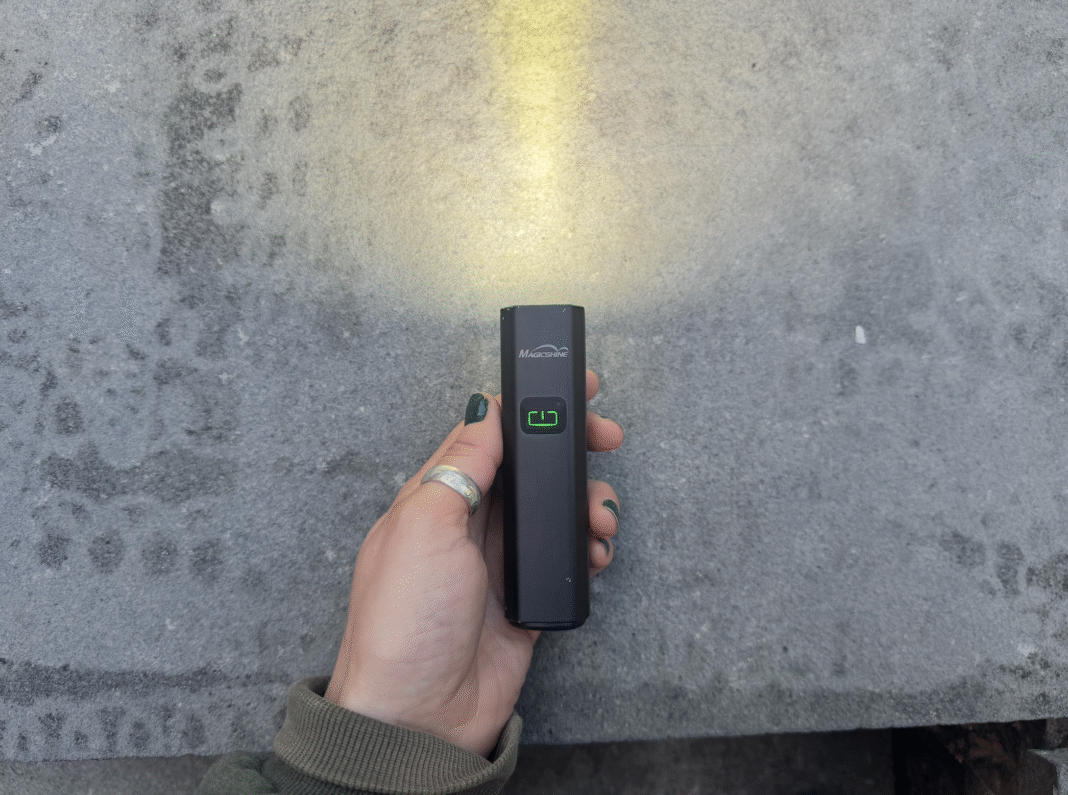 Photo Credit: Magicshine
Magicshine ALLTY 1200 and 1200U specifications compared
| Specification | ALLTY 1200 | ALLTY 1200U |
|---|---|---|
| Maximum output | 1,200 lumens | 1,200 lumens |
| Light position | Conventional above-bar mounting | Dedicated underside/out-front mounting |
| Maximum claimed runtime | 12 hours in lowest steady setting | 12 hours in lowest steady setting |
| High steady runtime | 2 hours at 1,200 lumens | 2 hours at 1,200 lumens |
| Mid steady runtime | 4h 50m at 600 lumens | 4h 50m at 600 lumens |
| Battery | 4,200mAh, 3.7V | 4,200mAh, 3.7V |
| Charging | USB-C, approximately 2h 30m | USB-C, approximately 2h 30m |
| Ingress protection | IPX7 | IPX7 |
| Manufacturer quoted weight | 163g | 165g |
| Claimed maximum throw | 184m | 184m |
| Mounting accessories | Conventional mounting configuration | Out-front mount, metal GoPro adapter, shims and Wahoo adapter |
| UK price reference | £62.99 UK promotional listing; £69.99 regular | Standalone UK price not verified; £99.99 front-and-rear bundle |
The shared specifications are striking, but they need interpreting carefully. A claimed throw of 184 metres does not mean that every rider will comfortably read the road surface at that distance. Mounting angle, bar bags, computer position and how the beam is directed all affect the light reaching the tarmac. The U model also has a different accessory package, which matters more than its two-gram weight difference.
 Photo Credit: Magicshine
Why the mounting position matters
An ordinary bar-mounted front light competes for space with the computer, bell, brake hoses, bar bag and any other accessory. On a narrow traditional round handlebar, that is often no problem. But modern road bikes commonly have flat aero tops or integrated stems with no suitable section for a simple rubber strap. A conventional light can be difficult to position neatly, even though it works perfectly when fitted.
The ALLTY 1200 is intended for this familiar style of mounting. Its shape and quarter-turn fixing let riders mount it in a standard position, depending on the supplied or optional bracket. The important question is whether the actual mount fits the bike rather than simply whether a Garmin-style quarter-turn connection is mentioned somewhere in the specification.
The ALLTY 1200U includes a dedicated out-front mount, a metal GoPro-style adapter, size shims and a Wahoo adapter, alongside a wireless remote according to Magicshine’s supplied-accessory list. It is designed for the lamp to sit below the cockpit rather than occupy a space alongside a computer. That is potentially useful on a road bike with a compatible stem and handlebar, but the supplied hardware should never be assumed to fit every integrated system.
Check the actual cockpit before ordering. Some one-piece bars only accept proprietary computer mounts, and a lamp suspended beneath them can foul cables or restrict clearance. A mount that can hold a cycling computer is not automatically rated to take the extra light or the additional leverage created by rough roads. If in doubt, check the handlebar or mount manufacturer’s limits.
The beam and what 1,200 lumens can actually do
Both products use a 1,200-lumen maximum and a stated beam throw of 184 metres. Magicshine advertises an anti-glare optical design intended to limit stray light above the main beam. This is particularly relevant on shared roads, where a powerful lamp aimed too high can dazzle oncoming drivers and cyclists. The exact angle of the lamp matters just as much as the optical specification.
The standard 1200 was independently tested by Cyclingnews in 2025. The reviewer praised the broad, even illumination and considered it strong value for dark roads, while also identifying a hot-running metal casing, a vague battery indicator and a mount that could be unreliable on larger bars. These are useful observations about the standard lamp, not independent proof of how the under-bar variant’s supplied metal fitting will behave.
A published hands-on assessment by JayLo Cycling reported that the 1200U’s GoPro-style mount remained stable on bumpy roads and gravel in that particular test. The light was supplied by Magicshine, and the assessment did not independently establish battery longevity over months of use. That makes it a useful account of the mounting arrangement, not a controlled head-to-head verdict over the standard model.
An underneath-mounted light also needs its beam properly oriented. Simply turning a conventional light upside down can sometimes create an unsuitable beam distribution; that is one reason to choose the specific model designed for the position rather than improvise with the standard one. Once correctly installed, a cyclist should still check the illuminated area from normal riding height in a safe location, with attention to the distance ahead and any glare directed towards oncoming traffic.
Battery life: the middle mode is the useful one for many rides
The strongest steady setting is rated at 1,200 lumens for two hours on each version. That is a credible maximum for short, unlit rides, but it is not the setting most riders should assume will last throughout a long winter training session. A rider out for three hours needs a reserve, particularly in cold weather or if the light has already seen repeated charging cycles.
Magicshine claims four hours and fifty minutes at 600 lumens, and twelve hours at 300 lumens. Those lower settings are likely to be more useful for mixed rides that move between lit towns and country lanes. The 1,200-lumen setting can then be treated as additional output for dark descents or situations when greater forward illumination is warranted.
The company also lists a night flash setting cycling between 300 and 1,200 lumens, and a daytime flash that alternates between zero and the maximum. Their claimed runtimes differ from continuous illumination because flashing is not the same electrical load. A long quoted flashing runtime is not sufficient evidence that the lamp can illuminate an unlit lane for the same number of hours.
The conventional ALLTY 1200 has been praised for effective illumination, but Cyclingnews also identified limitations in the battery indicator and a mount that could prove insecure on larger handlebars. The 1200U shares its headline electrical specification but uses a different fitting, so neither the complaint nor its absence can simply be transferred to the U model. Battery runtimes remain manufacturer claims until independently measured under the same conditions.
Remote control and phone app: useful or unnecessary?
Magicshine’s FTR LightSync system is designed to enable remote control and connected operation with compatible components. The ALLTY 1200U package includes the MJ-6558 remote and mounting strap according to the official product list. That can be particularly useful when the light is mounted underneath a computer, where a button on the body may be awkward to reach once riding.
The standard ALLTY 1200 also supports app customisation and compatible remote control, but buyers should check the specific UK package rather than assume the same physical remote is always included. A product that supports a feature does not necessarily include every accessory needed to use it. The price of missing accessories can erode any saving compared with a more complete bundle.
App customisation offers finer choice of light behaviour and output, but the physical controls should remain practical without a phone. On a cold, wet ride, being able to change the beam while keeping hands close to the bars is more useful than a long list of software options. The remote is a genuine point in the U model’s favour if the cockpit design makes its own button difficult to reach.
Durability, charging and winter weather
Both have aluminium bodies, USB-C charging, 4,200mAh battery specifications and IPX7 ingress ratings. Magicshine’s expected charge time is around two and a half hours with an appropriate 5V, 2.4A supply. That should be adequate for regular commuting, provided the rider has time to recharge before the next journey.
IPX7 is meaningful reassurance for wet weather, but it is not a guarantee against every form of damage. Charging seals need to be closed properly, and using a pressure washer directly on a light is a poor idea. A metal light body can also become hot during prolonged high-output operation. The standard 1200’s heat build-up was noted during independent testing, while the precise heat pattern of the under-bar version in every position has not been established by comparable controlled tests.
Weight is effectively a draw: the U is quoted at 165g, against 163g for the standard version. The complete installed mass will depend on the bracket and adapters, so the two-gram difference in the head unit is not a meaningful buying factor. The quality of the fitting and its ability to hold a consistent beam angle over rough tarmac are much more consequential.
Price and availability in the UK
Magicshine UK’s catalogue showed the standard ALLTY 1200 reduced to £62.99 from £69.99 when checked in November 2026. Its UK catalogue also listed an ALLTY 1200U and SEEMEE 50 V2.0 rear-light bundle at £99.99. Those are different packages, not like-for-like prices for the two front lights alone. UK promotions can change, and the bundle may be good value only if the rear light is actually wanted.
Magicshine’s international site lists the 1200U as an individual product, but I could not confirm a comparable standalone UK checkout price. Import currency, shipping and returns would need checking before using that price to calculate a saving. The safer comparison is between the contents and compatibility of the two packages rather than an invented percentage difference.
Riders who already use a suitable out-front mount may find the 1200U’s included fittings and remote attractive. Others could be paying for a mounting system they cannot use. The standard ALLTY 1200 is simpler where there is space on a conventional round bar, but the UK box contents must still be checked: wireless-control compatibility does not guarantee that every retail package includes a separate remote.
See the ALLTY 1200 UK product listing and the manufacturer’s ALLTY 1200U specification and mounting information. These are direct, non-affiliate links. Our published winter bike lights guide covers the regular ALLTY 1200 alongside other options.
Which should you buy?
Choose the standard ALLTY 1200 if you use conventional handlebars, have enough room to fit a front light above the bar and want a relatively straightforward 1,200-lumen option. Its optical performance and practical weaknesses have been tested independently, making the evidence base stronger. Check the strap security carefully if the handlebars are oversized or the route includes rough surfaces.
Choose the ALLTY 1200U if the goal is a clean road-bike cockpit with the light suspended below the cycling computer. The supplied out-front fittings and remote make sense for that use, particularly on bikes where pressing a button on an underneath-mounted unit would be awkward. Check the compatibility of your specific stem, out-front computer mount and brake hoses first.
Choose according to the mounting system you can use securely. The standard ALLTY 1200 is the straightforward purchase for conventional bars and an uncluttered cockpit. The 1200U offers a neater solution beneath a compatible out-front mount, with useful accessories in the box, but its extra complexity should earn its place on your particular bike.
-
 Photo Credit: Gregory van Gansen/PN/Cor Vos
-
Photo Credit: David Pintens / BELGA MAG/AFP via Getty Images