Belgium did not invent cyclocross, but it turned an unusual form of winter bike racing into one of the most recognisable sporting traditions in Europe. A muddy field beside a village, a short flight of steps and a packed crowd do not resemble the grand roads of a Monument. Yet in Flanders those ingredients have become a winter ritual, with local races capable of attracting the same attention that other countries reserve for major road events.
To understand how that happened, it helps to separate the uncertain beginnings of the discipline from the much clearer history of Belgian championships, riders and organisers. The first international milestones lie largely in France. Belgium’s distinctive contribution came through the communities that sustained racing, the champions who gave it a national identity and the competition series that eventually took it to an international audience.
Cyclocross did not begin as a Belgian invention
Cyclocross has several plausible origin stories, and the UCI does not identify a single proven inventor. One tradition describes military cyclists crossing fields and streams rather than following roads. Another describes road riders looking for something competitive to do through winter. Both help explain the mixture of cycling and running that survives today, but neither is evidence that the discipline began in Flanders.
A frequently repeated account identifies French soldier Daniel Gousseau with early cross-country cycling contests around the turn of the twentieth century. The historical record is stronger when describing the early formal competitions than when identifying one inventor. France was the principal early centre, and the discipline was known under names that reflected riders carrying and running with their bicycles as much as riding them.
That French beginning matters because modern cyclocross is often described as instinctively Flemish. The geography of the sport did not arrive fully formed. It grew through several countries, as the need for winter training overlapped with the attractions of technical racing and the sheer spectacle of athletes taking bikes over terrain designed for neither roads nor conventional tracks.
Early courses were less standardised than the modern UCI circuit. Competitors ran, scrambled and shouldered their machines across ground that a road rider would avoid. The distinctive practice of dismounting to overcome an obstacle survived every subsequent development in equipment, tyres and race organisation. Even on a fast contemporary course, the boundary between riding and running remains part of the contest.
Belgium’s early championships and the road-racing connection
Belgium staged a national cyclocross championship in 1910, with Philippe Thys recorded as its first men’s winner. Thys would later win the Tour de France three times, a reminder that early cyclocross did not belong to a separate professional world. It was part of a cycling culture in which ambitious road riders could use the winter to compete, train and maintain a public presence.
The first major international cyclocross competition was organised in France in the 1920s. The International Critérium, held from 1924, is widely regarded as a forerunner of the World Championships. It attracted riders from across Europe and helped shift what had been a loosely defined cross-country challenge towards a recognisable racing discipline with stars, rivalries and an audience.
These were not races contested on today’s specialist machines. Carrying and controlling a comparatively heavy bicycle was integral to the challenge, and the rider who could dismount and restart cleanly had an advantage. For Belgian road cyclists and their followers, that difficulty was understandable at a glance. Cyclocross could be watched without explaining a points classification or waiting hours for a breakaway to return.
A national championship was also an organisational statement. It gave the discipline a hierarchy and an identifiable Belgian title, encouraging repeat competition and a sporting narrative from year to year. The importance of that structure is easy to overlook today, when a dense calendar of international televised races can make the sport appear inevitable.
The first world titles and Belgium’s rise
The first official UCI Cyclocross World Championships took place in Paris in 1950. Jean Robic, already a Tour de France winner, took the inaugural title. The coincidence says a great deal about how closely cyclocross and road racing were connected at the time: winning off-road in winter was not necessarily incompatible with being one of the world’s leading road racers.
Belgium first hosted the World Championships in 1957 at Edelare, near Oudenaarde. French rider André Dufraisse took the title, while Belgian Firmin Van Kerrebroeck finished second. It was an important moment for Belgian organisers and supporters even without a home win. The international championship had arrived in Flanders and the home crowd had a leading rider to follow.
Eric De Vlaeminck changed Belgium’s standing in the sport. He took the country’s first men’s elite world title in 1966 and ultimately won seven in total. Six came consecutively from 1968 through 1973, an achievement that cannot be explained by familiarity with one Belgian course. His victories established a standard across European venues and made the world championship an arena for repeated Belgian success.
Belgium then established a succession of champions. Albert Van Damme took the world title in 1974 and Roger De Vlaeminck followed in 1975. Roland Liboton later won four elite world championships, in 1980, 1982, 1983 and 1984. Their results gave the sport a line of heroes through whom clubs, spectators and the Belgian press could follow a winter rivalry with real historical weight.
Why Flemish villages became major cyclocross venues
Much of Belgian cyclocross’s appeal comes from the distance between a race’s international significance and the modest scale of its surroundings. A field, a hillside, a short stretch of woodland and a familiar local road can become a venue watched by people far beyond the province. The course is often compact enough for spectators to see riders repeatedly, something a long road race cannot offer.
The Jaarmarktcross in Niel shows how an international contest can grow around a community fixture. The annual fair on 11 November gives the meeting a date and an identity beyond television rights or ranking points. Riders arrive to contest a serious race, but the occasion belongs equally to a town that expects cyclocross to be part of its public holiday.
A typical Belgian cyclocross course also gives organisers opportunities for contrast. Slippery grass, cambers, steps, short ramps, sand and abrupt corners can all appear in a single lap, though no one obstacle is universal. The point is to force a sequence of small decisions. When to stay on the bike, when to run and when to change equipment can matter more than a rider’s sustained road-racing power.
That creates an unusually concentrated spectator experience. Fans at one section see the same competitors several times, watching a line become quicker, a bank deteriorate or a lead disappear after a mistake. On television, the same tight courses translate into visible, repeated tactical problems. The strength of the format helped turn the Belgian winter circuit into a product broadcasters could follow.
Belgian world championship venues built a tradition
Belgium’s role as a World Championships host grew alongside its strength on the course. The UCI records Belgian venues including Edelare, Overboelare, Zolder, Lembeek, Koksijde, Hooglede and Heusden-Zolder among the locations that shaped the modern competition. These are not identical courses; the contrasting conditions are part of why success at several of them is prized.
Koksijde is especially associated with deep sand and the technique required to stay balanced while power is repeatedly interrupted. Zolder has often created a different tactical problem, with its own fast passages and technical sequences. These well-known identities make a venue more than a dot on the calendar. They create sporting memories that survive changes in organisers, sponsors and generations of riders.
In the UCI’s account, Belgian victories at home include Paul Herygers in Koksijde in 1994, Mario De Clercq in Zolder in 2002, Erwin Vervecken in Hooglede in 2007, Niels Albert in Koksijde in 2012 and Wout van Aert at Heusden-Zolder in 2016. The names cover different generations, but each victory became part of the link between a technical local venue and the international rainbow jersey.
The scale of that audience is not solely a product of World Championships. Strong local races create expertise among spectators. Supporters learn which features favour a particular riding style and how quickly a course can change after rain. That makes the atmosphere informed as well as loud, and it helps explain why comparatively small towns continue to matter.
Women and the development of the Belgian winter
Any history that concentrates only on men’s champions misses an important part of the modern sport. Women’s elite cyclocross now has its own championship, major television races and the same sorts of technical and tactical demands. In Belgium, that professional visibility grew through organisers adding and strengthening women’s programmes and through riders who made cyclocross a career rather than an occasional winter activity.
Sanne Cant provided one of Belgium’s strongest modern reference points, taking the women’s elite world championship in 2017, 2018 and 2019. Her three titles sit within a field increasingly shaped by powerful Dutch riders, including Marianne Vos. Describing the period only through Belgian men’s champions would miss both the expansion of women’s racing and the international competition that has helped raise its standard.
The women’s events at famous Belgian venues now allow direct comparisons in course development, tactical choices and television coverage without suggesting that the men’s race is the default contest. The races may start at different times or use different lap counts, but the skill involved in negotiating a changing surface is not confined to one category.
For spectators discovering the sport, the explanation of pits, bike changes and lap times is a useful companion. It shows how the discipline works on its own terms, rather than treating it as road racing with a little mud added.
From local events to the Superprestige and international calendar
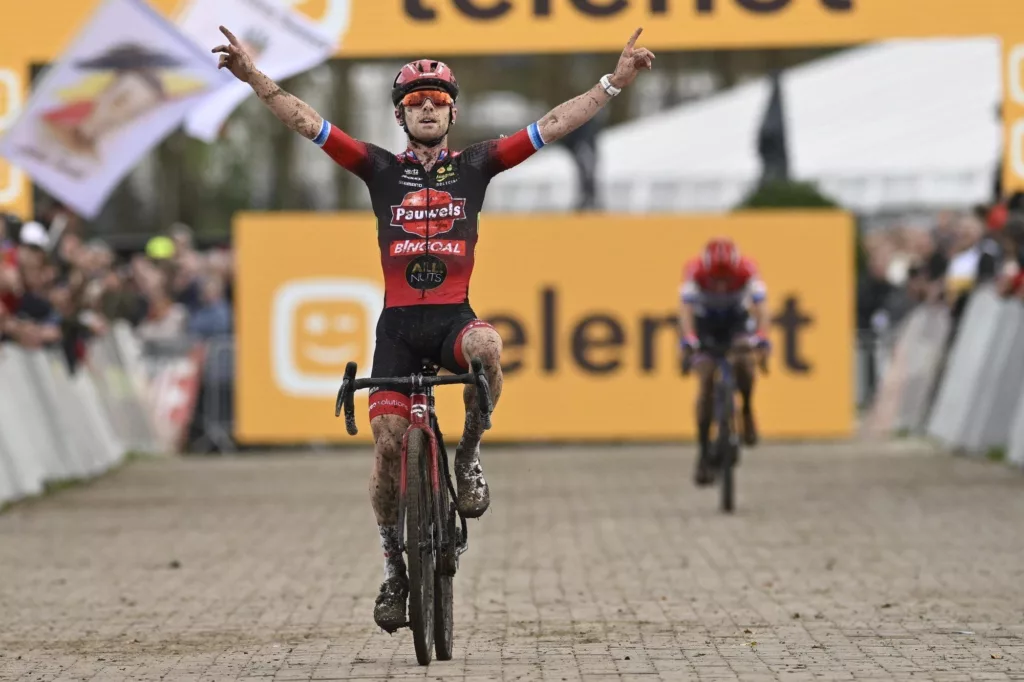
The contemporary Belgian winter is built around overlapping competitions, not one uninterrupted national championship. The Telenet Superprestige has become one of the important season-long series, while the X²O Trophy and the UCI Cyclocross World Cup follow different structures. Riders can contest more than one without those results being combined into a single overall table.
Organisers use their different venues and histories to give each meeting an identity. Overijse, Niel, Merksplas, Ruddervoorde, Heusden-Zolder and Diegem offer contrasting settings within the 2026–27 Superprestige calendar. Their dates also matter: a holiday meeting such as Niel can create a concentrated midweek crowd, while the Christmas period has its own established rhythm of major races.
Broadcasting has made a familiar Belgian scene accessible to audiences who have never stood at a racecourse in Flanders. Rights differ by country and series, but the essential pictures travel well: spectators gathered beside an awkward bank, a mechanic preparing a spare bike, a rider choosing to run rather than risk a stalled wheel. The appeal remains rooted in the local circumstances even when the audience is global.
The history of the Superprestige explains one strand of this development. The history of Niel’s Jaarmarktcross offers a closer look at how a single local event became part of a major series, while the 2026–27 cyclocross calendar shows how Belgium’s races sit alongside the international competitions that have grown around them.