The Jaarmarktcross belongs to Niel as much as it belongs to the Superprestige. Held on 11 November alongside the town’s annual fair, it combines a difficult course beside the River Rupel with a crowd that treats the race as part of the local calendar. Riders must deal with sand, short climbs, slippery descents and the constant interruption of their rhythm. It is a very different challenge from the long, regular efforts of a road race.
The race returns on Wednesday, 11 November 2026 as the third round of the Superprestige. Its recent winners underline how demanding it is. Laurens Sweeck won the men’s race in 2024 and 2025, the latter after an exceptionally close finish against Niels Vandeputte. Lucinda Brand won the women’s event in 2025, adding another Niel victory to a record built on handling difficult terrain with remarkable consistency. The combination of history and technical difficulty makes Niel a useful reference point for understanding the Belgian winter.
Why the Jaarmarktcross is different
The name comes from the local jaarmarkt, the annual fair that gives the town an occasion far bigger than a single sporting event. The race is held on 11 November, a public holiday in Belgium, when spectators can gather around the circuit rather than trying to fit an afternoon of racing into a working day. That tradition gives Niel a recognisable identity even as sponsors and the wider cyclocross series have changed over time.
Niel lies in Antwerp province, south of the city of Antwerp and close to the Rupel. The surrounding landscape is not mountainous, but a cyclocross course does not need a long climb to be selective. Short, awkward banks can force riders out of the saddle or off the bike altogether, while repeated tight corners make it difficult to maintain a smooth pace. The local setting also exposes the course to autumn weather. A dry week can produce a fast, technical race; persistent rain can turn the same ground into a much slower test of traction.
The course has been revised in individual editions, so the exact sequence of obstacles should not be treated as permanent. In 2024, for example, organisers retained the familiar sand section while introducing a new climbing passage ahead of a steep descent. In 2025 the start position changed and the sand appeared earlier in the lap. Those details matter because they alter where riders can attack and where a poor start is most costly.
From a local race to a Superprestige fixture
The Jaarmarktcross has roots in the 1960s, with the first edition recorded in 1964. It has subsequently appeared in several of the sport’s major domestic competitions, reflecting the way Belgian cyclocross has repeatedly reorganised its calendar and sponsorship. For a period the race was associated with the Gazet van Antwerpen competition, and later with the Soudal Classics and the DVV Trophy. Since 2020 it has been part of the Superprestige.
The event has retained its identity through those changes. The Jaarmarktcross name, its traditional date and the characteristic demands of the circuit have given Niel continuity. The wider classification determines how many points a rider earns and how the event fits into a season, but the appeal of winning on 11 November has always extended beyond the standings.
The modern Superprestige uses points accumulated over a sequence of races. The 2026–27 competition begins at Overijse, continues at Middelkerke on 5 November and reaches Niel six days later. Merksplas follows on 14 November before a break until Ruddervoorde in December. That places Niel in an intense early run of four events, where consistency can begin to separate riders targeting the overall title from those focused on individual victories.
Unlike the X²O Trophy, which is decided by accumulated time, the Superprestige rewards finishing position at each round. A rider who cannot win may still rescue important points by limiting a bad day. At Niel, where technical mistakes can quickly produce a substantial gap, that distinction shapes tactical choices. A contender might avoid an excessive risk on a descent if the overall championship matters more than a single place.
The sand section and its tactical importance
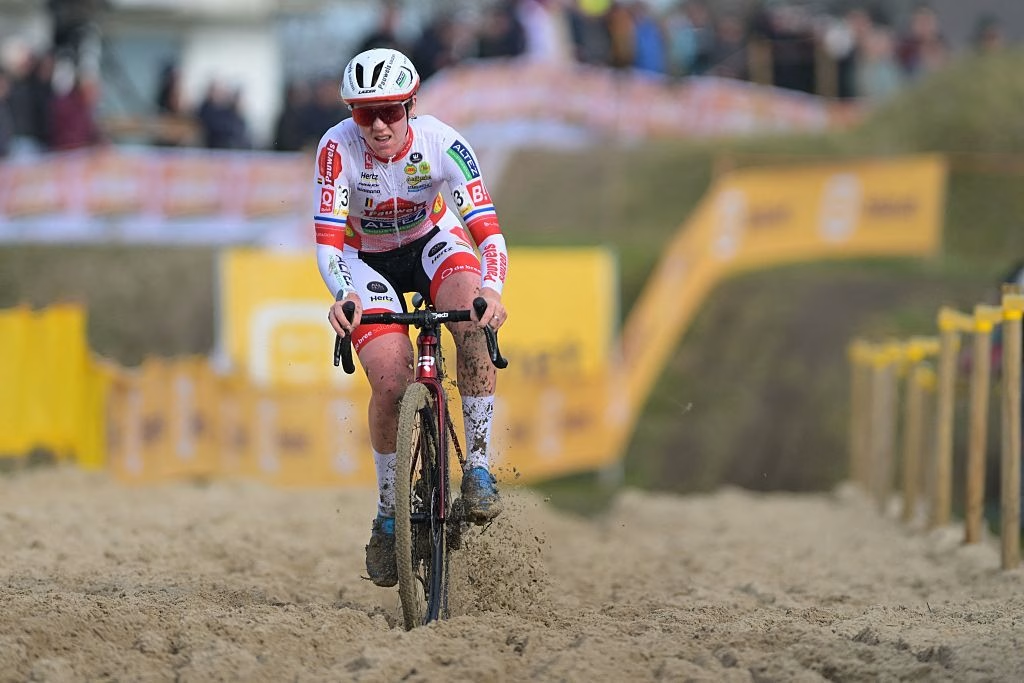
Sand is one of Niel’s defining obstacles. Riders can choose between pedalling through, carrying speed on a stable line or dismounting and running when the surface becomes too soft. The quickest method is not always the same from lap to lap. A line that was rideable early in the race may deteriorate after dozens of wheels have cut through it, while a firmer strip at the edge can become the preferred option.
There is also a difference between a rider who can cross sand quickly once and one who can do it repeatedly without a large spike in effort. A specialist who rides a difficult section while rivals run may gain only a few seconds, but those seconds accumulate. Chasers then have to work harder on the easier parts of the lap, arriving at the next sand section already fatigued. It is a classic cyclocross pattern in which technical efficiency creates an aerobic advantage.
Sweeck’s successes at Niel reflect his confidence on sandy circuits, although the race has never been decided by sand alone. The climbs and descents force riders to change gears, adjust body position and make quick decisions under pressure. A clean line through a steep section can be worth as much as a short acceleration. A mistake can cost several positions in a tightly packed group.
Weather changes the calculation. Rain can make the banks slippery and encourage riders to run sections they would otherwise ride. Dry conditions can keep more competitors together, increasing the importance of position and the final sprint. Mechanics must also decide whether a bike change will save time by removing mud or merely interrupt a good rhythm. The pit becomes part of the race rather than an emergency service.
The men’s winners and the Sweeck connection
Recent men’s results show how difficult it is to dominate Niel year after year. Eli Iserbyt won in 2021 and 2023, while Laurens Sweeck took the 2022, 2024 and 2025 editions. Mathieu van der Poel won in 2018 and 2019, and Toon Aerts had consecutive victories in 2016 and 2017. The list includes riders with very different strengths, from sustained power to exceptional bike handling and sprint speed.
Sweeck’s 2025 victory was especially dramatic. He spent much of the race in a leading group with Vandeputte and Michael Vanthourenhout. Vandeputte briefly opened a gap in the closing laps, but the others regained contact, and Sweeck edged him at the finish. Vanthourenhout came home third. The result demonstrated that Niel can be selective without producing a lone winner: even on a technically difficult circuit, several riders can remain close enough for the last metres to decide the outcome.
The 2024 race offered a different picture. Sweeck won with a commanding ride in which he made use of his skill in the sand and his ability to keep momentum through the course’s awkward sections. He had already won Niel in 2020 and 2022, making it one of the more productive venues of his career. Those repeat victories are not an accident. Familiarity with the terrain and the confidence to commit to a line can be decisive.
Sven Nys also belongs in the race’s historical conversation. His multiple victories at Niel helped establish the event as a benchmark for elite cyclocross riders. But comparing eras requires care. Course designs, equipment, race formats and the depth of women’s participation have all evolved. A win on the same date and in the same town does not mean every generation faced an identical challenge.
The women’s winners and Brand’s 2025 performance
The women’s Jaarmarktcross has produced a particularly strong sequence of Dutch winners. Lucinda Brand won in 2019, 2020 and 2021, while Ceylin del Carmen Alvarado followed with victories in 2022, 2023 and 2024. Brand reclaimed the title in 2025, becoming a four-time winner at Niel. That pattern illustrates how technical consistency can translate into repeat success even as the wider field changes.
In 2025 Brand took control through the sand, steadily extending her advantage as the laps passed. Inge van der Heijden finished second and Aniek van Alphen third. Brand’s victory was not simply a matter of riding away with superior power. She kept making small gains in the difficult sections and forced her rivals to chase on terrain where they could not easily recover the time. It was an example of the cumulative nature of a strong cyclocross performance.
Alvarado’s three consecutive victories from 2022 to 2024 tell a slightly different story. Her ability to read the surface, find traction and remain composed when the race becomes chaotic has repeatedly made her a threat. She won the 2023 edition convincingly on a heavy circuit, demonstrating how much time a technically accomplished rider can gain when conditions make each lap difficult to complete cleanly.
The women’s race now provides a compelling contest in its own right. Its leading riders have used Niel to establish Superprestige campaigns, prepare for championships and demonstrate form against a deep international field. The recent sequence of Brand and Alvarado victories provides an obvious narrative, but each new edition should be assessed on the actual riders entered and the conditions they face.
Niel in the 2026–27 calendar
The 2026 Jaarmarktcross is scheduled for Wednesday, 11 November, six days after the rearranged Middelkerke evening race. It is the third Superprestige round and comes just before Merksplas on 14 November. That short turnaround makes recovery and equipment preparation important. Riders who competed in the European Championships at Zeddam over the preceding weekend may also arrive with a different balance of fatigue and confidence.
The early series standings will help frame the event, but the exact start lists should be checked close to race day. Not every top cyclocross rider contests every series, and road commitments or championship plans can affect participation. Historical results can identify who tends to excel on the course without proving that those riders will be on the start line in 2026.
Readers following the series can use ProCyclingUK’s Superprestige history and rules guide, full 2026–27 cyclocross calendar and explanation of sand, mud and steep-bank technique. The Middelkerke race history also explains why the previous Superprestige finale has moved to November.
Past winners at Niel
Selected recent elite winners underline the race’s character. In the men’s competition, Laurens Sweeck won in 2022, 2024 and 2025, with Eli Iserbyt taking 2023. In the women’s competition, Ceylin del Carmen Alvarado won in 2022, 2023 and 2024 before Lucinda Brand won in 2025. The earlier record includes multiple successes for riders such as Sven Nys, Sanne Cant and Mathieu van der Poel.
-
 Photo Credit: Telenet Superprestige
-
 Photo Credit: Getty