
A cyclocross race can turn on a section that lasts only ten seconds. A rider carries speed through a sand pit while the next has to run, or finds a clean line up a bank where everyone else loses traction. Those differences are small in isolation but become decisive when the same obstacle returns lap after lap. Sand, deep mud, steep slopes and barriers all ask different questions of the rider, and trying to use one technique everywhere is usually the fastest route to losing time.
The best riders are not necessarily those who stay on the bike longest. They recognise the point at which riding becomes slower than running, prepare the dismount before their momentum disappears and remount where it gives them an advantage. Courses also change as tyres cut ruts into the ground. The line that works on the opening lap may have collapsed into a muddy trench by the middle of the race.
Reading the course before the start
Course inspection is not a gentle warm-up. It tells riders where they can ride, where they might need to run and which bends permit overtaking. On a technical circuit, they will usually consider more than one line through an obstacle. A wider route can be quicker if it allows them to brake less and accelerate earlier. A short inside line can be costly if they reach it almost stationary, especially with several riders fighting for the same strip of firm ground.
Inspection also shows how one section affects the next. A deep corner immediately before a rise makes entry speed more valuable than it first appears. A short piece of tarmac following a sand pit changes whether a rider should run to the end or remount early. Teams can discuss these decisions with the rider, but the final choice is made at speed when other competitors and evolving conditions complicate the plan.
Riders looking at the weather forecast must consider what happens during the race, not simply whether it rained overnight. A dry morning can leave sticky soil beneath a thin crust. Persistent rain may wash some sections clean while turning others into ruts that trap a front wheel. Tyre choice, warm-up and the location of the pits are part of the same calculation.
How riders tackle sand pits
Sand punishes abrupt movements. Riders generally try to enter with useful speed, keep their weight balanced, look towards the exit and avoid braking hard once the wheels are sinking. Steering across deep sand creates extra resistance because the front wheel has to plough sideways through the surface. Holding a smooth line with steady pressure on the pedals is often faster than repeatedly correcting the handlebars.
The depth and consistency of the sand matter more than the label on a course map. A beach-like section can have a firm track worn by earlier races or a sheltered strip near the side; the middle may be much softer. A rider needs to decide before reaching the pit which line offers a realistic exit. Cutting across a rut late is risky because the front wheel may catch the edge and stall. The riders behind then face a difficult decision: follow the stalled rider or run around them.
When momentum is gone, continuing to pedal can use more energy than dismounting. Experienced riders often take several quick running steps, keep the bike moving beside them and remount as the ground firms up. There is no prize for riding a sand pit when it takes five seconds longer. The skill is making the decision early enough to avoid planting a foot awkwardly in deep sand with one pedal still clipped in.
Pressure in the tyres is part of the picture. More tyre deformation can improve contact and float on uneven ground, but excessively low pressure raises the risks of tyre folding, impacts and control problems when the course includes hard edges. A setup that floats well in sand may be a poor choice for sharp, rocky corners elsewhere. This is why riders inspect the entire lap rather than basing their choice on the most photographed section.
Why mud changes the rules
Mud is not one surface. A thin film of mud over hard ground can be dangerously slippery, while deeper, consistent mud might offer more predictable grip at low speed. Clay can clog the tread and drivetrain, whereas wetter soil may clear itself as the wheel rotates. Riders who simply try to use road-racing corner speed discover that tyres can lose grip abruptly when leaned over.
The approach to a muddy corner begins before the turn. Brake while the bike is relatively upright, avoid grabbing a brake when already leaning, and choose a gear that permits smooth acceleration on exit. Standing on the pedals can help deliver power but may also break traction if the rear wheel is unloaded. Seated pedalling often gives a steadier load on slippery climbs, with the rider moving their body to maintain steering and drive.
As ruts develop, steering through them becomes a distinct skill. The front wheel may follow the track without much input, but a rider has to commit to the correct rut early. Crossing from one trench into another halfway through a muddy turn can pitch the bike sideways. The apparently cleaner grass outside a rut is useful only if it supports the tyre rather than hiding an equally slippery surface.
Teams may prepare several bikes so mechanics can clean mud out of the frame and drivetrain between laps. A bike change can restore reliable shifting and braking, but it also interrupts the rider’s rhythm. The decision depends on how much equipment has accumulated, the pit layout and the cost of running the next lap on a compromised bike. For a first introduction to exchanges, read our guide to cyclocross racing and rules.
Steep banks: ride, shoulder the bike or run?
Short, steep banks highlight the difference between power and traction. A rider can be strong enough to ride the slope but still lose time if the rear tyre spins or the front wheel lifts. The approach is crucial: carry speed from the preceding section, find a manageable gear and remain ready to shift body weight as the gradient changes. Trying to force the pedals through a nearly stationary bike rarely works if the ground is wet.
On a climb that is barely rideable, running can be the safer and faster choice. Riders frequently dismount at the foot, lift the bike or push it with enough clearance to avoid the pedals and chainrings striking their legs, and accelerate on foot. Running shoes with suitable studs provide traction a tyre may not. On the Koppenberg or a muddy bank at Overijse, the distinction can be visible when a runner closes a gap to someone spinning the rear wheel on the slope.
Descending asks the opposite question. The rider must allow the bike to roll without losing control, keep the pedals level where clearance is tight and avoid sudden steering movements over slippery roots or broken ground. Weight distribution changes with the gradient, but simply throwing the body backwards can leave the front tyre too light to turn. Confident riders keep their movements controlled and look far enough ahead to identify the next corner before the downhill is over.
The transition from running back to riding is another opportunity to win time. A good remount positions the bike towards the exit and brings the rider back onto the pedals without unnecessary hopping or pausing. Trying to remount too soon on a steep slope can squander the time just gained by dismounting. In races decided by seconds, the entrance and exit of a bank matter as much as the climb itself.
Barriers, bunny-hops and the value of a clean dismount
The familiar pair of wooden planks is a regulated feature of cyclocross, not an arbitrary obstacle. UCI rules set a maximum height of 40cm for the planks, which are placed four to six metres apart in a straight section. Riders may dismount and run over them or, if they have the technique and circumstances allow, jump the obstacles while mounted. The same obstacle section must be used for the elite men’s and women’s races.
A rider who bunny-hops cleanly can avoid the time required to dismount and remount, particularly if the barriers sit on flat, fast ground. But the advantage disappears if the approach is muddy, the landing is unpredictable or a mistake causes a fall. Jumping a barrier is not automatically superior. A rapid run with a smooth remount can beat a hesitant hop and carry fewer risks when tired.
The dismount itself begins before the first plank. Competitors need a stable speed, a clear space to put their feet down and the bike lifted far enough to pass the obstacle. They then accelerate away while choosing the remount point. When two riders are close together, a badly timed dismount can block the other competitor, so positioning and the flow of traffic become as important as technique.
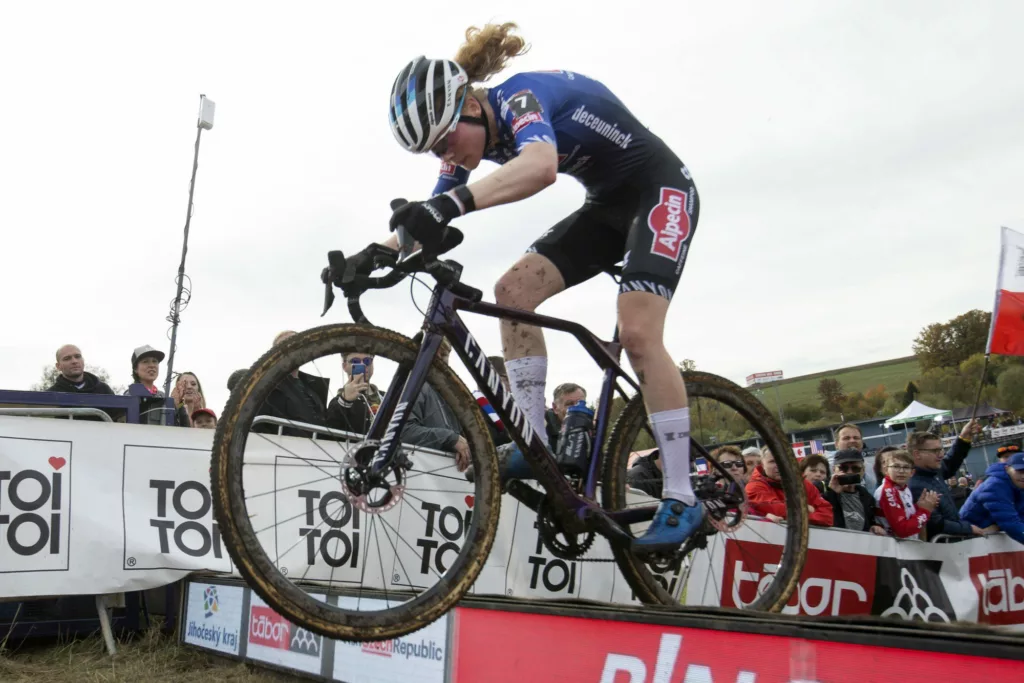 Photo Credit: Cor Vos
Tyre choice and pit strategy link everything together
Mechanics and riders make compromises rather than choosing a universally fastest tyre. A tread that clears mud well may not roll as efficiently on paved sections, and a tyre chosen for dry grass may lack bite on a slippery climb. Pressure changes the feel of the bike and the shape of the contact patch. Riders normally compare options on course during the warm-up and adjust for body weight, tyre construction, surface and their own handling confidence.
Bike exchanges also depend on the location of the designated pit. If the pit sits immediately after a muddy section, riders can swap machines before entering the next lap. If it comes early in the circuit, they must decide whether they can finish the lap with accumulated mud or mechanical trouble. Mechanics may prepare a matching second bike to make the transition familiar. Not every rider has the same support or number of spare machines.
In a crowded race, maintaining a clean line can be worth more than a theoretical gain from equipment. Starting too far back can force a skilled rider to queue at the first narrow feature. Conversely, sprinting recklessly to the front can leave a rider short of power before the most demanding climb. Strong technical execution is inseparable from race pacing.
Practising the skills without treating every obstacle as a jump
The safest progression is controlled and specific. Practise dismounting and remounting at walking speed on level ground before attempting it under pressure; develop braking and cornering on a predictable grass surface; then introduce steeper gradients and awkward conditions. Sand riding becomes easier when the rider can identify a steady exit line and resist the impulse to overcorrect. A session that repeats one feature with deliberate variations is often more valuable than simply riding a full circuit as quickly as possible.
In Britain, local cyclocross races provide practice in race traffic, which is difficult to recreate alone. British Cycling publishes introductory and skill-specific guidance, while organisers can explain the safety requirements for their circuits. Equipment can be borrowed or adapted for beginners, but any bike needs functioning brakes, reliable tyres and enough clearance to handle the conditions. Our guide to cyclocross in Britain covers ways to get involved.
When watching the professionals, look for the decisions made before an obstacle rather than only the impressive move in the middle. A rider can gain two seconds by entering a corner on the right line, three more by running a climb rather than stalling, and another two with an efficient remount. Multiply those choices over the full race and the technical gap can be more important than a spectacular single attack.