Cyclocross is a form of off-road bicycle racing held on short, twisting circuits of grass, mud, sand, gravel and occasional paved roads. Riders start together, complete repeated laps and sometimes have to get off and carry their bikes over obstacles. Most races last less than an hour, but the combination of hard efforts, bike handling and difficult surfaces makes them demanding from the first lap.
It is often written as cyclo-cross and shortened to ‘cross or CX. The sport is especially popular in Belgium and the Netherlands, where some winter races attract big crowds. Britain has its own regional leagues and national championships, with local events taking place in parks and fields throughout the autumn and winter.
For someone accustomed to road cycling, the biggest difference is the rhythm. Instead of following a peloton for hours, riders spend the race accelerating out of corners, negotiating ruts, choosing lines through mud and attempting to stay on the bike when running might be quicker. A stronger cyclist can lose ground to someone with better technique, and a mechanical problem can change the race in seconds.
This guide explains how a race works, the bikes and tyres used, the basic rules, why riders run with their bicycles and how to follow the main women’s and men’s competitions. It also covers what a first-time spectator should watch for and how a beginner can try cyclocross without buying an expensive racing bike.
How does a cyclocross race work?
A cyclocross race normally begins with riders lined up on a starting grid. At international events, grid positions are determined by the applicable ranking and start rules. A leading rider may have a clear run into the first corner, while someone several rows back needs to gain places before the course becomes narrow.
The circuit is typically only a few kilometres long, so the field passes the same climbs, corners and pits repeatedly. After the first laps, officials determine the number of remaining laps needed to reach the intended race duration. A bell signals that the leaders are beginning their final lap. The winner is the first rider to complete the full race distance and cross the finish line.
At the highest level, men’s elite races are generally organised for about 60 minutes and women’s elite races for about 50 minutes. Junior, under-23 and grassroots race durations vary by category and organiser. They are not distance races in the same sense as road events: the actual number of laps depends on the speed of the leading riders and the conditions on that particular day.
Riders who are lapped may be withdrawn before the finish under the event’s applicable rules, including the UCI’s 80 per cent rule where it is applied. The result is that the leading riders remain the focus of the last laps rather than the circuit becoming crowded with competitors moving at very different speeds. That rule does not mean a rider must be within 80 per cent of the winner’s finish time; it concerns race gaps measured against the leader’s lap.
Races are usually fast from the start because there is little time to recover from a poor opening lap. Gaps of just five or ten seconds can be difficult to close on a narrow course where overtaking requires either a mistake from the rider ahead or a substantial burst of power.
Why do cyclocross riders get off and run?
Getting off the bike is a normal racing decision, not a sign that someone has failed. Courses may contain wooden barriers, steps, steep banks, deep sand or sections of mud where pedalling is slower than carrying the bike. Cyclists practise dismounting before reaching the obstacle and getting back on quickly, because an awkward remount can cost as much time as the obstacle itself.
Some top riders can ride sections that others have to run. That does not automatically make riding the better option: a rider who battles to keep momentum on a slippery climb may expend more energy and lose more time than someone who runs a clear line. Conditions also change during the race, so a climb that was rideable on the first lap may become a running section as deep ruts form.
The barriers are usually cleared by dismounting, lifting the bike and stepping or jumping over them, although skilled riders sometimes bunny-hop permitted obstacles. The quickest technique is the one that balances speed with the risk of falling or stalling. Spectators often see the same rider switch between running and riding on different laps.
The repeated dismounts also explain why shoulder-carrying is part of the sport. Riders usually pick up their bike by the frame, keeping the wheels away from their legs as they run. Even elite riders practise this movement, along with cornering, braking and choosing a line through ruts.
What is different about a cyclocross bike?
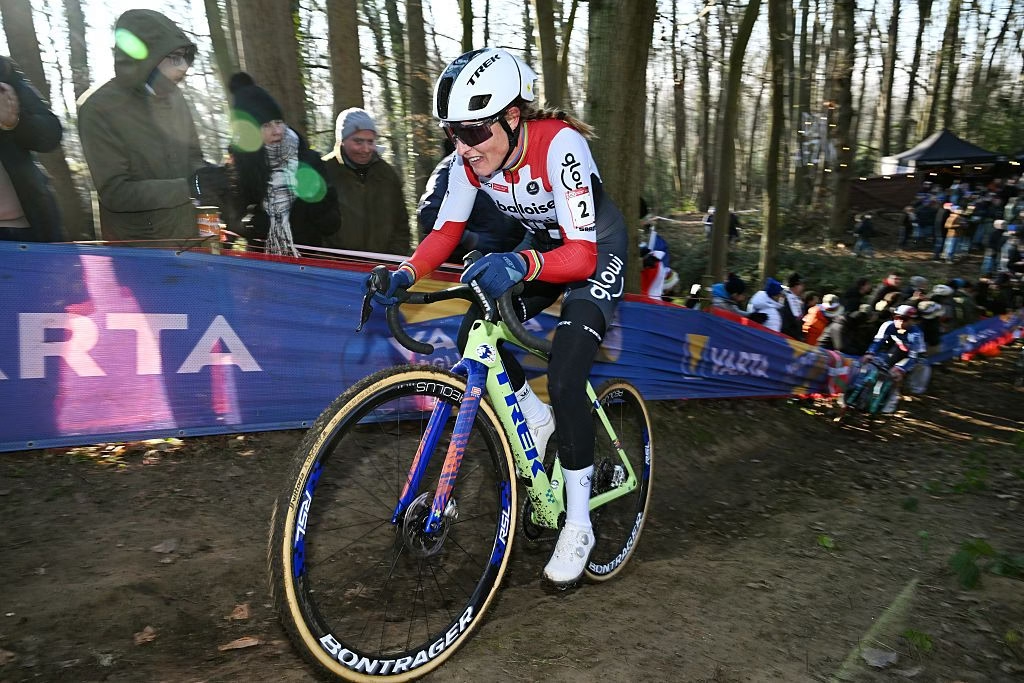
A cyclocross bike resembles a road bike at a glance: drop handlebars, a rigid frame and large wheels. Look closer and the differences become clear. There is more clearance around the tyres for mud, the gearing favours repeated changes of pace, and the tyres have knobs that provide grip on grass, loose earth and sand. Disc brakes are common, providing predictable stopping performance when rims and tyres are covered in muck.
At UCI-regulated top-level cyclocross events, tyres must not exceed 33mm in measured width and may not use spikes or studs. This is an important distinction from gravel riding, where much wider tyres are usual. The exact measured width can depend on the rim and tyre combination, and local non-UCI competitions may have different equipment rules.
Professional riders often use tubular tyres glued to specialist rims, choosing tread patterns and pressures for the course. The right setup changes with conditions: small closely spaced knobs are fast on hard ground, while open, more aggressive treads can shed mud and improve traction. Tyre pressure is deliberately low compared with road racing, but reducing it too far risks folding a tyre in a corner or damaging a rim.
Many professional bikes use a single chainring and a wide-range cassette, reducing the number of moving parts exposed to mud. The gearing still needs to allow high-speed sections and short steep climbs. A typical race bike is also designed for quick lifting, efficient carrying and fast replacement when something breaks.
You do not need a fully equipped professional bike to take part in a novice local event. Some organisers permit suitable mountain bikes, and a second-hand cyclocross or gravel bike can be an economical starting point. Before entering, check the event’s bicycle, tyre-width and category rules rather than assuming equipment permitted at one race will be allowed everywhere.
What happens in the pits, and can riders change bikes?
International cyclocross venues have designated pit areas. They are not conventional roadside feed zones: riders enter to exchange a muddy or damaged bicycle for a clean, ready-to-ride machine. Mechanics may then wash the used bike and prepare it for the next lap. A rider might swap bikes several times in a wet race, particularly when grass and heavy mud begin clogging the frame and drivetrain.
A pit exchange is a coordinated manoeuvre. The rider must follow the correct pit route and receive the replacement bike from the team at the permitted location. A missed exchange, a change made at the wrong point or a problem getting back up to speed can cost several seconds. On fast circuits, that is enough to lose contact with the leading group.
Weather can make bike changes central to the race. On a dry course, an elite rider may use the same bicycle for the entire event. On a muddy day, mechanics may spend almost as much time cleaning and preparing bikes as the competitors do riding. The pit crew’s work is one reason teams bring substantial equipment even though the racing lasts only an hour.

Most newcomers do not have two bikes or a mechanic waiting in the pits, and they do not need them. The priority at grassroots level is a reliable bike, the ability to fix an ordinary puncture and enough time to clean it after the race. If local rules allow a spare bike, that is a convenience rather than a condition of taking part.
How is cyclocross different from road racing, mountain biking and gravel?
Road racing rewards positioning and teamwork over much longer distances. Mountain biking usually features more sustained off-road riding, and some cross-country courses have larger technical features. Gravel races often cover tens or hundreds of kilometres on mixed roads and tracks. Cyclocross concentrates a wide range of off-road problems into a short circuit that must be ridden repeatedly at high intensity.
The same skills overlap across disciplines. Road riders bring strong aerobic fitness and sprint power. Mountain bikers may have an advantage on technical descents and uneven ground. Cyclocross specialists combine both with race-specific decisions such as whether to run, which rut to follow and when to change bikes.
Because the circuit is compact, cyclocross is unusually easy to watch at the venue. Supporters can stand at one technical section, see the leaders repeatedly and move to a different part of the course without driving between locations. It is also approachable for families and beginners who want to understand a race without following hours of action.
Who are the main cyclocross riders and competitions?
The sport has a long Belgian and Dutch history. Sven Nys, Marianne Vos, Wout van Aert, Mathieu van der Poel, Fem van Empel, Lucinda Brand, Thibau Nys and Puck Pieterse are among the familiar names associated with modern elite cyclocross. Their sporting backgrounds differ: some have also won major road or mountain-bike races, while others have built their reputations principally through winter racing.
The headline calendar includes the UCI Cyclo-cross World Cup, the Superprestige and the X²O Trophy, alongside national championships, continental championships and the World Championships. These are separate competitions with different organisers, points systems and calendars. Winning a World Cup race does not automatically mean winning the World Cup overall, and the same is true of the other series.
The world champion wears the rainbow jersey in their category until the next championships. National champions wear their national colours under the relevant regulations. The distinctive clothing helps newcomers pick out the favourites, but a rider leading a series or wearing a race leader’s jersey should not be confused with the reigning world champion.
The winter calendar typically runs from September or October into February, with a particularly busy Christmas and New Year period. The 2026–27 Superprestige begins at Overijse on 25 October 2026. For an introduction to one of its oldest races, see our Overijse cyclocross history and past winners guide. That event is a useful example of how climbing, cobbles and repeated technical corners can shape an entire race.
The HG Cross Meulebeke women’s preview and men’s preview explain what to look for in an early-season race, while the Dendermonde women’s race report and men’s report show how small gaps can decide a race.
How can a beginner start racing cyclocross in the UK?
British Cycling describes cyclocross as an accessible discipline, and local leagues usually cater for a range of ages and abilities. The simplest route in is to find a nearby event, check the organiser’s entry requirements and contact the club if you are unsure about equipment. Some events have a novice-friendly race or a category suitable for first-time competitors; others are intended for more experienced riders.
A small amount of technique practice can make a bigger difference than another week of high-intensity training. Begin by learning to brake on loose ground, pick a line through corners and dismount safely at walking speed. Once those movements feel reliable, practise remounting, carrying the bike over a short obstruction and riding short repetitions on grass.
In the week before a race, check the weather and the course information. A dry park may become very muddy after rain, and the tyres that work on compact summer trails may struggle on wet grass. Arrive early enough to sign on, check your bike, identify the course entrance and ride a practice lap if the organiser permits one.
It is normal to be lapped in an early race. A novice learns by staying upright, riding consistently and using the repeated laps to understand which corners are worth attacking and which are better taken steadily. You will usually get more from completing a clean race than from chasing a fast start and exhausting yourself in the first ten minutes.

How to watch your first cyclocross race
A useful way to follow a race is to watch the start, the first climb or technical obstacle, the pits and the final two laps. At the start, look for riders losing places before the first pinch point. On a difficult section, watch whether the leaders choose different lines and whether that choice changes as the surface deteriorates. A sudden bike swap may explain a gap that appeared to open without an attack.
When a rider gains five seconds, the question is whether they can sustain that advantage over the next full lap. At the highest level, a small mistake at a barrier or a slippery corner may allow the chaser to close most of that distance. Attacks are often a sequence of small gains on successive corners rather than a single uninterrupted acceleration.
Live broadcast availability varies by race and territory. In Britain, some major events are available through TNT Sports streaming on HBO Max; organisers and broadcasters also carry other races through their own channels. A television replay is not necessarily the live showing, so check the race-specific guide for the correct UK start time and streaming window.
If you are watching from the side of the course, choose a safe viewing area behind the barriers and leave the pit entrances and exits clear. A cyclocross circuit is most engaging when you can see how the same section changes with every lap. That repeated test of judgement, grip and fitness is the essential difference between cyclocross and almost every other form of cycle racing.