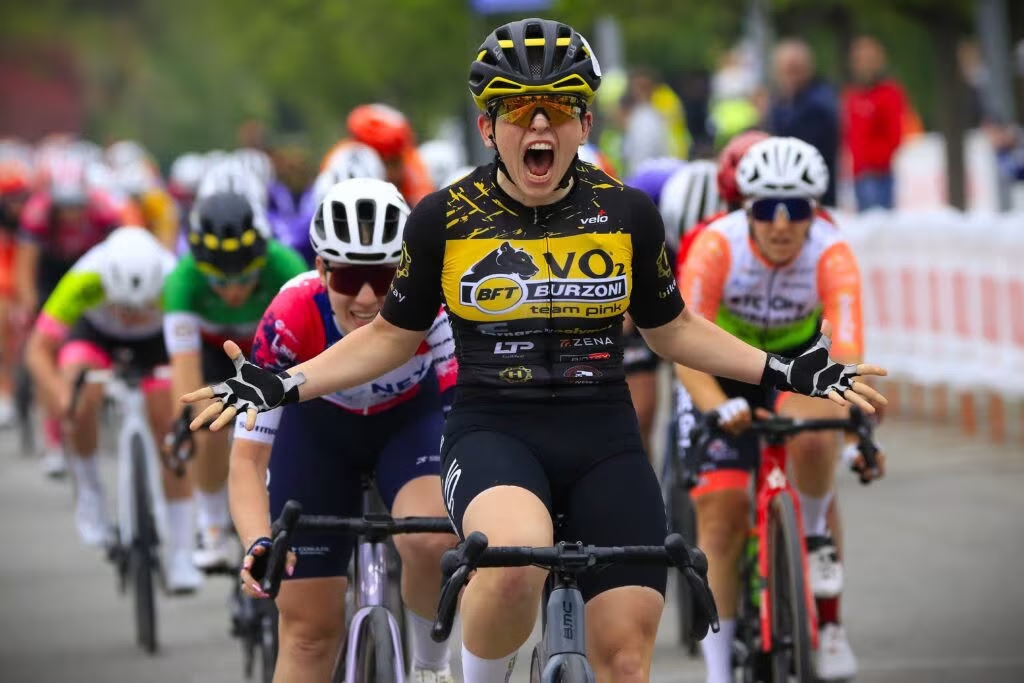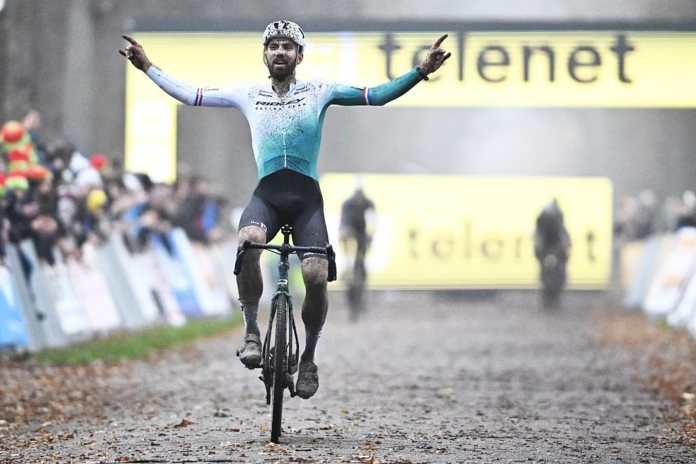
Merksplas almost lost its cyclocross race in 2025. The organisers of the Aardbeiencross announced that rising costs had made the event unsustainable, threatening a fixture that had survived several venue changes and nearly four decades on the calendar. A rescue involving the municipality and new partners kept it alive. When the riders returned in November, Joris Nieuwenhuis and Lucinda Brand won on a course that had been reshaped to give the event a viable future.
The near-collapse was the latest disruption in a race that had already changed venues several times. Although the race now takes place at Merksplas-Kolonie, its history stretches back to Hoogstraten in 1987. It has been won by Sven Nys, Mathieu van der Poel, Sanne Cant and the leading riders of the modern Superprestige. Understanding its changing locations and conditions explains more than a list of champions can.
From Hoogstraten to Merksplas
The Aardbeiencross began in 1987 in the Hoogstraten area of northern Belgium, with Wim Lambrechts winning the inaugural men’s race. The strawberry name reflects the region’s agricultural identity and the long association with the Hoogstraten growers’ cooperative. Over time the race became a familiar stop in the Belgian winter calendar, although its location was far less permanent than the name suggested.
The organisers, Hoogstraatse Spurters, used several sites. The recreational area at De Mosten in Meer hosted the race for many years, before a move to the Blauwbossen at Minderhout. The latter offered an appealing circuit but was less convenient for spectators. In 2014 the event moved again, this time to land around the Hoogstraten auction facilities. Access and infrastructure improved, but the surroundings gave the organisers fewer opportunities to create the kind of natural cyclocross course that had characterised earlier editions.
By 2019 expansion at the auction site meant another venue was needed. Merksplas-Kolonie, a former agricultural colony with distinctive buildings and open land, provided a new home nearby. The move was planned for February 2020, but Storm Ciara forced that edition to be cancelled. Racing finally resumed at Merksplas in November 2020. The interruption matters when comparing winners by year: there was no February 2020 champion, only the winner of the November race.
The event had also moved between season-long competitions. It joined the Gazet van Antwerpen Trofee in the 1990s before switching to the Superprestige for the 1998–99 season. Its position within the Superprestige gives riders a reason to contest it even when they are not specifically targeting the Aardbeiencross. Points gained here can shape the overall series, particularly when several rounds fall close together.

The course at Merksplas-Kolonie
Merksplas is not a race defined by one famous climb. Its character comes from the combination of grass, technical corners, changes of surface and sections where the ground can deteriorate quickly. Conditions can shift from fast, hard-packed racing to a far more selective test when rain softens the fields. The riders must judge whether to carry speed through corners or sacrifice momentum to avoid mistakes.
The open stretches offer opportunities for powerful riders to accelerate and force gaps, but the repeated changes of direction mean that an advantage is not always easy to protect. A rider who attacks must continue riding cleanly through the technical sections. Someone chasing can regain time through better lines, only to lose it again on the next open stretch. The race rewards rhythm as much as raw power.
Bike choice and tyre pressure become increasingly important in wet conditions. Teams can prepare alternative machines in the pits, and riders may change bikes to deal with mud or mechanical problems. A tyre that rolls efficiently on firm grass may not give enough control on slippery corners. The correct decision depends on conditions on the day, not simply the course’s reputation. Our guide to cyclocross pits and bike changes explains how those decisions fit within race rules.
For the 2025 restart, organisers deliberately shortened the circuit’s footprint. Organisers explained that some wooded sections were difficult for spectators to reach and expensive to manage. Bringing the route into a smaller area made access control and event operations easier, while keeping the racing on the Merksplas-Kolonie estate. That change was an organisational decision with sporting consequences: a shorter, more concentrated venue can alter where spectators gather and how the course flows.
The record winners: Sven Nys and Sanne Cant
Sven Nys remains the most successful man in the race’s history with eight victories. His record belongs chiefly to the Hoogstraten era and illustrates how effectively he could adapt to different winter conditions. Nys was rarely dependent on a single type of circuit. He could exploit technical mistakes, sustain pressure on difficult ground and still find the acceleration needed when a race remained close late on.
Sanne Cant leads the women’s roll of honour with five wins. Her victories helped establish the women’s race as an important part of the fixture, particularly during the years when she was among the most consistent riders in Belgian cyclocross. The women’s event has its own shorter history: it first appeared in 2012, when Daphny van den Brand won. Counting men’s editions from 1987 and women’s editions from 2012 without that distinction would give a misleading impression of the records.
The winners’ list charts a clear shift in who controlled the event. Mathieu van der Poel won five successive editions from 2015 to 2019, all before the move to Merksplas. His run came during the period when his repeated accelerations and technical ability were beginning to reshape elite men’s cyclocross. In the women’s race, Cant’s dominance gave way to a sequence of wins by Ceylin del Carmen Alvarado and Lucinda Brand.

Recent Aardbeiencross winners
The following results cover the ten most recent completed editions of the men’s and women’s races through 2025. They combine the final Hoogstraten years with the Merksplas period; the February 2020 cancellation is not counted as a completed edition.
| Year | Elite men | Elite women |
|---|---|---|
| 2025 | Joris Nieuwenhuis | Lucinda Brand |
| 2024 | Laurens Sweeck | Ceylin del Carmen Alvarado |
| 2023 | Joris Nieuwenhuis | Ceylin del Carmen Alvarado |
| 2022 | Laurens Sweeck | Ceylin del Carmen Alvarado |
| 2021 | Eli Iserbyt | Lucinda Brand |
| 2020 (November) | Michael Vanthourenhout | Lucinda Brand |
| 2019 | Mathieu van der Poel | Sanne Cant |
| 2018 | Mathieu van der Poel | Sanne Cant |
| 2017 | Mathieu van der Poel | Sophie de Boer |
| 2016 | Mathieu van der Poel | Sanne Cant |
The men’s winners since the move have been more varied than Van der Poel’s late-Hoogstraten sequence. Michael Vanthourenhout won the first Merksplas edition, followed by Eli Iserbyt, Laurens Sweeck and Nieuwenhuis. The women’s results tell a different story: Brand won the first two Merksplas races, Alvarado took the next three, and Brand returned to the top in 2025.
The races that shaped the event
The 2020 cancellation was a defining moment without a winner. Storm Ciara prevented the planned February race from taking place, delaying the debut of the new venue. When Merksplas finally hosted the Aardbeiencross that November, the race had moved not only geographically but also into a different part of the season. Vanthourenhout and Brand became the first elite winners at the new site.
Van der Poel’s five-race winning sequence from 2015 to 2019 provides the clearest example of individual domination. Those wins came on the old Hoogstraten course rather than Merksplas, a distinction that is easily lost when results databases use the modern event name for the entire history. They belong to the same continuous Aardbeiencross lineage, but not to the same circuit.
Alvarado’s three consecutive victories from 2022 to 2024 formed the next major streak in the women’s race. They came at Merksplas and demonstrated her ability to win on a course where handling and changes of rhythm can be as decisive as sustained power. Her sequence ended when Brand reclaimed the race in 2025.
Nieuwenhuis’s 2025 victory gave the revived event a memorable men’s race. Nieuwenhuis endured a crash, problems with his shoe and mechanical difficulties, yet remained in contention. He accelerated with two laps remaining and won alone in 1:00:26, six seconds ahead of Niels Vandeputte, with Emiel Verstrynge another second back. It was Nieuwenhuis’s second Aardbeiencross victory after 2023.
Brand was more decisive in the women’s race. She went clear around halfway and held the advantage to win in 45:20. Aniek van Alphen finished ten seconds behind, with Inge van der Heijden third at thirteen seconds. Both races were won by Dutch riders, but they unfolded differently: Brand established control early, while Nieuwenhuis had to overcome a troubled opening before making the winning move.

The 2025 rescue and what changed
In March 2025, Hoogstraatse Spurters announced that the event would stop. Organising costs had risen substantially, and the financial burden had become difficult to sustain. A cyclocross race needs more than a field and some course tape: barriers, security, television infrastructure, medical provision, staff and hospitality all carry costs. A fixture can attract respected riders and still struggle commercially.
The decision was reversed after discussions involving the municipality and investors. The municipality committed support, including a financial contribution, and the event’s operation was restructured. The new organisers also sought to reduce costs by concentrating the course and using the restored buildings at Merksplas-Kolonie rather than relying on larger temporary hospitality facilities.
That rescue is significant beyond one Belgian race. Cyclocross has a crowded calendar, and organisers compete for sponsorship, spectators and elite fields. Established names offer prestige but do not guarantee financial security. The Aardbeiencross survived because local partners judged that the event’s sporting and regional value justified a different model. The 2025 restart showed that continuity could be preserved without pretending the old arrangements were still viable.
Merksplas in the 2026–27 Superprestige
The next Aardbeiencross is scheduled for Saturday, 14 November 2026 as part of the Superprestige series. It follows the earlier rounds at Overijse, Middelkerke and Niel. The date places it in a busy autumn period, when the overall classification can change quickly and riders are balancing series commitments with their broader cyclocross programmes.
The historical winners should not be treated as a start list for 2026. Brand, Alvarado, Nieuwenhuis and Sweeck have all demonstrated that they can win this event, but participation and current form must be established from the confirmed entries nearer race day. Conditions may also be very different from 2025. A dry course could favour riders who maintain high speed through repeated corners, while prolonged rain would put a greater premium on traction, running and clean bike changes.
The 2026 race will be another test of whether the more compact Merksplas venue can deliver the same sporting spectacle on a sustainable budget. For the riders, the immediate challenge is simpler: find grip, carry speed through the corners and make fewer mistakes than the opposition.