
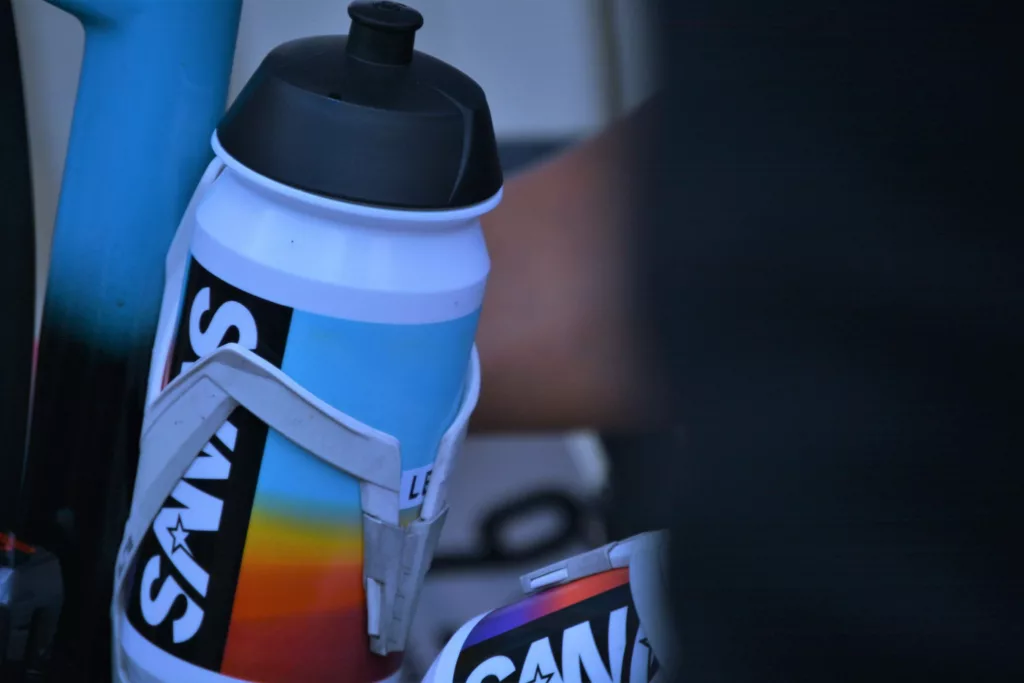
A feed zone is a designated section of a road race where team staff stand beside the course and hand food and drinks to their riders.
The hand-up may contain a musette filled with bottles, energy gels, bars, rice cakes and other food chosen for that stage. Riders collect it without stopping, place the strap over their shoulder and sort through the contents while continuing to race.
Feed zones are only one part of a professional cyclist’s nutrition system. Riders can also receive bottles and food from team cars, carry supplies from the start and collect items from teammates acting as domestiques.
The challenge is not simply consuming enough energy. Riders must eat and drink while travelling at speed, surrounded by a moving peloton and often approaching the hardest part of the stage.
 Photo Credit: Getty
Feed zones in cycling at a glance
- Team staff wait at designated points beside the road
- Riders collect bottles or musettes without stopping
- A musette is a lightweight shoulder bag containing food and drinks
- Organisers position feed zones at planned intervals along the route
- Teams can also supply riders from their vehicles
- Domestiques often collect bottles for several teammates
- Feeding may be restricted near the start, finish or dangerous sections
- Riders discard rubbish in designated litter zones
- Missing a hand-up can become a serious problem on a long or hot stage
What is a cycling feed zone?
A feed zone is a controlled part of the course where riders can safely receive food and drink from team staff.
Each team normally sends one or more soigneurs or other support staff ahead of the race. They wait at an allocated position wearing team clothing and carrying musettes or bottles.
As the race approaches, riders identify their team’s staff member among a long line of people standing beside the road.
The rider then moves towards the edge of the peloton, reaches out and takes the bag or bottle while still moving.
Nobody stops for lunch.
The process lasts only a few seconds, but it has been planned before the stage and coordinated throughout the day.
What is inside a musette?
A musette is a small, lightweight cloth bag with a long shoulder strap.
It may contain:
- Water
- Carbohydrate drink
- Energy gels
- Energy bars
- Rice cakes
- Small sandwiches
- Fruit
- Caffeine products
- Electrolyte drinks
- Ice or cooling items in hot weather
The exact contents depend on the rider, stage and weather.
A sprinter may receive different food from a general classification leader. A rider targeting the breakaway may need easier-to-open products because they have less opportunity to eat calmly.
Bottles may also be labelled so riders know whether they contain water, carbohydrates or a more concentrated drink.
Team nutritionists calculate what should be included, while chefs and soigneurs prepare the food before the stage.
 Photo Credit: A.S.O./Pauline Ballet
Why is the bag called a musette?
The term comes from a small shoulder bag traditionally used in France.
Its simple design is ideal for racing. The strap can be placed over the rider’s head and shoulder with one movement, leaving the rider able to continue controlling the bike.
Once the rider has moved away from the feed zone, they usually empty the contents into their jersey pockets and bottle cages.
The musette is then folded away or discarded in an approved waste area.
Although modern teams use highly detailed nutrition plans, the basic musette has changed relatively little. It remains one of professional cycling’s most recognisable pieces of equipment.
The term sits alongside several other French expressions still used throughout the sport, many of which are covered in our guide to common French cycling terms.
How does a rider collect a musette?
Collecting a musette is more difficult than it appears.
The rider must first reach the correct side of the peloton. They then need to locate their team staff member among dozens of people offering almost identical-looking bags.
The soigneur holds the strap out at arm’s length. The rider reaches for it, takes the weight and quickly places the strap over their shoulder.
Both people must account for the rider’s speed.
The staff member cannot hold on for too long because the bag may pull the rider off balance. Letting go too early can cause it to fall before the rider has secured it.
The rider must also avoid:
- Other cyclists moving towards their own staff
- Dropped bottles and bags
- Team personnel standing close to the road
- Sudden braking
- Road furniture
- Spectators
- Changes in the width of the course
Feed zones can become some of the most chaotic points of an otherwise routine stage.
 Photo Credit: A.S.O./Pauline Ballet
Why are fixed feed zones used?
Designated feed zones make feeding more predictable for riders, teams and race organisers.
Professional road races use planned roadside feeding areas, generally placed at suitable intervals and accompanied by designated litter zones.
The intention is to reduce the number of unregulated hand-ups taking place at random points along the course.
A properly designed zone should provide:
- A sufficiently wide and straight road
- Clear visibility
- Enough room for team staff
- Space for riders to move towards the roadside
- A nearby litter zone
- Separation from dangerous corners or road furniture
Race organisers can adapt feeding arrangements when conditions require it, particularly during extreme heat or on long categorised climbs.
The additional measures available during dangerous temperatures are explained in our Tour de France heat protocol guide.
Can riders take food outside the feed zone?
Riders do not rely entirely on official roadside feed zones.
They can begin the stage with food in their jersey pockets and bottles on the bike. They may also receive supplies from a team car when race regulations and the position of the convoy allow it.
A domestique can drop back to the vehicle, collect several bottles and carry them back through the peloton.
Organisers and commissaires can place restrictions on when feeding from vehicles is permitted. Feeding is commonly limited near the beginning and end of a stage, on dangerous roads or during sections where moving between vehicles and riders would create additional risk.
Race officials can also relax normal arrangements in exceptional heat.
The exact instructions are communicated to teams before each stage.
How do riders receive bottles from the team car?
A rider who needs supplies drops towards the rear of the peloton and enters the line of race vehicles.
The team car moves into the correct position when permitted by race officials. A sports director or mechanic leans from the window and passes bottles to the rider.
The rider may take one bottle for themselves or several for teammates.
A rider carrying multiple bottles will place them:
- In both bottle cages
- Down the front or back of the jersey
- Inside jersey pockets
- Under the jersey collar
They then ride back through the convoy and peloton, distributing the bottles to teammates.
This task is often performed by a domestique rather than the protected leader.
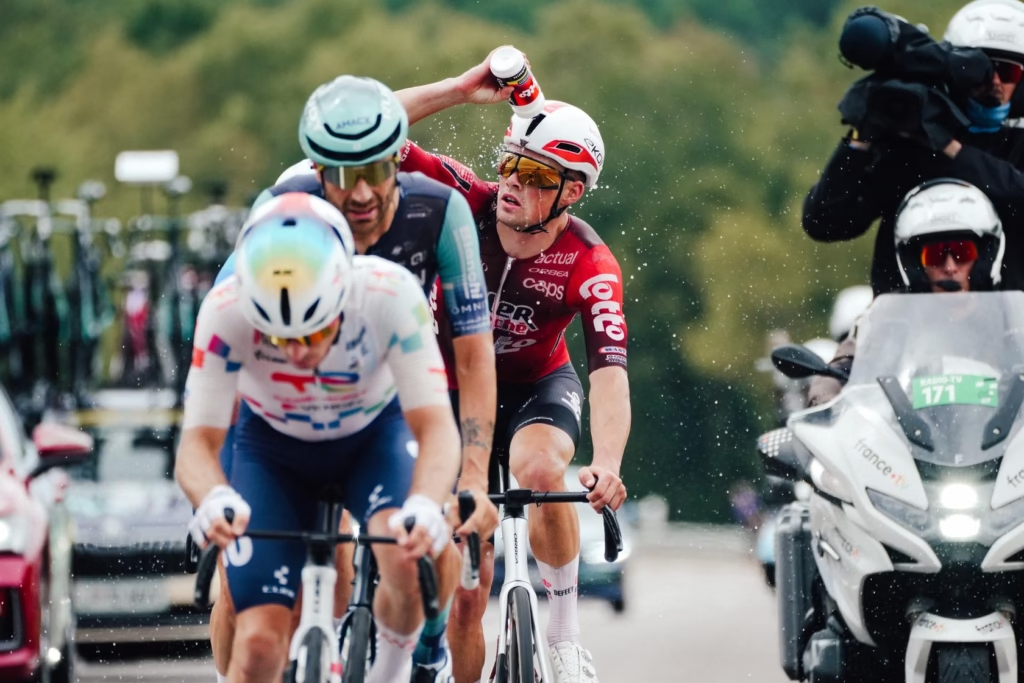 Photo Credit: A.S.O./Thomas Maheux
What is a bottle domestique?
A bottle domestique is a rider who drops back to collect drinks for the team.
The job requires significant effort.
Dropping to the car is easy when the peloton is moving steadily. Returning to the front while carrying several kilograms of liquid can be much harder, particularly on rolling roads or when teams begin increasing the pace.
A domestique may need to accelerate past dozens of riders before delivering bottles to the leader.
The work costs energy that could otherwise be saved for later in the stage, but it allows protected riders to remain safely positioned near the front.
Fetching bottles is only one part of the role. Our guide to what a domestique does at the Tour de France explains how these riders also protect leaders, control breakaways and provide support after mechanical problems.
Why do team leaders not collect their own bottles?
They sometimes do, but teams usually try to avoid it during important parts of a race.
Moving towards the back creates several risks.
The leader may become caught behind a crash, split or sudden acceleration. They must then spend energy returning to the front and may lose the protection of teammates.
A general classification rider also has more valuable tactical responsibilities than collecting supplies for the group.
Domestiques handle much of the routine work so the leader can focus on positioning, rivals and the decisive sections of the stage.
During a calm day, leaders may move back to the car themselves to speak with the sports director or collect a preferred bottle. As the race becomes more intense, they are more likely to stay near the front.
The wider division of labour is covered in our explainer on how Tour de France teams work.
How much do professional cyclists eat during a stage?
The amount varies according to the rider, stage length and intensity.
Professional riders may target roughly 60 to 120 grams of carbohydrate per hour during racing, with the highest amounts used on long or demanding stages by athletes whose stomachs have been trained to tolerate them.
That intake can come from a mixture of:
- Carbohydrate drinks
- Gels
- Bars
- Rice cakes
- Chews
- Cakes or small sandwiches
- Fruit
- Concentrated carbohydrate products
A rider cannot wait until they feel hungry.
By that point, energy availability may already be falling. Teams create schedules that encourage riders to eat regularly from the early kilometres.
The plan is adjusted for the route.
A rider may consume more solid food during a calm opening section and switch to gels or drinks when the racing becomes harder.
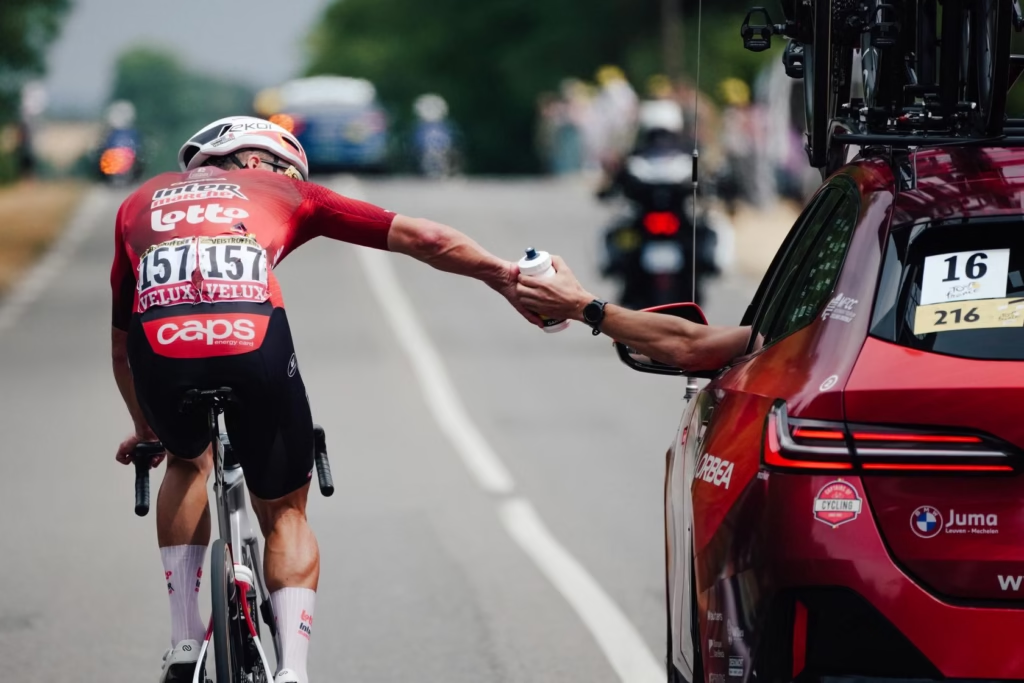 Photo Credit: A.S.O./Thomas Maheux
Why do cyclists eat so often?
A professional race can last four, five or six hours.
The body stores carbohydrate as glycogen in the muscles and liver, but those reserves are limited. Hard racing uses them quickly.
Eating during the stage helps maintain the supply of carbohydrate needed for repeated accelerations, climbs and high-intensity efforts.
Failing to consume enough can lead to a dramatic loss of performance often described as bonking or hitting the wall.
A rider who runs low on energy may experience:
- Heavy legs
- Reduced concentration
- Difficulty responding to attacks
- Loss of coordination
- Irritability
- Dizziness
- A sudden collapse in power
In a stage race, under-fuelling also affects recovery. A rider who finishes one day depleted begins the next stage at a disadvantage.
Do riders eat normal food on the bike?
Yes.
Gels and drinks are convenient, but riders may become tired of consuming sweet products for hours. Solid food also helps provide variety and can be easier on the stomach during long stages.
Common team-made foods include rice cakes, small wraps, cakes and miniature sandwiches.
Rice cakes are particularly popular because they can provide carbohydrate in a soft, compact form. Teams can prepare sweet or savoury versions depending on the rider’s preference.
Solid food is generally eaten during calmer parts of the race.
As the speed increases, riders prefer products that can be opened and swallowed quickly. A gel is more practical during a mountain attack than a sandwich wrapped in foil.
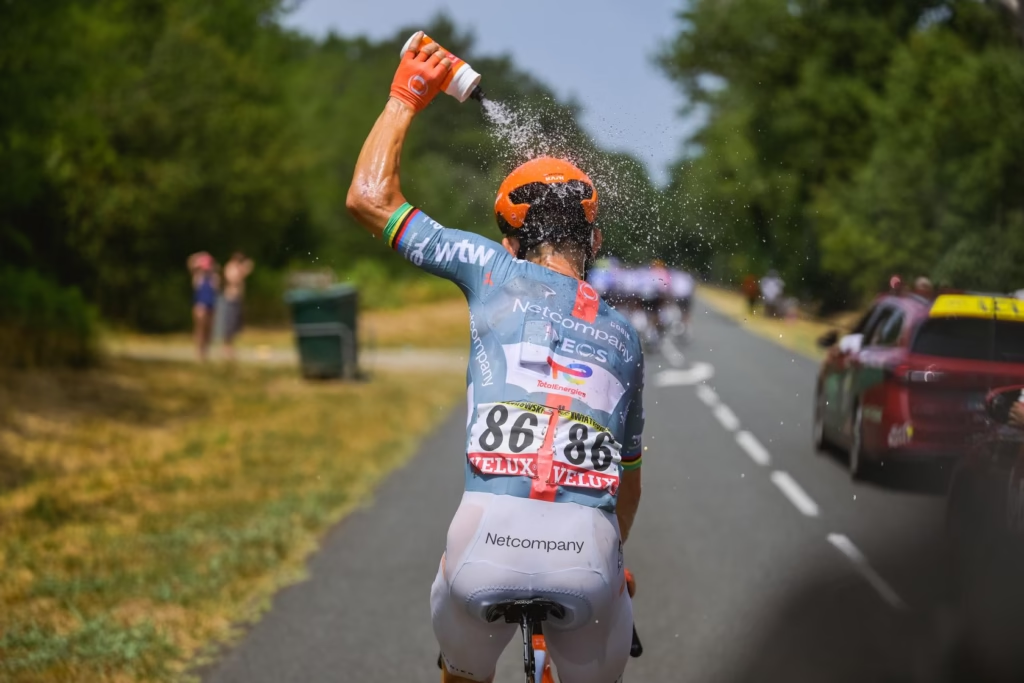 Photo Credit: A.S.O./Charly López
How do cyclists open food while riding?
Products are prepared to be opened with one hand or with the teeth.
Team staff may partially tear gel wrappers or arrange food so the rider can reach it easily. Homemade items are wrapped in paper or foil that can be peeled back without stopping.
A rider normally keeps one hand on the handlebars while retrieving food from a jersey pocket with the other.
Experienced professionals can unwrap and eat food while maintaining their position in the peloton, but the task still requires concentration.
The discarded wrapper must be stored or released in an authorised litter area rather than thrown randomly beside the road.
What do professional cyclists drink?
The two basic options are water and carbohydrate-electrolyte drinks.
Water helps with cooling and hydration. A carbohydrate drink contributes to the rider’s energy intake while also replacing fluid.
Electrolytes, particularly sodium, help replace some of what is lost through sweat. The concentration is adjusted according to temperature, stage difficulty and individual needs.
Teams may use different bottle markings or colours to help riders identify the contents.
A rider might carry:
- One bottle of water
- One bottle of carbohydrate drink
- Two carbohydrate bottles
- A concentrated energy bottle alongside plain water
The plan changes throughout the stage. On a very hot day, riders may prioritise water for drinking and cooling while still taking carbohydrate through gels and other products.
How many bottles does a rider drink?
There is no single number.
Fluid requirements depend on:
- Temperature
- Humidity
- Rider size
- Sweat rate
- Stage intensity
- Altitude
- Bottle size
- The amount consumed before the start
On a cool stage, riders may drink relatively slowly. During extreme heat, they can require far more frequent bottle deliveries.
Not every bottle is consumed fully.
Riders often pour water over their head, neck and clothing to help manage body temperature. They may also take a few mouthfuls before passing a bottle to a teammate.
Teams monitor conditions and try to ensure riders neither become dehydrated nor drink excessively.
 Photo Credit: A.S.O./Charly López
Why do riders pour water over themselves?
Evaporation helps remove heat from the body.
Pouring cool water over the head, neck and jersey can reduce thermal strain during hot stages, particularly on climbs where speeds are lower and natural airflow is reduced.
Some teams also provide:
- Ice socks placed down the jersey
- Cold towels before the start
- Frozen drinks
- Ice vests during warm-ups
- Menthol products that create a cooling sensation
Water used for cooling is normally kept separate from bottles containing concentrated carbohydrate.
A rider does not want to pour a sticky energy drink over their face or clothing by mistake.
The growing challenge of racing through repeated heatwaves is examined in our feature asking whether the Tour de France can continue racing in July heat.
What is an ice sock?
An ice sock is a stocking or thin fabric tube filled with ice.
A rider places it down the back of their jersey, allowing the ice to cool the upper body as it melts.
Teams may hand them out from feed zones or roadside support positions during extremely hot stages.
The name is literal because ordinary stockings or tights have traditionally been used to hold the ice.
Ice socks are temporary. Once the ice has melted, the rider discards the empty fabric in an appropriate zone or passes it back to team staff where possible.
 Photo Credit: A.S.O./Pauline Ballet
Why can feeding be dangerous?
A feed zone forces many riders to move towards the same narrow part of the road.
Each rider is searching for a specific staff member while watching the people and bikes around them. A dropped musette can become entangled in a wheel, while a bottle rolling across the road can cause a crash.
Dangerous situations include:
- Riders suddenly changing direction
- Staff leaning too far into the road
- A musette strap catching on the handlebars
- Bottles falling beneath wheels
- Riders slowing unexpectedly
- Teams positioned too close together
- Feeding on a narrow or twisting road
The risk is one reason organisers use designated and carefully assessed feeding areas.
Riders also tend to move towards the feed zone before reaching it. Teams that need no supplies may keep their leaders away from the roadside congestion.
What happens when a rider misses a hand-up?
The immediate response depends on what was missed and how urgently it is needed.
A rider may ask a teammate to share a bottle or some food. A domestique can drop back to the team car at the next opportunity, or the rider can wait for another official feed zone.
Teams often carry spare supplies precisely because hand-ups can fail.
Missing one musette is unlikely to end a rider’s stage if the team reacts quickly. Repeated failures become more serious, particularly during a hot mountain stage.
A rider may also receive the wrong bag or accidentally take a rival team’s musette. In that situation, they can use whatever suitable supplies are available and resolve the mistake later.
Nutrition plans are detailed, but survival takes priority over branding.
Can riders share food and bottles?
Yes.
Teammates routinely pass bottles and food between one another.
A domestique may collect supplies and distribute them throughout the group. A rider who has more than they need may give a bottle to someone who missed a hand-up.
Riders from different teams may also share water in some situations, particularly during extreme heat or when someone has suffered a mechanical problem away from their team car.
Professional cycling remains competitive, but there is a practical understanding that access to basic hydration can become a safety matter.
A shared bottle does not normally create a meaningful tactical advantage. Refusing help to a dehydrated rider could create a much more serious problem.
 Photo Credit: A.S.O./Pauline Ballet
Can a rider take food from a spectator?
Generally, riders should receive supplies through authorised team and race arrangements rather than accepting unknown products from spectators.
A spectator may offer a bottle or can of drink on a climb, but the rider cannot know exactly what it contains or whether it has been handled safely.
There may also be restrictions on feeding outside designated areas.
Taking an unknown item creates additional risk because professional riders are responsible for what enters their body under anti-doping rules.
Water offered by spectators is sometimes poured over riders rather than consumed. Even that can be unwelcome if the bottle contains a sugary drink or the conditions are cold.
What are neutral bottles?
Race organisers sometimes provide neutral water supplies available to riders from any team.
Neutral service vehicles or motorbikes may carry bottles, particularly when access to team cars is difficult or weather conditions create unusually high demand.
The bottles are usually plain or carry event branding rather than the colours of one team.
Neutral support helps ensure that a rider does not become dangerously short of fluid simply because their team car is trapped far behind in the convoy.
It supplements rather than replaces the team’s nutrition strategy.
A neutral bottle provides hydration, but it may not contain the exact carbohydrate or electrolyte mixture planned for that rider.
Why do riders throw bottles away?
A rider only has room for two bottles in the bike’s cages.
When a bottle is empty, it must be removed before a full one can be stored. Riders may also discard a half-finished bottle before a climb to reduce weight or because the drink is no longer needed.
Modern regulations require riders to discard bottles and rubbish in designated zones rather than throwing them randomly along the route.
These areas allow staff and organisers to collect waste more efficiently.
Riders sometimes throw bottles carefully towards spectators within authorised zones, where they become souvenirs. The action must not endanger anyone or send the bottle beneath another rider’s wheels.
Throwing rubbish outside the permitted areas can lead to fines or sporting sanctions.
 Photo Credit: A.S.O./Alex Broadway
What is a litter zone?
A litter zone is a marked section of the course where riders are permitted to discard bottles, wrappers, musettes and other race waste.
It is often positioned close to a feed zone because riders empty bags and replace bottles shortly after collecting supplies.
Race staff clean the area once the peloton has passed.
The system is intended to reduce roadside waste and prevent riders from throwing objects at unsafe locations.
A rider should not discard a gel wrapper on a descent, in the middle of the peloton or on an unprotected section of countryside.
The environmental rules also affect team preparation. Staff choose packaging that is easy to retain until the next authorised zone.
Breaches of feeding, waste and convoy rules can result in fines or other sanctions. Our Tour de France penalties and yellow cards explainer covers how race officials enforce those regulations.
Why do riders sometimes throw away full bottles before a climb?
Water is heavy.
A standard 500ml bottle adds approximately half a kilogram before accounting for the bottle itself. Carrying two full bottles therefore adds more than one kilogram to the bike and rider.
Before a decisive climb, riders may drink what they need and discard unnecessary liquid in the litter zone.
This marginal weight saving matters most when the climb is steep and the rider expects the race to become aggressive.
The decision still involves a calculation.
Throwing away both bottles could leave the rider without fluid during a long ascent. Team staff may instead stand near the lower slopes with smaller or partially filled bottles.
Leaders may also receive one final bottle from a domestique before the pace increases.
Why are feed zones sometimes placed before climbs?
The approach to a major climb is one of the last opportunities to take supplies before the race becomes difficult.
A rider can collect a bottle, drink during the early slopes and discard it later if the extra weight is no longer worthwhile.
However, a feed zone too close to the foot of a climb can create congestion during an intense positioning battle.
Organisers must balance nutrition needs against safety.
Feeding arrangements may be made more flexible during hot weather, including additional opportunities on categorised climbs when conditions demand it.
The selected location still needs sufficient width and visibility.
Do riders eat on mountain stages?
Yes, although timing becomes more complicated.
Mountain stages use enormous amounts of energy, but the decisive climbs may leave riders unable or unwilling to eat solid food.
The team therefore plans feeding around the route.
A typical pattern may involve:
- Solid food during the flatter opening section
- Regular carbohydrate intake before the mountains
- Gels and drinks during the middle climbs
- Caffeine before the decisive ascent
- Small, rapidly absorbed products late in the stage
Eating enough before the final climb is essential.
Once the GC group begins attacking, a rider may not have a safe opportunity to reach into a pocket or chew food. The energy required for the finish must already be available.
Sprinters face a different but equally demanding problem. Our guide to why sprinters suffer in the Tour de France mountains explains how they must balance eating, climbing and staying inside the time limit.
 Photo Credit: A.S.O./Pauline Ballet
Do riders eat during sprint stages?
Sprint stages can still be physically demanding and often last several hours.
The main difference is that the peloton may spend longer at a controlled pace, giving riders more opportunities to eat solid food.
Sprinters must remain fuelled for an extremely intense final effort. Their lead-out riders also need enough energy to produce repeated high-power turns during the closing kilometres.
Food intake normally stops before the sprint preparation becomes chaotic.
During the final 20km, riders focus on position and bike handling rather than trying to open a rice cake.
The last gel or drink is usually consumed before teams begin forming their lead-outs.
How does feeding work from a breakaway?
Riders in a breakaway normally collect supplies from feed zones in the same way as the peloton.
The situation can be easier because fewer riders are competing for space, but support may become complicated if the gap is small and the team cars remain behind the peloton.
Race officials decide which vehicles are permitted to move into the gap.
A rider may need to rely more heavily on roadside staff or neutral service when their team car cannot reach the breakaway.
Breakaway riders also have to eat while continuing to contribute to the move. Missing turns to sort through a musette may annoy the other riders, while failing to eat can ruin the attack later.
Experienced stage hunters choose calm moments to take supplies without disrupting the group.
The tactical responsibilities involved are covered in our guide to what a breakaway is at the Tour de France.
How do teams plan nutrition for every rider?
Nutrition planning begins before the race.
Teams estimate:
- Stage duration
- Energy expenditure
- Weather conditions
- Climbing load
- Likely race intensity
- Feed-zone locations
- Access to team cars
- Each rider’s role
- Individual food preferences
- Previous stomach problems
Each rider may receive a schedule showing what to consume and when.
The plan is not completely rigid. A stage expected to be controlled may become aggressive from the start, increasing carbohydrate needs and reducing opportunities to eat.
Riders, nutritionists, soigneurs and sports directors therefore adapt throughout the day.
The best plan is detailed enough to prevent mistakes but flexible enough to survive an unpredictable race.
What happens after the stage?
Feeding continues immediately after the finish.
A soigneur waits beyond the line with a recovery drink, water, warm clothing and food. Riders begin replacing carbohydrates and fluids before travelling to the team hotel.
They may consume:
- Recovery drinks
- Rice or pasta
- Sandwiches
- Fruit
- Protein
- Electrolytes
- Water
The team chef later prepares the main evening meal.
Recovery nutrition is particularly important during a Grand Tour because the rider may have less than 24 hours before the next stage.
The food consumed during the race supports that day’s performance. The food consumed afterwards begins preparation for tomorrow.
Our guide to how Tour de France riders recover between stages explains how refuelling fits alongside rehydration, sleep, massage and travel.
-
 Photo Credit: Getty

Why feed zones matter in stage races
A feed zone can appear to be a routine part of the race, but it connects a large support system to riders travelling through the stage.
Nutritionists design the plan. Chefs prepare the food. Soigneurs travel ahead and wait beside the road. Domestiques carry supplies back through the peloton. Sports directors monitor what the leader still needs.
A missed bottle, dropped musette or badly timed hand-up can create a problem hours later.
The importance becomes greater across a stage race. A rider who repeatedly fails to eat and drink enough may recover poorly, lose strength over several days and eventually suffer a major collapse.
Professional cyclists do not simply eat when hungry and drink when thirsty.
They follow a rolling nutrition strategy designed around the route, weather, race situation and their role within the team.
What is a feed zone in cycling?
A feed zone is a designated section of a cycling race where team staff hand food and drinks to riders as they pass.
Riders normally collect a musette containing bottles, gels, bars, rice cakes and other supplies without stopping. They can also receive food and bottles from team cars, neutral service vehicles and teammates.
Feed zones allow riders to replace the energy and fluid used during stages that can last five hours or more.
The hand-up may take only a few seconds, but it requires careful organisation. Riders must identify their team, collect the bag safely, continue eating throughout the stage and discard waste only in authorised zones.
Getting it right helps a rider reach the final climb or sprint with enough energy to compete.
Getting it wrong can end their chances before the decisive racing has even begun.

