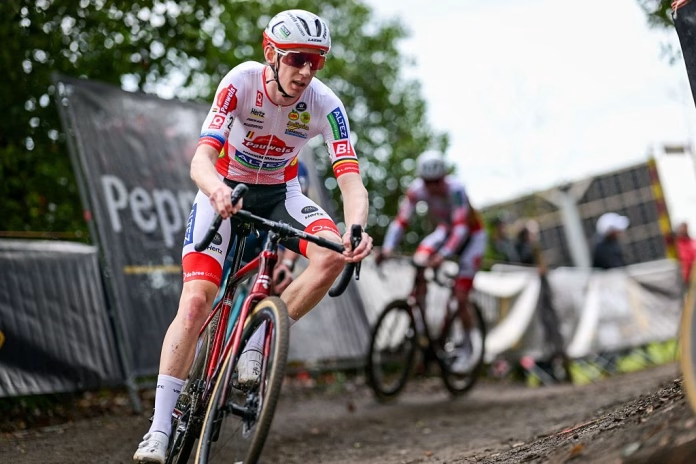
Michael Vanthourenhout returns to one of his most successful early-season venues at HG Cross Meulebeke on Saturday 17 October 2026, but his Pauwels Sauzen–Altez Industriebouw teammates may provide his toughest opposition. The elite men’s race starts at 14:00 BST (15:00 local time), with Vanthourenhout arriving as the Dendermonde winner and Gerben Kuypers fresh from Thursday’s Kermiscross Ardooie victory.
The Berencross is the second event in the renamed HG Cross calendar, formerly Exact Cross, and takes place at Ter Borcht in West Flanders. The organisers have changed the direction of the lap and removed the large bridge, leaving the familiar sandpit, washboard, short banks and steps arranged in a new sequence. It should provide a different kind of test to Dendermonde’s fast opener and Ardooie’s sprint finish.
Last year’s winner Joran Wyseure is another leading contender, alongside Yordi Corsus, Niels Vandeputte, Witse Meeussen and Britain’s Cameron Mason. Laurens Sweeck appears on the published start list but had been ill before Ardooie, making his actual condition and participation important to recheck on race day.
Ter Borcht course: a familiar venue, a different lap
Meulebeke’s circuit is built around Sport- en Recreatiecentrum Ter Borcht, with the start and finish near the football field. A series of compact technical obstacles means riders seldom have long enough to establish a steady rhythm. Short climbs can be ridden quickly when entered with momentum, but a small slip or a stalled remount can cost several places in seconds.
The 2026 layout differs from the courses used for earlier editions of the Berencross. Organisers have taken away the large bridge and reversed the direction of the lap, so previous race footage is not a reliable guide to which section will become decisive. Sand, a washboard section, steps and sharp banks remain, but their order and the speed at which they are approached matter.
The change in direction is particularly relevant for the men because the strongest riders will likely identify different points at which to force the pace. A corner that was a manageable exit before a straight might now place riders immediately onto a technical obstacle. The best line is not necessarily the most obvious line, and first-lap positioning is important for riders hoping to avoid congestion.
If conditions remain dry, the laps may be fast and relatively compressed, making the smallest loss of momentum costly. In wetter weather, the gaps may grow quickly if riders are repeatedly forced to run while others remain on their bikes. Riders who can alternate smoothly between those techniques should find several opportunities to attack.
The course rewards repeated accelerations rather than a single climbing effort. Vanthourenhout’s Dendermonde winning move showed how he can use a technical section late in a race, but his rivals now know they cannot simply wait for the finishing straight. At Ter Borcht, the right attack could begin much earlier if a gap opens at the same obstacle on successive laps.
Vanthourenhout leads a strong Pauwels Sauzen challenge
Vanthourenhout opened the 2026–27 HG Cross season by winning the men’s race in Dendermonde in 59:20. Yordi Corsus finished two seconds behind to complete a Pauwels Sauzen one-two, while Joran Wyseure took third on the same gap and Kuypers fourth. It was an unusually close race, with Niels Vandeputte just four seconds off the winning time.
The final-lap success followed a decisive acceleration and errors from Wyseure on the technical sections. Vanthourenhout’s control under pressure earned him the victory, but the size of the gap showed how many riders could match his speed for most of the race. Our Dendermonde men’s race report has the full finishing order.
Kuypers then won Kermiscross Ardooie on Thursday from a five-rider sprint, beating Meeussen and Vanthourenhout with Mason and Wyseure on the same finishing time. That immediately changed the form picture. A rider who finished behind his teammate on Sunday showed he could beat him in a direct confrontation only four days later.
Pauwels Sauzen can therefore approach Meulebeke with several realistic winning options. Corsus’s second place in Dendermonde was a particularly strong performance, and Kuypers has already demonstrated his finishing speed. Vanthourenhout may remain the reference because of his record at Ter Borcht, but there is little reason for his teammates to ignore their own chances.

Wyseure, Vandeputte and the challengers
Joran Wyseure won Meulebeke’s last edition and finished third in Dendermonde, then fifth in Ardooie. That is a solid early-season sequence, although it has not yet produced a win. His knowledge of the older Ter Borcht circuit will help with the venue’s general character, but the reversed direction means his experience will not necessarily translate into an immediate technical advantage.
Niels Vandeputte was fifth within four seconds of the Dendermonde winner and is another rider likely to thrive on a fast course. He is quick into a rhythm and can produce repeated accelerations if he can find space near the front. A more selective section with few opportunities to recover afterwards might suit an attack from a rider who has struggled to escape from a larger group.
Meeussen was the runner-up in Ardooie, finishing alongside the winner, and Crelan-Corendon can also call on Wyseure and potentially Laurens Sweeck. Sweeck is an established specialist on sand and technical courses, but illness caused him to miss Ardooie. His name on the Meulebeke list is not proof he has fully recovered; his start and physical condition need checking close to the race.
Cameron Mason has shown competitive form this week. The British rider was eighth at Dendermonde and fourth in Ardooie, where he finished on the same time as Kuypers. Felipe Orts, a consistent presence in major European cyclocross races, finished seventh in Ardooie. Both could benefit if the leading Belgian teams spend too much time watching one another.
Joris Nieuwenhuis adds a further threat, particularly on a course where an early attack might force others to make repeated efforts to get back. He has the ability to sustain pressure rather than rely on a short finishing burst. The combination of riders and teams means the race should not be reduced to a straight comparison between Vanthourenhout and Kuypers.
How the men’s race could be decided
First-lap placement could be decisive if the altered obstacle sequence causes traffic problems. A rider starting several positions too far back may lose contact simply because others stall on the steps or in the sand, rather than because he lacks the physical condition. Vanthourenhout and the Pauwels Sauzen riders have enough depth to place more than one rider near the front, but that advantage can disappear if the course becomes too narrow.
A move on the sand or after the washboard section is plausible, particularly if the conditions allow someone to ride the obstacle while others dismount. Yet Dendermonde and Ardooie both demonstrated how competitive this group is: riders who have been separated by a few bike lengths have often found the speed to return on the following straight.
Should a compact selection survive into the final lap, Kuypers and Meeussen have strong recent finishing evidence, while Vanthourenhout has shown he can take the race out of the sprinters’ hands before the line. Wyseure may prefer a harder and more selective race to another five-man sprint after two near misses.
The weather forecast and actual ground conditions on Saturday will be worth checking before making a final judgement. A dry lap could make it difficult for anyone to escape; a slippery entrance to the banks might create a gap that cannot be recovered. This is the kind of cyclocross course where technical details are as important as a rider’s recent placing.
Start time, UK coverage and form guide
The men start at 15:00 CEST on Saturday 17 October, or 14:00 BST. UK streaming is listed via TNT Sports and HBO Max from approximately 13:57 BST, with Belgian coverage through Sporza/VRT. The later TNT Sports 2 television listings include replays rather than a guaranteed live linear broadcast.
The Berencross takes place after the women’s elite race, which starts at 12:45 BST. The same course changes will affect both events, so watching the women’s race can provide a useful guide to which sections are most selective and whether riders are riding or running the sand and banks.
Vanthourenhout’s previous victories at Meulebeke and his Dendermonde win make him the leading pick, but Kuypers and Wyseure have strong claims after the first two events of the week. The Ardooie men’s report provides the best recent guide to their relative finishing speed.
The main tactical question is whether one of those riders can get far enough clear before the final lap to avoid a group sprint. On the new Ter Borcht layout, the answer may depend on a single clean passage through a technical sequence that others cannot match.