The women’s Superprestige heads to Middelkerke on Thursday, 5 November 2026 with Lucinda Brand already setting the pace in the early cyclocross season. The world champion won the opening Superprestige round at Overijse and added the Koppenbergcross on 1 November, but the Noordzeecross is a different assignment: an evening race on the Belgian coast, brought forward from its traditional February position and now held before the European Championships weekend.
Brand sets the form standard, although her participation still requires confirmation from the final start list. Aniek van Alphen and Inge van der Heijden filled the remaining podium places at Overijse, while Amandine Fouquenet won the most recent Middelkerke edition in February. Ceylin del Carmen Alvarado, meanwhile, has already taken a 2026–27 victory at Heerderstrand. Those results give the preview a credible group of contenders to examine without claiming that every rider will be present on Thursday.
Middelkerke moves from February to November
The 2026–27 Superprestige calendar has been rearranged around the World Championships in Ostend, which take place at the end of January. Middelkerke’s Noordzeecross, long established as a February finale, is now the second of eight rounds. The organisers have turned it into a Halloween-themed evening meeting, with elite women racing before the elite men. That creates an unfamiliar setting for a race whose late-winter editions have often decided the series.
A February finale brings an entirely different competitive landscape. Riders may be carrying injuries, fatigue and the accumulated pressure of a long season. A November round instead tests early form, recent racing rhythm and the ability to recover between events. The women have raced on the Koppenberg only four days earlier, and the European Championships at Zeddam follow at the weekend. The proximity of those events may influence who starts, how hard they are prepared to race and whether a rider prioritises a particular championship.
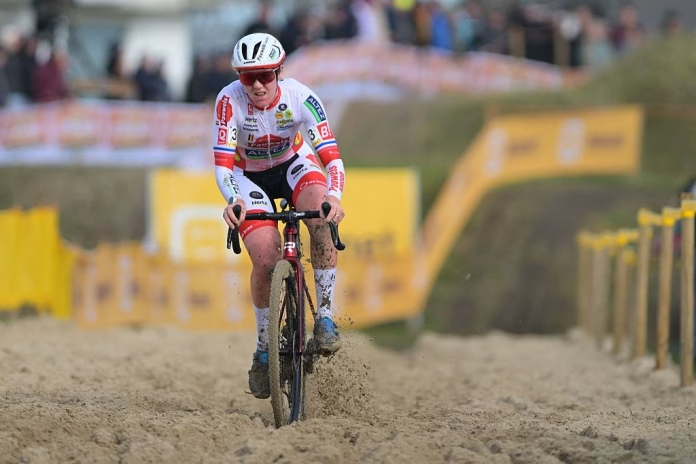
The coastal location is another variable. A course that appears fast during inspection can change quickly when rain softens the ground and repeated laps carve new lines into the corners. Conversely, a dry evening may reward aggressive acceleration and precise handling more than sustained mud-running. It is too early to make a firm claim about the state of the circuit, so the most useful preview is one built around adaptable riders rather than a forecast masquerading as certainty.
Brand’s momentum and why she remains difficult to beat
Brand’s early results have carried the authority of a rider who knows exactly how to manage a cyclocross race. She won at Dendermonde in October, controlled the Superprestige opener at Overijse and then climbed clear at the Koppenbergcross. Those wins were achieved on different types of terrain, which matters more than the headline tally. They suggest she can win through pace, technical efficiency and the judgement to attack at a moment when rivals are already close to their limit.
At Overijse she made the decisive separation while the strongest challengers were still trying to establish their positions. That pattern has become familiar: Brand does not always need a spectacular attack to take control. She raises the speed through the hardest sections, forces rivals to work on the easier ground and then repeats the process until the gaps become difficult to close. In a points series, this reliability can be more valuable than occasional exceptional performances.
The Koppenbergcross reinforced that form. Its steep gradients and repeated accelerations reward strength under fatigue, while Middelkerke may place more emphasis on the handling and tyre choices needed to maintain momentum. Brand has shown throughout her career that she can adjust, but a course with long sandy sections or awkward technical transitions can still create opportunities for riders who specialise in those conditions.
Her early Superprestige victory also changes the tactical picture. If she is on the start line, she does not need to win at any cost to remain well placed overall. A strong podium result would preserve her position. The riders behind her, by contrast, may have an incentive to take greater risks in pursuit of the points they missed at Overijse.
Van Alphen and Van der Heijden have series ambitions
Aniek van Alphen was second at Overijse and comes into the winter as the defending overall Superprestige champion. Her 2025–26 success was built on consistent performances across the series rather than reliance on a single dominant afternoon. That makes her especially relevant at Middelkerke, where the championship is still in its early stages and every finish near the front has value.
Van Alphen also finished third at Heerderstrand in October, recovering ground late in the race as others began to fade. That ability to keep a difficult race together is useful in coastal conditions. She may not always be the first rider to force the decisive move, but she can limit losses when a race breaks apart and capitalise when the early attackers begin to tire.
Inge van der Heijden, third at Overijse, brings a different form of consistency. She has become a regular presence in the leading group and can make the most of a race in which several contenders remain together deep into the final laps. At Niel in 2025 she was second behind Brand, a reminder that she is capable of maintaining pressure on a course that rewards sound technique. Her ability to avoid major errors may be as important as her raw speed.
A single result can carry two very different meanings in a series like this. A rider can be pleased with third place on Thursday while still disappointed not to have challenged for the win. Equally, a rider targeting the European Championships might treat Middelkerke as an opportunity to test equipment and racing rhythm rather than take every possible risk. Those priorities are not always obvious from the outside.
Fouquenet and Alvarado offer different threats
Amandine Fouquenet has the strongest recent connection to this particular venue. She won the February 2026 Noordzeecross, a breakthrough victory that helped confirm her status among the leading international cyclocross riders. A change of season and likely conditions means that result cannot simply be carried forward, but knowing where time can be gained on the circuit is useful. If she starts, her ability to attack on difficult terrain makes her a serious candidate.
Ceylin del Carmen Alvarado has also shown encouraging early form. The Dutch champion won at Heerderstrand on 24 October after a closely contested race, breaking clear through the sandy sections on the final lap. She beat Denise Betsema and Van Alphen, with Manon Bakker also prominent. The result was a reminder that Alvarado can find speed precisely where a rival is beginning to struggle with traction or bike handling.
Alvarado’s 2026 victory at Heerderstrand followed a winter in which she had already demonstrated her technical quality in the sand. That does not establish her Middelkerke participation, but it does identify a possible route to beating Brand if both line up. Rather than trying to match the world champion’s rhythm everywhere, a challenger can aim to make the race irregular, forcing accelerations and changes of line that prevent a long, even effort.
Fem van Empel adds another intriguing question to the season. After stepping away from competition, she returned in October with a more measured programme and finished fifth at Heerderstrand. She remains one of the most naturally gifted cyclocross riders of her generation, but a comeback should not be judged against the standard of her strongest championship seasons. Her schedule and priorities need confirmation before she can be treated as a likely Middelkerke starter.
What could decide the women’s race
Start position is important on any compact cyclocross circuit, but especially one where a narrow corner or sandy section can create a queue. A rider who loses several places in the opening minute may have to spend much of the first lap recovering ground, while those at the front can choose their own lines. The first technical passage will be worth watching as closely as the first attack.
Tyre pressure can turn a small advantage into a repeatable one. Softer ground generally encourages riders to search for traction, but very low pressure carries its own risks, including impacts and instability. Teams will balance rolling speed on firm ground against control in sand, mud and off-camber corners. A set-up that works in the opening laps may become less effective if the surface changes.
The pit is another potential dividing line. A bike change can clear accumulated mud and restore clean shifting, but it costs time and disrupts rhythm. The decision depends on how quickly the course is deteriorating and how much of the lap remains. A leader who changes at the right moment can extend an advantage without appearing to ride any faster; a rival who delays can lose time at every difficult corner.
The decisive difference may be which rider still handles the bike cleanly when fatigue begins to affect concentration. At elite level the differences in power are often small. Mistakes at the end of a long lap, when concentration slips and arms become tired, can create the decisive gap. The strongest rider on paper is not always the one who handles that moment best.
How the series and championships affect the race
The Superprestige awards points across eight races. Overijse opened the competition on 25 October; Middelkerke is followed by Niel and Merksplas in November, then Ruddervoorde, Heusden-Zolder, Diegem and Gullegem. Brand’s opening victory puts her in control for now, but the championship remains wide open. Van Alphen and Van der Heijden are well placed to apply pressure if they continue to finish consistently.
The European Championships in Zeddam take place over the following weekend. That creates a scheduling complication unusual for a midweek Superprestige round. Some riders will be thinking about national-team selection, recovery and the possibility of wearing a championship jersey. Others will be targeting the series above all else. Until the definitive start lists are published for both events, it is better to explain those competing priorities than to pretend every contender has the same plan.
The women’s elite race is scheduled for the evening of Thursday, 5 November, before the men’s event. Provisional listings differ slightly on exact start times, so the organiser’s final programme should take precedence. For background, see ProCyclingUK’s Middelkerke race history, Overijse women’s report, Alvarado’s Heerderstrand victory and Brand’s Koppenbergcross win.
2026 Superprestige Middelkerke startlist
The definitive elite women’s start list has not yet been verified. The names above are contenders identified through recent results and course suitability, not a confirmed list of entrants. Check the organiser’s final published entry list before race day.