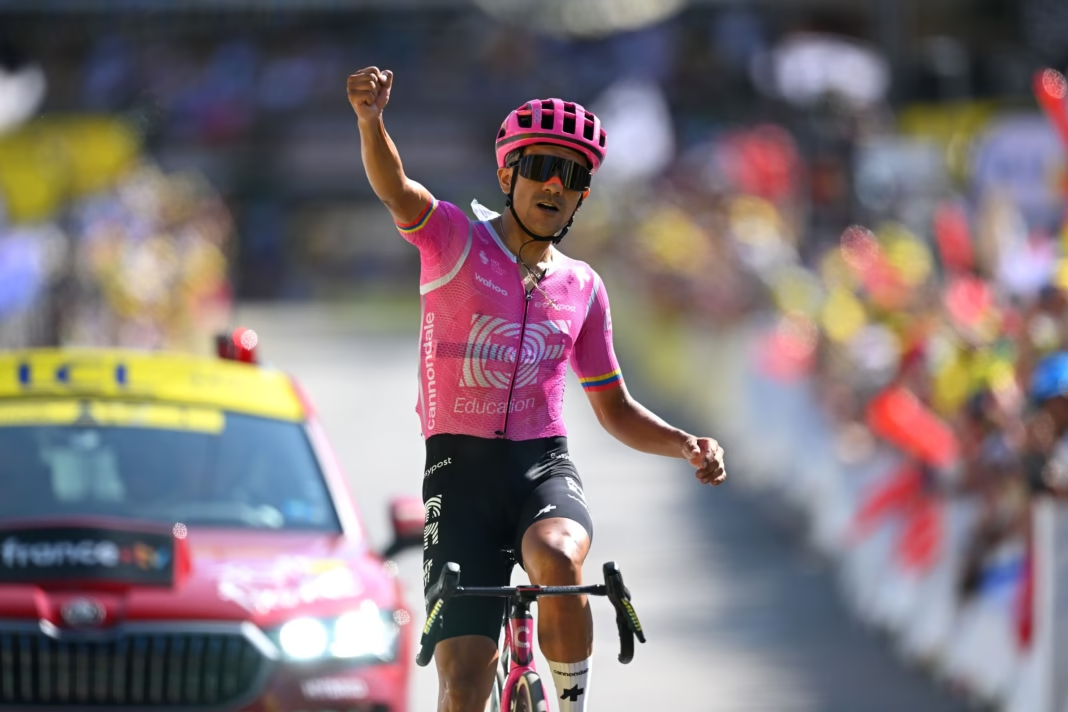
Overijse’s Druivencross is one of the oldest and most distinctive races in cyclocross. Held in the hills south-east of Brussels, it combines steep climbs, cobbled sections, awkward descents and narrow corners on a circuit where a single mistake can decide the result. Riders have been racing here since 1960, helping explain why the event is often called the Mother of All Crosses.
The race is also known as the Vlaamse Druivenveldrit, a reference to the grape-growing tradition around Overijse. It belongs to the winter cyclocross calendar rather than the summer Druivenkoers road race, which takes place in the same wider area but is a completely different event. Looking up Overijse results without specifying cyclocross can easily bring up the wrong palmarès.
For the 2026–27 season, Overijse is the opening round of the eight-race Telenet Superprestige on Sunday 25 October 2026. The first standings of the winter series will therefore be decided on the same circuit that has produced memorable victories for Roland Liboton, Sven Nys, Mathieu van der Poel, Fem van Empel, Lucinda Brand and many others.
The most recent elite winners are Michael Vanthourenhout and Sara Casasola in October 2025. Their victories came in different ways: Vanthourenhout escaped from Pim Ronhaar late in the men’s race, while Casasola took control of the women’s contest after a fall cost Brand ground. The course was dry enough for fast riding in places, yet difficult enough to punish any lapse in concentration.
Why Overijse is called the Mother of All Crosses
The first recorded men’s edition dates to 1960, won by Pierre Kumps. The event subsequently became associated with Belgium’s long cyclocross tradition, regularly attracting the leading riders in a period when the discipline was much more concentrated in Belgium, the Netherlands and neighbouring countries than it is today.
One name stands above the rest of the men’s historical winners: Roland Liboton, who won 15 times between 1978 and 1987, a total boosted by years when the event was held more than once during the same winter. Erik De Vlaeminck accumulated nine victories, while Roger De Vlaeminck and Sven Nys each won six. The prominence of these riders in the roll of honour shows how the race predates today’s overlapping World Cup and Superprestige calendars.
Overijse has never been defined solely by the result sheet. The climbs, changing grip and physical demands became a reference point for generations of Belgian racers. Riders who could dominate a flatter, faster circuit sometimes found themselves struggling here against opponents better able to handle repeated steep efforts.
The women’s race became established in the early 2000s, with Daphny van den Brand collecting four victories and helping create a lasting women’s elite tradition. More recent winners include Katie Compton, Sanne Cant, Pauline Ferrand-Prévot, Lucinda Brand, Fem van Empel, Puck Pieterse and Sara Casasola. The last several years have produced a different women’s winner each year rather than a single rider dominating.
The Overijse cyclocross course: cobbles, climbs and fast decisions
The event uses a compact course around Overijse rather than a long off-road route. Its defining features are short, steep climbs, cobbled stretches and technical changes of direction. Riders can be riding hard out of a corner one moment and dismounting to run up a muddy bank the next. The repeated changes of speed are as decisive as the total metres climbed.
One famous feature is the Tenotsberg, associated with the 2006 race when Sven Nys suffered a broken chain and had to run uphill with his bike. Other editions have used sharply turning meadow sections, a climb through the woods and a technical downhill late in the lap. The exact layout changes between seasons, so descriptions of one year’s obstacles should not be mistaken for a permanent, metre-by-metre route.
The cobbles make tyre selection difficult. A harder, drier day may tempt riders towards faster-rolling tyres, but damp stones and shaded wooded sections can still be treacherous. In deep mud, grip and the ability to clear mud from the frame become more important. Teams choose tyres and pressures after practice laps, and those choices may change if rain arrives before the elite races.
At Overijse, the quickest line through a corner is not always the shortest. A rider carrying a little more speed onto a technical descent can gain seconds without making a visible attack. Conversely, catching a rut at the wrong angle or getting caught behind someone running can turn a narrow lead into a chase within half a lap.
 Photo Credit: Getty
The circuit also helps explain why a strong start matters. Races quickly string out through the narrower turns and steep sections. A rider trapped in the middle of the field may spend the first two laps taking risks merely to reach the leading group, while the front riders can select their lines without being slowed by anyone ahead.
Overijse previous winners: men and women
The recent winners show the range of riders suited to Druivencross. Pure power matters, but the list also contains exceptional bike handlers and riders known for difficult, muddy races. The table below covers recent completed editions up to 2025. It does not include a 2026 winner because this year’s race takes place on 25 October.
| Edition | Men’s winner | Women’s winner |
|---|---|---|
| 2025 | Michael Vanthourenhout | Sara Casasola |
| 2024 | Thibau Nys | Lucinda Brand |
| 2023 | Eli Iserbyt | Fem van Empel |
| 2022 | Michael Vanthourenhout | Puck Pieterse |
| October 2021 | Eli Iserbyt | Kata Blanka Vas |
| January 2021 | Wout van Aert | Ceylin del Carmen Alvarado |
| 2019 | Mathieu van der Poel | Annemarie Worst |
| 2018 | Toon Aerts | Lucinda Brand |
| 2017 | Mathieu van der Poel | Pauline Ferrand-Prévot |
| 2016 | Mathieu van der Poel | Sophie de Boer |
There were two races recorded in 2021, one in January and another in October, following the disrupted winter calendar around that period. Listing both as simply ‘2021’ would create a misleading impression that the results conflict, so they are separated in the table. The current annual schedule does not necessarily reproduce that older pattern.
The men’s list includes the same winner in 2022 and 2025, as Vanthourenhout has shown he can win on this course under different conditions. In the women’s event, Brand’s victories are separated by six years, in 2018 and 2024. The list also includes several riders who made their names across both cyclocross and road or mountain-bike racing.
The races belong to a much longer history. Not every early edition had the same status on international calendars or an equivalent women’s programme, so all-time totals and comparisons need to be interpreted in that context. The modern dual elite programme offers a more consistent basis for comparing the past decade.
The defining men’s races and long-running rivalries
Sven Nys’s relationship with Overijse illustrates its reputation for difficult racing. He won six times, but there were also years when mechanical trouble or controversy overshadowed the sporting result. During the 2006 event, his broken chain on the Tenotsberg turned a climb into a running effort. The race became part of his wider cyclocross history rather than simply another line on a results list.
Mathieu van der Poel’s run of victories in 2015, 2016 and 2017, followed by another in 2019, came during the period when he and Wout van Aert were redefining the leading men’s races. Overijse was particularly well suited to Van der Poel’s ability to accelerate over short climbs and carry speed through technical corners, although the conditions could still present problems.
More recently, the 2024 event became notable for Thibau Nys claiming his first Superprestige victory. He beat Eli Iserbyt after repeated attacks and responses on a hard course, with Lars van der Haar finishing third. A year later, Vanthourenhout’s decisive acceleration on the final lap dropped Pim Ronhaar and gave him the 2025 victory.
These are examples of how Overijse tends to reward repeated pressure rather than waiting for one long attack. A rider may be unable to create a large gap on a climb, yet use a superior descent immediately afterwards to turn a few bike lengths into a meaningful lead.
The women’s winners: a changing generation
Daphny van den Brand was an early reference point in the women’s race, recording four victories across its formative editions. Katie Compton later won three consecutive editions from 2011 to 2013, while Sanne Cant and several other leading specialists added their names to the honours. The women’s event now attracts much of the same international depth as the major winter series.
Fem van Empel won in 2023, ahead of Ceylin del Carmen Alvarado and Inge van der Heijden. Her acceleration and smooth handling made the course look manageable, but the gaps behind her showed how hard it was for the other favourites to keep matching the pace.
In 2024, Brand rode one of her strongest early-season performances, holding off Van Empel by ten seconds and Casasola by 35. The finishing order emphasised how closely matched the top riders could be on a course where a small mistake or moment of hesitation would immediately change the chase.

The 2025 women’s race changed in the final stages. Casasola and Brand had been the decisive pair, but Brand lost ground after a crash and the Italian went on to win in 45:53. Brand finished 28 seconds behind, with Aniek van Alphen at 37 seconds. That result gave Casasola a major early-season victory and demonstrated that being the strongest rider for most of the race does not guarantee the win at Overijse.
The women’s roll of honour remains useful when assessing new editions, though an early-season start list can include riders at very different points in their winter preparation. A previous winner may be returning from a road campaign, concentrating on the World Cup or starting cyclocross later in the autumn.
Where Overijse fits in the 2026–27 Superprestige
The Telenet Superprestige is a season-long series rather than a single championship race. In 2026–27 there are eight rounds, with riders accumulating points as the winter progresses. Overijse opens the competition on Sunday 25 October 2026, replacing the earlier-season opening role that Ruddervoorde has often held in previous editions.
The confirmed sequence is Overijse on 25 October, Middelkerke on 5 November, Niel on 11 November, Merksplas on 14 November, Ruddervoorde on 6 December, Heusden-Zolder on Christmas Day, Diegem on 30 December and Gullegem on 2 January 2027. The calendar includes evening and holiday races, making the series more varied than a collection of ordinary Sunday afternoons.
The shift of Middelkerke into November is related to Ostend hosting the 2027 World Championships in late January. Ruddervoorde consequently moves to December. For spectators, the changes mean that familiar races appear in a different order and that the first Superprestige points of the season will come from the Overijse hills.
The organisers’ provisional programme for 25 October lists the elite women at 13:40 Belgian time and the elite men at 15:10. Because the clocks change in both countries that morning, these are approximately 12:40 GMT and 14:10 GMT in the UK, not BST. Always check the latest organiser programme and broadcaster listings closer to the race.
The venue information places the event around Begijnhof in Overijse, with the elite programme following the junior races. Spectators should consult the official parking and admission arrangements before travelling, particularly because local roads and access points can be restricted on race day.
What makes a good performance at Overijse?
The decisive part of Overijse can come at any point in the race. A hard acceleration on the wooded climb may separate the top riders; an error on the descent may then change the lead completely. Riders who repeatedly take slightly better lines can save energy on each lap and still have enough left to attack near the finish.
The best riders here combine aerobic strength, quick handling and the judgement to recognise when running is faster than riding. Wet conditions can increase the influence of equipment and pit strategy, while drier ground tends to produce faster laps and closer racing. The same course can therefore favour different strengths from one year to the next.
A new viewer should pay particular attention to changes in the gap over a complete lap. Someone who loses five seconds on the steep climb but gains six through the technical turns is not necessarily weaker. Watching the same riders at the same obstacle on successive laps often explains the result better than simply following who is leading on the screen.
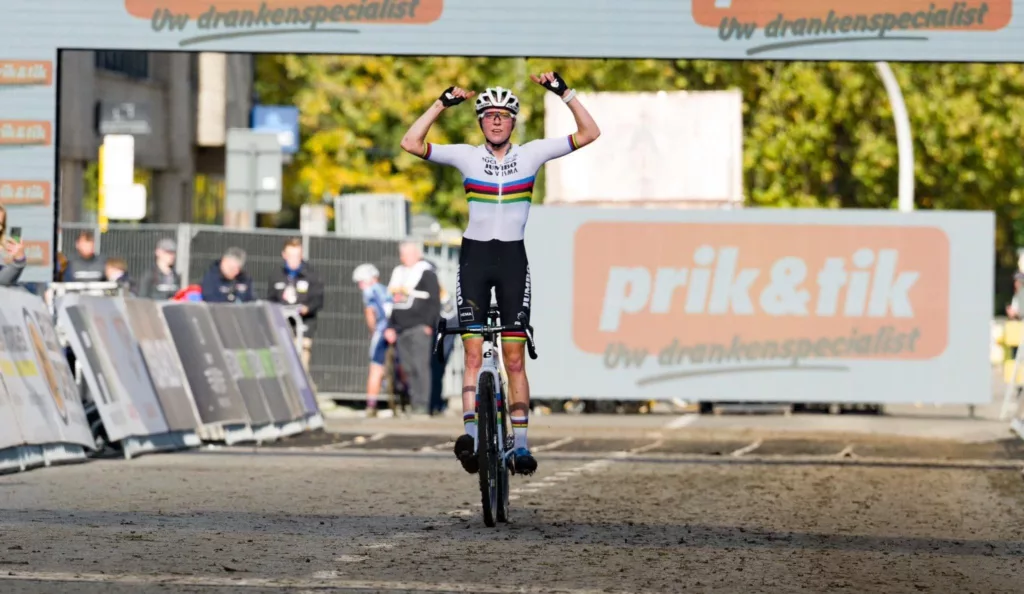
For an explanation of how lap counts, tyre restrictions, running sections and bike changes work, see our beginner’s guide to cyclocross racing and rules. Recent women’s Dendermonde results and men’s Dendermonde results show the type of close early-season racing that often shapes expectations before Superprestige begins.
What to watch for at the next Overijse race
The immediate attraction of the 2026 edition is its place at the beginning of the Superprestige season. There are no existing points gaps to defend, so riders and teams can focus on winning rather than managing a series lead. That may make the opening laps more aggressive than a late-season round where the overall classification is already taking shape.
It is still important not to turn the past-winners list into a prediction. The course configuration, weather and start list can change, and different riders may begin their cyclocross campaigns at different times. The correct favourites will only become clear once the start list is available and the season’s early results have been assessed.
Overijse is worth following whatever the conditions. More than sixty years of racing have left an unusually rich record, but the basic contest is unchanged: who can climb, corner, carry and accelerate most consistently for roughly an hour? On 25 October, the next names will be added to the men’s and women’s roll of honour.