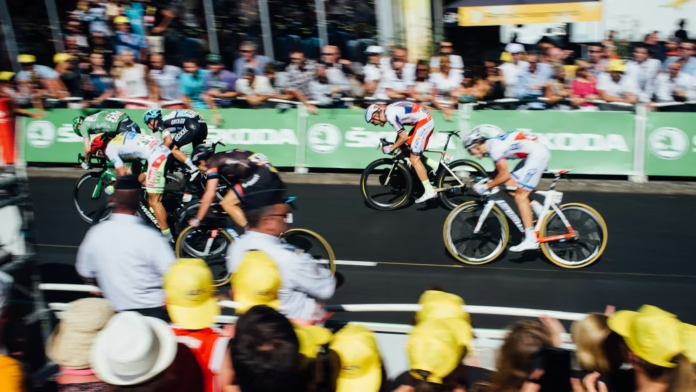
A sprinter does not need four teammates in front of them to win a bunch finish. A well-drilled lead-out train makes positioning easier and protects a rider from the wind, but a rider without that support can still win by reading the final kilometres, using other teams’ momentum and choosing the right moment to accelerate. The crucial skill is choosing a wheel that offers both shelter and a way out. It is arriving at the launch point with enough speed, space and energy to make the sprint count.
That distinction explains why riders sometimes beat more heavily supported rivals. A team can spend several kilometres controlling the front only to deliver its sprinter too early, while an opponent who has saved energy in the wheels comes past in the final metres. The unsupported sprinter must make more decisions personally, and a single wrong choice can leave them boxed in or exposed to the wind.
What a lead-out normally provides
A lead-out train is a sequence of teammates who increase the pace and guide a sprinter towards the front of the bunch. Earlier riders help with positioning, while the final lead-out rider aims to deliver the sprinter to a point where they can accelerate without wasting energy. The exact number of riders varies with the team, the route and the strength of the sprint field.
The main advantage is not just the speed of the final teammate. It is the ability to protect a sprinter from repeated accelerations, crosswinds and the need to fight for position through every corner. A rider who is sheltered for the last few kilometres may reach the final 200 metres with more usable power than someone who has spent that period moving through traffic.
A lead-out is not infallible. A team may lose its sprinter at a roundabout, enter a bend too far back, or launch its final rider into a headwind too early. A fast train also creates a tempting wheel for opponents. When a rival attaches themselves to the last rider in a train, the team can end up doing much of the work for a competitor.
Finding the right wheel without a teammate
An unsupported sprinter needs to identify which teams are likely to control the finish. That is a judgement based on the strength of their lead-out, the road ahead and the behaviour of the bunch. The fastest rider on paper is not always the best wheel to follow if their team is already badly positioned.
A useful wheel offers shelter and carries the sprinter forward without requiring a long effort in the wind. Following a rival’s final lead-out rider can be effective, but it is rarely as simple as attaching yourself and staying there. Other sprinters are trying to occupy the same space, and the best position can change after a corner or a short climb.
Riders also need an exit route. A wheel that looks perfect with 500 metres remaining may become a trap if the rider ahead hesitates or runs out of speed. Experienced sprinters constantly assess whether there is room to accelerate on either side. They must do that without forcing unsafe gaps or deviating dangerously once the sprint has begun.
Positioning is decided before the final 200 metres
The television picture often makes a sprint look like a contest that begins with the first acceleration. In reality, much of the outcome is determined in the previous two or three kilometres. Riders need to be close enough to the front to avoid traffic, but not so exposed that they spend the entire approach fighting the wind.
The correct position depends on the finish. A wide, straight road may allow a rider to move up later than a narrow approach with several corners. A roundabout or pinch point can make the order entering it decisive, while a headwind can discourage teams from leading for too long. There is no universal rule that the sprinter must be fifth or tenth wheel at a particular kilometre marker.
Without a lead-out, the rider has to anticipate these changes. Moving up too early can waste energy and leave them exposed. Waiting too long can make the final sprint irrelevant because the road is already full. The best unsupported riders are often those who make small, efficient changes of position rather than one enormous surge from the back.
Using other teams without being boxed in
Riding behind another team’s train is a legitimate part of sprint tactics. The leading team creates speed and shelter, and an opponent can benefit from that work if they remain correctly positioned. This is sometimes described as surfing wheels, but the important point is that the sprinter is making a series of rapid choices rather than passively being carried to the finish.
A train can change shape as its riders finish their turns. The final lead-out rider may peel away, another team may surge past, and a sprinter who was well placed can suddenly find themselves behind someone who is slowing. A rider without teammates needs to read those changes early enough to avoid braking or making an unsafe move.
Freedom from one particular train can be an advantage. A supported sprinter may feel committed to the work their team has done, while an independent rider can choose whichever line is moving fastest. That flexibility only helps if the rider has the confidence and experience to switch wheels without wasting speed.
The downside is that other riders may not allow the outsider to sit comfortably on their chosen wheel. Position is contested at high speed, and a rider who spends too much energy fighting for one particular place may be better served by finding a different route through the bunch.
When to launch the sprint
There is no fixed launch distance that works for every finish. On a flat finish in relatively calm conditions, many riders begin their final effort somewhere around 200 metres from the line, but the wind, gradient and speed of the bunch can move that decision considerably. Into a headwind, waiting longer can be an advantage because the rider in front bears more aerodynamic cost. With a tailwind or downhill finish, an earlier acceleration may be harder to close.
An unsupported sprinter must judge when the rider ahead is beginning to slow. If they wait until the wheel loses speed, they may have to brake before accelerating, which costs precious momentum. If they launch too early, the riders behind gain shelter and can come past before the line. The right decision often lasts only a second.
Raw power cannot compensate for every tactical mistake. The ability to accelerate from an already high speed, maintain an efficient position and continue driving through the line can be more important than the highest number recorded on a power meter. A rider who launches from the wrong position may produce an impressive sprint and still finish outside the top ten.
Wind, corners and the finish profile
A headwind finish makes the shelter of another rider especially valuable. A sprinter without a train may deliberately wait behind the leaders, forcing supported rivals to open the sprint first. In a tailwind, the speed of the group is higher and the opportunity to come around can be shorter. The same launch that works into a headwind may be too late when everyone is travelling faster.
Corners create another problem. A rider who enters a bend in the right position can accelerate onto the straight without having to pass several competitors. Someone who takes the corner badly may lose momentum and be forced into a longer sprint. The UCI has tightened its expectations for bunch-sprint finishing straights, including a minimum 200-metre straight in its 2026 safety amendments, but the approach to that straight still matters.
Small changes in gradient can also change the best strategy. A slight rise near the finish rewards riders who can maintain power while others fade, while a downhill run-in increases speed and makes passing more difficult. The unsupported sprinter must recognise those features before the race reaches the final kilometre. Waiting to discover the finish profile in the sprint itself is too late.
What the rules mean for an independent sprinter
An unsupported sprinter does not receive any exemption from the rules. Sprinting is not a licence to push rivals aside or move unpredictably across the road. UCI regulations prohibit dangerous deviations from the chosen sprinting line that obstruct or endanger other riders. A rider can be relegated or face further sanctions even after crossing the line first.
That matters when a sprinter is trying to escape from a poor wheel. There is a difference between moving into available space before launching and swerving across another rider’s path once the sprint is underway. The quickest line is not always a legal or safe line, and a rider who takes an unnecessary risk can lose the result entirely.
The race jury also distinguishes sprint conduct from incidents affecting the general classification in stage races. The familiar three-kilometre incident rule, sometimes extended to five kilometres on approved stages, concerns time credited after certain late incidents. It does not give a rider permission to obstruct someone else in a sprint or guarantee a particular finishing position.
How teams and riders prepare for this situation
A good sprint team prepares for the moment its lead-out falls apart. A puncture, crash, wrong turn or a particularly aggressive rival can leave a sprinter alone in the final kilometres. Preparation therefore includes reading the route, identifying the fastest rival trains and agreeing on a fallback approach if the team loses contact.
A rider may have one teammate available to position them before the final kilometre rather than a full train. That support can still be valuable. The teammate can help them avoid traffic and deliver them to a useful wheel, after which the sprinter makes the final decisions independently. The distinction between a full lead-out and no support at all is not always clear-cut.
For a useful comparison, see how sprint lead-outs work in women’s cycling and our look at the leading Tour de France lead-out riders. The broader tactical question of when teams commit to chasing a breakaway is covered in how cycling teams calculate a breakaway chase.