Ruddervoorde’s greatest asset is a field. Not a forest, a stretch of dunes or an imposing hillside, but a meadow in West Flanders where the organisers have spent decades manufacturing a selective cyclocross course. Since joining the Superprestige in 1998, the race has produced long winning runs by Mathieu van der Poel and Eli Iserbyt, but also finishes decided by a couple of seconds.
The village lies in the municipality of Oostkamp, south of Bruges. What makes its cyclocross unusual is how much racing can be squeezed into a single field. The course builders have created a permanent sand section, artificial changes of elevation and a succession of tight corners on land that would otherwise offer little natural climbing. It is a race where the fastest rider on paper can find themselves having to sprint repeatedly just to stay in contact.
Eli Iserbyt and Mathieu van der Poel both won four successive editions of the men’s race. Ceylin del Carmen Alvarado has won four times in the women’s event, while Helen Wyman helped establish the elite women’s race in the early 2010s. Ruddervoorde’s recent winners also include Joran Wyseure, Michael Vanthourenhout and Marion Norbert Riberolle.
From the Baliebrugge village fair to the Superprestige
The origins of the event are local rather than commercial. In 1984 the Sint-Godelieve neighbourhood committee began organising road races for juniors at the April fair in Baliebrugge. Four years later it changed disciplines, encouraged by local cyclocross rider Kris Devlaeminck. The first cross was a B-category event, rather than a meeting with the best professionals in Belgium and the Netherlands.
An elite race followed in 1992. The committee’s big breakthrough came in 1998, when Ruddervoorde joined the Superprestige and also hosted the Belgian championships for younger age groups. Sven Vanthourenhout, who went on to race professionally and later became Belgium’s national coach, won the junior title that year. His namesake Michael Vanthourenhout would win the senior Superprestige race much later.
Joining the Superprestige changed what was at stake on the field in Baliebrugge. In a standalone race, losing third place on the final lap costs a podium. In a points-based winter series it can also cost a rider the lead in the classification, particularly when the rider moving ahead is a direct rival for the title. The local committee gained a regular place on the professional calendar without losing the identity of the event.
Ruddervoorde has often opened the series in October, but that is not a permanent feature of the calendar. Its date in the 2026-27 season is Sunday, 6th December. That makes this edition a different test from the October races of the past, with riders deeper into the winter campaign and the series already underway.
How the Ruddervoorde course works
There is no lengthy natural climb to break up the field at Ruddervoorde. Instead, the organisers have built a compact circuit around artificial ramps, sand, steps and bridges. The hard work comes in short bursts: a sprint out of a corner, a brief climb, a descent and another effort to get back up to speed. Riders who can carry momentum through the turns have fewer accelerations to make.
The sand is particularly important. A rider who enters the sand with speed may be able to ride a section that another rider has to run. Conversely, a strong runner can sometimes overtake someone who persists with trying to pedal a line that has become too difficult. In a small leading group, the decision has to be made with other bikes immediately ahead and behind, which can remove the option of choosing a clear rut.
The repeated climbs are short enough that positioning is often more valuable than climbing at a steady rhythm. Approaching one of the ramps in fourth or fifth wheel can mean losing momentum behind the riders ahead. If the leader opens a few metres over the crest, the chasers must close it again on terrain that offers few opportunities to recover. A sequence of these efforts over the course of an hour is very different from climbing a single long hill.
The organisers have installed drainage on the site, which helps explain why Ruddervoorde is not automatically transformed into the sort of deep mud race associated with some Belgian venues when the weather deteriorates. That does not make a wet race straightforward. Slippery corners and wet grass still change where it is possible to accelerate, and a rider who enters each bend too quickly may surrender more ground through braking than they gained on the preceding straight.
A paved finishing stretch was added inside the field in the 2010s. That provides a conventional sprint finish after an otherwise unconventional lap, although the layout and direction of individual features can change between editions. The close proximity of different sections also makes it an excellent venue for spectators who want to follow a developing battle rather than watch a rider pass just once per lap.
Sven Nys and the changing generations of men’s winners
The first generation of Superprestige regulars at Ruddervoorde was defined by Sven Nys. His long career straddled the rise of Bart Wellens and Niels Albert, and his ability to convert difficult sections into repeated small gains suited a venue on which the opposition could rarely afford to switch off. The early race records are dominated by Belgian riders, long before Van der Poel began his four-year sequence.
The 2009 Belgian championships at Ruddervoorde were a separate event from the regular Superprestige round. Nys won the men’s national title after a contest with Niels Albert, while Joyce Vanderbeken took the women’s title ahead of a young Sanne Cant. It is worth distinguishing a championship victory at the venue from a win in the annual series race when comparing riders’ records.
The subsequent transition in the men’s field is easy to see in the results. Tom Meeusen won in 2014 and Kevin Pauwels in 2015. Mathieu van der Poel then took the next four editions from 2016 to 2019. The Dutchman’s explosive accelerations and confidence on difficult ground were well suited to a circuit that offers little time to settle into a rhythm behind the leader.
Eli Iserbyt matched that sequence with victories from 2020 to 2023. The run coincided with his emergence as one of the most important riders in the regular season-long competitions. It also demonstrated the importance of availability. A rider contesting most rounds of the Belgian series can accumulate a record at individual venues that riders with more selective winter programmes may never have an opportunity to match.
Helen Wyman, Sanne Cant and Alvarado’s four victories
The women’s race has its own history rather than simply being a later version of the men’s. Helen Wyman won the 2011 edition ahead of fellow British rider Nikki Harris, later known as Nikki Brammeier. Wyman repeated the victory in 2013, again with Harris second. For British cyclocross followers, those results are a reminder of how much success the country’s specialist riders enjoyed in Belgium before the more recent generation of British road and off-road stars arrived.
Sanne Cant won back-to-back editions in 2014 and 2015. The following three years brought victories for Sophie de Boer, Maud Kaptheijns and Marianne Vos respectively. Vos’s 2018 victory sits within an extraordinary career across road cycling and cyclocross, whereas the other names show the depth of specialists who could win major Belgian races in that period.
Alvarado won in 2019 and 2020 before Denise Betsema took consecutive editions in 2021 and 2022. Alvarado returned to the top in 2023 and 2024 to reach four victories. Unlike the four-year runs in the men’s race, her record was built in two spells, interrupted by Betsema’s success. In the women’s series, that period also saw the emergence of Fem van Empel and a changing competitive balance between established champions and younger riders.
The races of 2024 and 2025
Two laps from the finish in 2024, Joran Wyseure made the move that finally interrupted Iserbyt’s winning run. Niels Vandeputte finished just two seconds behind him and Michael Vanthourenhout was third at ten seconds. Wyseure’s first Superprestige victory came on a course where an attack was hardly guaranteed to survive the final turns.
The women’s finish was equally competitive. Alvarado held off Fem van Empel and Lucinda Brand, both three seconds down, to establish a fourth victory at Ruddervoorde. The calibre of the chasing pair made this one of the most significant of her wins at the venue. For both races, it was the first round of the 2024-25 series.
A year later Vanthourenhout finally took the men’s win. He and Joris Nieuwenhuis were given the same time of 1:01:51, with Niels Vandeputte two seconds back. The outcome reinforced the possibility of a small group surviving to the closing stages despite the technical nature of the course. In such circumstances, the last passage through the sand can be as important as the actual sprint.
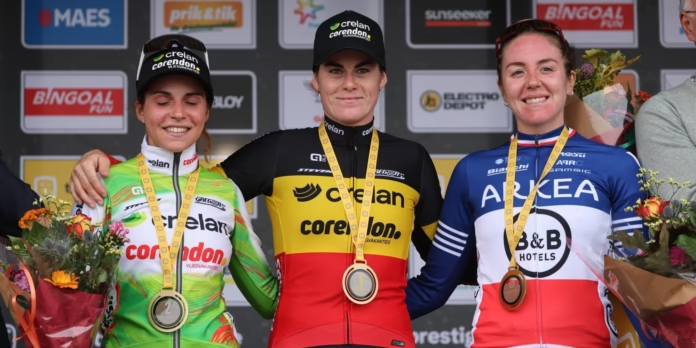
The women’s 2025 winner was Belgian champion Marion Norbert Riberolle. She finished five seconds ahead of Sara Casasola and Amandine Fouquenet. It was a particularly interesting podium after several years in which Dutch riders had dominated the venue, with Belgium, Italy and France represented on the steps.
Recent Ruddervoorde winners
The following results refer to the annual elite race, not the Belgian championships or junior events. They cover the period from 2016, when Van der Poel began his run, through the most recent completed edition.
| Year | Men | Women |
|---|---|---|
| 2025 | Michael Vanthourenhout | Marion Norbert Riberolle |
| 2024 | Joran Wyseure | Ceylin del Carmen Alvarado |
| 2023 | Eli Iserbyt | Ceylin del Carmen Alvarado |
| 2022 | Eli Iserbyt | Denise Betsema |
| 2021 | Eli Iserbyt | Denise Betsema |
| 2020 | Eli Iserbyt | Ceylin del Carmen Alvarado |
| 2019 | Mathieu van der Poel | Ceylin del Carmen Alvarado |
| 2018 | Mathieu van der Poel | Marianne Vos |
| 2017 | Mathieu van der Poel | Maud Kaptheijns |
| 2016 | Mathieu van der Poel | Sophie de Boer |
What to watch when the race returns
The useful thing about the December date in 2026 is that the racing can be read against an established Superprestige classification. The race remains the same technical examination, but the incentives for a rider protecting a series lead will differ from those of someone trying to recover points lost in November.
Watch how the leading riders position themselves immediately before the sand and whether the same rider consistently exits it with a gap. That is a better guide to who has the technical advantage than a single spectacular acceleration elsewhere on the lap. A rider repeatedly having to chase back after the sand may still be in the group with two laps remaining, but they will have spent a disproportionate amount of energy getting there.
The series standings can also affect the willingness of riders to chase. A rider who already holds a healthy advantage may prefer to follow their principal championship rival rather than expend energy pursuing a rider who poses little threat to the overall classification. The change of date in 2026 makes this particularly relevant, as the contenders will have results from earlier Superprestige rounds to take into account. The wider 2026-27 cyclocross calendar also puts the event in context alongside the World Cup and other winter competitions.
-
 Photo Credit: Nicolas ANCEAU / Wikimedia Commons