
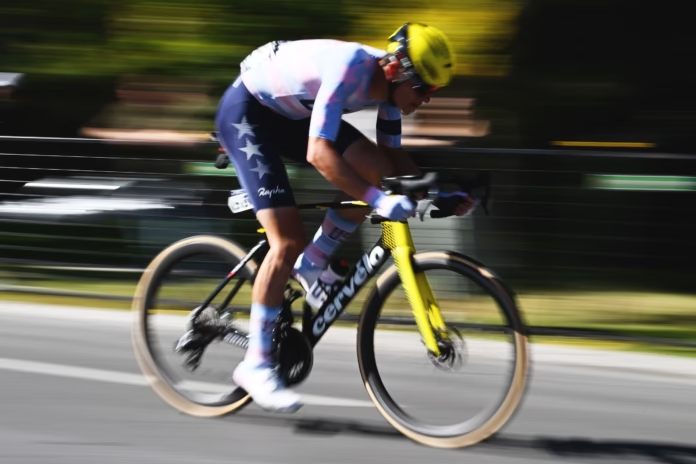
Ashlin Barry won the men’s U23 road race world title in Montréal, turning his 19th birthday into the biggest victory of his career so far. The United States rider finished the 174.2km race in 4:17:35, with Héctor Álvarez taking silver at 53 seconds and Jesper Stiansen winning bronze on the same gap.
Aubin Sparfel was also credited at 53 seconds in fourth, while Niels Driesen and Matteo Scalco followed at 55 seconds. Barry’s winning margin stood out after a race in which the chase behind him repeatedly changed shape on the Mount Royal circuit.
The U23 men completed 13 laps and around 3,497 metres of climbing on the same Montréal roads covered in our 2026 World Championships course guide. Barry had already finished fourth in the U23 time-trial earlier in the week, but the road race gave him the rainbow jersey on the day he turned 19.
How it unfolded
The opening phase was active almost immediately. The live race feed recorded repeated attacks from the peloton with 173km, 168km and 163km remaining before Romet Pajur counter-attacked at 161km to go. The first named incident away from those early moves came at 152km, when Manuel Sanroma crashed in the peloton.
Eñaut Urkaregi and Jaka Marolt countered at 151km, Samuel Novák moved at 146km and another sequence of attacks followed at 140km. Novák went again at 132km before William Heffernan countered at 129km. Ireland then began contributing to the pace in the peloton, first at 128km and again at 119km.
That work started to alter the balance between the front of the race and the bunch. A gap of 930 metres was recorded between the leading group and the peloton at 114km, but it had fallen to 560 metres by 93km. The race was therefore never allowed to settle into a simple procession behind one long-lived move.
Victor Loulergue accelerated with 90km remaining and Moritz Mauss followed at 82km. Matteo Vanhuffel was helping drive the peloton at 80km before Matthew Dodd attacked from the front group at 79km. Patryk Goszczurny and Melk Zumstein then tried to change the race from behind, keeping the pressure high well before the final laps.
Barry moves into the decisive part of the race
Loulergue attacked again with 69km left, and the race briefly produced a ten-rider group with a small advantage. One kilometre later, Dodd, Heffernan and Barry formed a three-rider move. Barry was now at the front at a point when the race was beginning to split into smaller groups and the repeated attacks behind were making an organised chase increasingly difficult.
Pierre-Henry Basset helped drive the peloton at 65km, while Anže Ravbar lost contact shortly afterwards. Jacob Bush and Rémi Arsac attacked together at 64km, followed almost immediately by a four-rider move containing Matteo Vanhuffel, Max Bock, Jack Ward and Matteo Scalco. Those attacks did not produce a recorded catch of Barry’s group, but they kept the chase from settling around one set of riders.
With 53km left, Tomáš Přidal, Eñaut Urkaregi, Ben Wiggins, Patryk Goszczurny and Mads Landbo attacked together. Kristian Egholm also accelerated from the front group at almost exactly the same point, while Belgium later took responsibility for the pace behind. The race remained open enough that riders were still trying to bridge rather than simply waiting for the last circuit.
Kasper Haugland was pulling in the peloton at 48km. Erazem Valjavec and Ugo Fabries then counter-attacked at 44km before Paul Fietzke joined another move with the same pair at 41km. Fabries, Fietzke and Valjavec were all caught by 39km, while Landbo, Heffernan, Wiggins and Urkaregi were among the riders losing contact.
Álvarez and the chase keep reshaping the race
With 38km left, the front pair still had a recorded advantage of 170 metres over the peloton. Héctor Álvarez attacked from behind at the same distance, but he was caught one kilometre later. The pattern was becoming clear: every time one chase move appeared to have established itself, another acceleration altered the composition again.
Matteo Scalco and Jurgen Zomermaand attacked together at 35km, while Ashlin Barry made another important acceleration with 34km remaining from the two-man lead group. The live feed did not record the exact moment his eventual solo advantage was established, so there is no need to force a false precision onto the move. What it does show is that Barry was already dictating the front of the race before the main medal contenders behind him began their final sequence of attacks.
Scalco and Zomermaand were caught at 33km, Kasper Haugland accelerated at 32km and Kristian Egholm was dropped soon afterwards. At 28km, Guus van den Eijnden, Matisse Van Kerckhove, Álvarez and Cameron Rogers accelerated together. Egholm was caught by the first chase group at 26km as the race continued to fragment.
Scalco attacked again at 25km, but he was brought back by the second group at 19km. At the same distance, Aubin Sparfel, Niels Driesen and Álvarez attacked together, while Van den Eijnden countered from the peloton. These were not isolated moves. They came on top of more than an hour of constant changes in the chase, which helped Barry maintain separation at the front.
The medal fight becomes the race behind Barry
Jesper Stiansen attacked with 17km remaining. By then, the chase was increasingly about the podium rather than simply catching Barry. The eventual silver and bronze medallists were both active late, but neither could reduce the winner’s advantage enough to bring the rainbow jersey back into play.
Inside the final four kilometres, Stiansen was recorded pulling in the first chase group. Sparfel attacked from that group at 3.6km, while Driesen made another move with only 400 metres remaining. The late attacks helped decide the order behind Barry, but they also showed how little cooperation remained among the riders trying to close him down.
That lack of cohesion mattered because the gaps between the chasers themselves were still tiny. Álvarez, Stiansen and Sparfel all eventually finished 53 seconds down. Driesen and Scalco were only two seconds further back, so the difference between silver and sixth place was almost negligible compared with Barry’s advantage.
Barry holds 53 seconds to the finish
Barry crossed the line in 4:17:35 to take the rainbow jersey. His race had been built over a long period rather than one isolated final-lap attack: he was already part of the three-rider front move at 68km, then accelerated again from the leading pair at 34km, before defending the advantage as the chase repeatedly reorganised behind.
Álvarez took second after being repeatedly involved in the late attacks, including his move at 38km and the four-rider acceleration at 28km. Stiansen secured bronze after his 17km attack and his work in the first chase group close to the finish.
Sparfel finished fourth on the same 53-second gap, narrowly missing the medals despite attacking again inside the final four kilometres. Driesen and Scalco followed at 55 seconds, while Mattia Negrente, Erazem Valjavec, Richard Riška and Jack Ward completed the top 10 at 1:19.
Barry’s victory completed a strong World Championships week after his fourth place in the U23 time-trial. The Visma | Lease a Bike Development rider arrived in Montréal as the US U23 road champion and left with the rainbow jersey, having won on a circuit where repeated climbing and constant movement rewarded a rider willing to commit well before the finish.
Men’s U23 World Championships Road Race 2026 Result
| Pos. | Rider | Nation | Time / gap |
|---|---|---|---|
| 1 | Ashlin Barry | United States | 4:17:35 |
| 2 | Héctor Álvarez | Spain | +0:53 |
| 3 | Jesper Stiansen | Norway | +0:53 |
| 4 | Aubin Sparfel | France | +0:53 |
| 5 | Niels Driesen | Belgium | +0:55 |
| 6 | Matteo Scalco | Italy | +0:55 |
| 7 | Mattia Negrente | Italy | +1:19 |
| 8 | Erazem Valjavec | Slovenia | +1:19 |
| 9 | Richard Riška | Slovenia | +1:19 |
| 10 | Jack Ward | Australia | +1:19 |

